Prepare smarter for your automation career with these latest UiPath interview questions and answers designed for freshers, intermediate learners, and experienced professionals.
UiPath has become one of the most widely used RPA (Robotic Process Automation) tools in modern businesses. Companies across banking, healthcare, finance, retail, and IT are using UiPath to automate repetitive tasks, reduce manual work, and improve operational efficiency. Because of this growing adoption, the demand for UiPath professionals is increasing rapidly.
Whether you are preparing for your first RPA interview or applying for an advanced automation role, recruiters now expect candidates to understand not just UiPath basics, but also workflows, selectors, orchestrators, exception handling, frameworks, and real-world automation scenarios.
In this article, I will cover the most important UiPath interview questions with answers for freshers, intermediate learners, and experienced professionals. These questions will help you strengthen your concepts, improve your confidence, and understand the kind of UiPath interview questions companies are asking in 2026.
These basic UiPath interview questions for freshers to help beginners get an idea of the kind of questions they can face.
UiPath is a leading RPA platform that enables businesses to automate repetitive digital tasks using software robots. This platform combines AI, computer vision for screen reading, APIs and pre-built automation components to facilitate the automation of routine processes. Its popularity comes from the robust features it provides like:
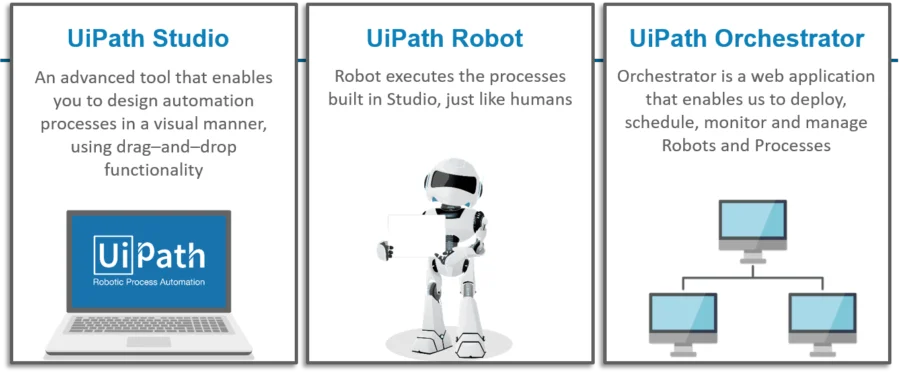
There are three components of UiPath.
RPA is used to automate routine, time consuming tasks. The purpose is to free employees to utilize their skills somewhere more important. AI is employed for complex analysis and decision-making tasks that require intelligence.
Arguments in UiPath pass one variable's value/data from one workflow to a different one. These are bound to follow a set direction.
Flowcharts are extremely important in this tool as they provide exceptional flexibility while representing complicated workflows. It is easy to maintain and understand them. They also offer various branching logical operators.
Here are the differences between these two-
| ATTENDED RPA BOTS | UNATTENDED RPA BOTS |
| These are basically virtual assistants that aid single employees in carrying out their responsibilities. | These bots enable self-contained automation without any human assistance. |
| They wait for employees to activate them whenever the need arises. | They follow a pre-inserted set of instructions. They can also get triggered by logic. |
| It leads to enhanced efficiency & customer satisfaction. | It boosts productivity while reducing the operating cost. |
| They assist with front-office activities. | They automate back-office processes on a large scale. |
Exception handling in UiPath pertains to handling errors in various activities in this tool. It offers four key options - terminate workflow, try catch, throw and rethrow.
Those who consider themselves on the intermediate level will benefit incredibly from these interview questions on UiPath.
Automations possible with this tool include -
In UiPath, generic variables are ones that have the potential to handle plenty of arrays, data formats, data types, strings and ints.
Yes, this tool supports automatic recording. It keeps a track of the activities and actions executed on the system. The automatic recording tool is used to swiftly personalize the projects, opening various possibilities.
Related Article- UiPath Tutorial
The design of Selenium is dedicated for testing web applications and pages. It can not interact with multiple applications and use one of their results as input for another. It does not have compatibility with virtual environments like Citrix.
UiPath, as an RPA solution, is able to automate existing software processes and replace activities. This means there is no need for extensive human efforts. In conclusion, we can say that UiPath can perform all the tasks of Selenium but vice versa is not possible.
Package manager is a functionality used for downloading activity packages, frameworks, libraries, wrappers, etc. It also allows individuals to view, update, delete and add these elements. It provides a list of packages per feed with an array of dependencies for the real-time project. One can view these lists every time they open the manage package window.
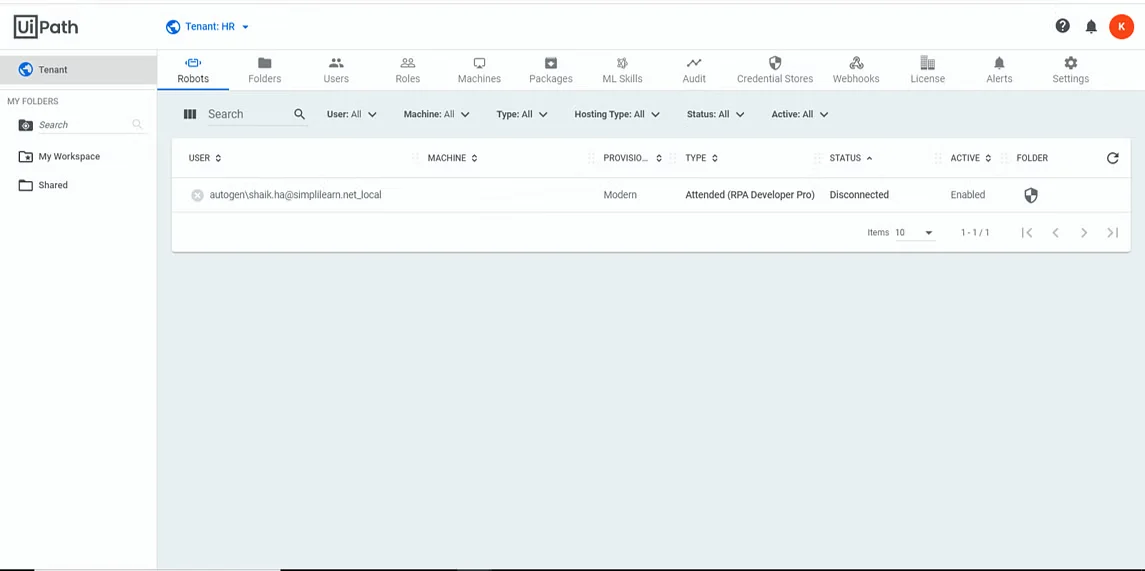
Both of them are essential for complete automation governance.Tenants provide overarching security and control. Folders provide detailed management within a special project.
These UiPath interview questions for experienced professionals are meant as guiding lights. Experience and expertise play a big role in getting any job, and with these questions, the process will become smoother.
Excel Application Scope is a classic activity that encapsulates Excel-related actions within a process. It provides a controlled environment for interacting with Excel, ensuring that actions performed within its scope are isolated and will not interfere with other running instances. When the scope is exited, the Excel application and workbook are closed to prevent potential conflicts.
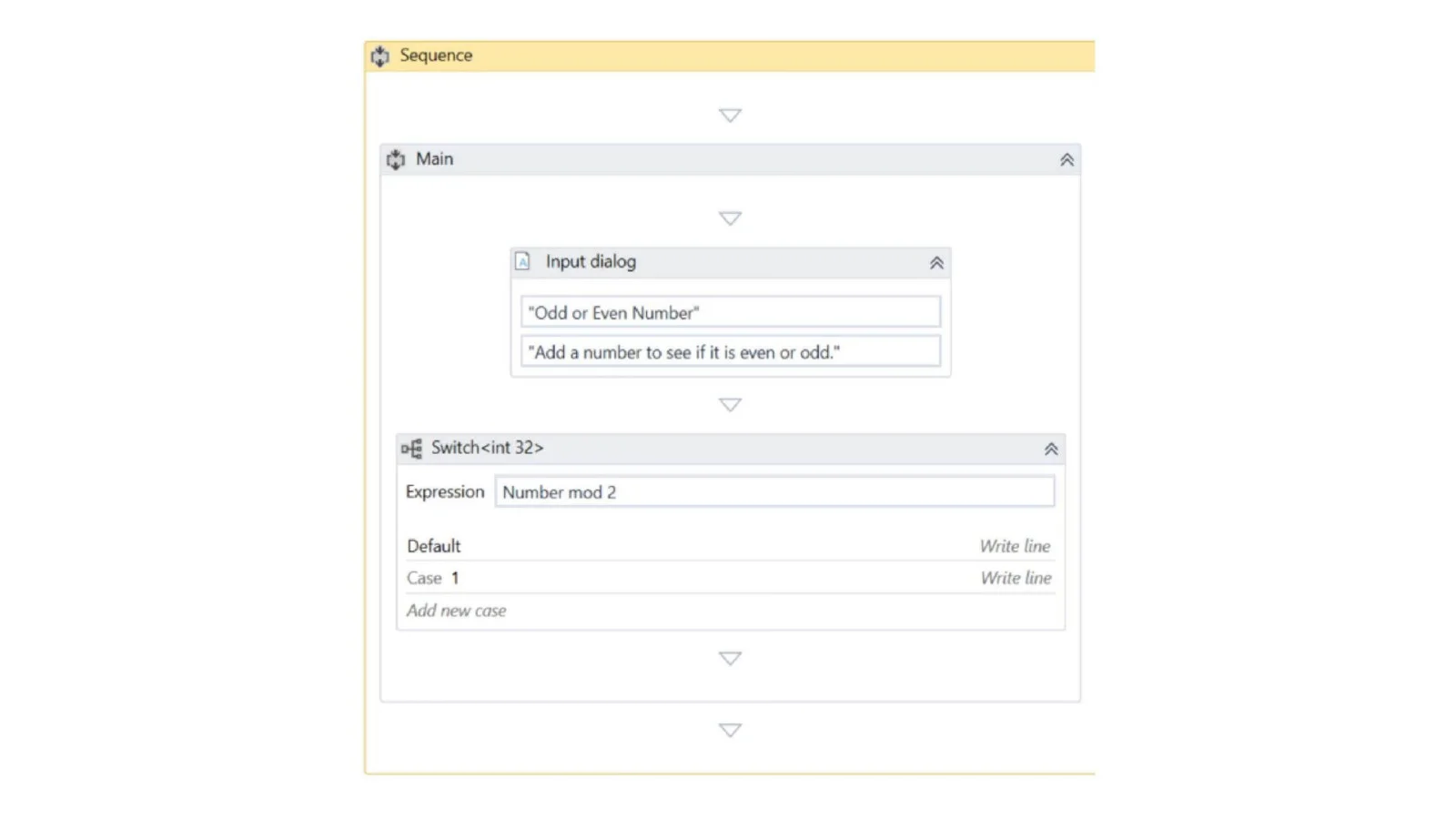
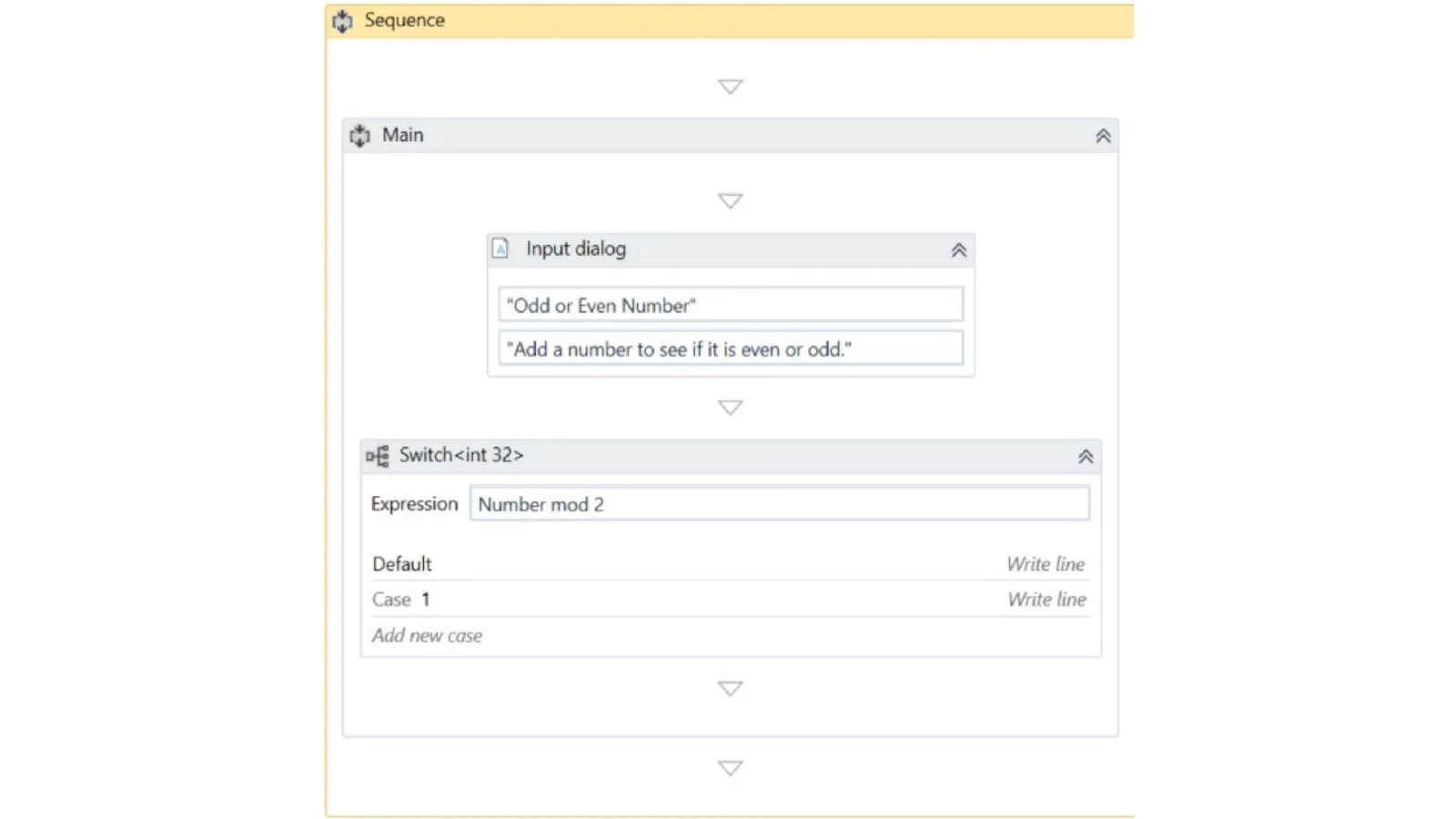
The switch activity is typically used for transition between two values according to a specified value of the expression. It is achieved with the switch integer argument. However, it is also possible to change the type of argument from the properties tab. This activity proves to be very useful when it comes to data categorization. It can also store data into multiple spreadsheets or sort through an array list of user-names, as shown below:
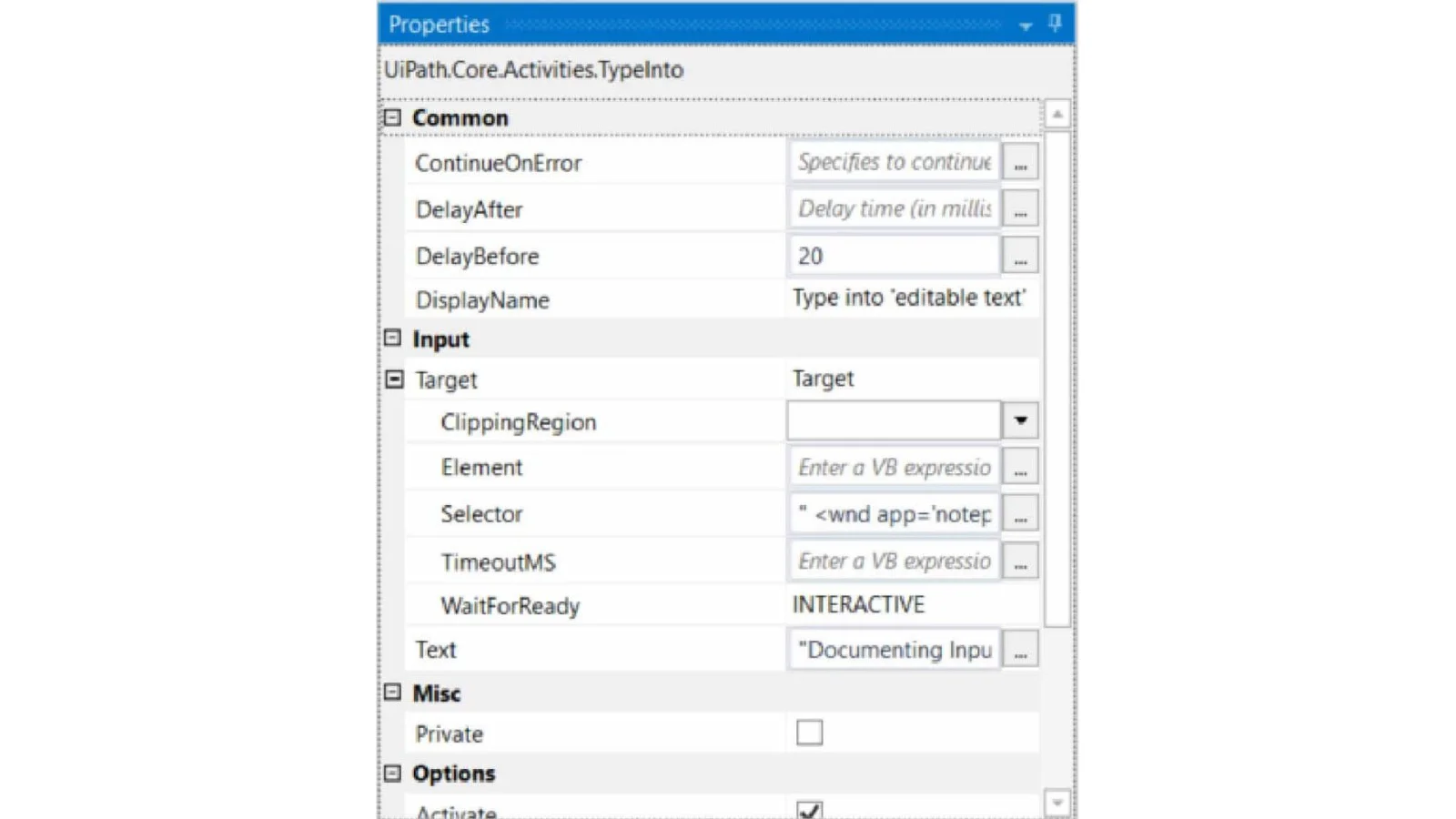
This platform has a Properties Panel where one can view and configure the properties of a selected activity. The number of properties can vary on the basis of specific activity. Here is an instance of the properties in UiPath:
Branching is the use of conditional statements and control flow structures that determine the execution path of a workflow according to specific conditions. This allows for flexible automation logic, where different actions are taken depending on whether a condition is true or false, or if one of several possible events occurs.
| Feature | Mainframe | Non-mainframe |
| Hardware | Run on large, specialized mainframe computers (e.g., IBM Z, Unisys Dorado, Unisys Libra) | Run on commodity servers, distributed systems, cloud infrastructure, personal computers, etc. |
| Use Cases | Banking, finance, healthcare, government, large-scale retail and insurance. Bulk data processing and enterprise resource planning (ERP). | Wide range of applications, from web and mobile apps to data analytics, enterprise software, and general business applications. |
| Reliability (RAS) | It is designed for unparalleled Reliability, Availability, and Serviceability and often has 99.999% uptime or higher, with decades of mean time between failures (MTBF). Redundant components, hot-swapping, and disaster recovery features are built-in. | Reliability varies widely depending on design and infrastructure. Often relies on distributed systems, redundancy, and cloud services for high availability. |
| Scalability | It is vertically scalable and can handle billions of transactions per day and manage massive databases. | It is horizontally scalable and can also handle large volumes but often through distributed architectures. |
| Security | Highest levels of security | Low vulnerability rates |
These activities help to interact with an external file or database. Some of the most common activities are:
The UiPath architecture consists of three layers.
Users can interact with all the UiPath components here. These include UiPath Studio, Robots, Executors, Agents and Browsers, among others. These components aid in building and developing automation tasks. It is also called the presentation layer sometimes.
All the server-related information is displayed here, along with UiPath Orchestrator.
This layer is mainly composed of database servers wherein the information about UiPath bots configuration is held. The queues and tasks are organized & regulated here.
Read Also- Top 20+ RPA Interview Questions and Answers [Updated 2026]
The following are some of the most UiPath interview questions for 5+ years of experience
Non-mainframe applications are ones that incorporate more than a single screen. Here, the control is passed between screens.
Wildcards in UiPath are symbols. These enable the user to substitute 0/more characters within a string. Asterisk (*) and question mark (?) are common wildcards. The former replaces one or more characters while the latter is to replace a single character with (?).
I will design the automation process in a way that can easily handle exceptions. The approach to achieve this purpose involves -
Yes, it is possible with the following steps -
I will implement the following practices -
Connecting a robot to an orchestrator requires configuring the robot with the orchestrator URL with a machine key or client credentials. These requirements depend on the robot type (attended or unattended) and the orchestrator setup. Attended robots typically use interactive sign-in or client credentials, whereas unattended robots often use machine keys. The complete process is performed with the following steps:
It would be a multistep process including the following steps:
To handle dynamic selectors in UiPath, we generally use variables or wildcards in the selector string to target elements that change, like IDs or titles. We inspect the selector using UI Explorer, identify the changing part, and replace it with * (wildcard) or concatenate it with a variable. This helps the bot interact with UI elements reliably, even when parts of the selector change during runtime.
This platform does not have a direct activity to create charts. It can be achieved by using Invoke VBA, Excel Application Scope, and writing a custom macro (VBA). This involves the following steps:
1. Prepare Your Excel File: Make sure your Excel file has data in a structured format. Here is an example:
| Month | Sales |
| Jan | 100 |
| Feb | 150 |
| Mar | 130 |
2. Create the VBA Macro: Create a text file with this VBA code (you can store it as CreateChart.vbs or just paste it as a string in UiPath).
Sub CreateChart() Dim ws As Worksheet Set ws = ThisWorkbook.Sheets("Sheet1") Dim chartObj As ChartObject Set chartObj = ws.ChartObjects.Add(Left:=100, Width:=375, Top:=75, Height:=225) With chartObj.Chart .SetSourceData Source:=ws.Range("A1:B4") ' Adjust as per your data range .ChartType = xlColumnClustered ' Change to desired chart type .HasTitle = True .ChartTitle.Text = "Monthly Sales" End With End Sub |
3. Use UiPath to Run the Macro: Activities to Use:
UiPath is a well-known and widely used RPA tool in organizations globally. This has led to a steep rise for professionals with its knowledge and skills. These UiPath interview questions are for everyone who has gained prowess in this tool and wish to work with top enterprises using automation.
Yes, reading these UiPath Interview Questions will be beneficial as they'll help you gain confidence and easily clear your interview round.
These UiPath Interview questions are free for everyone to practice and learn from. these or similar questions can be asked by the hiring manager.
You should focus most on its architecture, components, benefits, features and draw backs.
UiPath jobs include roles like RPA Developer, RPA Analyst, RPA Consultant, Test Automation Engineer and Process Designer.
Not necessarily. UiPath mainly uses drag-and-drop activities to build automation but having basic knowledge of programming languages like VB.Net or C# can be beneficial for advanced tasks.