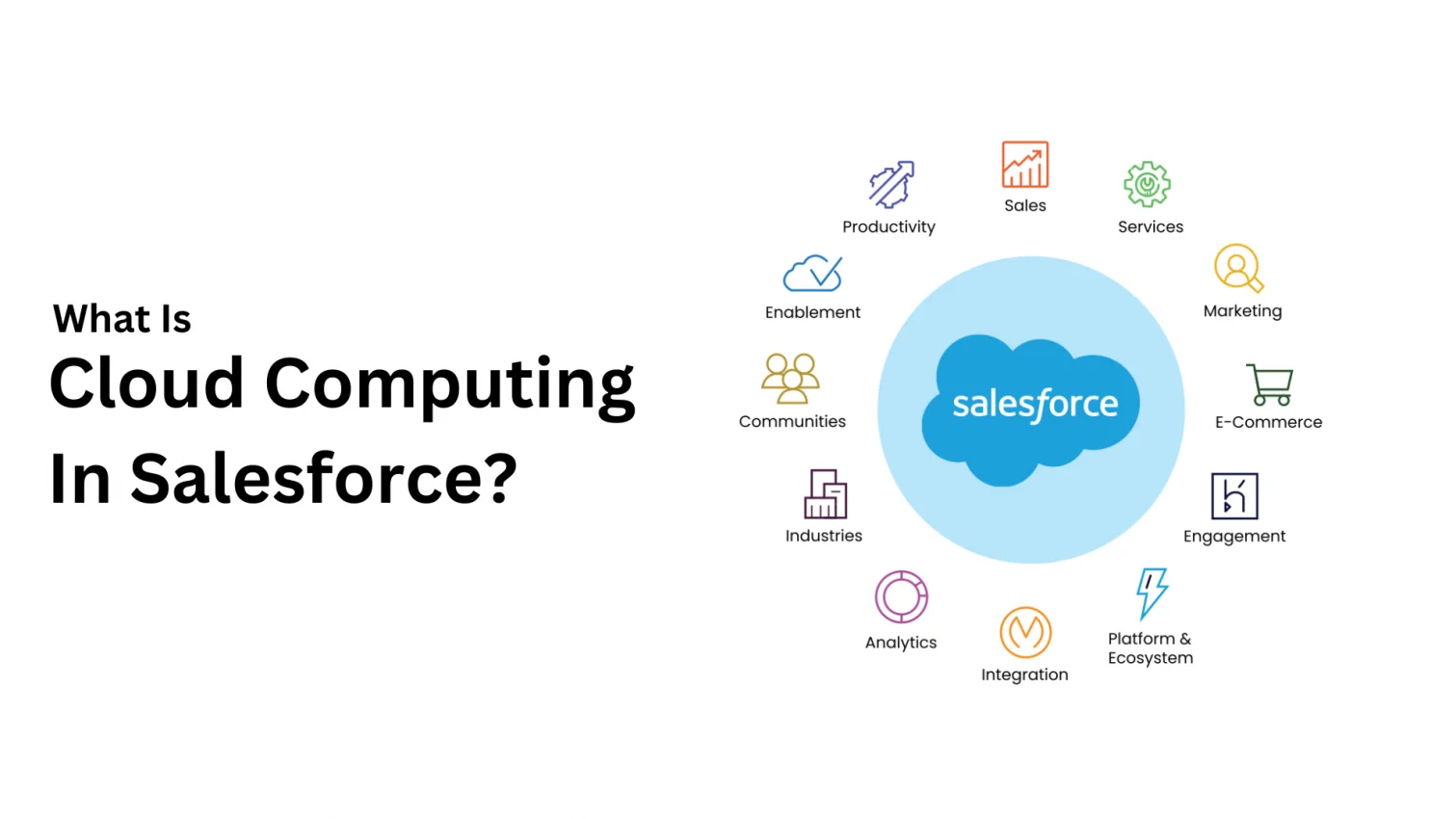
Cloud computing in Salesforce has changed how businesses operate through scalable, on-demand access to a plethora of computing services and resources. This technology supports various modern business applications, such as CRM systems like Salesforce.
Salesforce uses cloud computing to offer a flexible, accessible and powerful CRM platform. This helps businesses in tracking sales, automating marketing efforts and managing customer data from anywhere on the globe. Understanding the components and principles of cloud computing is needed to fully learn how Salesforce works. It also helps learn why it is a chosen pick for many organizations.
Cloud computing in Salesforce refers to the delivery of computing services like storage, servers, networking, databases, analytics and software. All this happens over the internet. These services are provided by cloud providers, mostly on a pay-as-you-go basis. This enables businesses to dodge the upfront complexity and costs of maintaining and owning their own IT infrastructure.
There are three key cloud computing models are-
It provides software and hardware tools across the internet, usually for app development. Top examples are Microsoft Azure and Google App Engine.
Offers virtualized computing resources across the internet. Top examples are Microsoft Azure and Amazon Web Services (AWS).
It delivers software apps through the internet and that too on a subscription basis. Top examples are Google Workspace, Microsoft 365 and Salesforce.
Salesforce comes under the SaaS model. It delivers its CRM software completely through the cloud.
| Enroll in igmGuru's Salesforce training program to become a Salesforce expert. |
Cloud computing provides many advantages that sum up why Salesforce has become so popular.
Resources can easily be scaled down or up as per the demand. This ensures cost management and optimal performance.
It eliminates the capital expense associated with buying software and hardware. One only has to pay for the services they use.
These services are easily accessible from anywhere that has an internet connection. Thus, supporting collaboration and remote work.
High security measures are set forth by cloud providers to protect applications, infrastructure and data.
Cloud providers provide high levels of data backup and redundancy. This ensures minimal data loss and downtime.
Cloud services receive updates regularly, usually without any user intervention.
Understanding how Salesforce uses cloud computing means understanding the core components of this technology.
Cloud providers present extensive networking capabilities that manage and connect various parts of the infrastructure. For instance, load balancers, domain name systems (DNS) and virtual private networks (VPNs).
Cloud storage solutions provide many scalable storage options, which grow along with business needs. Data is also stored in various locations for reliability and redundancy.
Cloud computing in Salesforce enables the creation of virtual instances for all physical hardware. This enables multiple OSs to run on one physical machine and optimizes resource usage.
Cloud providers present many tools for monitoring and managing cloud resources. This ensures cost-efficiency and optimal performance.
| Related Article- Introduction To Salesforce [A Complete Guide] |
Salesforce uses cloud computing principles to maintain a robust CRM platform for users. Here is how these two are intertwined.
Related Article- Omni Channel In Salesforce
Salesforce leverages cloud computing to enhance business operations in various ways:
Cloud computing is the backbone of Salesforce. It enables Salesforce to provide a scalable, accessible and powerful CRM platform. Understanding cloud computing principles, along with how they all apply to Salesforce, can help businesses fully use this technology. It aids in improving customer relationships, driving growth and enhancing operations.
The comprehensive suite of tools provided by Salesforce, along with the plenty of benefits of cloud computing, is a game-changer. These come together to make it an indispensable asset for any business seeking to excel today.
Cloud computing is the backbone of Salesforce, operating primarily under the Software as a Service (SaaS) model to deliver a robust, accessible, and scalable CRM platform. This foundation provides businesses with critical advantages: scalability, cost efficiency, and global accessibility. Salesforce leverages cloud principles like multi-tenancy and robust security to streamline operations, enhance customer relationships, and enable data-driven decision-making, making it an indispensable asset for modern business growth.
Related Articles
Q1. What is Cloud Computing in Salesforce?
Delivery of CRM software, storage, and services over the internet, eliminating on-premise IT needs.
Q2. Which cloud model does Salesforce use?
Software as a Service (SaaS).
Q3. What are the 3 main cloud models?
SaaS (Software), PaaS (Platform), and IaaS (Infrastructure).
Q4. What is the main benefit of Salesforce's scalability?
Resources can easily adjust (up or down) to meet demand, ensuring optimal performance and cost management.
Q5. How does Multi-Tenancy work in Salesforce?
Multiple clients share the same infrastructure and resources efficiently, reducing costs and enabling automatic updates.
Course Schedule
| Course Name | Batch Type | Details |
| Salesforce Certifications | Every Weekday | View Details |
| Salesforce Certifications | Every Weekend | View Details |