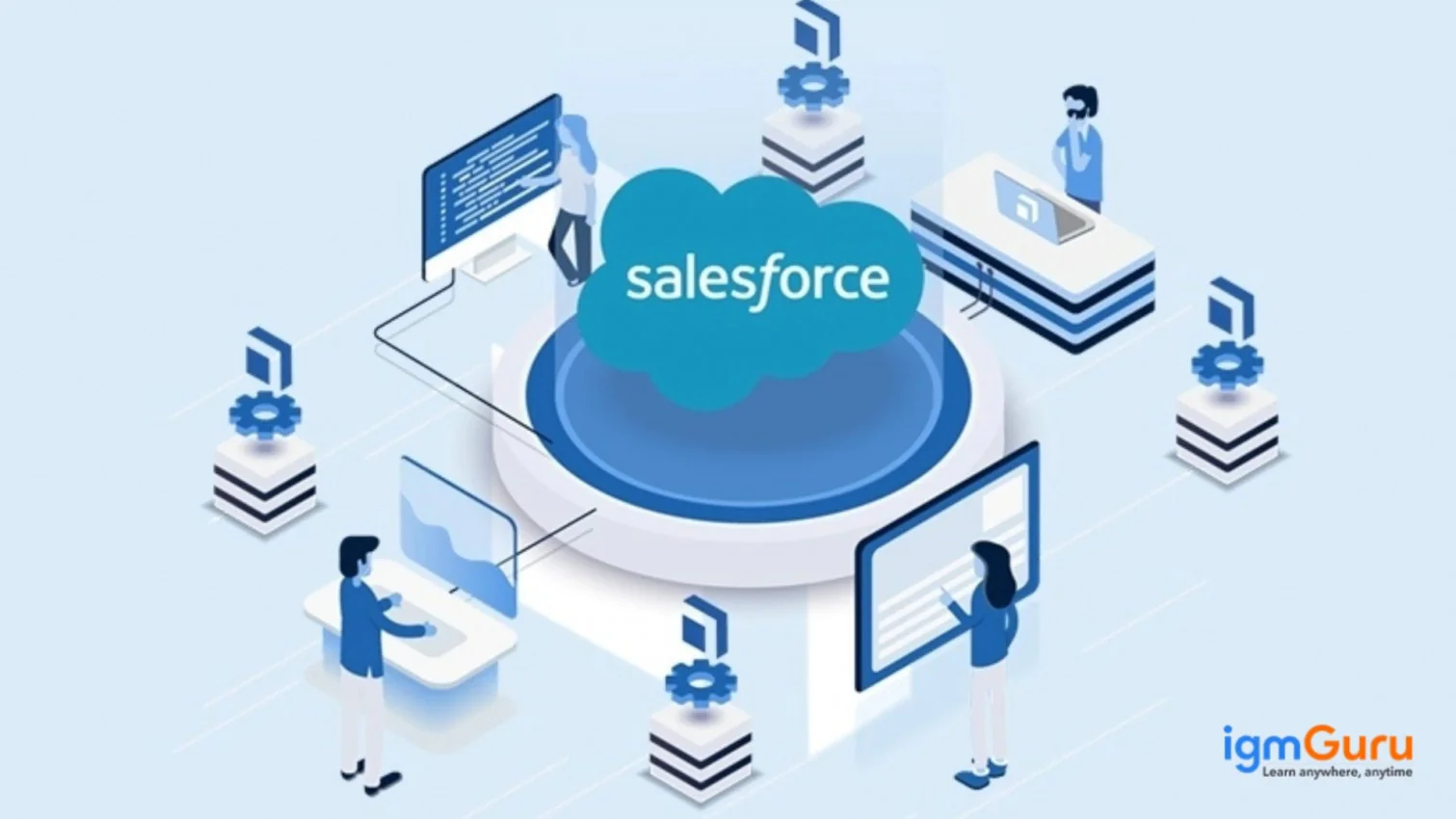
Salesforce is one of the most popular cloud-based Customer Relationship Management (CRM) platforms in the world. Trusted by leading organizations across industries, it empowers businesses to streamline their operations - from sales and marketing to customer service and beyond.
Since its founding in 1999, Salesforce has revolutionized how companies manage customer relationships. With its comprehensive suite of applications, businesses can effortlessly track sales leads, manage client accounts, deliver top-tier customer support, and launch targeted marketing campaigns - all from a single, unified platform.
What truly sets Salesforce apart is its highly customizable and scalable architecture. Whether you're a small startup or a global enterprise, the platform can be tailored to fit your unique business needs. Plus, with built-in artificial intelligence and advanced analytics tools, Salesforce enables organizations to unlock powerful insights and make smarter, data-driven decisions. This article will dive deep into what is Salesforce, history, how does it work, architecture, cloud services, and more.
So, what is Salesforce. It is a one-of-a-kind cloud-oriented CRM platform that is crafted to aid businesses in managing their marketing, service, sales, and other operations. This cloud-based CRM has completely revolutionized CRM via its plenty of offerings. It provides services entirely through the internet. This allows seamless scalability and access. It offers a complete suite of tools to manage sales pipelines, track customer interactions, offer customer support and automate marketing campaigns.
It boasts incredible flexibility that allows it to be tailored as per the specific business needs. This cloud-based CRM offers support to a gigantic ecosystem comprising third-party applications and integrations via its AppExchange. This further extends its functionality. With its user-friendly, robust platform, Salesforce aids businesses in fostering customer loyalty, driving growth and improving efficiency.
| Explore igmGuru's Salesforce Developer training program to unlock career benefits. |
Salesforce was founded by Parker Harris, Marc Benioff, Frank Dominguez and Dave Moellenhoff in 1999. It spearheaded the concept around delivering high quality customer relationship management software via a cloud-based model. This revolutionized the entire software industry. The mission of this company was to replace traditional CRM systems, which were often costly. These were switched with a more scalable, user-friendly and accessible solution.
Under the ticker symbol CRM, this cloud-based CRM went public in 2004 on the New York Stock Exchange. This step further solidified its position in the market. Throughout these years, Salesforce has expanded its key offerings and has gone way beyond CRM. Today, it includes plenty of cloud services like marketing automation, sales automation, analytics, and customer service.
AppExchange was introduced in 2005, which enabled third-party developers to curate and distribute their apps. This led to significant expansion of Salesforce's ecosystem. It has continuously innovated and grown to become a leader in enterprise cloud computing. This is via strategic acquisitions such as MuleSoft, Tableau and ExactTarget.
Salesforce works as a cloud-based CRM platform that successfully streamlines business processes to improve customer interactions. Users can access this cloud-based CRM through a web browser. This enables real-time data entry, analysis and retrieval from any location. It provides many tools for sales, marketing, customer service, and more. This helps businesses in managing customer information, automating marketing campaigns and tracking sales leads.
Salesforce's architecture offers support for extensive customization via its point-and-click interface as well as Apex programming language. AppExchange marketplace provides many third-party apps to extend functionality. It also integrates with other business systems, like ERP, social media and email. This facilitates uninterrupted data flow across platforms.
Advanced features such as Salesforce Einstein utilize AI to offer insights and predictive analytics. The platform's security measures help in data compliance and integrity. All this makes Salesforce a complete solution for driving business growth and managing customer relationships.
In order to get a strong grasp of any platform, one must begin with a clear understanding of its structure. Thus, this section discusses SF architecture to equip readers with a better understanding of how this platform functions.
Here are some 'must-know' terms used in SF architecture.
Superpod is an order of stack balances and frameworks based on the blueprint of 15 computer pods. Each pod serves thousands of customers with shared services. This includes various systems like outgoing proxy servers, SAN texture, mail servers, load balancers and other components that support diverse operations.
A new org is produced with every sign up or trial on developer.force.com or www.salesforce.com. An org can be customized in many ways along with enhanced options for security and sharing. Users can alter the visual appeal and feel of the user interface. They can also set up workflows, produce triggers and work with custom APIs.
All the necessary elements of metadata like classes, objects and Visualforce pages do not rely on the app itself. An app largely assists users to keep things organized visually.
An instance is the configuration users see once they log in. Each instance shows the server details for a particular SF organization. Multiple instances can coexist on a single server. When an instance is created, it's based on where the user is located, but it can change depending on which region they are logging in from.
The four kinds of Salesforce sandbox includes Developer Pro, Partial Copy, Developer and Full Sandbox. SF replicates the metadata from a user's production org to the sandbox everytime a sandbox is created. This allows users to form multiple versions of their production org in separate spaces.
Related Article- Salesforce Interview Questions
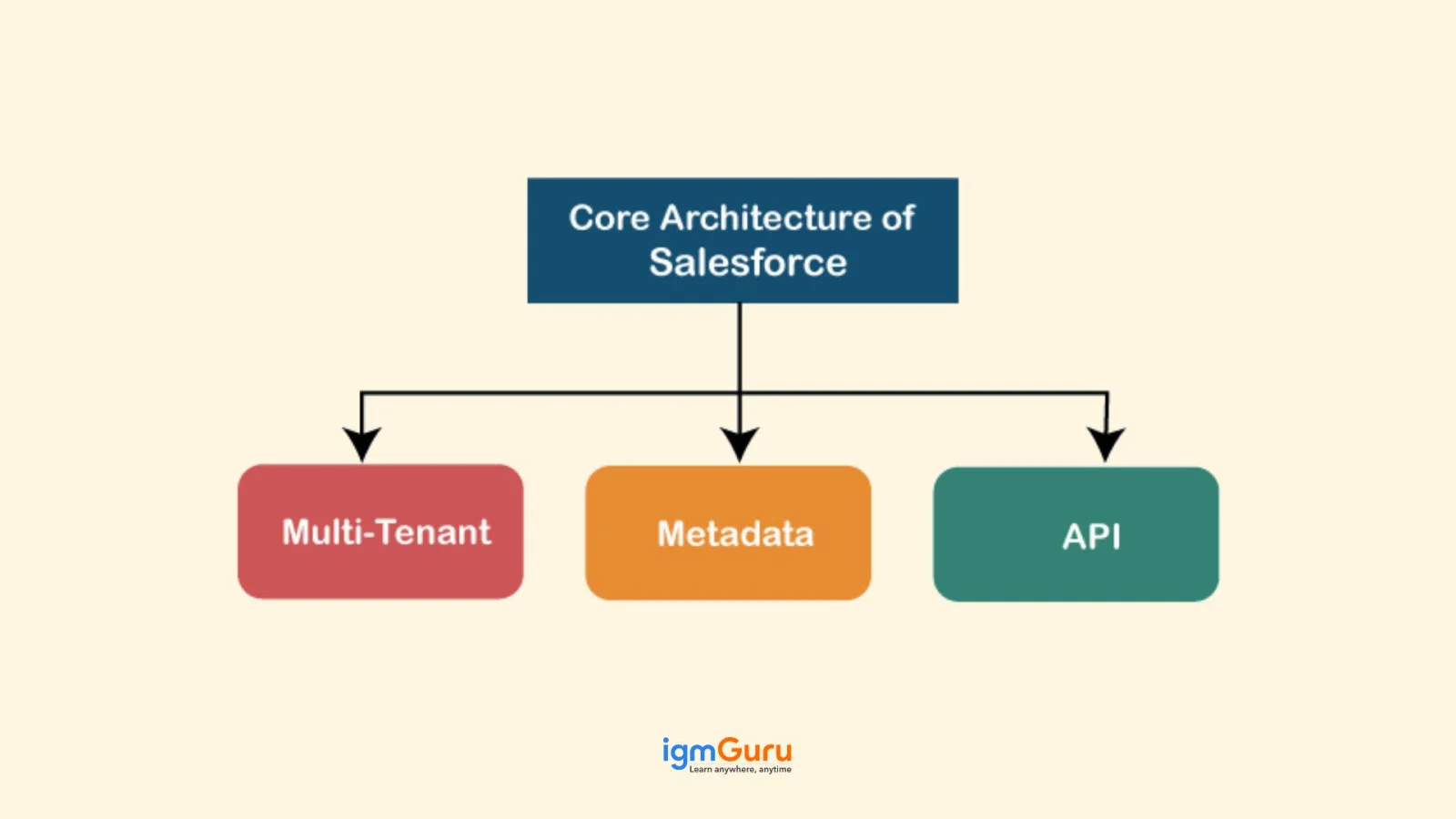
One can visualize the SF architecture as a string of different layers on top of one another. Let's discuss further to understand how these layers fit together.
This architecture involves a single application delivering its services to many clients at the same time. A SF application built by a developer can be shared with several clients once it's uploaded onto the cloud. This architecture comes with a big perk of being economical for clients as its maintenance costs are shared. Updates made in the software by a developer will automatically be accessible to all the clients.
In single-tenant setups, each client gets their own software or app. This indicates that a single client is accountable for all the costs related to development and maintenance. If the developer needs to make updates, they must do it for every single client separately. Plus, one app can only meet the needs of one client at a time.
This specific architecture stores data on various levels, enhancing security measures. All the data is kept in shared databases, and the metadata directs you to the specific data for each client levels.
The API Integration Layer is responsible for enabling communication between Salesforce and external systems like databases, ERPs, web apps, third-party platforms, or even other Salesforce orgs. It exposes Salesforce's data and metadata securely through various APIs.
Related Article - Salesforce Tutorial
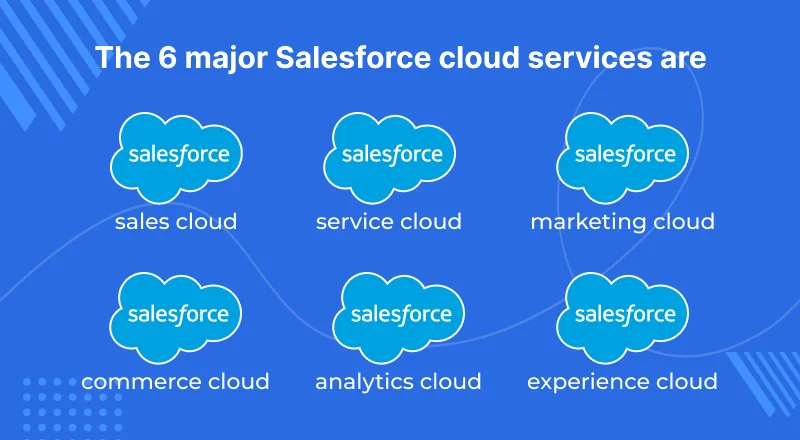
This section includes a list for inspecting various Salesforce cloud services along with their eminent features.
It brings together all the marketing channels in one spot and automates a number of marketing processes. Some crucial features of the Marketing Cloud is mentioned down below -
It brings an impressive collection of services and applications for online shopping, enhancing the engagement between businesses and customers across various channels.
It offers a quick and AI-driven way for customers to get support while helping businesses manage their operations effectively. Here are some key features of Salesforce Service Cloud.
It is also known as Salesforce Wave Analytics, is a tool that helps businesses quickly make sense of their data and make informed decisions. With features from Einstein Analytics and Tableau, it allows medium to large companies to efficiently analyze and work with large datasets. Here are some key features of the Analytics Cloud:
This cloud service enables teams to concentrate on the sales parts of CRM as well as customer support. The Sales Cloud has some key features, including -
Related Article- Salesforce vs Servicenow
The following are some of the technologies of this platform. Exploring these will help you gain more insights about it.
Lightning is an evolved edition of Salesforce Classic with a component-based framework. Developers can create responsive Software as a Service (SaaS) applications for any device. Plus, business users who aren't great at coding can also make their own apps on top of SF.
Apex is a programming language that lets developers manage flow and transaction rules on the SF platform. It's pretty straightforward to use, works well with data, and is designed to run in a shared environment. Plus, it gets updates automatically, is easy to test, and keeps track of different versions.
This is an AI tool made for CRM on the platform, enabling sales and marketing teams to get better and more current insights about customers and leads.
Visualforce is a tool that lets developers build dynamic and reusable interfaces right on SF. With it, they can make whole custom pages for their SF setup or link their code to a controller class written in Apex. Developers can use Visualforce pages for a bunch of things, like changing standard buttons, setting up custom tabs, adding components to detail page layouts, creating dashboard parts, and even adding menu items.
Salesforce CRM and Microsoft Dynamics CRM are among the leading CRM platforms out there. Each of these offer distinct benefits and features, which pull the audience towards them. Here are some ways they are different from one another.
| Related Article- Salesforce Marketing Cloud Email Studio Tutorial |
There are many reasons to chose SF but the most important are as follow-
Implementing Salesforce is not just about setting up new software; it is a complete business transformation. It touches your customers, processes, and long-term goals. To help you make the transition smoother, here’s a practical step-by-step framework you can follow to ensure a successful implementation and strong user adoption.
Before you begin, outline your business objectives and define what success means for your organization. A clear roadmap keeps your project focused and measurable.
Here’s what your Salesforce journey should look like:
Salesforce’s flexibility is one of its biggest strengths — but too much customization can make upgrades and maintenance difficult. Focus on:
If needed, involve experienced Salesforce consultants to ensure your setup stays efficient, scalable, and easy to manage in the future.
No matter how powerful Salesforce is, it won’t create impact unless your team actually uses it. Here’s how to drive adoption effectively:
Many organizations face similar challenges during a Salesforce rollout. Stay proactive by avoiding these pitfalls:
Salesforce isn’t a one-time setup — it’s an evolving platform that grows with your business. Conduct regular reviews to check how it’s being used, gather feedback, and optimize workflows. Continuous improvement ensures your Salesforce investment keeps delivering long-term value.
Well, here in this guide- what is salesforce, we have discussed every about the SF. This cloud-based CRM has evolved into a dominant force in the CRM landscape. Therefore, understanding its intricacies is increasingly vital in today's business environment. This comprehensive overview has explored its foundational architecture, diverse cloud services, underlying technologies, etc.
As we move into 2026, its continued innovation and robust ecosystem solidify its position as a key platform for driving growth and efficiency across industries. Whether you are a professional or beginner to CRM, learning this platform can provide you with a variety of opportunity.
Salesforce is used to manage customer relationships, sales, marketing and customer support through a cloud-based CRM platform.
Yes, beginners can start learning Salesforce through Trailhead, its free learning platform.
The key salesforce products include Sales Cloud, Service Cloud, Marketing Cloud and Experience Cloud.
Basic use does not require coding but advanced customization uses Apex and Lightning Web Components.
Salesforce is a CRM platform delivered as cloud-based software. It helps businesses manage customer relationships and operations efficiently.
Explore These Trending Articles:
What Is Salesforce CPQ (Configure, Price, Quote)?
What Is Salesforce Marketing Cloud? Key Components and Benefits
What is Salesforce Developer? Everything You Need To Know
What is Cloud Architect? Everything You Need To Know
Course Schedule
| Course Name | Batch Type | Details |
| Salesforce Certifications | Every Weekday | View Details |
| Salesforce Certifications | Every Weekend | View Details |