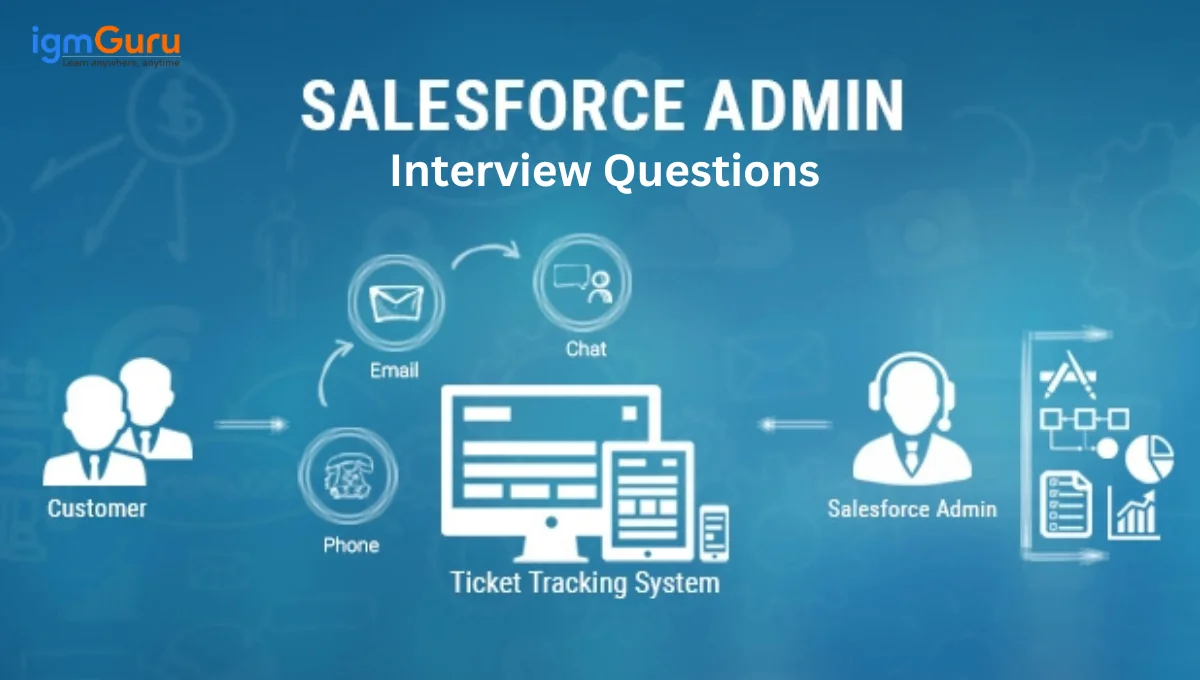
Are you preparing for a Salesforce admin interview? Then you have to understand that it is beyond just clicking through the UI. The employers are looking for individuals who understand far beyond that how Salesforce works. They test your skills in automation tools, layouts, data management, data modeling, data security, reporting and more.
Well, don’t get overwhelmed by the industry requirements as I have got you back with the most asked Salesforce admin interview questions and answers. The questions are designed by experienced professionals to make them current industry-relevant. These will help you prepare and crack your next interview.
SF is a leading customer relationship management or CRM platform. Its purpose is to aid organizations connect with their customers in a better light. It provides a standard information of every customer to different departments including sales, service, marketing and commerce. All the data can be stored securely on a Cloud, giving businesses the advantage to operate their business from anywhere.
Some popular subsidiaries in SF are -
No, it is not possible to delete a user in SFDC. However, it is possible to deactivate a user with the 'Freeze' option.
SaaS in SF benefits businesses greatly. It offers -
There are four standard fields namely -
Related Article- Salesforce Admin Tutorial - A Complete Guide For Beginners
We cannot export on joined reports.
There are 3 portals available on SFDC namely customer portal, self-service portal and partner portal.
Different types of reports are -
Sales are tracked in multiple ways, including -
Salesforce.com aids in building CRM-functionality-based apps. For instance, an android app.
Force.com, on the other hand, is utilized to customize a user interface and a data model. For instance, an android OS (operating system) environment where apps can be built and run.
Related Article - Salesforce Admin vs Developer- A Detailed Comparison
Objects in this CRM are basically database tables employed for storing information about the organization. It has two types of objects namely -
The three types of object relations in SF are -
There are two management tools, including -
Images, files and documents are stored in SF as -
Data loader is an open-source client application developed by SF. It can perform different actions on bulk data including importing, exporting, inserting, updating, deleting and upserting. It uses SF APIs to perform these operations and supports CSV files.
There are many third party tools and multiple techniques to perform these tasks but still data loader is one of the most preferred ones. It is because no other option gives an unified platform to perform each of these tasks.
Related Article- Salesforce Admin Certification Study Guide
A wrapper class refers to a custom Apex class. It is employed to encapsulate various data objects or types into a single object. This unified structure makes it easy to work with and even pass around in the Apex code.
Field types refers to the type of data a field can store. These fields are the basic building blocks of the data storage system. They can store multiple forms of data in different categories including number, text, currency, date, etc. Each type of data has a different particular storage location in the system, making it easier to detect and use reliable data.
The latest field in SFDC is 'Time'.
The Roll-up summary field is used for calculating the values for associated records. As per the values in the detailed records, it is also used to create the values for a master record. To make it happen, the master and the detail must be connected via master-detail relationship.
A Formula Field refers to a read-only field that gets its value from the formula expression defined by the user. It gets updated when a source field changes.
The default index fields in SFDC are -
A Profile is similar to permissions and settings. It acts as an additional method of managing particular records and performs various functions defined by the users.
The two types of profiles are -
SF standard profiles include -
The two sharing rules are -
Queues aid the user in distributing, assigning and prioritizing the records to share workloads. Queues are applicable to custom objects, leads, cases, service contracts, etc.
Governor Limits controls how many records and how much data can one user store in the shared database.
Since SF is built on the concept of multi-tenant architecture, one database is used to store the data of various customers. Governor Limits is essential to ensure no client monopolizes the shared resources.
Audit trail is a feature in this CRM that keeps a track of and logs any changes made to records. It then sets up a configuration within the platform. Audit trail offers a historical record of all the modifications and activities that enables the user and administrators to monitor and review the changes as time passes. It makes sure there is compliance, accountability and integrity within the SF environment.
Related Article- 10 Most Skills You Must Have As A Salesforce Admin To Succeed
Time-dependent actions should be performed at a fixed time prior to closing the record. Workflow reevaluates and checks if the workflow rule criteria is being satisfied or not.
Auto-Response refers to transmitting emails to cases/leads for a certain record attribute. It enables promptly responding to customer issues. The user can set one rule for a case and another for the lead.
Apex programming language is specially designed for SF. It can automate the complicated business processes and implement custom logics within the platform. This enables developers to create triggers, custom controllers and other functionalities to improve platform capabilities.
An approval process is a series of steps, criteria and operations that review the changes in a record. It is done to ensure that all the changes and updates are working well before finalizing them. It is a fully automated process that streamlines decision making and reduces human efforts. The allowed use cases are:
Related Article- How To Become A Certified Salesforce Admin
In this CRM, App refers to a container that consists of multiple things such as name and logo, along with a set of required tabs. It can also be termed as a group of tabs working simultaneously to prove the intended functionality.
The user can customize the app to suit the enterprise's requirements. Alternatively, a new application can also be built by incorporating standard and custom tabs.
Two types of apps can be created in SFDC -
Yes, AppExchange does provide a variety of mobile ready solutions. There are also many partners providing different custom mobile applications. We can find these applications on the All Apps page.
The effect of any AppExchange solutions on SF org limits depends on whether the package is certified and listed. The certified packages have their own limits. Whereas, the unmanaged packages and those not listed on AppExchange count against the org's total limits.
Related Article - 5 Reasons Why SFDC Admin is the Best Career Choice
Change Set is a group of components that can be migrated between associated organizations.
The sandboxes are isolated copies of the production environments that can develop and test new features. This practice allows us to check the changes in different features to ensure their effectiveness, facilitating effective change management.
Deploying a change set between orgs involves the following steps -
Validate option checks for errors and ensures all tests pass before making actual changes to the target org. It helps to prevent deployment failures and identify issues at an early stage. In simple words, it simulates the deployment process to ensure the effectiveness of changes without actually doing it.
This section lists the top-most frequently asked technical Salesforce admin interview questions and answers. These questions can be asked in any Salesforce admin interview.
To retrieve recently created accounts using SOQL, one has to order the results by the CreatedDate field in descending order and potentially limit the number of records returned. Here is how you can do it.
SELECT Id, Name, CreatedDate FROM Account ORDER BY CreatedDate DESC |
I will use the Metadata API of Apex programming language to create an instance of CustomField and specify its properties. Next, I will deploy it using MetadataService.
It is done by writing a trigger. Here is an example:
trigger UpdateContact on Account (after update) { List<Contact> contactsToUpdate = [SELECT Id, CustomField__c FROM Contact WHERE AccountId IN :Trigger.newMap.keySet()]; for (Contact con : contactsToUpdate) { con.CustomField__c = Trigger.newMap.get(con.AccountId).AccountCustomField__c; } update contactsToUpdate; } |
To schedule an Apex class for running at a specific time, one should either use the UI or code. The UI approach involves navigating to Setup and selecting Schedule Apex within Apex Classes. Here they can specify the class, frequency, start and end dates and a preferred start time. The coding approach uses the System.schedule() method and a CRON expression to define the schedule.
public List getContactsByAccountId(Id accountId) { return [SELECT Id, Name FROM Contact WHERE AccountId = :accountId]; } |
Dynamic Forms allow admins to create flexible, dynamic page layouts in Lightning by adding, removing, or rearranging fields and sections directly in the Lightning App Builder without relying on traditional page layouts. To implement, navigate to the Lightning App Builder, select a custom object's Lightning Record Page, add the Dynamic Forms component and configure fields and sections with visibility rules based on user criteria. Limitations include partial support for some standard objects and potential performance impacts with complex layouts.
Einstein Activity Capture syncs emails and calendar events to Salesforce automatically. To configure, enable it in Setup under Einstein Activity Capture settings, connect user email accounts (e.g., Gmail/Outlook) and map data fields. For privacy, ensure compliance by setting data retention policies, restricting sensitive data capture via filters and reviewing sharing settings to align with regulations like GDPR or CCPA. Regular audits and user consent are critical.
To transition, audit existing profiles, identify permissions and create Permission Set Groups in Setup under Permission Set Groups. Assign specific permissions to individual Permission Sets, then bundle them into groups for roles like "Sales Manager" or "Sales Rep." Assign groups to users, test access and remove profile-based permissions. Use tools like Permission Set Group Assignment reports to ensure coverage. Profiles' retirement requires proactive planning to avoid access disruptions.
In Flow Builder, create a Screen Flow, add a variable for the record ID and pass it via a button or URL. Use Get Records to fetch the record, add decision elements for approval logic and update records or send notifications. Unlike Process Builder, Screen Flows offer user interaction, better debugging and scalability. Process Builder is simpler for basic automation but lacks Screen Flow's flexibility for complex, user-driven processes.
Custom Metadata Types store configuration data (e.g., discount rates) as metadata, enabling deployment without data migration. Create them in Setup under Custom Metadata Types, define fields and add records. Deploy using Change Sets or Metadata API. Unlike Custom Objects, they are metadata, not data, so they are editable in production and deployable without impacting data limits. Benefits include easier management, versioning and environment consistency.
The following scenario-based Salesforce Admin interview questions test your ability to solve real-world problems related to security, automation, data management and performance.
I would first set the Organization-Wide Default (OWD) for Opportunities to Private so users cannot automatically access records owned by others. Then, I would configure the Role Hierarchy so the sales manager is positioned above their team members. This allows the manager to access opportunities owned by users below them in the hierarchy. If additional access is required outside the hierarchy, I would use Sharing Rules, Public Groups or manual sharing instead of providing unnecessarily broad permissions.
I would use a Record-Triggered Flow that runs when an Opportunity is created or updated. The Flow would check whether the Opportunity Amount exceeds the specified threshold and then perform the required action, such as updating the record owner, creating a review task or sending a notification to the senior manager. I would also define conditions to prevent the Flow from repeatedly triggering the same action whenever the record is edited.
I would configure Matching Rules to define how Salesforce identifies potential duplicate Accounts and Contacts using fields such as email address, phone number or company name. I would then create Duplicate Rules to either block users from creating duplicate records or display a warning based on business requirements. I would also analyze existing data for duplicates and establish a controlled data-cleanup process. For ongoing data imports, I would use unique identifiers and upsert operations where appropriate to reduce duplicate creation.
I would first use Flow debugging and monitoring tools to identify which elements are consuming resources or executing unnecessarily. I would review the Flow's entry conditions so it runs only when relevant fields change and avoid unnecessary Get Records, Update Records and loop operations. Where possible, I would process collections instead of updating records individually inside loops. I would also check for recursion caused by multiple automations updating the same records and consolidate overlapping automations where appropriate.
I would immediately freeze the user's account to prevent login access while preserving the account for administrative actions. I would then review scheduled jobs, integrations, queues, and other dependencies associated with the user. The relevant records should be transferred to the appropriate active user or users using Salesforce's record transfer capabilities. After confirming that ownership and dependencies have been handled correctly, I would deactivate the user while retaining their historical record ownership information where required for auditing and reporting.
I would first identify which customer data the AI feature needs and verify that users have the appropriate permissions to access it. I would then configure the required Salesforce AI capabilities and test the recommendations using realistic customer records. Sensitive fields should be protected through appropriate field-level security, permission sets and sharing rules. I would also review AI-generated summaries and recommendations before allowing them to influence important business decisions. Finally, I would monitor usage, accuracy and data access regularly to ensure the AI solution remains secure and useful.
When it comes to acing your Salesforce admin interview, it comes down to how well you prepare for it. One thing that will definitely help you is a Salesforce admin certification because it will give you the opportunity to learn from industry experts.
This blog is only the tip of the iceberg in terms of questions that can be asked in your Salesforce administrator interview. Keep reading and learning to keep yourself updated with the changing trends.
Related Article - Salesforce Tutorial
Ans. There are dozens of benefits of using this CRM, including -
Ans. Yes, it is one of the best career options as it is being used in top companies across the globe.
Ans. No, coding is not an essential component for SF as it is built on a drag-and-drop interface.
A Salesforce Admin mainly needs knowledge of user management, reports, dashboards and basic automation tools.
To crack a Salesforce Admin interview, mainly understand core features like users, reports, dashboards and automation. Practice common interview questions and get hands-on experience to build confidence.