Python Course in Hyderabad

SKU: 20234
13 Lesson
|
40 Hours
Enroll in the best Python training institute in Hyderabad, which is designed for everyone from beginners to IT professionals. In this course, you will learn how to write code for data analysis, automation, AI &ML, and web development. We have successfully trained over 500 individuals. Enroll in our Python classes to prepare for the PCAP – Certified Associate in Python Programming exam and become certified.

Overview

Python is one of the most popular and open-source programming languages in the world. Our training program covers Python fundamentals, control structures, libraries, and object-oriented programming.

Prerequisites

  • No prior programming experience required
  • Basic understanding of computers and file systems
  • Interest in coding, data, or web technologies

What You Will Learn in Python training in Hyderabad

  • Fundamentals of Python Programming
  • Real-World Problem Solving with Python
  • Object-Oriented Programming (OOP)
  • Python Libraries: Pandas, NumPy, Matplotlib
  • Web Applications with Flask or Django
  • File Handling & Exception Management
  • Task Automation with Python Scripts
  • AI & Machine Learning Basics
  • Mini-Projects & Practical Assignments
  • Prepare for the PCAP – Certified Associate in Python Programming exam

We Also Cover Trending Topics

  • FastAPI – Python framework for building APIs
  • Generative AI tools – Using Python with OpenAI API, LangChain, and Hugging Face
  • Python for Cloud Computing – AWS Lambda, Google Cloud Functions, Azure SDKs

Tools Covered in Python Classes in Hyderabad

  • Python (Latest Version)
  • Jupyter Notebook
  • VS Code (Visual Studio Code)
  • Anaconda Distribution
  • Git & GitHub
  • Flask / Django (for web development)
  • Pandas, NumPy, Matplotlib, Seaborn
  • OpenAI API / LangChain

Key Features

Course Curriculum

1. What is Python and why it's popular
2. Installing Python and IDEs (VS Code, Jupyter) with Python script
3. Understanding syntax and indentation
1. Variables, data types, and type casting
2. Input/output functions
3. String manipulation and formatting
4. Operators and expressions
1. Conditional statements
2. Loops and Loop control statements
1. Introduction to Anaconda
2. Installation of Anaconda Python Distribution - For Windows, Mac OS, and Linux
3. Jupyter Notebook Installation, Jupyter Notebook Introduction
4. Variable Assignment
5. Basic Data Types: Integer, Float, String, None, and Boolean; Typecasting
6. Creating, accessing, and slicing tuples
7. Creating, accessing, and slicing lists
8. Creating, viewing, accessing, and modifying dicts
9. Creating and using operations on sets
10. Basic Operators: 'in', '+', '*', Functions, Control Flow
1. NumPy Overview
2. Properties, Purpose, and Types of ndarray
3. Class and Attributes of ndarray Object
4. Basic Operations: Concept and Examples
5. Accessing Array Elements: Indexing, Slicing, Iteration, Indexing with Boolean Arrays
6. Copy and Views, Universal Functions (ufunc)
7. Shape Manipulation, Broadcasting, Linear Algebra
1. SciPy and its Characteristics, SciPy sub-packages
2. SciPy sub-packages –Integration, SciPy sub-packages – Optimize
3. Linear Algebra
4. SciPy sub-packages – Statistics, SciPy sub-packages – Weave
5. SciPy sub-packages - I O
1. Introduction to Pandas
2. Data Structures, Series, DataFrame, Missing Values
3. Data Operations, Data Standardization
4. Pandas File Read and Write Support
5. SQL Operation
1. Introduction to Machine Learning
2. Machine Learning Approach
3. How Supervised and Unsupervised Learning Models Work
4. Scikit-Learn
5. Supervised Learning Models - Linear Regression, Logistic Regression
6. K Nearest Neighbors (K-NN) Model
7. Unsupervised Learning Models: Clustering, Dimensionality Reduction
8. Pipeline, Model Persistence, Model Evaluation - Metric Functions
1. NLP Overview
2. NLP Approach for Text Data
3. NLP Environment Setup
4. NLP Sentence analysis, NLP Applications
5. Major NLP Libraries, Scikit-Learn Approach
6. Scikit - Learn Approach Built - in Modules, Scikit - Learn Approach Feature Extraction
7. Bag of Words, Extraction Considerations
8. Scikit - Learn Approach Model Training
9. Scikit - Learn Grid Search and Multiple Parameters
10. Pipeline
1. Introduction to Data Visualization
2. Python Libraries, Plots
3. Matplotlib Features: Line Properties Plot with (x, y), Controlling Line Patterns and Colors, Set Axis, Labels, and Legend Properties, Alpha and Annotation, Multiple Plots, Subplots
4. Types of Plots and Seaborn
1. Web Scraping
2. Common Data/Page Formats on The Web
3. The Parser, Importance of Objects
4. Understanding the Tree, Searching the Tree
5. Navigating options, Modifying the Tree
6. Parsing Only Part of the Document
7. Printing and Formatting, Encoding
1. Need for Integrating Python with Hadoop
2. Big Data Hadoop Architecture
3. MapReduce, Cloudera QuickStart VM Set Up
4. Apache Spark
5. Resilient Distributed Systems (RDD)
6. PySpark, Spark Tools
7. PySpark Integration with Jupyter Notebook
1. FastAPI for API development
2. Using OpenAI API & LangChain for AI apps
3. Cloud integration with AWS/GCP
4. Python scripting for DevOps and CI/CD basics
Talk To Us

We are happy to help you

1-800-7430-173 (US Toll Free)
Drop Us a Query
Fields marked * are mandatory

Request For Live Demo Class

Course Fees

Online Class Room Program

US $ 599.00
100% Money Back Guarantee
  • Duration : 40 Hrs
  • Plus Self Paced

Classes Starting From

  • Fast Track Batch 28 May 2026
  • Weekday Batch 01 Jun 2026
  • Weekend Batch 30 May 2026

Corporate Training

Corporate Training
  • Customized Training Delivery Model
  • Flexible Training Schedule Options
  • Industry Experienced Trainers
  • 24x7 Support

Trusted By Top Companies Worldwide

MITSUBISHI
Emirates
BECHTEL
Tech Mahindra
Techmill
metacube
Fareportal
Trelleborg
Capgemini
AU Small Finance Bank
United Nations
Inter Mid
SoftFlex
align
utthunga
Rimini Street
EJADAH
Yash Technologies
suyati
Hettich
APPCINO

Want to know Today's Offer

X

Python Certification

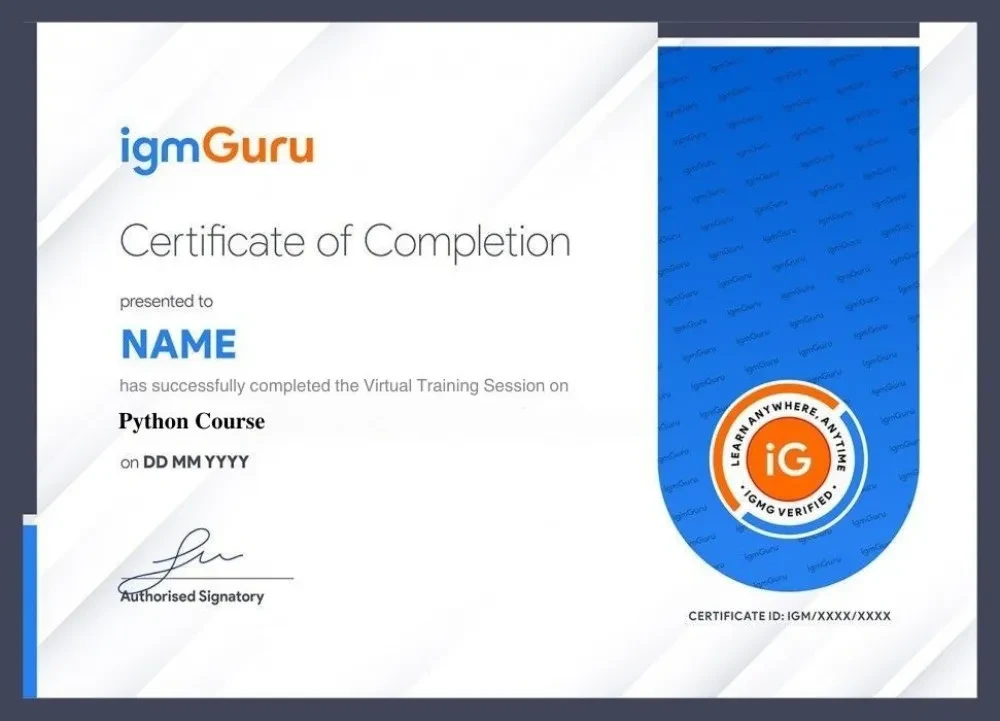
After completing the Python training, you will receive a recognized certificate to validate your skills.

The official certification exam names are PCAP- Certified Associate in Python Programming (exam code PCAP-31-03) and PCEP (Certified Entry-Level Python Programmer), issued by the Python Institute.

Exam Cost

The PCAP exam costs $295 (approximately ₹24,600), and for PCEP, it is $59 (approximately ₹5,340)

With optional bundles that include a retake or a practice test. Local taxes may apply and affect the final price.

PCEP vs PCAP Certification - Which Should You Choose?

Feature PCEP (Certified Entry-Level Python Programmer) PCAP (Certified Associate in Python Programming)
Certification Level Entry-Level Associate-Level
Ideal For Absolute beginners starting Python Learners with basic Python knowledge
Difficulty Level Easy Moderate
Focus Area Python fundamentals and basic syntax Advanced concepts including OOP, modules, and packages.
Topics Covered Data types, control flow, functions, basic operations OOP, exceptions, modules, packages, advanced data handling
Recommended Experience No prior experience required 6-12 months of Python practice
Exam Code PCEP-30-02 PCAP-31-03
Exam Duration 45 minutes 65 minutes (+10 minutes NDA/tutorial)
Number of Questions 30 40
Passing Score 70% 70%
Certification Provider Python Institute Python Institute
Career Impact Helps start a programming career Strengthens resume for developer roles
Best Choice If You are new to programming You want professional-level Python validation
Python Certification

Reviews


Login
Don't have an account?
Sign Up

Our Alumni works at

HCL
FAI
YOKAGAWA
Tech Mahindra
SOCIETE GENERALE
SAMSUNG
EMIDS
DHL
FedEx
PayPal
BOSCH
asian paints
MICRO FOCUS
hgs
eClerx
Nasdaq
Persistent
CSS CORP
×

Your Shopping Cart


Your shopping cart is empty.