As a working professional in the Java development space, I can understand how difficult it can be to find the proper structured Spring interview questions and Multiple Choice Questions (MCQs). To help you out, I have created this comprehensive guide for both freshers and experienced developers to confidently prepare for Spring-related interviews.
Spring Framework is a lightweight, open-source Java framework that provides a powerful infrastructure for developing enterprise-level applications. In fact, if you are preparing for a core Java backend developer role or aiming for a position in full-stack development, Spring Framework and Spring Boot are almost always part of the technical interview.
Explore igmGuru's Java Course program to learn core and advanced Java.
This guide is structured to cover all essential areas- Spring Core, Spring Boot, Spring AOP, Spring JDBC, Hibernate and Spring MVC. Let's dive together to prepare for your next Spring Interview!
I can confidently say that mastering the fundamentals of the Spring framework, including its Core module and IoC container, is very crucial for any Java developer. Therefore, this section covers the essential fundamental questions.
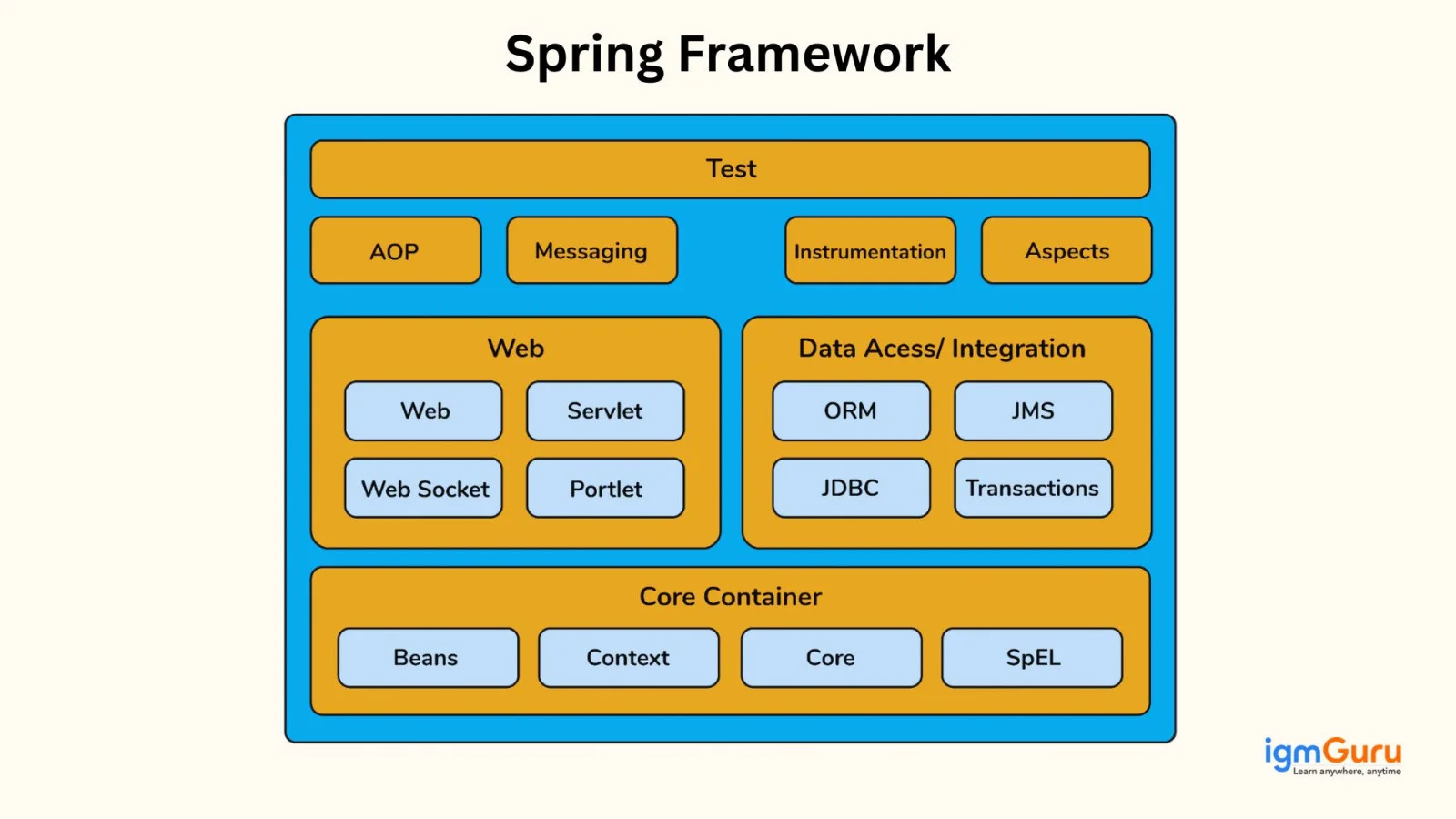
Spring Framework is a powerful, open-source, lightweight application development framework for Java. It provides comprehensive infrastructure support for developing Java applications. Spring framework in Java is widely used for building robust, loosely coupled and testable enterprise applications by promoting the use of dependency injection (DI) and aspect-oriented programming (AOP).
The key modules of Spring include:
The Spring Framework has a lot of features, which helps in the simplification of enterprise application development. Some of them are:
Bean wiring in Spring refers to the process of defining how beans, i.e., objects, are linked together within the Spring container. It determines how the dependencies between different beans are resolved and injected. This wiring allows Spring to automatically manage object creation and dependency injection based on the configuration provided.
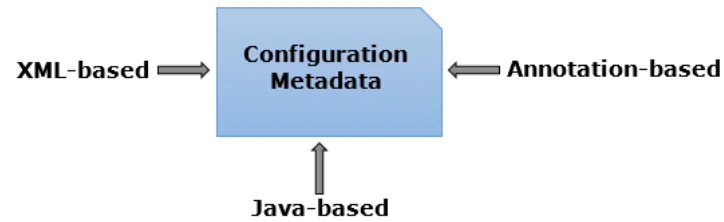
There are three types of Metadata in Spring. They are as follows:
A Spring Bean is an object that is managed by the Spring IoC container. It is created, configured and managed automatically as defined in the configuration. Spring also supports five scopes to control the life cycle and visibility of the bean instances. They are:
Read Also- Java Tutorial For Beginners
As someone working closely with modern Java development stacks, I can say that Spring Boot is like a game-changer. This section covers key Spring Boot concepts questions along with their answers, which interviewers frequently focus on to check your practical development and deployment knowledge.
Spring Boot is an extension of the Spring Framework. It is designed to make the development of Java applications quicker and easier. It provides default configurations, eliminates boilerplate code and includes embedded web servers. Therefore, the developers can focus more on business logic not on that complex setup.
The difference between Spring and Spring Boot is shown in the below given table.
| Feature | Spring Framework | Spring Boot |
| Setup & Configuration | It requires manual configuration. | It provides auto-configuration and starter templates. |
| Web Server | It needs external web server setup (e.g., Tomcat, Jetty). | It comes with embedded servers like Tomcat and Jetty. |
| Boilerplate Code | It is more boilerplate code and XML/Java config. | It reduces boilerplate with defaults and annotations. |
| Startup Time | It is slower to bootstrap and configure manually. | It is faster startup and development with built-in features. |
| Focus | The focus is on Flexibility and control. | The focus is on Rapid development, simplicity and production readiness. |
The key advantages of using Spring Boot include:
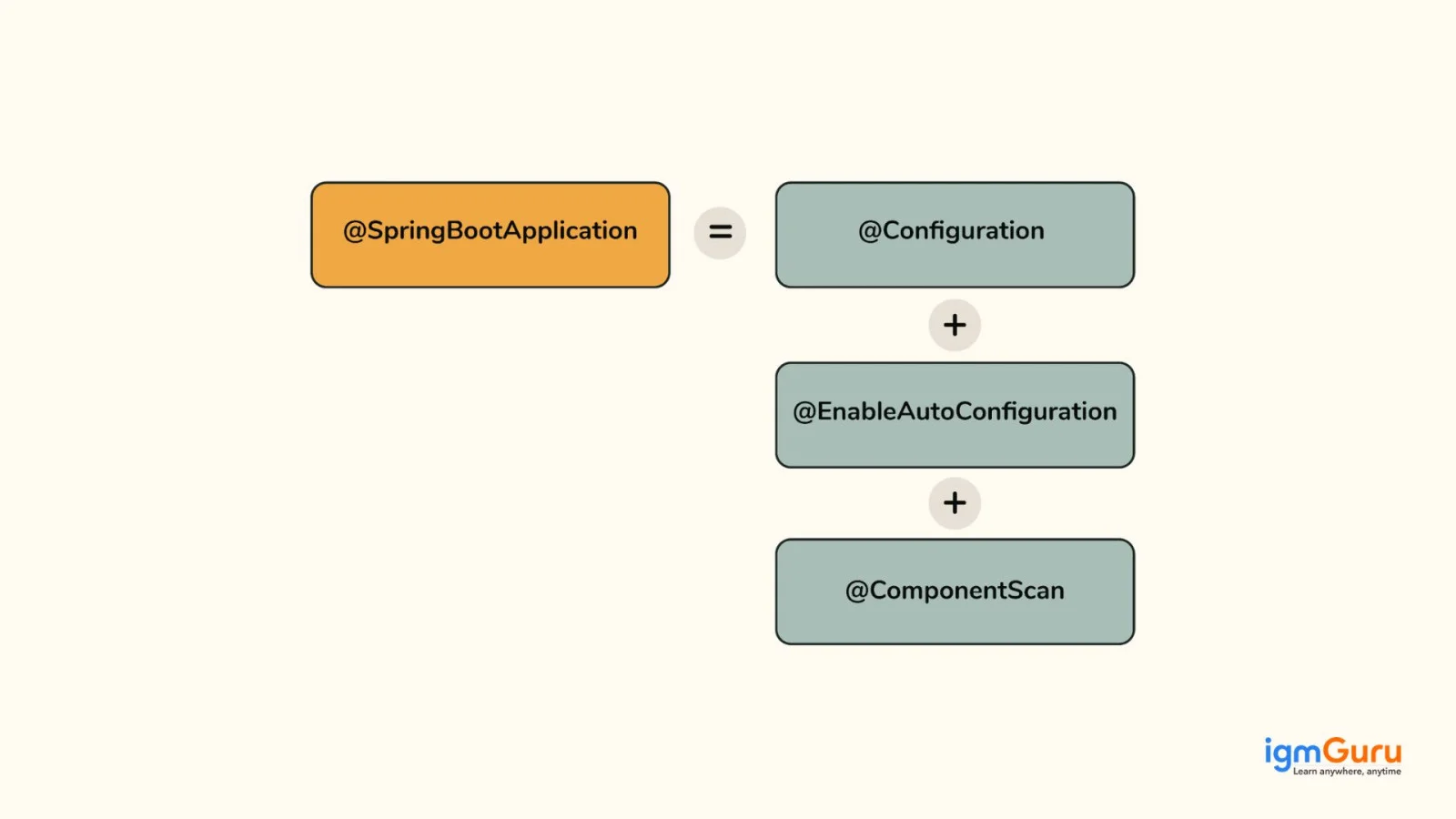
The @SpringBootApplication annotation is made up of the combination of three core Spring annotations. They are:
Yes, application.properties is used to configure the web application type. It can be done by adding spring.main.web-application-type=none in it.
Read Also- 60+ Java Interview Questions and Answers (2026)
This section highlights practical questions that test your ability to work with these core components in a production environment.
Spring AOP, also known as Aspect-Oriented Programming, is a programming paradigm in the Spring Framework. It helps in separating cross-cutting concerns, such as logging, security and transaction management from the business logic. It also allows developers to modularize concerns, which can cut across multiple types and objects using aspects.
Spring AOP is implemented using proxies i.e. JDK dynamic proxies or CGLIB and works at runtime.
HibernateTemplate is a helper class provided by Spring. It simplifies interactions with the Hibernate ORM framework. It abstracts the boilerplate code required for session management and exception handling. Additionally, it provides convenience methods for common operations, such as saving, deleting, updating and loading objects. Developers can write cleaner and more readable data access code in Spring applications with the help of HibernateTemplate.
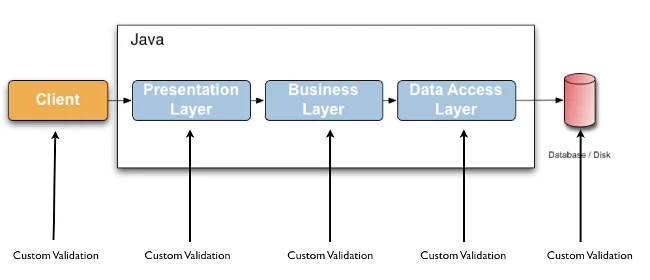
Hibernate Validator is a framework for validating data and is the reference implementation of the Bean Validation (JSR 380) specification. This framework helps to make sure that the data inside the objects is correct and satisfies the business rules before any usage.
The difference between Spring AOP and AspectJ AOP is given below in the table.
| Feature | Spring AOP | AspectJ AOP |
| Execution Time | It works at runtime using dynamic proxies. | It works at compile-time or load-time (via weaving). |
| Weaving Support | It supports only method-level weaving. | It supports method, field and constructor-level weaving. |
| Complexity | It is simpler and suitable for common cross-cutting tasks. | It is more powerful and suited for complex AOP scenarios. |
| Performance | It is slightly slower due to proxy creation. | It is faster due to compile-time weaving. |
| Integration | It is integrated within the Spring ecosystem. | It requires additional setup with AspectJ libraries. |
Hibernate is an open source ORM framework for Java. It helps in mapping the Java objects to database tables and simplifies database operations by eliminating the need for complex SQL and JDBC code. Hibernate supports features like HQL, caching, lazy loading and annotation-based mapping, which makes the data access cleaner and more efficient.
Read Also- How to Learn Java from Scratch
When it comes to building scalable and maintainable web applications in Java, Spring MVC stands as a key framework. As a developer, having a solid grasp of its architecture, annotations and request-handling flow is essential. This section focuses on commonly asked Spring MVC interview questions that interviewers ask to check your ability to structure and manage web-layer logic effectively.
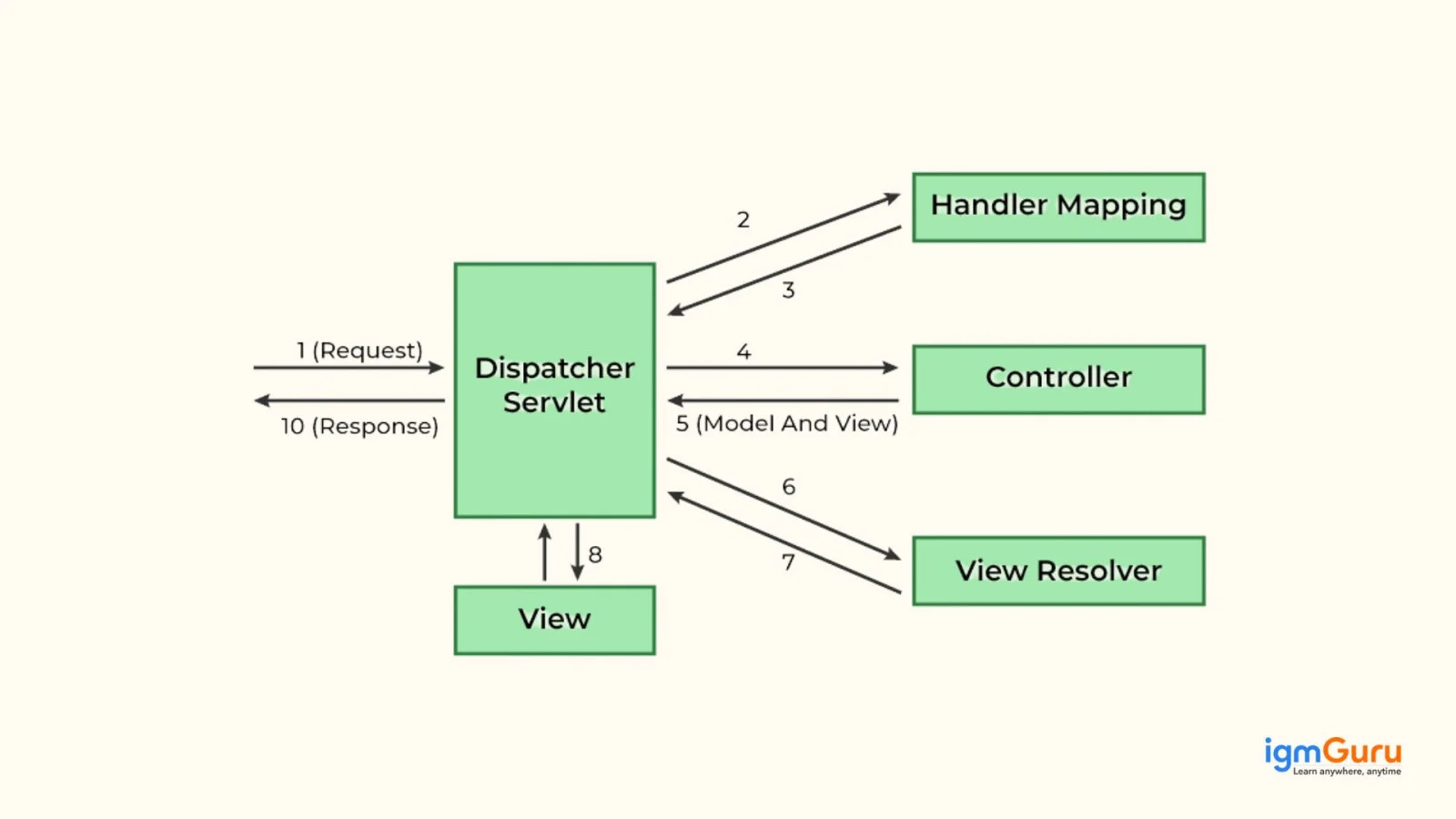
Spring MVC is a web framework based on the Model-View-Controller design pattern built on top of the Spring framework. It helps in building loosely coupled and maintainable web applications by separating concerns.
It core components are:
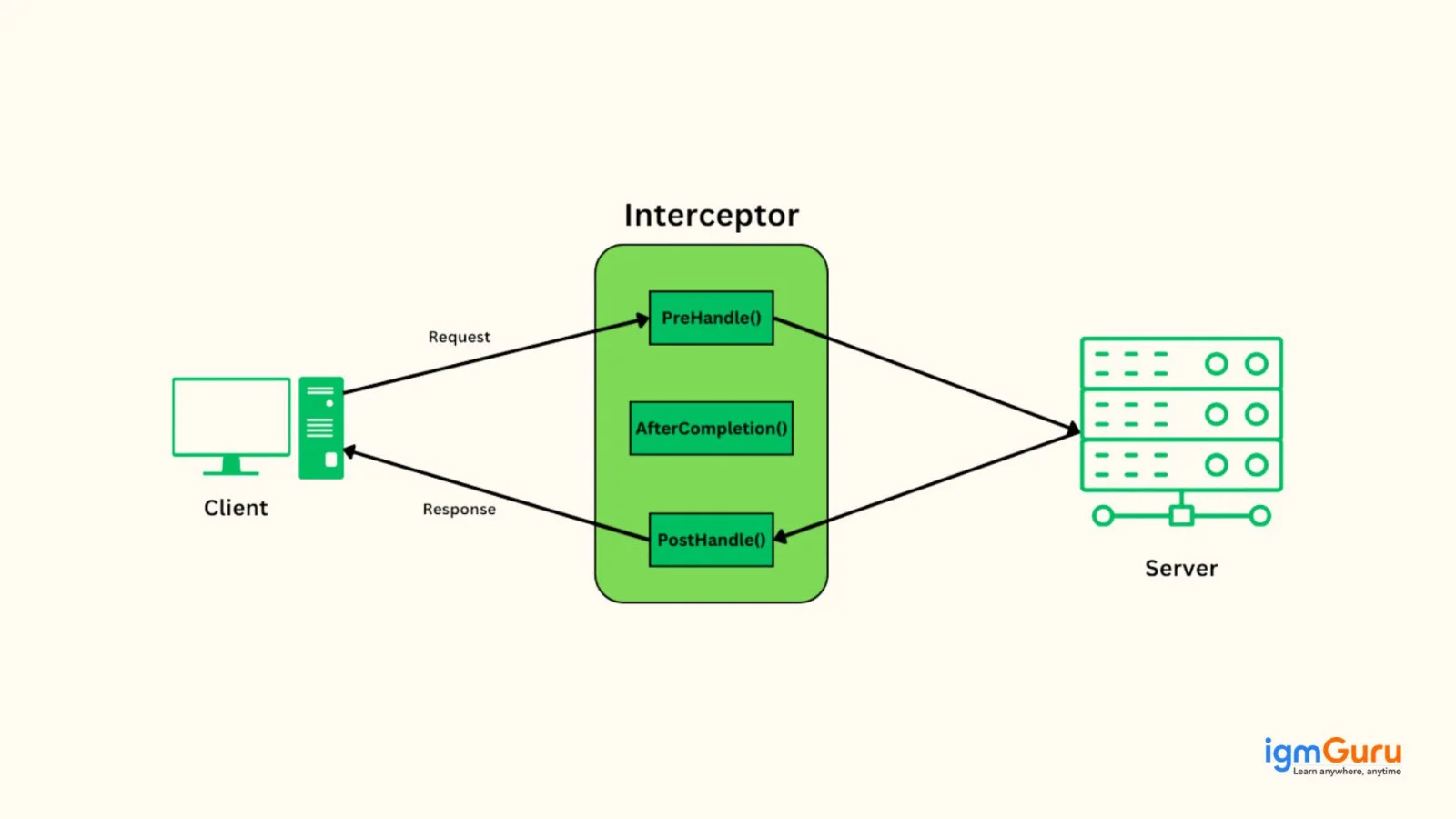
Spring Interceptors are way too similar to Servlet Filters. It allows you to pre-process and post-process web requests in Spring MVC. They are used for tasks like logging, authentication, request modification, etc. They implement the HandlerInterceptor interface and provide three main methods:
The root application context is loaded by ContextLoaderListener. It is typically defined in web.xml or via Java config. It loads shared beans like services and repositories. It is separated from the WebApplicationContext, which is used by DispatcherServlet for web-specific beans like controllers and views.
The dispatcher servlet started with servlet containers like Tomcat. It should be defined in web.xm. It is explained in web.xml as shown below:
<?xml version="1.0" encoding="UTF-8"?> <web-app version="2.5" xmlns="http://java.sun.com/xml/ns/javaee" xmlns:xsi="http://www.w3.org/2001/XMLSchema-instance" xsi:schemaLocation="http://java.sun.com/xml/ns/javaee http://java.sun.com/xml/ns/javaee/web-app_2_5.xsd"> <servlet> <servlet-name>appServlet</servlet-name> <servlet-class>org.springframework.web.servlet.DispatcherServlet</servlet-class> <init-param> <param-name>contextConfigLocation</param-name> <param-value>/WEB-INF/spring/appServlet/servlet-context.xml</param-value> </init-param> <load-on-startup>1</load-on-startup> </servlet> <servlet-mapping> <servlet-name>igmGuruServlet</servlet-name> <url-pattern>/</url-pattern> </servlet-mapping> |
The above shows that the load-on-startup tag is set to 1, which means the DispatcherServlet is instantiated whenever the Spring MVC application is loaded into the servlet container. During this process, it searches for the servlet-name-context.xml file and initializes the beans defined in that file.
The most important Spring MVC annotations depend on the user's choice. Here are some of them:
@Controller public class igmGuruController { } |
@Controller @RequestMapping("/igmGuru") public class igmGuruController { } |
@Controller @RequestMapping("/igmGuru") public class igmGuruController { @RequestMapping("/get/{id}") public String getigm(@PathVariable("Id") Long id) { return "igmDetails"; } } |
@Controller @RequestMapping("/igmGuru") public class igmGuruController { @RequestMapping("/get") public String getigm(@RequestParam("igm") String igm) { return "igmDetails"; } } |
@Controller @RequestMapping("/igmGuru") public class igmGuruController { @ModelAttribute("igm") public igm getigm() { return service.getigm(); } } |
Explore the most asked advanced Java Spring interview questions and answers in this section. It will help you boost your knowledge and improve credibility.
Spring Boot 3.2 builds on Spring WebFlux and Project Reactor for reactive programming. It does so by offering non-blocking, event-driven architectures. It integrates with Netty by default for WebFlux applications and supports reactive data access with R2DBC.
Key considerations for migration include:
Spring Boot 3.2 integrates with OpenTelemetry for distributed tracing via the spring-boot-starter-otel dependency. It is configured by setting management.tracing.enabled=true and exporting traces to backends like Jaeger or Zipkin.
The benefits of this architecture are:
Use Spring Kafka with @KafkaListener for Kafka message consumption, or spring-boot-starter-amqp for RabbitMQ. This enables asynchronous, loosely coupled communication between microservices.
Spring Boot 3.2 improves caching with Caffeine via spring-boot-starter-cache. Caffeine is a high-performance caching library. We can configure advanced strategies using @Cacheable, @CacheEvict and @CachePut annotations. You can implement eviction policies like time-based (TTL, TTI) or size-based using CaffeineSpec, e.g., maximumSize=1000, expireAfterWrite=1h.
Spring Boot 3.2 enhances security with Spring Security 6 to support rate limiting via Spring Cloud Gateway or third-party libraries like Bucket4j. Configure rate limiting with @EnableRateLimiting and define rules in application.properties, e.g., spring.cloud.gateway.routes[0].filters[0].name=RequestRateLimiter.
For CSRF, enable it by default for browser-based apps using http.csrf(csrf -> csrf.ignoringRequestMatchers("/api/**")) to protect against cross-site attacks, ensuring secure REST endpoints.
The focus of advanced Spring interviews in India and the USA has shifted heavily toward cloud-native readiness, performance optimization and observability. A strong candidate must understand how Spring Boot 3 addresses these modern architectural challenges.
GraalVM Native Images allow Spring Boot applications to be compiled into standalone, native executables ahead-of-time (AOT). This compilation process converts the Java bytecode into machine code. This eliminates the need for a traditional JVM at runtime. Key Benefits are:
Observability is the ability to understand the internal state of a system from external outputs. Spring Boot 3 fully embraces this through Micrometer and integration with OpenTelemetry.
Modern applications rely on external Authorization Servers (AS) for managing users and issuing tokens, separating identity from the resource server.
i. Introspects the token (calls the AS to validate it and get user details).
ii. Validates it locally if the token is a signed JWT (JSON Web Token), which is the performance-preferred approach.
Q1. What is the core concept of Spring's Inversion of Control (IoC)?
Q2. Which Spring module supports reactive programming?
Q3. What is the primary purpose of Spring Boot?
Q4. Which annotation is used to define a Spring Bean?
Q5. What is a key feature of Spring Boot 3.x introduced in recent updates?
Q6. How does Spring Cloud Gateway enhance microservices?
Q7. What is the purpose of the @Autowired annotation in Spring?
Q8. Which Spring component manages RESTful web services?
Q9. What is the benefit of Spring's Aspect-Oriented Programming (AOP)?
Q10. How does Spring Security enhance application security?
When you prepare for Spring-related interviews, it does not only require theoretical knowledge, but a clear understanding of how its components work in real-world applications. This guide has covered the most frequently asked questions across Spring Core, Boot, AOP, JDBC, Hibernate and MVC.
Now, by doing consistent practice and hands-on experience, I can surely say that you will be able to tackle Spring interview rounds with confidence and succeed.
Test your knowledge by attempting these Top 50 Java MCQs With Answers
You must focus on core concepts like Spring IoC, Dependency Injection, Spring Boot, Spring MVC, AOP and Spring Data JPA. Additionally, practice real-world coding scenarios, revise configuration styles (XML vs Java-based) and stay updated with the latest Spring 6 and Spring Boot 3.2 features.
The popular questions asked in the spring interview questions Java are:
You can explore our full list in the blog for detailed answers.
Spring 6 and Spring Boot 3.x introduce major changes. It includes native support for GraalVM, observability improvements and better integration with modern DevOps tools. Make sure to brush up on these new features before interviews.
Spring provides the core framework features, while Spring Boot makes it easier to create and run Spring applications with less configuration.
Course Schedule
| Course Name | Batch Type | Details |
| Java Training | Every Weekday | View Details |
| Java Training | Every Weekend | View Details |