


Becoming a Cybersecurity engineer involves learning networking, operating systems, and cybersecurity fundamentals while gaining hands-on experience with industry tools. Earning relevant certifications and building practical skills through labs and projects can help you stand out to employers.
This guide provides a step-by-step roadmap to help you confidently start and grow your cybersecurity career.
Cybersecurity engineers are the protectors of our digital world. They secure sensitive information, defend systems from cyber threats, and build the technologies that keep data safe. Their work involves developing and managing hardware, software, and strong security policies- everything needed to safeguard networks, computers, and critical business information.
These professionals combine principles of computer science and electrical engineering to understand how systems work and how to protect them. A major part of their role is designing and implementing secure network solutions that prevent hackers and other online threats. They also test, monitor, and upgrade systems regularly to ensure they remain resilient against new and evolving attacks.
The roles and responsibilities of a cybersecurity engineer include.
According to Cybersecurity Ventures' Official Cybercrime Report, global cybercrime costs were projected to reach $10.5 trillion annually by 2025, up from $3 trillion in 2015 — a more than threefold increase in a decade.
I have divided this section into different parts to help you easily understand the required skills of a cybersecurity engineer.
The following are the important technical skills that cybersecurity engineers hold-
The following are the essential business and compliance knowledge a professional holds-
Here are some of the vital soft skills that a cybersecurity engineer holds-
The following are the essential analytical and problem-solving skills that a professional has-
Read Also- Cyber Security Tutorial: A Step-by-Step Guide For Beginners
The most important question to consider is not 'how to become a cybersecurity engineer.' Before that, you must think about 'why become a cybersecurity engineer' in the first place. Find your own answer and also take a look at the following reasons to become one.
The role of a cybersecurity engineer is intellectually stimulating as it never remains the same. New technologies, threats and tools are always emerging to keep you learning. The field of cybersecurity is for you if you are someone who likes to solve problems, face challenges, and learn new things.
Technology is what drives every single organization and it keeps on advancing. This advancement comes with an increased risk of cyber threats. Organizations deal with many such risks like phishing, ransomware and large-scale data breaches. There is no shortage of organizations, but there is a shortage of cybersecurity experts. There's a great demand for cybersecurity engineers, which makes their profession highly sought after.
Companies actively hiring for these roles include Lockheed Martin, Cisco, IBM, Microsoft, Amazon Web Services, and CyberArk, among many others across finance, healthcare, and government.
Cybersecurity professionals enjoy competitive salaries and amazing benefits due to the high demand we discussed in the above point. A number of cybersecurity roles are among the highest-paid jobs in the IT industry.
A great salary, work environment, opportunities, and other benefits are definitely good factors to consider. Is that all that matters? You are going to make a real difference as a cybersecurity professional. It's a career with an impact that enables you to secure businesses, individuals, and the government from rising digital threats.
Choosing to become a cybersecurity professional is not the only path. You have room to grow by starting as a security analyst and then moving to engineering roles. You can eventually move to more advanced positions like Chief Information Security Officer or Cybersecurity Architect. There are a number of roles to explore and keep moving towards.
Read Also- Cybersecurity Interview Questions
Cybersecurity isn't just for people who can code for hours or those who dream of becoming ethical hackers. It's a field built for curious problem-solvers- people who enjoy understanding how things work and how to protect them. You might be a great fit if you naturally pay attention to details, stay calm under pressure, and enjoy investigating issues until you find the root cause.
This career is also ideal for anyone who loves continuous learning. Cyber threats evolve every day, so cybersecurity engineers must adapt quickly, explore new tools, and stay updated with emerging risks. If you like challenges, enjoy technology, and want a career where your work genuinely makes an impact, cybersecurity can be an exciting and rewarding path for you.
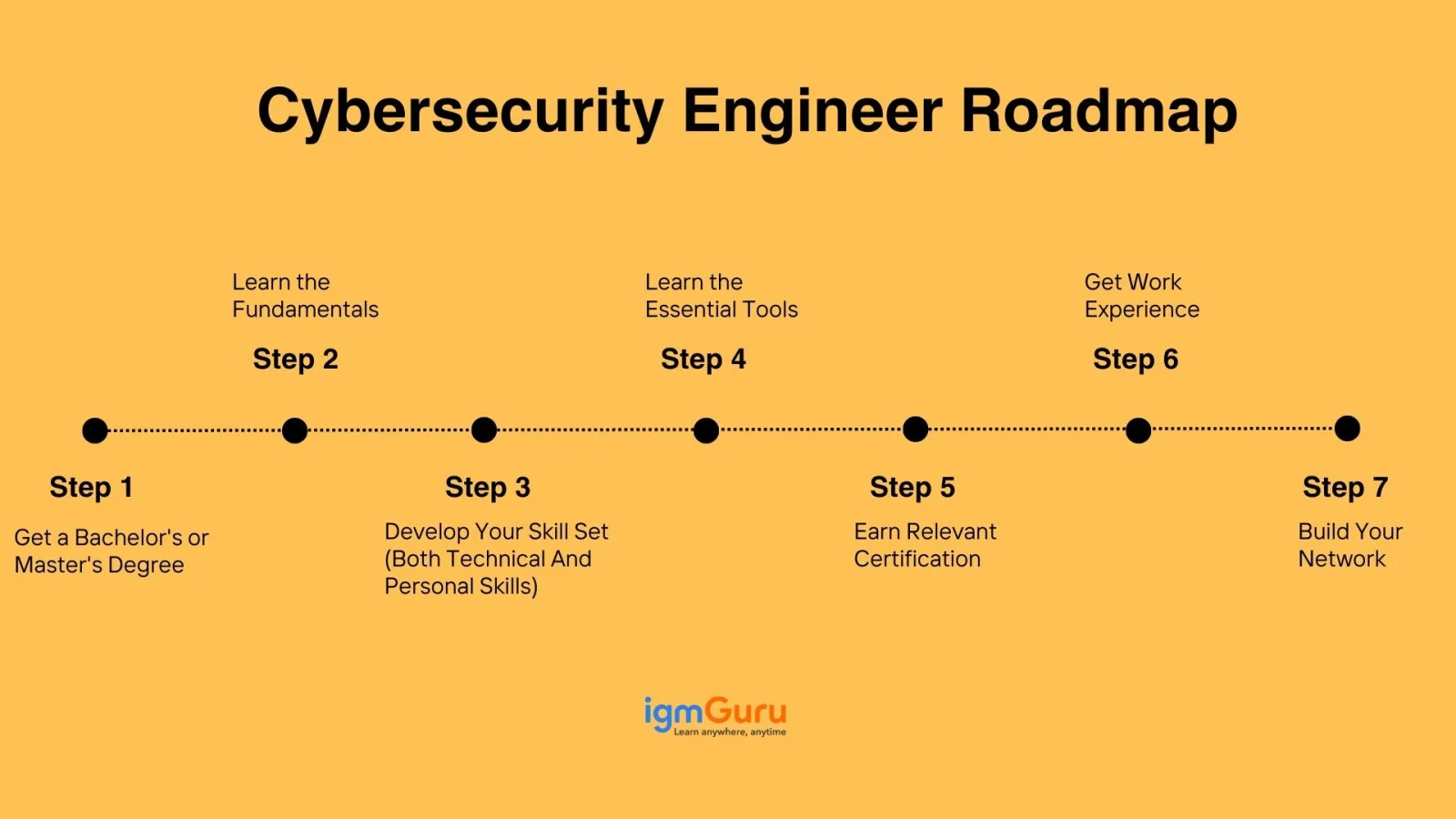
There are many different answers to how to become a cybersecurity engineer and each answer has different steps. The learning journey is different for everyone since everyone starts with different skills and intentions. This section covers the top steps one can undertake to become a professional in cybersecurity.
The most important requirement is a degree in a related field like computer science, computer programming, software engineering, and other related subjects. Engineering courses would especially help you in understanding the groundwork of cybersecurity. This includes understanding computer networks, cryptography, network communication and infrastructure. Some roles may be considered if you have a degree or work experience paired with strong technical skills.
Note that it is not a necessity to go for higher studies to land a job in cybersecurity.
According to Zippia's analysis of cybersecurity engineer resumes, 60% of cybersecurity engineers hold a bachelor's degree, 20% hold an associate degree, and the remainder enter through alternative paths like certifications and hands-on experience.
Step 2. Learn the Fundamentals
The first step is to become familiar with the basics and essentials of this field. This includes understanding basic computer science concepts, operating systems, main programming languages, and networking.
There are many different security concepts like risk assessment, threat modeling, security frameworks and cryptography. All these are important and should be covered to move ahead. This knowledge and skill set paves the path for understanding the existing security landscape while developing effective security solutions.
A diverse skill set is needed to become a cybersecurity engineer, as already discussed in the above section. There are many important technical and personal skills for cybersecurity professionals.
Cybersecurity engineers are proficient in working with certain tools. These tools are great for detecting, mitigating and analyzing different kinds of cyber threats and attacks. These engineers use different open source and commercial tools for digital forensics, incident response and cryptography.
The security information and event management (SIEM) system is a common one for collecting and aggregating security data from different sources. Other important tools are mentioned below -
Cybersecurity certifications are an important part of becoming successful as a cybersecurity engineer. Credentials are great for staying updated with the latest technologies and trends. These improve one's knowledge and skills in this field. There are many amazing credentials one can pursue to get started or become successful.
Keep in mind that not having work experience should not demotivate you. Work experience is not required but preferred for advanced roles. Beginners should start by applying for entry-level roles, like a Security Analyst, to get practical exposure. Experience in networking, system administration, and IT service can serve as a strong factor in your resume. These positions will help you understand how to maintain a network or database.
Expand your knowledge by attending cybersecurity conferences and connecting with other professionals to stay informed on industry trends. Publish Cybersecurity blogs and contribute to open-source projects to display your projects and knowledge.
Related Article- Top 70 Cyber Security MCQs
As a future cybersecurity engineer, tools will become your best companions. They help you detect vulnerabilities, monitor systems, analyze threats, and strengthen defenses. You don't need to master everything on day one, but getting familiar with the key tools early will make your learning journey smoother and more practical.
These help track network traffic and detect unusual activity.
Name of Tools:
These scan systems and web apps for weaknesses.
Name of Tools:
These detect and block suspicious activity.
Name of Tools:
These tools are used to encrypt data and manage credentials.
Name of Tools:
These tools are used for ethical hacking and vulnerability exploitation.
Name of Tools:
These tools are used for log analysis and incident detection.
Name of Tools:
Related Article- Top 10 Career Opportunities in Cyber Security (Updated 2026)
Here is the certification roadmap, which you can choose as per your skill set.
| Certification | Difficulty Level | Approx. Cost | Best For |
| CompTIA Security+ | Beginner | ₹30,000 - ₹40,000 ($370 exam fee) | Anyone starting in cybersecurity, IT support, network technicians, freshers building foundational knowledge. |
| CompTIA CySA+ | Intermediate | ₹40,000 - ₹50,000 ($392 exam fee) | Security analysts, SOC analysts, and professionals working in threat detection and incident response. |
| CEH (Certified Ethical Hacker) | Intermediate | ₹80,000 - ₹1,20,000 ($950–$1,199) | Learners interested in ethical hacking, penetration testing, and offensive security roles. |
| CISSP (Certified Information Systems Security Professional) | Advanced | ₹75,000 - ₹1,00,000 ($749 exam fee) | Experienced security engineers and professionals aiming for leadership roles like Security Manager or Security Architect. |
| CompTIA CASP+ | Advanced | ₹45,000 - ₹55,000 ($494 exam fee) | Senior cybersecurity engineers working in enterprise security, risk management, and advanced security architecture. |
| OSCP (Offensive Security Certified Professional) | Advanced | ₹1,00,000 - ₹1,40,000 ($1,599+) | Professionals who want hands-on penetration testing expertise and real-world exploit skills. |
Now, let's get to know the cybersecurity engineer salary through the given table. Keep in mind that wages may vary depending on demand in different regions. Cybersecurity engineers enjoy high competitive pay, irrespective of the location.
| Experience Level/Typical Scenario | India (Annual Salary) | USA (Annual Salary) |
| Entry-level / Junior (0-2 years) | ₹ 4 LPA - ₹ 7 LPA (Futurense) | US $85,000 - US $95,000 (Indeed) |
| Early to Mid-level (2-5 years) | ₹ 8 LPA - ₹ 15 LPA (Futurense) | US $110,000 - US $130,000 (Indeed) |
| Mid to Senior (5-8 years/specialized/with certifications) | ₹ 15 LPA - ₹ 25 LPA+ (varies with firm, role, skills) (Glassdoor) | US $130,000 - US $165,000 |
| Senior/Highly Experienced/Specialist (7+ years, niche skill, leadership) | ₹ 20 LPA - ₹ 40 LPA+ (depending on specialization, company size) (Futurense) | US $150,000 - US $200,000+ (Glassdoor) |
Learning how to become a cybersecurity engineer is more than just a career choice. It is your chance to make an impact by protecting the digital world while building a strong profession. This guide was created to help you confidently step into this field with the right mix of education, skills, and certifications. Keep learning and grow into the digital guardian every company needs.
Explore These Trending Articles:
Becoming a cybersecurity engineer requires a combination of education, technical skills, and hands-on experience. The learning path involves earning a degree in computer science, information technology or a related field and gaining certifications in cybersecurity.
Cybersecurity engineers generally hold a bachelor's degree in computer science, information technology or a related field. Some professionals also pursue a master's degree for advanced roles.
The salary of a cybersecurity engineer is INR 12,87,500 per year in India and $215,461 in the USA. The range of this salary depends on the experience and role of the individuals.
Course Schedule
| Course Name | Batch Type | Details |
| Cyber Security Training | Every Weekday | View Details |
| Cyber Security Training | Every Weekend | View Details |


