Want to build a career in Generative AI? This guide on 'how to learn Generative AI' will give you a deep understanding of Gen AI and help you become one.
Artificial intelligence (AI) has already made its way into almost all industries, enabling transformation, revolutionization, and innovation. Closely following in its footsteps is Generative AI, one of AI's many subfields. The key aspect that makes this subfield stand tall is its ability to imitate human-like creation, generating new content.
Gen AI has become a huge field and at the pace at which it is expanding, its expansion is not going to stop anytime soon. This guide from experts paves a roadmap on how to learn generative AI from scratch. After all, a technology that is spreading like wildfire must bring in brilliant future opportunities too. Here is an introduction to generative AI.
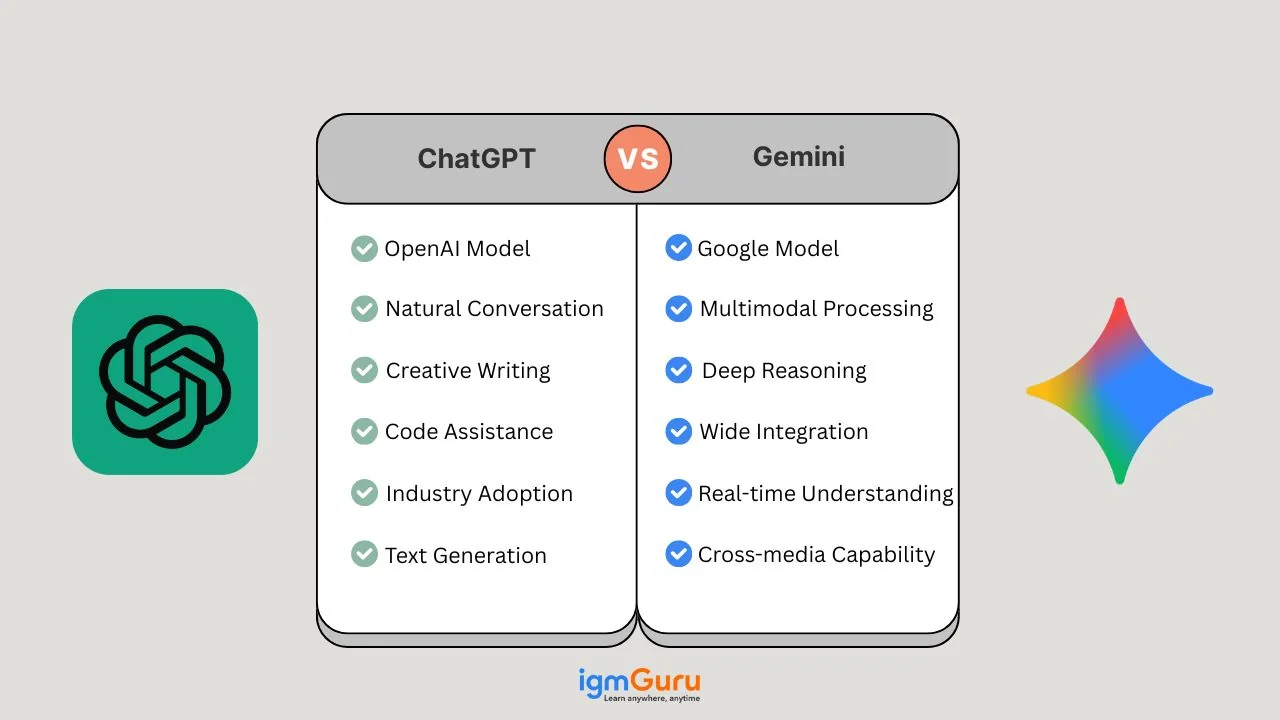
Gen AI has completely transformed how various organizations and individuals approach content generation and associated tasks like question-answering and language translation. OpenAI's language model-based apps like ChatGPT and DALL-E, Anthropic's code generation platform Claude, and Google's Gemini are all exceptional examples of what this technology can do.
In fact, what can it not do? Think about anything that needs to be done and there are some Gen AI tools that have already been made to make it happen. Initial human intervention is essential, but then the tool itself is programmed to drive out answers and follow commands.
This brings us back to the imperative question of how to learn generative AI. Here are certain bases you have to cover to begin your career in this field.
The first thing to do is to get to know the basics of gen AI. This includes understanding its models, tools, applications, and how it works. Having an in-depth understanding of these key factors will help you get started and learn faster.
Generative models are basically algorithms that aid in generating data after being trained on gigantic data sets. To get the basics straight and have some amount of basic knowledge, you can read online blogs, watch tutorials and go through videos.
It is ultimately all about the skills and knowledge you have in different associated technologies and languages. Here are a few.
Algorithms and techniques employed in machine learning and its subset, deep learning, play an important role. It incorporates getting a hold of concepts like reinforcement learning, supervised learning, unsupervised learning and neural networks. Knowledge of various types of Gen models like GANs (generative adversarial networks) and VAEs (variational autoencoders) is needed.
Gen AI consists of two AI subfields and these are computer vision and Natural Language Processing. NLP is focused on interactions happening between computers and human language to create realistic text on the basis of the prompt given. Computer visions divert focus on ensuring computers understand and interpret visual information to create realistic videos and images based on a concept.
Two foundational concepts of gen AI are mathematics and statistics, both of which offer necessary concepts and tools to understand the underlying algorithm and principles of generative models. Calculus, statistics, linear algebra and probability theory are essential concepts used for different purposes. These help in modeling uncertainty, transforming and manipulating data, making data-driven predictions and optimizing algorithms and models.
A strong foundation in top programming languages is imperative to make a career in this field. Python, R, PyTorch and TensorFlow are some of the key languages that have all the essential libraries and tools needed to train and implement gen AI models. Python is the most important one to know, along with its libraries like Matplotlib, NumPy and Pandas.
If you are serious about getting an answer to how to learn generative AI, then you must enroll in a Generative AI online course program. It would be better to go for an online learning course and it will give you more flexibility in learning anytime and anywhere.
Be certain to pick a course that is taught by industry professionals with good knowledge, experience and expertise. This is a key step in ensuring you have the right means to kickstart your learning journey. A good course will also prepare you to pass any certification exam you aim to earn.
While Gen AI is a field that is yet to have any official certification, there are many different ones out there that are totally mandatory. Most of the certifications you find on Gen AI are provided by the ones offering the training. However, you can also go with a training that simply provides a course completion certification and it would be all the same.
Making it big in the space of gen AI is all about how good you are while doing tasks and not just on paper. To ensure you ace your interviews and get the job of your dreams, you should practice implementing it as much as possible. Exactly what you need in hands-on skills depends on the job role and responsibilities.
Have you too been wondering why learn generative AI? The reasons are too many to ignore, and here are a few.
The global generative AI market is expanding rapidly. According to Fortune Business Insights, the generative AI market was valued at around USD 43.87 billion in 2023 and is projected to grow from about USD 67.18 billion in 2024 to USD 967.65 billion by 2032, reflecting a very high compound annual growth rate (CAGR).
Since the market size is growing, the future is getting better too. More and more industries are adopting gen AI best practices, which sums up to the fact that more employment possibilities will open up for those who have skills and knowledge in this sector.
A key reason to learn Generative AI is career growth. Most organizations want to imbibe gen AI but find it difficult to find trained and experienced professionals for the same. Hence, anyone who can offer both of them will be able to ask for better pay than other job roles.
There is no two-way about the fact that gen AI is the future. Getting started in your learning journey today means you are already a step ahead of your competitors. By the time others start, your knowledge span will be vast.
Related Article - 10 Skills Required To Become A Prompt Engineer
One of the biggest misconceptions about Generative AI is that it is only for data scientists and AI researchers. In reality, Generative AI is becoming a valuable skill for professionals across almost every industry. Whether you work in technology, marketing, business, education, healthcare, or finance, understanding how AI tools work can help you improve productivity, automate repetitive tasks, and make better decisions.
From my experience, the professionals who gain the most value from Generative AI are those who combine domain expertise with AI capabilities. You do not need to become an AI researcher to benefit from it. Even learning how to write effective prompts, use AI assistants, and integrate AI into daily workflows can significantly improve efficiency and job performance.
Generative AI is especially beneficial for:
If you are comfortable using computers and willing to learn new technologies, you can start learning Generative AI regardless of your educational background. While programming knowledge can be helpful for advanced AI development, many modern AI tools are designed for non-technical users as well. The most important requirement is curiosity, continuous learning, and a willingness to experiment with AI-powered technologies.
Now that you know how to learn generative AI, what are you waiting for? It is certainly the technology of the future and will yield the great outcomes that are expected from it. With its expanding applications and tools, gen AI is not far from becoming the backbone of many organizations.
Explore Our Trending Articles-
Python is the most important programming language needed for Gen AI. Without this, it is not possible to become a pro, as it has all the amazing libraries and frameworks needed.
To learn generative AI for free, start with fundamentals, use generative AI tools, explore machine learning, deep learning, and neural networks. Also consider tutorials, online courses, videos, and get experience with hands-on projects.
The time required to learn Generative AI depends on your current background. If you already have knowledge of Python and basic machine learning concepts, you can understand the fundamentals in 8-12 weeks with consistent practice. For complete beginners, it may take mare then 15 to build strong foundations in AI, mathematics, and deep learning before moving to advanced generative models.
Generative AI opens doors to high-paying roles such as Generative AI Engineer, Machine Learning Engineer, NLP Engineer, AI Researcher, Prompt Engineer, and Data Scientist.
Yes, mathematics plays an important role in understanding how generative models work. Concepts such as linear algebra, probability, calculus, and statistics help you understand model training, optimization, and data transformations.
Course Schedule
| Course Name | Batch Type | Details |
| Generative AI Training | Every Weekday | View Details |
| Generative AI Training | Every Weekend | View Details |