Generative AI has become an integral part of almost every technology we see today. Whether it is development, finance, production, management, or healthcare, it has a prominent role. This has increased the demand for professionals who understand Gen AI tools very well and know how to implement them in industries. The best part is that learning it is not too complicated if you follow a Generative AI roadmap.
This guide is all about it. It provides a structured learning path that transitions you from AI fundamentals to building production-grade AI applications. It logically progresses through programming, machine learning, Large Language Models (LLMs), Retrieval-Augmented Generation (RAG), and AI agents. This will allow you to build expertise in the correct sequence. Let’s begin with the basic definition.
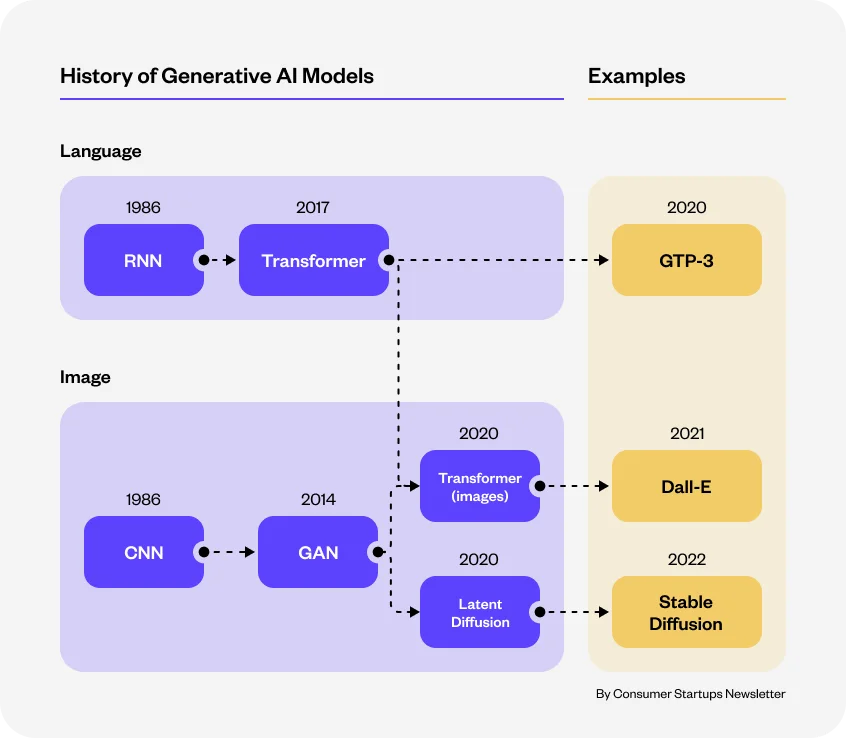
Image Source: Consumer Startups Newsletter
Generative AI falls in the umbrella term of artificial intelligence, as it makes use of large language models (LLMs) and advanced deep learning models. Gen AI has become an integral go-to for generating top-notch and unique content such as images, text, music, code, speech, product design, etc.
Gen AI is basically models that learn from the already-existing facts, leading to generation of new and realistic outputs, all by reading and learning from provided data sets. Various different techniques are incorporated to keep up the pace of evolution. In our everyday lives, Gen AI is enabled to create content even by reading natural language requests.
Hence, knowledge or the need to enter code is not there. There are also plenty of enterprise use cases, leading to incredible innovations in material science development, drug and chip design, healthcare, and others. This is certainly the technology of the future, which is paving the way for other technologies too.
| Explore igmGuru's Generative AI Course program to learn Gen AI with industry experts. |
Generative AI is much easier to learn when you follow a structured path instead of randomly exploring different tools. Each stage teaches a specific set of skills that prepares you for the next one. By mastering the fundamentals first, you can confidently build production-ready AI applications without feeling overwhelmed.
Python is the foundation of modern artificial intelligence and the most widely used programming language in the AI ecosystem. Nearly every popular machine learning library, deep learning framework, and Generative AI tool is built around this programming language. This makes it the first skill every beginner should learn.
You can start by focusing on understanding variables, data types, functions, loops, object-oriented programming, exception handling, file handling, and modules. Along with core Python, practice using libraries such as NumPy, Pandas, and Matplotlib, which are frequently used while working with AI applications.
Learning Resources:
Every professional AI developer uses Git for version control and GitHub for project collaboration. These tools help you track code changes, collaborate with teams, and maintain different versions of your AI projects.
Learn how to create repositories, commit changes, create branches, merge code, resolve conflicts, and publish projects on GitHub. Maintaining a GitHub profile also helps recruiters evaluate your practical skills and project experience.
Understanding Git early will save significant time when working on larger AI applications and collaborative development environments.
Learning Resources:
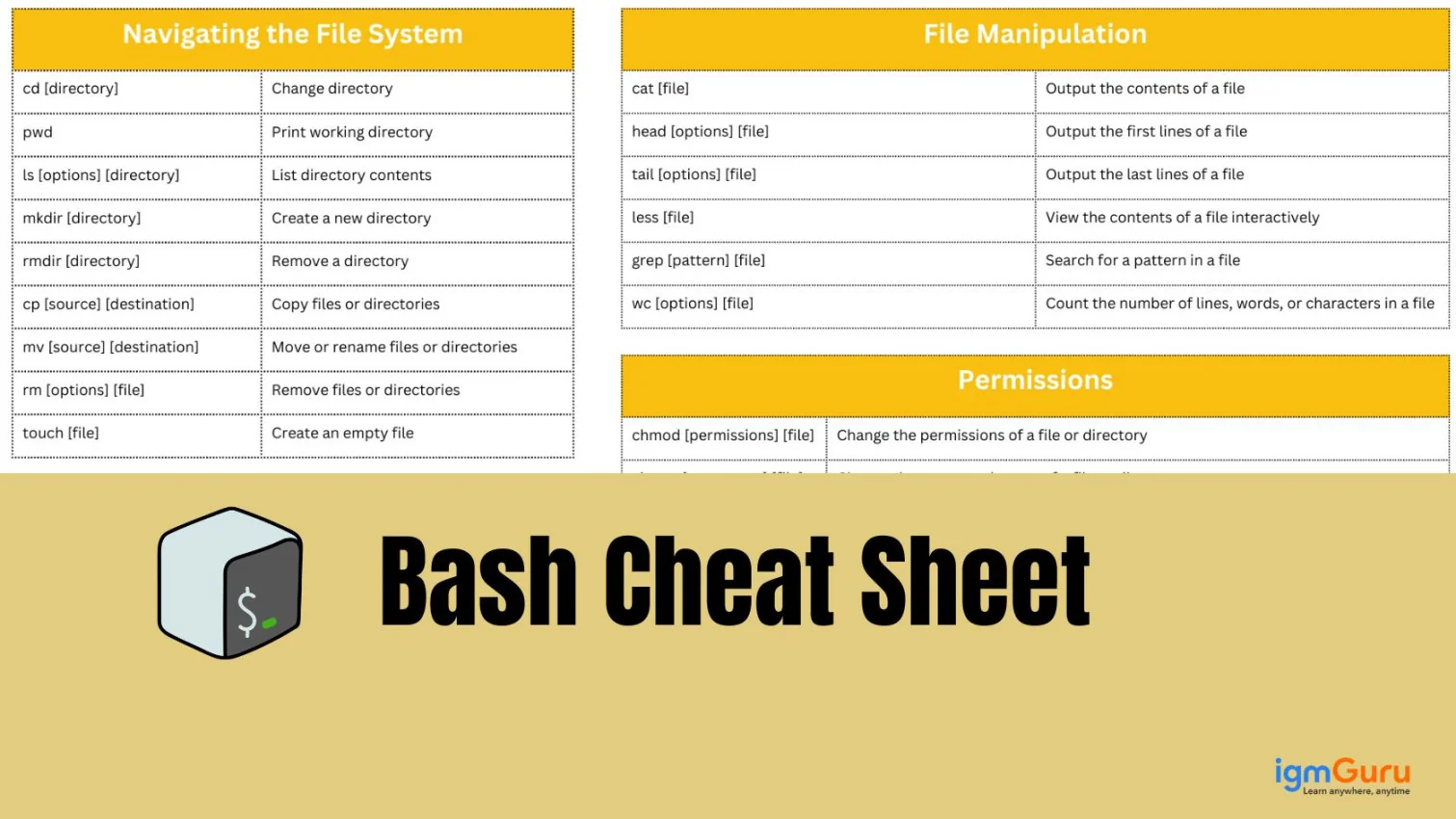
Most of the AI development environments run on Linux servers or cloud-based virtual machines. This is why professionals are expected to know basic Linux commands. This also makes installing frameworks, managing environments, deploying applications, and troubleshooting much easier.
Learn common commands for navigating directories, managing files, installing software packages, monitoring processes, and working with SSH. Familiarity with the command line becomes increasingly valuable as you start deploying AI models in production.
Learning Resources:
You do not need to become a mathematician to learn Generative AI, but understanding a few mathematical concepts helps you understand how AI models learn and make decisions. Focus primarily on:
Rather than memorizing formulas, understanding why these concepts are important for neural networks, optimization, embeddings, and machine learning algorithms. Having these fundamentals makes advanced AI topics much easier to understand later in your learning journey.
Machine Learning forms the backbone of Generative AI. Machine Learning teaches computers to identify patterns, make predictions and improve performance based on experience rather than explicit programming.
You can start from learning supervised learning, unsupervised learning, and reinforcement learning. Next understand popular algorithms such as Linear Regression, Logistic Regression, Decision Trees, Random Forest, K-Means Clustering, and Support Vector Machines. Alongside algorithms, learn concepts like overfitting, underfitting, feature engineering, model evaluation and cross-validation.
Learning Resources:
Deep Learning is a specialized branch of Machine Learning that uses artificial neural networks to solve complicated problems. Modern Generative AI systems such as ChatGPT, Gemini, Claude and Midjourney are all built on deep learning architectures.
You should start by understanding how neural networks work, including neurons, activation functions, forward propagation, backpropagation, and optimization algorithms. Then explore architectures such as Convolutional Neural Networks (CNNs), Recurrent Neural Networks (RNNs) and Transformer models.
Learn popular frameworks like TensorFlow and PyTorch to build and train deep learning models. At this stage, your goal is not to build ChatGPT but to understand the technology that powers modern AI systems.
Learning Resources:
Transformers completely changed the field of artificial intelligence and made modern Generative AI possible. Unlike traditional neural networks, Transformers can process long sequences of information efficiently. This makes them ideal for language understanding, code generation, translation, and content creation.
Learn how attention mechanisms work, why self-attention is important, and how Transformers differ from earlier neural network architectures. Then study encoder-decoder architectures, tokenization, embeddings, positional encoding, and inference.
After understanding Transformers, begin exploring popular Large Language Models such as GPT, Llama, Gemini, Claude, Mistral, and DeepSeek. Compare their capabilities, limitations, and common use cases to understand how different models solve real-world business problems.
Learning Resources:
Prompt Engineering is the skill of communicating effectively with AI models to produce accurate, relevant, and high-quality responses. Even the most advanced Large Language Model cannot deliver useful results if the instructions are unclear or incomplete.
Start by learning how prompts influence AI responses. Practice writing simple prompts before moving to advanced techniques such as role prompting, chain-of-thought prompting, few-shot prompting, zero-shot prompting, structured prompting, and prompt templates.
Experiment with different AI platforms to understand how prompt quality directly affects the generated output. This skill is valuable for developers, analysts, marketers, researchers, and business professionals who work with AI-powered applications.
Learning Resources:
One limitation of Large Language Models is that they cannot automatically access your company's private documents or the latest information unless you provide that context. This problem is solved using embeddings and vector databases.
Embeddings convert text into numerical representations that capture semantic meaning rather than exact keywords. It stores similar pieces of information together to allow AI systems to retrieve relevant knowledge efficiently.
Learn how embeddings work and explore popular vector databases such as Pinecone, ChromaDB, Weaviate, Milvus, and FAISS. Understanding vector search is essential because it serves as the foundation for Retrieval-Augmented Generation (RAG), semantic search, enterprise chatbots, and knowledge management systems.
Retrieval-Augmented Generation (RAG) has become one of the most important concepts in enterprise Generative AI. RAG retrieves relevant information from external sources before generating a response. It does not rely only on the knowledge stored inside a Large Language Model.
Learn how documents are collected, cleaned, chunked, converted into embeddings, stored in vector databases, retrieved based on semantic similarity, and finally passed to the language model to generate accurate responses.
Building RAG applications helps overcome many limitations of standalone LLMs, including outdated knowledge and hallucinations. It is widely used in AI-powered search engines, document assistants, legal research, healthcare systems, customer support, and enterprise knowledge bases.
Learning Resources:
AI Agents represent the next stage of Generative AI evolution. Unlike traditional chatbots that simply respond to prompts, AI agents can reason, plan, make decisions, use external tools, and complete multi-step tasks with minimal human intervention.
Understand concepts such as autonomous reasoning, memory management, tool calling, planning, workflow execution, and multi-agent collaboration. Explore frameworks that support agent development and learn how agents interact with APIs, databases, web services, and external applications.
Building AI agents enables you to create intelligent systems capable of automating business workflows, conducting research, analyzing documents, scheduling tasks, and solving complex real-world problems.
Learning Resources:
Generative AI development becomes significantly easier with specialized frameworks that simplify prompt management, document processing, workflow orchestration, and AI application development.
Start by learning LangChain for building LLM-powered applications, LangGraph for developing multi-agent workflows, and LlamaIndex for document indexing and Retrieval-Augmented Generation. Explore orchestration techniques, memory management, prompt templates, tool integration, and workflow automation.
Understanding these frameworks allows you to build scalable, production-ready AI applications much faster than developing every component from scratch.
Learning Resources:
Most real-world AI applications communicate with LLMs through APIs rather than running the models locally. Learning how to integrate AI APIs is therefore an essential skill for every Generative AI professional.
You can practice integrating APIs from OpenAI, Google Gemini, Anthropic Claude, Hugging Face, and other providers. You should also learn authentication, API requests, streaming responses, function calling, structured outputs, rate limiting and error handling. It will make you able to build chatbots, AI assistants, content generators, summarization tools, code assistants, and many other intelligent applications.
Learning Resources:
Building an AI application is only part of the journey. The next challenge is deploying it so that users can access it reliably and securely. Learn how to build REST APIs using FastAPI, containerize applications with Docker, manage dependencies, deploy applications on cloud platforms, and monitor performance after deployment. Understanding deployment ensures that your AI solutions can scale as user demand grows.
Knowledge of production deployment also prepares you for enterprise AI development, where security, reliability, and scalability are just as important as model accuracy.
Learning Generative AI is not only about understanding concepts but also about becoming comfortable with the tools used by AI professionals. These tools help you build, train, evaluate, deploy and manage AI applications efficiently. As you progress through your learning journey, gradually familiarize yourself with the following categories.
| Category | Popular Tools | Purpose |
|---|---|---|
| Programming | Python | Core programming language for AI development |
| Machine Learning | Scikit-learn | Traditional machine learning models |
| Deep Learning | TensorFlow, PyTorch | Build and train neural networks |
| Large Language Models | GPT, Gemini, Claude, Llama, Mistral | Build AI-powered applications |
| AI Frameworks | LangChain, LangGraph, LlamaIndex | Develop RAG systems and AI agents |
| Prompt Engineering | OpenAI Playground, Google AI Studio | Experiment with prompts and models |
| Vector Databases | Pinecone, ChromaDB, Weaviate, FAISS | Store and retrieve embeddings |
| Model Hosting | Hugging Face | Access and deploy open-source models |
| APIs | OpenAI API, Gemini API, Anthropic API | Integrate AI capabilities into applications |
| Backend Development | FastAPI | Build APIs for AI applications |
| Deployment | Docker | Package and deploy AI applications |
| Version Control | Git & GitHub | Manage source code and collaborate |
Learning Generative AI becomes meaningful only when you apply your knowledge to practical projects. Projects strengthen your understanding, expose you to real-world challenges, and help you build a portfolio that demonstrates your abilities to recruiters and employers. Some excellent project ideas include:
As you complete each project, upload the source code to GitHub, write proper documentation, and explain the technologies you used. A well-maintained portfolio often creates a stronger impression than certifications alone.
Generative AI has rapidly become one of the fastest-growing domains in the technology industry. Organizations across healthcare, finance, manufacturing, education, software development, cybersecurity, and marketing are actively investing in AI solutions to improve efficiency and automate business processes.
As a result, professionals with Generative AI expertise are in high demand across startups, multinational companies, consulting firms, and research organizations. Some popular career options include:
| Job Role | Beginner (0–2 Years) | Intermediate (3–5 Years) | Experienced (6+ Years) |
|---|---|---|---|
| Generative AI Engineer | ?? ₹8–15 LPA ?? $120K–160K |
?? ₹15–28 LPA ?? $160K–220K |
?? ₹28–80+ LPA ?? $220K–350K+ |
| AI Engineer | ?? ₹7–14 LPA ?? $100K–140K |
?? ₹14–25 LPA ?? $140K–190K |
?? ₹25–70+ LPA ?? $190K–280K+ |
| Machine Learning Engineer | ?? ₹6–12 LPA ?? $105K–145K |
?? ₹12–22 LPA ?? $145K–200K |
?? ₹22–65+ LPA ?? $200K–300K+ |
| LLM Engineer | ?? ₹10–18 LPA ?? $130K–180K |
?? ₹18–35 LPA ?? $180K–250K |
?? ₹35–90+ LPA ?? $250K–400K+ |
| Prompt Engineer | ?? ₹6–12 LPA ?? $90K–130K |
?? ₹12–20 LPA ?? $130K–170K |
?? ₹20–55+ LPA ?? $170K–240K+ |
| AI Application Developer | ?? ₹7–13 LPA ?? $100K–135K |
?? ₹13–24 LPA ?? $135K–180K |
?? ₹24–65+ LPA ?? $180K–260K+ |
| NLP Engineer | ?? ₹7–14 LPA ?? $110K–150K |
?? ₹14–25 LPA ?? $150K–210K |
?? ₹25–70+ LPA ?? $210K–320K+ |
| Data Scientist | ?? ₹8–16 LPA ?? $110K–150K |
?? ₹16–30 LPA ?? $150K–210K |
?? ₹30–80+ LPA ?? $210K–320K+ |
| AI Solutions Architect | ?? ₹12–20 LPA ?? $140K–180K |
?? ₹20–35 LPA ?? $180K–250K |
?? ₹35 LPA–₹1 Cr+ ?? $250K–400K+ |
| AI Research Engineer | ?? ₹10–18 LPA ?? $120K–170K |
?? ₹18–35 LPA ?? $170K–240K |
?? ₹35–90+ LPA ?? $240K–380K+ |
| AI Product Engineer | ?? ₹8–15 LPA ?? $110K–150K |
?? ₹15–28 LPA ?? $150K–210K |
?? ₹28–75+ LPA ?? $210K–320K+ |
When you choose a Generative AI roadmap, you choose to stay creative and take challenges head-on. Since this field is still growing and changing at a rapid rate, you will have to keep updating yourself too. While there is no one particular Generative AI certification, a good training resource will provide you with enough skills and knowledge to get a job in the field. So follow the Generative AI Roadmap to start your journey today.
Ans: The best Generative AI tools today include GPT-4, AlphaCode, Bard, ChatGPT, Claude, and GitHub Copilot.
Ans: The best place to study Generative AI is through a course offered by a leading learning platform. This is where you can be certain to get trained by the best.
Ans: It can take anywhere between 4 and 8 weeks to learn Generative AI through the Generative AI Roadmap. However, to become the best, you must work on it regularly.