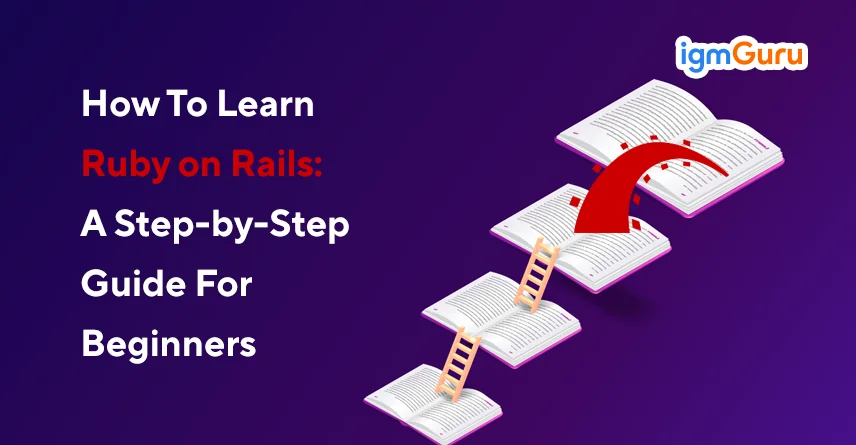
It has been a long time since Ruby on Rails (RoR) was discovered. Since its founding, it has enjoyed great popularity and is expected to continue enjoying it too. While it needs no introduction, we are going to take a different route today to get to the point. In short, we are going to give you what Ruby and Rails are distinctly and together. This guide 'Ruby On Rails Tutorial' will give you a good understanding of ROR.
In this journey, you will explore the definition and fundamentals of Ruby and Rails individually. Further, it moves to a comprehensive Ruby on Rails tutorial covering the installation, essential key terminologies and steps to master this server-side application framework.
Explore igmGuru's Ruby On Rails course program to build your career in web development.
RoR is a popular server-side web app development framework that is written in the Ruby Language. It allows the developer to create web applications with way less coding than any other framework or language out there. It has everything essential for creating database-backed web apps as per the MVC pattern.
Learning Ruby on Rails will give you an edge over your competitors when it comes down to getting hired. Finding a right job is something we all wish for a successful career. What really influences it is our decisions today.
Rail is full of features -
To learn this advanced framework, you should consider the points mentioned below. It will help you to learn as quickly as possible.
The right ROR learning resources will be the best fit to help you completely understand RoR as a framework. But before you get there, here are the two major guiding principles it follows religiously:
Follow the modulus given below to learn this robust framework:
Ruby is an object-oriented, interpreted, and high-level programming language which is used for lots of things such as web development, data analysis , DevOps tools (e.g., Chef, Puppet), and more. This open-source and dynamic language has risen to the top because of its exceptional community of developers. Created in 1995 by Yukihiro Matsumoto , it was designed for productivity and simplicity to encourage human first software code.
Written in Ruby, Rails is a development framework used to build web applications. It was released as an open-source framework in 2004. Rails is considered to be a suitable option for MVP development and prototyping because of its numerous built-in standard functionalities and features. It is considered one of the finest tools to build web applications and has been used on top sites like Shopify, GitHub, Airbnb, etc.
You will need an RoR environment to learn and be proficient in this open source framework. This framework is available for various operating systems including Windows, MacOS and Ubuntu. Here, we will discuss how to install RoR on MacOS.
Installing Homebrew is essential in this process, as it helps to compile software packages directly from source easily. Open the terminal and enter the following command. Then, the terminal will ask you to install Xcode Command Line Tools, say Yes.
/bin/bash -c "$(curl -fsSL https://raw.githubusercontent.com/Homebrew/install/HEAD/install.sh)" echo 'export PATH="/opt/homebrew/bin:$PATH"' >> ~/.zshrc source ~/.zshrc |
Once the Homebrew is installed, we can download the Ruby.s dependencies. This involves using the following command.
brew install openssl@3 libyaml gmp rust |
curl https://mise.run | sh echo 'eval "$(~/.local/bin/mise activate)"' >> ~/.zshrc source ~/.zshrc |
mise use --global ruby@3.4.1 |
ruby --version #=> 3.4.1 |
Using Git for version control can be very beneficial. Therefore, we have to first create a Github account. Configuring Git involves using the following command.
First, choose the version that you want to install in your system. We are using 8.0.1. Installing Ralis involves running one command that is given below:
gem install rails -v 8.0.1 |
Rails will use SQLite as its default database. However, you can change it with the following commands:
brew install mysql brew services start mysql |
brew install postgresql brew services start postgresql |
Create your first application to check if it is successfully installed.
rails new myapp #### If you want to use MySQL rails new myapp -d mysql #### If you want to use Postgres rails new myapp -d postgresql # Move into the application directory cd myapp bin/rails server |
If you have decided to learn Ruby on Rails, then you must want to know how to move ahead. Well, you are at the right place because we here have the necessary steps you can take to ensure you have all the right skills and knowledge to move ahead.
First things first and that means learning the core programming concepts.
Now, this is not the end of the list but still, these three points cover a lot. You are in for a journey of learning new things and uncovering a whole new world. So, don't worry if you are bombarded with new words and concepts.
It is extremely important to have the weapons to begin with and that means downloading and installing Ruby. Ruby on Rails training will guide you further but having this step already taken care of will save you time. You can download and install it using the steps mentioned above. Once it is downloaded and installed, start writing your Ruby programs by opening a terminal. That can be done by opening the windows menu and typing cmd.exe. Press enter and you are all set. If you use MacOS or Linux, then chances are you already have it installed. Just confirm it by opening a terminal by searching “terminal” in your menu. Once it's open, type ruby -v.
Downloading and installing Ruby will only work for you as long as you practice. To completely understand the concepts, you need to practice and making mistakes is alright.
If you think you can do everything on your own, then you probably can. But we suggest going for a Ruby on Rails course. When you learn under the guidance of industry experts, the quality of the knowledge you gain magnifies. Choose the best RoR course and start your journey to learn advanced programming.
To effectively develop and maintain RoR applications, a developer must be familiar with its core terminologies. Understanding these concepts facilitates efficient coding, debugging and collaboration within the Rails ecosystem.
The Rails Application Console is an interactive Ruby shell that can be accessed by the rails console command. It allows developers to test code snippets, interact with database models and debug issues directly within the app's context. This tool is invaluable for quickly experimenting with code and inspecting application behavior that provides immediate feedback during development.
ActiveRecord is the Object-Relational Mapping (ORM) layer within Rails that simplifies database interactions. Its models represent database tables as Ruby classes and allow experts to manipulate data using Ruby code instead of SQL. These models also define relationships between tables, validate data and perform database operations. One can use ActiveRecord to streamline data management and enhance code readability.
ERB is a templating system that allows professionals to embed Ruby code within HTML files. This enables the 1 dynamic generation of web pages, where data from the application can be seamlessly integrated into the HTML markup. It also facilitates the creation of dynamic views, where content changes based on user input or application logic. All of these functionalities improve the interactivity of web applications.
The Test Unit Framework provides tools for writing and running automated tests. It allows experts to ensure the reliability and correctness of their code by writing tests for models, controllers and views. It often uses Test-driven development (TDD) principles to write tests before the actual code, guiding the development process and improving code quality.
Metaprogramming is a unique development technique where developers write code to manipulate or generate other code at runtime. This provides dynamic and flexible solutions like defining methods and classes on the fly. It also simplifies development and reduces boilerplate code. Its techniques like dynamic method creation, class manipulation and domain-specific languages (DSLs) can create concise and expressive code. This improves the flexibility and power of Rails applications.
Once you master all the concepts and learn to work on this robust framework, you should apply for the job roles. The industry has various job roles and opportunities for RoR professionals. They also get competitive salary packages based on their job location and experience level. Here is a quick overview of the Jobs and salaries you can get as a RoR expert.
| Job Role | Primary Responsibilities | Required Skills | Average Salary (Global) | Average Salary (India) |
| RoR Developer (Junior) | Develop web apps, write clean code, maintain databases, collaborate with team | Ruby, Rails, HTML/CSS, JavaScript, Git | $60,000 - $80,000 | INR 4 - INR 8 LPA |
| RoR Developer (Mid-Level) | Full-stack development, API integration, performance tuning, testing | REST APIs, PostgreSQL, RSpec, deployment tools | $80,000 - $100,000 | INR 8 - INR 14 LPA |
| Senior RoR Developer | Lead projects, mentor juniors, ensure code quality, manage deployments | System architecture, DevOps, Docker, CI/CD | $100,000 - $130,000 | INR 14 - INR 22 LPA |
| RoR Architect / Tech Lead | Design application architecture, set coding standards, oversee technical execution | Microservices, cloud (AWS), security, scalability | $130,000 - $160,000+ | INR 22 - INR 35 LPA |
| Freelance RoR Developer | Build client projects, maintain legacy code, freelance consulting | Full-stack RoR, time/project management | $30 - $100/hr (freelance) | INR 1000 - INR 4000/hr |
| RoR Consultant / Mentor | Offer strategy, code review, training, performance optimization | Deep RoR expertise, business acumen, mentoring | $100,000+ (consulting) | INR 20 - INR 40 LPA (avg consulting) |
Ruby on Rails Developer is the most interesting and demanding job in this field. You can clearly see their career benefits in the above table. Follow the given steps to become one of them:
You are not the only one preparing for the Ruby on Rails developer job. Therefore, employers always seek the best talent in the industry. Hence, you have to prepare with the best Ruby on Rails Interview Questions to get the job of your dream.
One of the most important things to remember when you start anything new is to give yourself time and patience. If you are a beginner, everything is new to you. Thus, getting the ropes might take longer than you would have expected or than it took your friends.
If you are already a developer with knowledge in another language or framework, then it might take you some time to learn to differentiate between the two. All in all, you have to be patient with yourself and allow yourself the space to make mistakes and learn from them.
Ans. Ruby on Rails is an apt language to be learned by a beginner. If you are just starting out, then you can consider this language.
Ans. Ruby on Rails is not hard to learn. It is considered a beginner-friendly framework because of its straightforward workflow and a thriving community.
Ans. Ruby is a better fit for commercial web applications whereas Python is more apt for individuals looking to quickly build programs.
Ans. It is widely used as a backend framework for web applications because of its scalability and efficiency. It can shorten the production time as it needs fewer lines of code.
Ans. Ruby is extensively used for building static websites, desktop applications, automation tools, and data processing services, among others.
You can learn the basics in 1–2 months with regular practice. Mastery depends on project experience.
Course Schedule
| Course Name | Batch Type | Details |
| Ruby and Rails Training | Every Weekday | View Details |
| Ruby and Rails Training | Every Weekend | View Details |