MuleSoft is an advanced enterprise integration platform that connects applications, data, and devices across cloud, on-premises, and hybrid environments. Its primary function is to eliminate data silos and automate business processes by creating a unified application network.
This is achieved through the Anypoint Platform, a comprehensive, single solution for full lifecycle API management and integration (iPaaS). The platform empowers organizations to design, build & manage APIs, integrate any system, transform data seamlessly, govern & secure, and much more.
In this article, we will discuss what is Mulesoft, its features, benefits, etc.
Let's begin!
MuleSoft is an enterprise integration platform that connects different software applications, databases, and devices so they can share data and operate as a unified network. Acquired by Salesforce, it eliminates data silos and helps IT teams automate business processes using APIs (Application Programming Interfaces).
It is also widely known as an integration platform as it facilitates collaboration between businesses and SaaS apps. Its task is to centralize all data to provide a consolidated view of each customer. With MuleSoft's power rightly harnessed by businesses, a connected experience with prospects can be built. This software platform also facilitates the automation of business processes.
Now that we have answered the basic question of 'what is MuleSoft', it is time to elaborate on what it is used for. Let us take a closer look at what MuleSoft does differently to have outpaced its competitors when it comes to being employed by businesses worldwide.
Many times, employees find themselves struggling to switch between various systems for pulling and processing information, which is referred to as Swivel chair work.
This software platform removes this system as it integrates various applications or systems to make them work as one. As APIs are built, you get permission to circulate all this data to all the employees.
A big hurdle with disconnected systems is the lack of insights and visibility into the customer journey. By integrating your system with this platform, you can retrieve real-time customer data and lead you to better understand their requirements and behavior.
This software platform automates business processes that eliminate human error and decrease wasted employee time. It works as a middleman connecting systems and transmitting data through APIs.
You May Also Read- What is Snowflake | Introduction To Snowflake
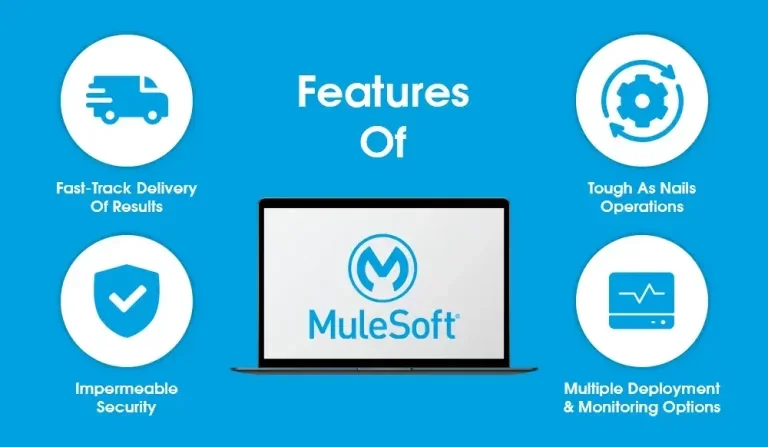
Here is a list of the top features of MuleSoft development software-
This software platform has built-in connectors that enable the business to experience rapid delivery of results in integration projects.
This platform integration offers speed, security, and efficiency that ultimately render reliability. Hence, it will help you make result-oriented business moves at your fingertips.
It offers a plethora of deployment and monitoring options for deploying in different apps and monitoring APIs closely.
It comes with a myriad of security measures and cares for all the governance parameters at all stages of the API lifecycle.
Related Article- Roadmap To Becoming A Certified MuleSoft Platform Architect
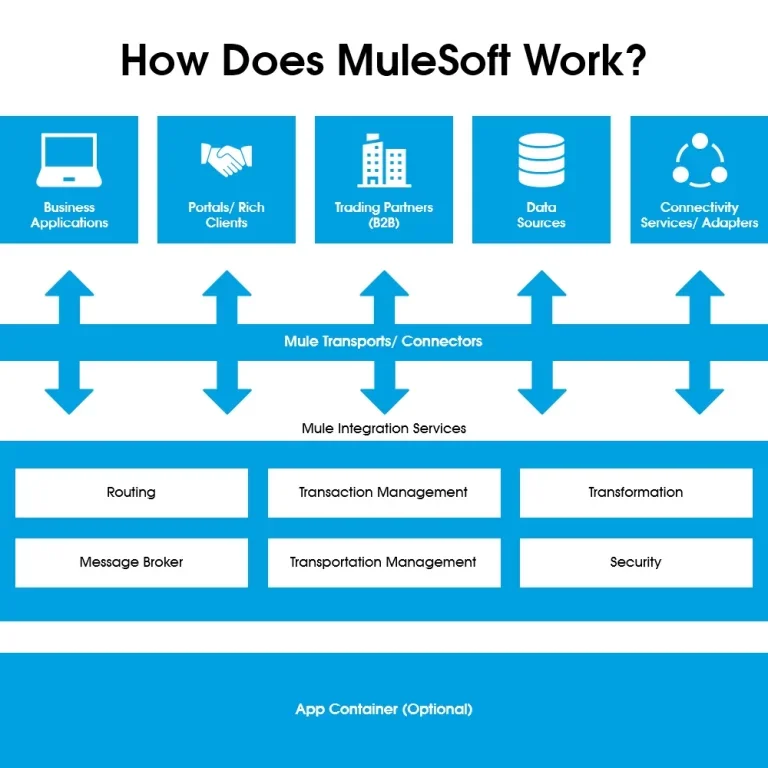
This platform has pre-built APIs for all types of systems and apps. As you place an API, you instantly get a modern way of interacting with the system. Every MuleSoft API is organized in the network and is assigned a different role. Complex process APIs are behind processing the extracted data as well as performing some logic. Experience APIs, on the other hand, work with formatting data that needs to be presented on various media devices such as apps, mobiles, desktops, etc.
The main aim of MuleSoft Anypoint Platform is to simplify API builds and discovery that can accelerate app development and delivery. This single, unified platform is further used for designing, securing, scaling, and building APIs and integrations in various protocols and testing those in many ways.
Read Also- MuleSoft Tutorial For Beginners
In this section, we will explore the key benefits of using this platform. From enhanced integration capabilities to improved efficiency, this platform offers valuable solutions for businesses.
It has multiple pre-built connectors and assets facilitating the quick start of integration projects. After setting a solid foundation, reusing existing APIs will help in further reducing future projects' development time.
The Anypoint Platform has built-in visibility, scalability, and reliability. Anypoint Monitoring, Visualizer, and Analytics components aid in making smarter operational decisions on runtime performance metrics and topology graphs.
Anypoint Platform provides governance and security at various levels of the API lifecycle. Standard security and logging requirements are complied with as the same are applied to all the APIs.
This platform is flexible and built for change. The Anypoint Platform has a plug-and-play architecture and offers versatility.
MuleSoft has expanded beyond traditional integration to become a core part of the "Agentic" enterprise stack. The platform now acts as a secure data and action layer that lets AI agents interact safely with legacy systems and enterprise data.
Key additions include:
This positions MuleSoft not just as an integration platform, but as critical infrastructure for enterprises deploying AI agents securely at scale.
Here are the key limitations of MuleSoft given below:
MuleSoft can be expensive, especially for small and mid-sized organizations. The pricing model is based on cores and usage, which may increase costs significantly as integration volume grows.
Although MuleSoft is powerful, new users often find it complex. Understanding Anypoint Platform, DataWeave, connectors, and deployment models takes time and hands-on experience.
An effective MuleSoft implementation needs trained integration developers. Teams without prior middleware or ESB experience may struggle during initial projects.
Debugging complex integrations can be challenging. Error messages are sometimes not detailed enough, making root cause analysis time-consuming in large flows.
For high-volume or real-time integrations, MuleSoft can introduce latency if not properly designed or tuned, especially when handling complex transformations.
DataWeave is powerful but unique to MuleSoft. Developers must learn and rely on it, which reduces the portability of skills to other integration platforms.
Related Article: Salesforce Tutorial
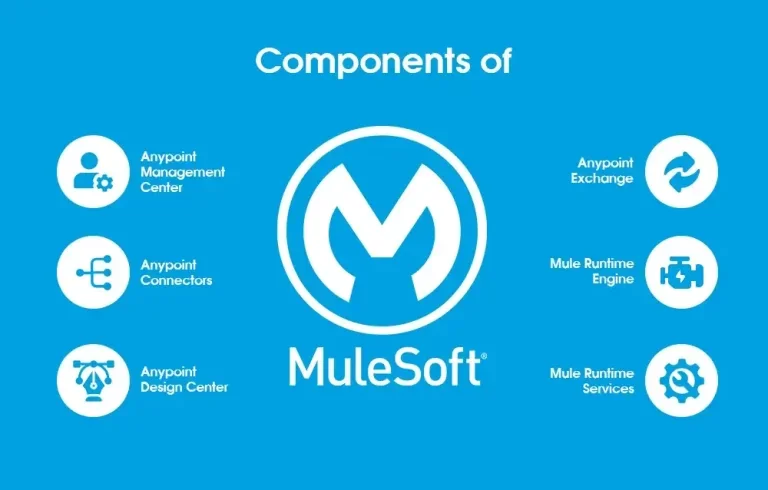
In this section, we will dive into the essential components of MuleSoft. We'll cover how each part contributes to building effective integration solutions.
Anypoint Management Center is a web interface handling API clients, traffic on the platform, SLAs, integration flows, etc. It provides visibility and robust control of APIs and employed applications.
Anypoint Exchange plays the role of a collaborative hub that helps in searching and utilizing private as well as open, pre-built, reusable resources. This library for API providers allows users to share templates, APIs, and assets.
Anypoint Connectors offers a plethora of tools and other ready-made resources for rapid connectivity. Users can draft their personal reusable connector via the Anypoint Connector DevKit software.
Mule Runtime Engine combines efficient data integration capabilities with real-time app orchestration or integration.
Anypoint Design Center offers a syntax-based web ecosystem for designing and documenting APIs. Presenting integration flows, designing APIs, and constructing connectors becomes easy with it.
Mule Runtime Services is a suite of services offering reliability, enterprise-level security, scalability, and high accessibility.
You May Also Read- What is Data Analysis? An Expert Guide With Examples
A MuleSoft Developer is an expert in this software, equipped with key skills and knowledge needed for designing, maintaining, building, managing, and testing APIs and integrations. These professionals play a key role in driving digital transformation initiatives in their company. The aim is to unlock data from systems, deliver capabilities to improve customer experiences, and orchestrate business processes.
MuleSoft for Salesforce developers is a great title to have in the future as the demand for this software platform is constantly rising.
If you wish to become a MuleSoft-certified Developer, then there are certain skills you will need to gain. Here is a list of both technical and soft skills to possess.
Also Read - MuleSoft Integration With Salesforce
Here is a MuleSoft Developer salary (India and the USA). The given figures are approximate industry averages and can vary by company, location, certification level, and project complexity.
| Experience Level | India (Annual Salary) | USA (Annual Salary) |
| Fresher/Entry-Level (0-2 years) | ₹4 LPA - ₹6.5 LPA | $75,000 - $95,000 |
| Mid-Level (3-5 years) | ₹7 LPA - ₹12 LPA | $100,000 - $130,000 |
| Senior Developer (6-8 years) | ₹13 LPA - ₹20 LPA | $135,000 - $160,000 |
| Lead/Architect (9+ years) | ₹22 LPA - ₹35+ LPA | $165,000 - $190,000+ |
Learning MuleSoft is one of the best decisions you can make to enhance your career. Getting a MuleSoft certification is a wise decision for anyone who wants to cement their career in this leading software. If you are thinking about becoming a MuleSoft Developer, then enrolling in the best MuleSoft course is what you should go for today.
Explore These Trending Articles:
Ans. A Mule developer analyzes business, science, engineering, and other data processing problems with the intent of developing and implementing solutions to network concerns, system administration issues, and application problems.
Ans. Yes, MuleSoft can be used as an ETL tool.
Ans. An MS developer earns somewhere between INR 3.9 LPA to INR 10.6 LPA.
Nowadays, most businesses use dozens of different software systems, such as CRM (like Salesforce), ERP, human resources software, and legacy databases. Traditionally, IT teams wrote custom code to connect these systems (point-to-point integration). If one system updates, the connection often breaks. MuleSoft solves this by using a centralized, reusable approach rather than building tangled, one-off connections.