The mobile application development industry is a rapidly growing global market and will exceed $600 billion by 2030. There are various technologies that are powering this innovation and development, where React Native is one prominent choice for cross-platform development. This raises a question among various developers- What is React Native and why to learn it?
React Native is an open-source JavaScript framework for building native mobile applications for iOS and Android. It allows developers to use their existing JavaScript knowledge and the React library to create mobile apps. What makes it different from other programming languages is its single code-based approach.
In this guide to what is React Native, we will explore everything one needs to know about this framework. It includes the core concepts, advantages, disadvantages, real-world applications, and alternatives. Let's begin!
React Native is a popular JavaScript-based mobile app framework that allows developers to build native apps for multiple platforms, such as iOS and Android, using a single codebase. This cross-platform approach streamlines development and maintenance, making it easier and faster to release consistent user experiences across devices. Originally developed by Meta (formerly Facebook), React Native is now widely adopted by major companies like Instagram, Skype and many others. It combines the power of JavaScript with native platform capabilities, enabling high-performance apps with a look and feel close to fully native applications.
Also Explore: A Complete Guide to Learn React Native
Since RN promotes cross-platform development, it's important to know what is cross-platform development. It's a practice wherein the software that's built is compatible on multiple (two or more) hardware platforms. Thus, a cross-platform app can be run on Linux, macOS, Windows, etc. Some perks of cross-platform development are:
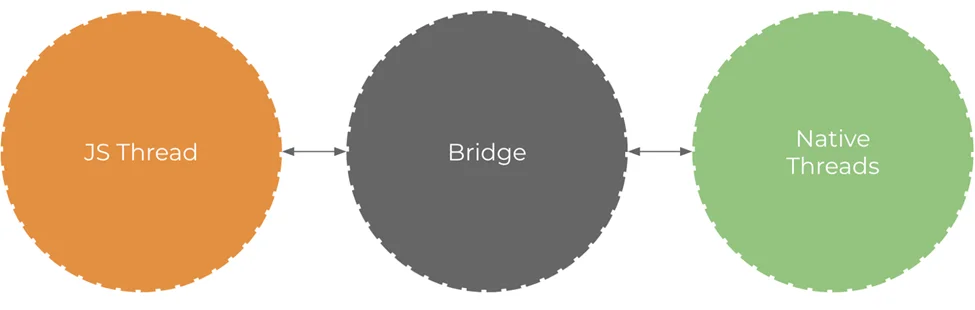
A very common question among those who are just beginning to learn RN is 'how does React Native work'. Here is an explanation of how it works in layman terms.
A mixture of JXL and JavaScript is used to write an RN code. It can communicate seamlessly with existing, native app threads and JS-based threads. This communication happens through a 'bridge'. This bridge facilitates bi-directional communication between these threads, in spite of being written in different languages.
Related Article - React Native Tutorial- A Comprehensive Guide For Beginners
When it comes to what it is used for, there is almost no limitation as to its use cases. It's a great framework that can be employed to build an app for any industry. The cross-platform apps created with RN are developed at a much faster pace, catering to customers easily and rapidly. Some top names that have used RN for their mobile app are:
The list of pros of RN is quite lengthy. It entails some significant features that help developers in building a brilliant, cross-platform mobile app.
React Native helps you build and launch a Minimum Viable Product (MVP) quickly for initial market testing. For instance, a car insurance company we worked with wanted an MVP for their new app idea, and we got it done in just 6 weeks. This allowed them to make informed choices for their business.
By creating a cross-platform app using one codebase, you don't have to worry about different teams or too much customization for each platform. This helps offer a consistent experience that feels almost like a native app on all devices.
One big reason React Native is so popular is its strong developer community. It's great for sharing knowledge, finding resources, and creating new tools. If you're looking to grow your team, it's also a good place to find talent.
CTOs often need to bring new solutions into their current systems. React Native works well with native code and is compatible with lots of third-party libraries and plugins, making integration straightforward.
There are certain cons of RN that must be kept in mind while learning this framework. These are also influential when a project is being built with it.
React Native works well for a lot of apps, but it doesn't match the performance of fully native apps, especially when dealing with heavy tasks like gaming or real-time data processing. This is mainly because it can't tap into some device-specific features directly, especially when using the JavaScript bridge. That said, things like the Hermes engine can help improve the performance of React Native apps.
This framework can struggle with complex user interfaces or detailed animations, especially in apps that need pixel-perfect designs. If precision is key, sticking with native development might be a better choice, since it gives you more control over how things are rendered. Tools like React Native, Reanimated, and Lottie can support animation rendering.
Keeping React Native up to date can be tricky, especially for bigger apps that have a lot of dependencies.
Debugging React Native apps can be tougher than working with fully native code. The interaction between JavaScript and the native platform adds layers that can complicate things. Sometimes, native crashes don't show up in JavaScript logs, making them harder to pinpoint without familiarity with tools like Xcode or Android Studio. Programs like Flipper and Sentry can help out with debugging in React Native.
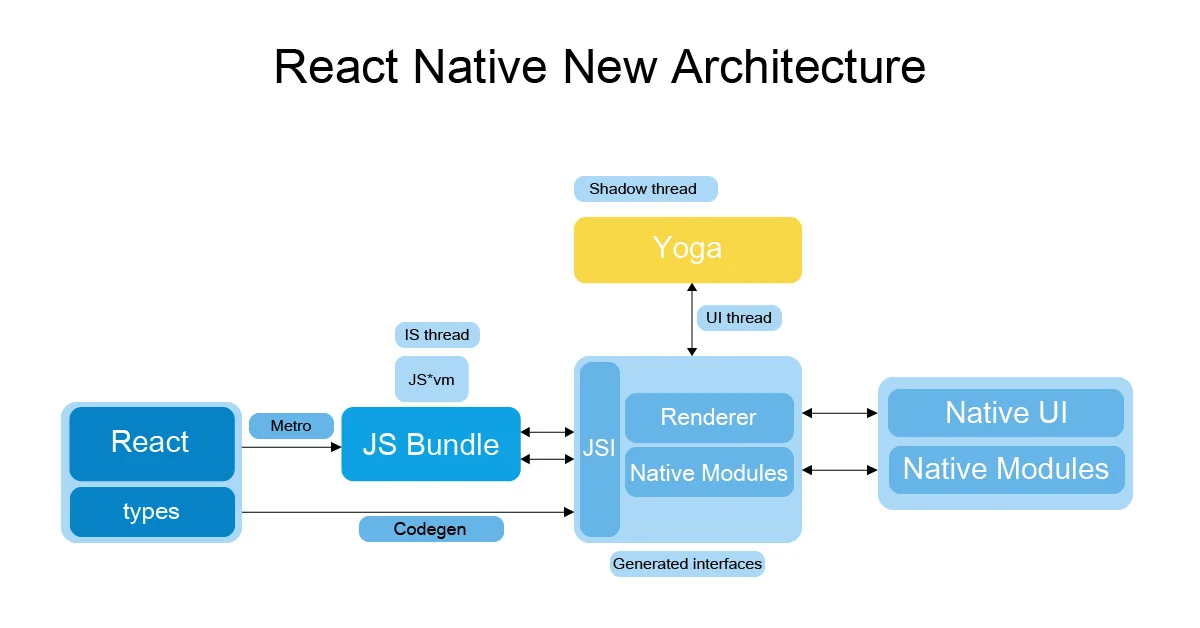
React Native has evolved significantly over the years, especially in how it handles communication between JavaScript and native components. Earlier versions relied on a bridge-based architecture, which worked well but introduced performance limitations in complex applications.
The old architecture used an asynchronous JavaScript Bridge to communicate with native modules. While functional, this bridge could become a bottleneck in apps with heavy UI updates or complex logic.
To address this, React Native introduced a New Architecture, built around Fabric and TurboModules. Fabric improves how UI components are rendered by enabling synchronous communication, while TurboModules make native module loading faster and more efficient.
Together, this new architecture delivers better performance, improved concurrency, smoother animations, and faster startup times, making React Native more suitable for modern, large-scale mobile applications.
Here is a side-by-side comparison of React vs React Native. This comparison is to clear out how RN native stands different from React.js.
| React | React Native |
| React is a JavaScript (JS) library. | RN is a JS-based framework. |
| It was released in 2013. | It was released in 2015. |
| It's used for front-end web development. | It's used for mobile app development. |
| It employs JS library & CSS for animations. | It has various built-in animation libraries. |
| It makes use of HTML tags. | HTML tags are not used. |
| There is a high level security. | The security here is lower as compared to ReactJS. |
| A React router is used to navigate through web pages. | There's an in-built navigator library to navigate through mobile apps. |
| Code components are used. This saves time. | RN UI modules and components can be reused. |
Related Article: React Native Interview Questions
Despite React Native being an all-in-one solution for developers to share code across multiple platforms along with enjoying its native app performance. However, this section is perfect for people looking for a different solution for their next project. Here are some best alternatives for React Native.
NativeScript is known as an open framework for the development of mobile applications with TypeScript or JavaScript. Unlike React Native, this platform offers direct access to native APIs. This enables users to develop native apps for Android and IOS. Widely used by tech companies to develop robust mobile applications with high performance.
This platform is ideal for complex projects that require deep hardware-level access. The fact that it does not need a web-based bridge is what distinguishes it from other platforms. Users can work with native UI components while coding in Angular, JavaScript or TypeScript.
Features
Another open platform, known for developing progressive applications for platforms like Windows, Android, and IOS. It has a user-friendly interface and, ability to easily integrate with Microsoft's IDE and Visual Studio. Developers can reuse the same codebase and they are not required to recall the syntax.
Features
This open-source toolbox gained popularity for its ability to build user interfaces. It's especially curated to develop desktop, web and mobile applications with shared code. It's simple to develop apps for Android, web or IOS as this platform uses the Dart programming language. It also allows developers to run code across different platforms and devices.
With its hot reload feature, the development process speeds up and displays updates on the screen immediately. AOT compilation is used during the launch of apps to ensure a seamless run for both IOS and Android.
Features
Kotlin Multi Platform is a feature of Kotlin that allows developers to share common code - such as business logic, data models, or utility functions - across platforms like Android, iOS, web, and desktop.
Unlike other cross-platform frameworks (e.g., Flutter, React Native), KMM doesn't aim to create a unified user interface. Instead, it focuses on sharing the core logic while leaving the user interface and platform-specific functionalities to be developed natively.
Also Read: DevOps Interview Questions with Answers
React Native is widely adopted across industries because it allows companies to build scalable, high-performance mobile applications. Many globally recognized brands rely on React Native to deliver consistent experiences across Android and iOS. Below are some practical use cases along with real application examples.
React Native is a top choice for startups building Minimum Viable Products (MVPs). It allows teams to launch apps quickly using a single codebase, validate ideas faster, and iterate based on user feedback without heavy development costs.
Examples of apps:
E-commerce apps benefit from React Native’s ability to deliver smooth navigation, consistent UI, and faster feature rollouts. Features such as product listings, carts, payments, and user profiles work efficiently across platforms.
Examples of apps:
Apps that rely heavily on feeds, media rendering, and real-time updates perform well with React Native. Its component-based architecture makes it ideal for handling dynamic content and frequent UI updates.
Examples of apps:
React Native is commonly used for enterprise-grade applications such as dashboards, internal tools, CRM systems, and employee portals. These apps often require cross-platform compatibility and frequent updates.
Examples of apps:
On-demand platforms need fast performance, real-time tracking, and regular feature updates. React Native enables these apps to maintain consistency while reducing development time.
Examples of apps:
React Native is frequently used for FinTech utilities, customer dashboards, and support applications where UI performance is important but extreme hardware optimization is not critical.
Examples of apps:
Read Also: How To Become A React Native Developer
Here is the salary payout
| Experience Level | United States (Annual) | India (Annual) |
| Entry-Level (0-2 yrs) | $75,000 - $93,000 (nextnative.dev) | ₹7,20,000 - ₹10,00,000 (Cutshort) |
| Mid-Level (3-5 yrs) | $115,000 - $137,000 (nextnative.dev) | ₹11,00,000 - ₹16,00,000 (Cutshort) |
| Senior (6+ yrs) | $155,000 - $191,500 (nextnative.dev) | ₹15,00,000 - ₹24,00,000 (Cutshort) |
| Lead/Staff (10+ yrs) | $190,000+ (nextnative.dev) | ₹20,00,000+ (approx) (Cutshort) |
RN is a brilliant solution to create apps that run smoothly on all systems and platforms. It's a widely preferred framework by many developers and businesses. It's a great way to save many hours of work, which leads to cost-efficiency and faster development. Many amazing apps have been created with it to date and that showcases how good it is. Learning RN as the next framework is a great choice for those who are interested in enjoying a career as a developer. Get the basics with this blog on 'what is React Native' and move ahead to ace it completely.
Explore These Trending Articles:
It is mainly used for building natively rendered mobile phone apps. It's used for building cross-functional apps via a single codebase.
It is the best fit for UI-focused front-ends that play an important role in delivering a high-end experience.
Learning RN is not an easy walk. It will take some time to learn it and then a long time to perfect its implementation. Good practice is the key to learning this framework.
RN uses concepts of React and JS to build native mobile apps. Thus, having knowledge of the latter two can make it easy to learn RN.
Course Schedule
| Course Name | Batch Type | Details |
| React Native Training | Every Weekday | View Details |
| React Native Training | Every Weekend | View Details |