Choosing the right one among the best programming languages can shape your career opportunities and skill growth in the long run. With the new technology trends, new tools and frameworks are appearing while existing coding or programming languages gain fresh updates and wider adoption. No matter if you are interested in data science, artificial intelligence, software development, web development or systems programming, the language you learn can open specific doors of opportunities.
According to the TIOBE Index, languages like Python, C++, Java, and C continue to rank among the most popular programming languages worldwide, reflecting their strong industry demand and widespread adoption.
Some languages are known for speed and performance, others for versatility and ease of use, and a few for their dominance in specialized fields. What this really means is that the best choice depends not only on trends but also on your goals. Still, certain languages stand out because they're in high demand, backed by strong communities, and widely used in industries that are growing fast.
Let's break down the top programming languages worth learning in 2026 and why they matter.
If you have prior knowledge, then you must already know this, but many beginners don't. So, here are the types of programming languages you must know about-
| Programming Language | Primary Use | Difficulty | Best For |
|---|---|---|---|
| Python | AI, Data Science, Automation, Web Development | Beginner | Beginners, Data Scientists, ML Engineers |
| JavaScript | Front-end & Back-end Web Development | Beginner | Web Developers |
| PHP | Server-side Web Development | Beginner | Backend Developers |
| Kotlin | Android Development | Intermediate | Android Developers |
| Swift | iOS & macOS Development | Intermediate | Apple App Developers |
| Go (Golang) | Cloud Computing & Backend Services | Intermediate | Cloud & DevOps Engineers |
| Rust | Systems Programming | Advanced | Systems & Security Engineers |
| Java | Enterprise Applications & Android | Intermediate | Enterprise Developers |
| C | Operating Systems & Embedded Systems | Intermediate | Systems Programmers |
| Ruby | Web Development | Beginner | Full-stack Developers |
| Vala | GNOME Desktop Applications | Intermediate | Linux Developers |
| Julia | Scientific Computing & Data Science | Intermediate | Researchers & Data Scientists |
| Perl | System Administration & Text Processing | Intermediate | System Administrators |
| TypeScript | Large-scale Web Applications | Intermediate | Frontend & Full-stack Developers |
| HTML/CSS | Web Page Structure & Styling | Beginner | Web Designers & Frontend Developers |
| Razor | ASP.NET Web Applications | Intermediate | .NET Developers |
| Elixir | Distributed & Concurrent Applications | Advanced | Backend Engineers |
| Svelte | Modern Front-end Development | Beginner | Frontend Developers |
| Hack | Large-scale PHP Applications | Intermediate | PHP Developers |
| Dart | Cross-platform App Development (Flutter) | Beginner | Flutter Developers |
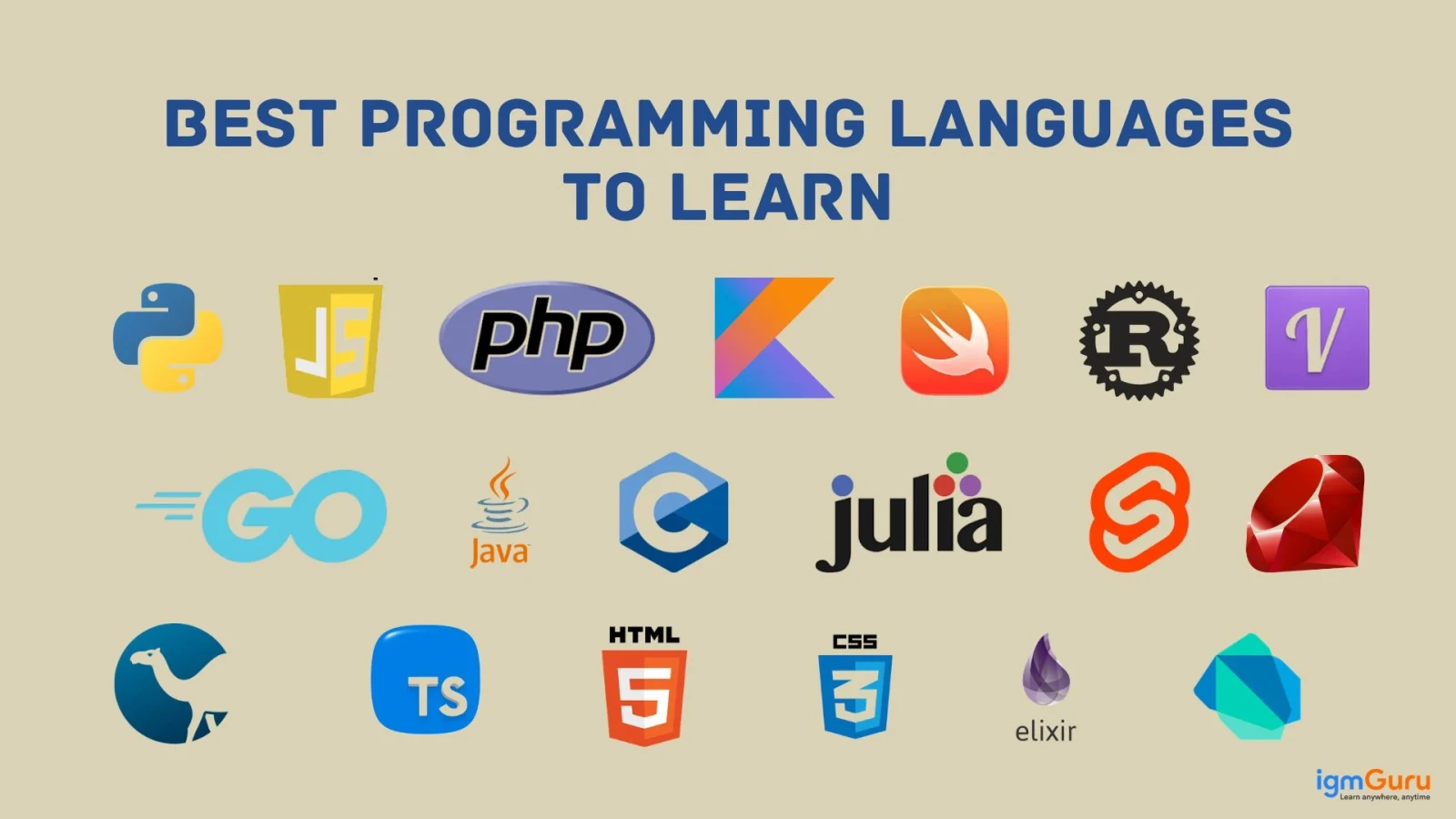
Building a career as a successful software developer is the dream of every individual. With the most in-demand coding languages, one can unlock opportunities in diverse industries, create innovative web, desktop and mobile apps, and stay relevant in the ever-evolving tech landscape. Here are the most in-demand programming languages you can choose based on your interests.
A significant name in the fields of artificial intelligence and data science is Python. This programming language is taking the world by storm due to its never-ending benefits. It has a simple English-like syntax, making it an apt first language for beginners.
It has various libraries such as Matplotlib, Pandas, and NumPy, all of which provide powerful data visualization and analysis capabilities. This makes it a highly valuable tool for all data scientists. Python is easily implementable in projects as it is full of libraries and frameworks.
This language is usually used for data science, web development, automation and machine learning applications.
Enroll in igmGuru's Python Training Online to start your career as a Python developer.
There is an ever-increasing demand and need for dynamic web applications. To make that happen, you must learn JavaScript (JS). It is one of those programming languages that are in demand and will continue to be as long as dynamic web apps are needed. Stack Overflow's 2023 Developer's Survey has ruled that JS is still the most chosen language among developers and has held the place for 11 years consecutively.
It is used for front-end development, server-side scripting, game development and mobile applications.
PHP is used globally for server-side scripting and web development, making it one of the favorites among developers. This open-source language provides developers with various tools for building efficient and scalable web apps. It is highly compatible with databases like PostgreSQL and MySQL.
It is also easy to use and due to Java and C-like syntax, these programmers find it easy to learn PHP. With its plethora of frameworks and libraries like Symfony and Laravel, there is no doubt about its continued popularity in the coming years too.
This language is majorly used for web applications, strong content generation and backend server development.
Kotlin has become a popular name among developers invested in Android app development. Developed by JetBrains, it was made with the key purpose of making Android app development a more efficient and faster process. Due to its concise syntax, developers have to write less code than Java, which plays in its favor.
This language is commonly used for Android development and web development with the JVM.
Related Article- How To Learn Coding
The language that has become a favorite for macOS and iOS development is Swift. While there are plenty of reasons for the same, it is mainly because of its user-friendly syntax, high compatibility with Objective-C, and efficiency.
It is developed by Apple and ensures a robust and modern development experience for developers building apps on the iOS platform.
This Apple's modern programming language is used for iOS and macOS application development.
Developed by Google, Go is a low-level language apt for engineers looking to step into the arena of systems programming. With functionality very similar to C++ and C but without the roadblocks of a steep learning curve and difficult syntax.
Go is also deemed as a key language to build data pipelines, machine learning packages, and web servers.
Go is usually used for cloud computing, web servers and distributed systems.
Go through igmGuru's Golang Training Course to leverage extensive course content.
Rust has also been tagged as a favorite among developers who are already using it. In fact, more than 80% of Rust developers say they do not intend to switch. It is a low-level programming language that adds great security and speed to the process of development.
It has a plethora of advantages, which makes it an often-used language by big names like Coursera and Dropbox.
This language is usually used for systems programming, web assembly and applications requiring high security and performance.
Java is a popular name in the field of enterprise application development. It has cross-platform compatibility, along with extensive frameworks and libraries like Hibernate and Spring. Thus, the development process becomes much faster and easier.
It is also widely used for Android development. Hence, as more mobile devices are being used, the demand for Java is growing too.
This language is commonly used for Android development, enterprise applications and server-side applications.
C programming is a foundational first-generation language that provides direct access to hardware. This makes it suitable for system programming. It is also one of the most popular languages due to its simple syntax and strong features, which make it suitable for operating systems and submerging systems.
C is usually used for operating systems, embedded systems and high-performance applications.
Read Also- Top 8 Frontend Languages To Learn
This language is easy to learn, as it is a strongly typed language that concentrates on simplicity and productivity. Ruby is famous for its role in web development, especially with the Ruby on Rails framework. Its core philosophy focuses on programmer productivity, simplicity, and fun. This is why its syntax is reads very closely to standard English
Ruby is usually used for web development and scripting applications.
Vala is designed to bring modern software features to developers on the GNOME platform without introducing extra runtime overhead. It features a syntax heavily inspired by C# and Java, but instead of executing inside a virtual machine, it compiles directly into standard C code. The goal is to offer a modern syntax and features while maintaining performance identical to C.
It is usually used for GNOME desktop applications and utilities.
Julia is a high-level, high-performance language especially for scientific computing and data analysis. It merges the ease of use with speed, which makes it ideal for computationally intensive tasks. It is designed to solve the "two-language problem" in technical and scientific computing.
Traditionally, researchers and data scientists prototype algorithms in a slow, user-friendly language like Python or MATLAB. If they need the program to run faster, engineers must completely rewrite that code in a fast, low-level language like C++. Julia eliminates this need by being both fast and easy from the start.
It is usually used for data science, machine learning and scientific computing.
Perl is a dynamic programming language originally developed by Larry Wall in 1987. It was initially designed specifically for advanced text processing and manipulation. Over the decades, it has evolved into a robust tool widely used for system administration, web development, network programming and GUI creation.
This language is usually used for web development, system administration and network programming.
TypeScript is another open-source programming language developed by Microsoft that builds directly on top of JavaScript. It is a strict "syntactical superset" of JavaScript, meaning that any valid JavaScript code is also valid TypeScript code. It provides optional static typing, which makes code more predictable and easier to debug during compilation.
This language is usually used for extensive web applications, especially when complicated and scalable codebases are needed.
Hypertext Markup Language (HTML) and Cascading Style Sheets (CSS) are the base languages of web content. HTML makes content, whereas CSS styles it, developing visually engaged and organized web pages. All the visual effects on websites, like popups, appealing headings and texts, and banners, are somehow designed using these programming languages.
These languages are used for building static web pages, structuring user interfaces and making sure of responsive designs.
Read Also- Tableau MCQs
Razor is a server-side templating and markup syntax used to embed C# code directly into HTML web pages. It is a Microsoft product as a core component of the ASP.NET and .NET web frameworks. It allows developers to build dynamic, data-driven web pages that process code on the server before sending the final HTML to the user's browser. It simplifies the making of web pages by providing flawless server-side and client-side integration.
It is used for making powerful, interactive and data-driven web applications in the .NET ecosystem.
Elixir is a functional programming language known for building highly scalable, maintainable, and fault-tolerant applications. It was created by José Valim and released in 2012. It can compile to bytecode and runs on the battle-tested Erlang VM (BEAM) that combines an approachable, Ruby-inspired syntax with industrial-grade reliability.
It is used for high-concurrency applications like messaging apps, financial systems and IoT devices.
Svelte is a modern JavaScript framework and compiler used for building highly interactive user interfaces and web applications. Unlike traditional frontend frameworks like React or Vue, which do the bulk of their work in the browser while the application is running, Svelte shifts that work into a compile step that happens when you build your application.
This language is used for building high-performance, fast-loading and interactive web applications.
This language was made by Meta (formerly Facebook) to solve the major scalability challenges due to the enormous codebase. Hack provides a mixture of static and strong typing to make PHP stronger while managing compatibility with the given PHP codebases. It brings the safety and predictability of static typing to PHP developers and also ensures their web applications will run with high performance
This language is mainly used for web development, particularly for a wide range of PHP applications which benefit from a more structured and performant habitat.
Dart is a class-based programming language developed by Google. It is specifically optimized for client development to build fast, high-performance user interfaces across mobile, web, and desktop platforms from a single codebase. Dart gives power to the Flutter platform, allowing cross-platform development with one codebase.
This language is usually used for mobile application development, web applications and server applications.
Read Also- Top Backend Languages To Learn
While we cannot tell you which coding language is the best for you, we can certainly segregate these languages based on the profession using them. The given table shows who should learn what language to become proficient in their domain.
| Programming Language | Front-end Web Developer | Back-end Web Developer | Mobile Developer | Game Developer | Desktop Application Developer | Systems Programmer |
| JavaScript | ✓ | ✓ | ✓ | - | ✓ | - |
| Python | - | ✓ | ✓ | ✓ | ✓ | - |
| React | ✓ | - | - | - | - | - |
| VueJS | ✓ | - | - | - | - | - |
| Angular | ✓ | - | - | - | - | - |
| Ruby on Rails | - | ✓ | - | - | - | - |
| PHP | - | ✓ | - | - | ✓ | - |
| C# | - | ✓ | - | - | ✓ | - |
| Java | - | - | ✓ | - | - | - |
| Swift | - | - | ✓ | - | - | ✓ |
| Rust | - | - | - | ✓ | - | ✓ |
| Unity | - | - | - | ✓ | - | - |
| Go | - | - | - | - | - | ✓ |
| Zig | - | - | - | - | - | ✓ |
The in-demand programming languages mentioned above are highly likely to enjoy their reigning status in the coming year too. Whether you are a fresher looking for the right programming language to begin with or you are a professional who wants to keep themselves updated, these languages should be your go-to. 2026 will be the year where you enjoy exceptional growth in the programming field. All you need to do is get started with the right coding language.
Ans. Python is a leading language for coding, followed by PHP, C, and C#.
Ans. Whether learning coding is hard or easy depends on your prior knowledge, experience, and zest to learn. Also, some languages like Python and Go have easy syntax, making them easier to learn.
Ans. Basic math skills such as geometry and algebra are needed while coding.
Course Schedule
| Course Name | Batch Type | Details |
| Programming Courses | Every Weekday | View Details |
| Programming Courses | Every Weekend | View Details |