Salesforce has been dominating the CRM (Customer Relationship Management) market consistently for the last 12 years. Businesses have seen a massive growth in development in their ecosystem with robust tools, apps and solutions. Want to know more about it to ponder the question- why? There are many reasons, including Salesforce features, benefits, capabilities, etc., to use this CRM.
This blog explains the top Salesforce features and benefits to help you understand why it is so popular and how it can benefit your career. It will help you to uncover the true capabilities of Salesforce. Let's begin with understanding Salesforce.
What is Salesforce?
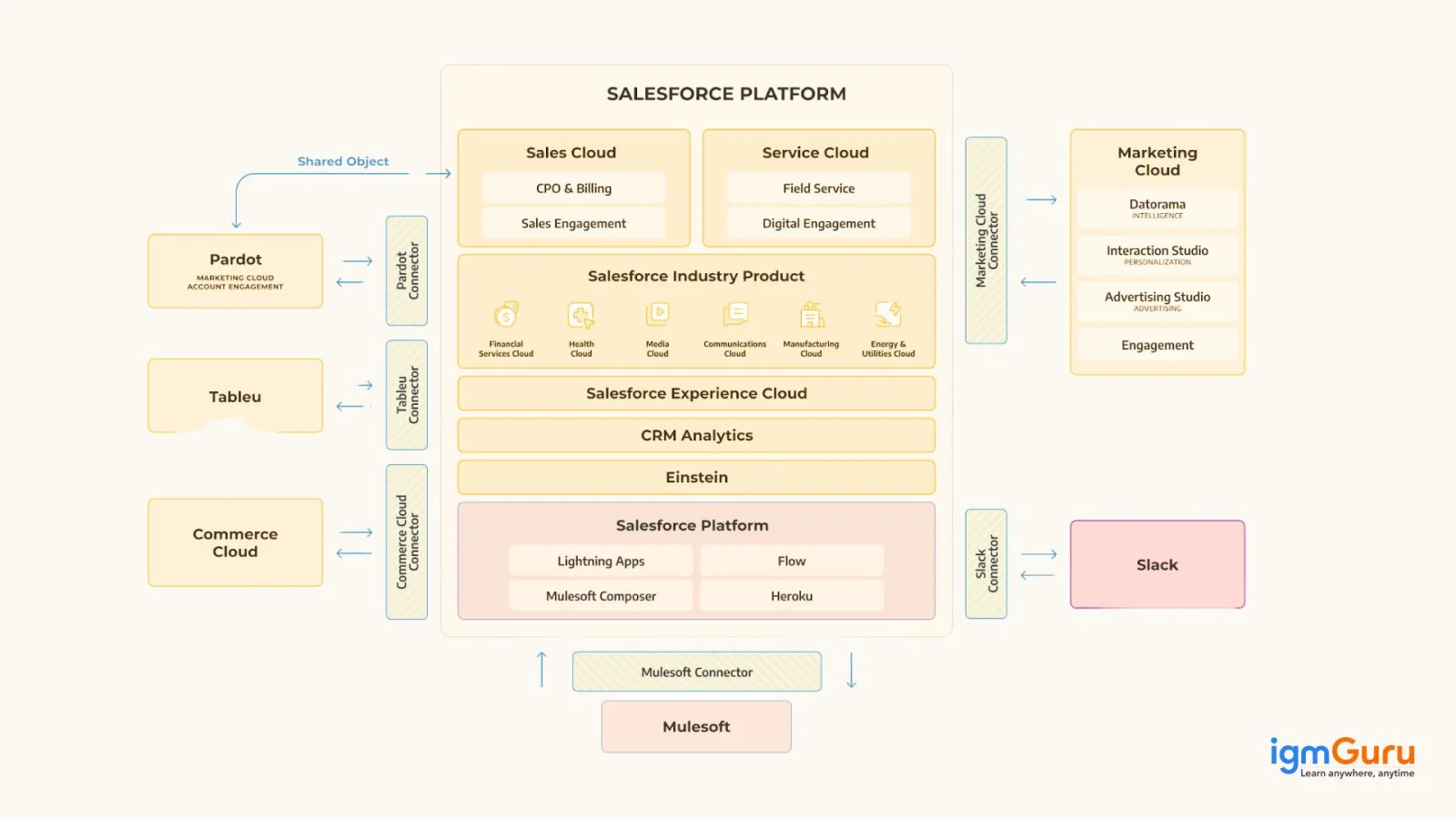
Salesforce is an online customer relationship management platform that helps businesses manage and improve their customer relationships. It provides a central hub for sales, service, marketing and other teams to collaborate and track customer interactions.
It comes with an extensive ecosystem with a variety of applications and tools, including sales automation, customer service management and marketing automation. All these applications work together to streamline business processes and enhance customer relationships.
Salesforce is ranked as the #1 platform with 20% of market share in the CRM industry. Today, it is trusted among the top 150,000 companies to manage their sales processes, customer relationships and data.
Enroll in igmGuru's Salesforce Developer Training program to learn Salesforce.
Top Salesforce Features
Salesforce is famous for its features that improve various aspects of customer relationship management, business operations, and sales. Let's explore Salesforce features in depth-
1. Opportunity Management
It gives sales teams complete visibility into every deal. It simplifies sales tracking, improves forecasting accuracy, and helps teams close deals faster. Here are the key features:
- Customizable Stages: Businesses can personalize the sales stages in Salesforce to meet the unique sales processes followed by them. This personalization ensures that Salesforce aligns perfectly with the set requirements and workflows of every organization.
- Deal Tracking: Opportunity Management in Salesforce facilitates users to easily track sales deals throughout the steps. It offers insight into each stage of the sales pipeline, such as potential revenue, expected close dates and stages. This aids sales teams in managing and prioritizing their opportunities.
- Opportunity Insights: Salesforce provides detailed analytics and insights on opportunities. This includes potential revenue and the probability of closure. This knowledge aids sales teams in making informed decisions and strategizing effectively.
2. Salesforce Engage
Salesforce Engage helps sales teams connect with leads and customers in real time through personalized communication. It bridges the gap between sales and marketing to ensure a seamless customer experience. Here are the key features:
- Real-Time Notifications: Users get real-time notifications as leads try to interact with their content or emails. This uninterrupted feedback facilitates timely engagement and follow-up, improving the impact of sales efforts.
- Personalized Engagement: Salesforce Engage enables sales teams to effectively send personalized content and emails to prospects and leads. It aids in nurturing relationships as well as driving engagement via customized communication. This leads to heightened chances of conversion.
- Marketing Integration: Salesforce Engage integrates seamlessly with marketing automation tools. This integration guarantees that marketing and sales efforts are always aligned. It also facilitates seamless data sharing and communication between teams.
3. Sales Collaboration
Sales Collaboration in Salesforce promotes teamwork and transparency by centralizing communication across departments. It ensures all team members stay aligned on goals, updates, and opportunities. Here are the key features:
- Group Discussions: Teams can easily create groups for specific topics or projects. Hence, promoting easy access to relevant information and focused discussions. This aids in organizing conversations and aligning team members.
- Chatter Integration: Salesforce Chatter is a highly esteemed collaboration tool that improves team communication. This is done by prompting users to share documents, insights and updates in real-time. This breeds a collaborative environment wherein team members can always stay engaged and informed.
- Record-Level Collaboration: Collaboration is directly possible within Salesforce records, such as accounts and opportunities. This is context-specific communication and ensures that all intended members are a part of the updates and discussions.
4. Lead Management
Salesforce’s Lead Management system helps businesses efficiently capture, track, and nurture leads through every stage of the sales funnel. It ensures no potential opportunity is missed. Here are the key features:
- Lead Scoring & Assignment: This is one of the best key features of Salesforce. Leads can be scored as per the criteria like potential and engagement. It is then assigned to apt sales representatives. This prioritization diverts focus towards efforts on high-quality leads, enhancing conversion rates.
- Lead Capture & Tracking: Salesforce easily captures leads from multiple sources, like social media, email campaigns and web forms. This lead management system renders no potential lead overlooked, effectively tracking all leads.
- Lead Nurturing: Salesforce has automated lead nurturing processes, such as follow-ups and personalized communication. It accelerates the conversion process and enhances lead engagement.
5. Workflow and Approvals
Businesses streamline operations by automating repetitive tasks and standardizing processes. This ensures smoother operations and faster approvals. Here are the key features:
- Custom Approval Processes: Salesforce allows businesses to design tailored approval workflows as per their specific requirements. This streamlines approvals and improves operational efficiency.
- Automated Workflows: Salesforce automates major business workflows, like task assignments and approval processes. Automation minimizes manual effort and guarantees consistent and efficient processes.
- Process Automation: Routine tasks are automated to leave time for sales experts to divert focus towards more strategic activities.
Related Article- Salesforce Admin Vs Developer- A Detailed Comparison
6. Sales Forecasting
Sales Forecasting in Salesforce helps businesses predict revenue trends and monitor sales performance with accuracy. It empowers leaders to make data-driven decisions for growth. Here are the key features:
- Customizable Forecasts: Users can personalize forecasts as per the organizational needs and sales processes. This provides actionable insights.
- Accurate Forecasting: Salesforce presents advanced-level forecasting tools offering accurate sales predictions as per current opportunities, sales trends and historical data.
- Forecasting Analytics: In-depth analytics on forecast performance, like pipeline accuracy and health, facilitate businesses to optimize and assess their sales strategies.
7. Reports & Dashboards
Salesforce Reports and Dashboards offer real-time visibility into performance metrics and KPIs. They help organizations make informed decisions quickly using clear visual insights. Here are the key features:
- Interactive Dashboards: Interactive dashboards help visualize key performance indicators and metrics, offering real-time insights about business performance. Dashboards are customizable and shareable for effective decision-making.
- Customizable Reports: Salesforce offers powerful reporting tools that enable users to curate detailed reports on multiple sales and business performance aspects. Reports are customizable as per specific requirements and needs.
- Data Analysis: Salesforce enables in-depth data analysis. It aids businesses in tracking performance, making data-driven decisions and identifying trends.
8. Email Integration
Salesforce’s Email Integration connects CRM capabilities with your email system, enabling smoother communication and easier tracking of client interactions. Here are the key features:
- Email Templates: Users can seamlessly create and use email templates to maintain efficient and consistent communication. Templates can also be automated and personalized for more effectiveness.
- Email Tracking: Salesforce integrates well with email platforms to help track email engagement and interactions. This offers insights about how contacts and leads are responding to communications.
- Integration with Email Clients: Salesforce flawlessly integrates with other popular email clients, like Gmail to ensure seamless email management with Salesforce data.
9. Territory Management
Salesforce’s Territory Management feature allows organizations to allocate sales territories strategically to improve coverage and efficiency. Here are the key features:
- Territory Planning: Tools for optimizing and planning sales territories make sure resources are efficiently allocated with maximized sales coverage.
- Territory Assignment: Salesforce promotes the assignment of sales territories as per criteria like industry, account size, or geography. This improves the organization and management of sales efforts.
- Performance Tracking: Salesforce traces different sales territories' performance. Hence, it renders insights into sales outcomes and activities in different regions.
10. Partner Management
Salesforce Partner Management helps businesses strengthen relationships with partners, resellers, and distributors by providing tools for collaboration and performance tracking. Here are the key features:
- Partner Portal: It offers a segregated space so partners can submit leads, track their performance and access resources. This improves collaboration and communication with partners.
- Partner Relationship Management: Salesforce presents tools to manage partner relationships. These include training, collaboration and onboarding. This gives a push to effective partner engagement and improves partner performance.
- Partner Analytics: Salesforce offers reporting and analytics on partner performance. It aids businesses in assessing their partner programs' effectiveness and identifying areas for improvement.
Related Article- Top Salesforce Careers to Look For in 2026
Top Benefits of Using Salesforce
There are a variety of benefits you can get from using Salesforce. Let's explore some of the most them:
1. Real-Time Analytics and Reporting
Salesforce offers real-time analytics and reporting capabilities through its built-in reports and dashboards. These benefits allow businesses to access and analyze data as it is entered. This enables them to react to changes quickly and make informed decisions accordingly.
2. Secure Collaboration and Data Sharing
Salesforce provides strong authentication, layered access controls and encryption. With these features, administrators can fine-tune record visibility and sharing settings at different levels, including organization, object, field and record. This helps them balance collaboration and security.
3. Centralized Data Storage and Management
Salesforce provides the capability of consolidating the entire data of an organization into a single identity. All this data is managed by a central authority that ensures data integrity and avoids silos and inconsistencies. It helps to efficiently manage customer data, sales processes and interactions.
Salesforce provides different tools for development, customization and deployment of applications for different business requirements. Enterprise can create customizable user interfaces, workflows, objects, fields, etc. It also provides easy-to-implement automation capabilities with low-code or no-code development tools.
5. AppExchange
AppExchange is a unified platform where enterprises can find all the applications provided by Salesforce. It includes almost 4,500 third-party applications as well as Salesforce products. All of these applications are tested to cater to different requirements. Therefore, anyone can trust on these applications for their business uses.
Conclusion
Well, Salesforce is known for its wide functionalities and it's being used for many reasons. The discussed Salesforce features play an important role in enhancing customer relationship management and empowering businesses to streamline operations.
Related Articles
FAQs For Salesforce Features
Q1. What are the 5 cores of Salesforce?
Innovation, Equality, Trust, Customer Success and Sustainability are the five cores of this platform.
Q2. What is Salesforce used for?
Salesforce is used as a CRM platform that helps enterprises track sales leads, manage customer interactions and automate their business processes.
Q3. What is Salesforce best for?
Salesforce is one of the best platforms to manage sales, commerce, marketing, service and IT.
Course Schedule


