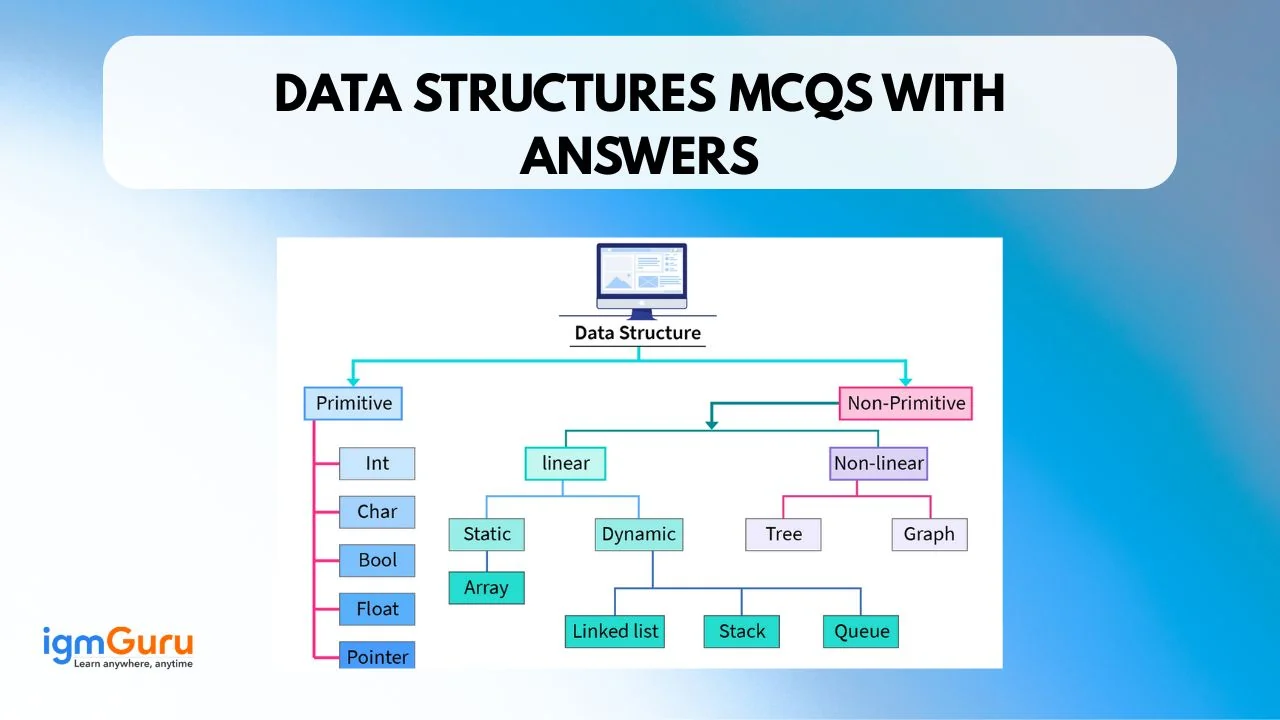
Preparing for data structures interviews or exams? This Top Data Structures MCQs collection is your ultimate practice resource. Questions are organized by topic for focused study, test your knowledge, identify gaps, and improve quickly.
Note: Score 60% or higher to unlock an exclusive offer of up to 50% off on all self-paced Excel course.
Let's begin!
1. What is the primary purpose of a data structure?
2. Which of the following is a linear data structure?
3. Which data structure uses FIFO order?
4. Which data structure uses LIFO order?
5. Which operation does not belong to basic queue operations?
6. What is the time complexity to access an element by index in an array?
7. Which data structure is best for implementing recursion explicitly?
8. Which of these is NOT a characteristic of linked lists?
9. What is the drawback of singly linked list compared to arrays?
10. Which of these is an advantage of arrays over linked lists?
11. What is a circular queue useful for?
12. Which operation in a stack would be used to implement function calls?
13. What is the time complexity to push or pop from a stack implemented with a linked list?
14. Which queue variant supports priority-based removal?
15. A deque allows insertion and deletion at:
16. Which data structure is commonly used to check balanced parentheses?
17. Which operation does NOT belong to stack ADT?
18. Which of these can be implemented using two stacks?
19. In a binary tree, each node can have at most how many children?
20. Which traversal order gives nodes in non-decreasing order for a BST?
21. What property defines a binary search tree (BST)?
22. What is the height of a tree with a single node?
23. Which tree is self-balancing by rotations on insert/delete?
24. Which traversal is used to delete a tree safely (post-order deletes children before parent)?
25. Which data structure is most suitable to implement a priority queue?
26. What is the heap property for a max-heap?
27. What is the time complexity to extract the maximum element from a binary heap of size n?
28. How is a binary heap commonly stored in memory?
29. Which sorting algorithm can be implemented efficiently using a heap?
30. What is the worst-case time complexity to build a heap from an unsorted array (using optimal build-heap)?
31. What does a hash function do in a hash table?
32. What is a common method to resolve collisions in hash tables?
33. What is the average-time complexity for search/insert/delete in a well-implemented hash table?
34. Which load factor indicates when many hash table implementations resize the table?
35. Which of these is NOT a collision resolution technique?
36. Which data structure commonly represents a sparse graph efficiently?
37. Which traversal algorithm uses a queue to explore level by level?
38. What is the typical time complexity of BFS on a graph with V vertices and E edges (adjacency list)?
39. Which algorithm finds shortest paths from a single source in graphs with non-negative weights?
40. Which algorithm computes a Minimum Spanning Tree (MST)?
41. What is the average time complexity of quicksort?
42. Which sorting algorithm is stable?
43. Which search algorithm works on sorted arrays?
44. What is the worst-case time complexity of binary search?
45. Which sorting algorithm is most suitable for nearly-sorted data?
46. Big O notation describes:
47. If an algorithm runs in O(n log n) time, increasing input size from n to 2n will approximately change time by:
48. Which term refers to additional memory used by an algorithm apart from input?
49. Amortized analysis measures:
50. Which complexity class grows fastest as n increases?
51. Which data structure is efficient for prefix-based string searches?
52. Which C++ container provides unique keys and fast lookup on average?
53. Which map type maintains keys in sorted order (C++ std::map)?
54. Which is a typical use-case for a set data structure?
55. Which operation is typically fastest in a hash set?
56. Which structure helps implement undo functionality (reverse operations)?
57. Which technique is used to speed up repeated range-sum queries on arrays?
58. What is a Fenwick Tree (Binary Indexed Tree) mainly used for?
59. Which structure supports efficient range minimum queries (static array)?
60. Which of the following can store dynamic sets with order statistics (k-th smallest)?
61. Which approach often helps reduce memory copying when manipulating large arrays?
62. When is using an adjacency matrix preferred over adjacency list?
63. Which data structure pattern helps implement LRU cache efficiently?
64. For union-find (disjoint set) with path compression and union by rank, the amortized cost per operation is nearly:
65. Which data structure would you choose for implementing an event-driven simulation with future events prioritized by time?
66. Which method is commonly used to detect cycles in a directed graph?
67. Which structure is best when you need to frequently insert and delete elements from the middle and also iterate?
68. Which approach is preferred when memory locality is crucial for performance?
69. For very large datasets that don't fit in RAM, which type of data structure consideration becomes important?
70. Which practice is recommended for choosing the right data structure?
71. Which data structure is best suited for implementing BFS traversal?
72. Which traversal technique is typically implemented using a stack?
73. In a complete binary tree stored in an array, the left child of index i is:
74. Which data structure allows O(1) average-time insertion and deletion at both ends?
75. Which algorithm technique divides the problem into smaller subproblems and combines results?
76. Which structure is used internally by recursion calls?
77. Which data structure is most suitable for implementing autocomplete suggestions?
78. Which searching algorithm has O(n) worst-case time complexity?
79. Which data structure efficiently supports dynamic connectivity queries?
80. Which tree structure is commonly used in databases and file systems?
81. Which algorithm technique is used in problems like N-Queens?
82. Which structure is ideal for implementing a browser's back button?
83. Which tree guarantees O(log n) height in worst case?
84. Which structure allows efficient substring search?
85. Which technique is used to avoid repeated computations in dynamic programming?
86. Which traversal technique is used in topological sorting?
87. Which data structure helps detect cycles in an undirected graph efficiently?
88. Which algorithm is used to detect strongly connected components?
89. Which technique is used in sliding window problems?
90. Which data structure is commonly used in implementing compiler symbol tables?
91. Which data structure is most suitable for implementing a median finder in a dynamic data stream?
92. Which tree is commonly used in competitive programming for range updates and queries?
93. Which structure provides average O(1) insert/delete and preserves insertion order (like modern hash maps)?
94. Which graph representation consumes more space for sparse graphs?
95. Which data structure is ideal for implementing a scheduler with tasks ordered by deadline?
96. Which data structure efficiently handles prefix XOR or sum queries?
97. Which balancing technique is used in Red-Black Trees?
98. Which structure is commonly used in implementing network routing tables?
99. Which algorithm technique explores all possibilities and prunes invalid paths?
100. Which data structure provides O(log n) insertion, deletion, and search consistently?
101. Which principle is most important when selecting a data structure in real-world systems?
102. Which data structure is commonly used for implementing expression evaluation?
103. Which traversal visits the root node before its children?
104. Which graph representation requires O(V²) space?
105. Which sorting algorithm repeatedly selects the minimum element?
106. Which operation is performed when inserting an element into a max heap?
107. Which data structure stores elements in key-value pairs?
108. Which algorithm is used to find all-pairs shortest paths?
109. Which tree is commonly used for indexing in databases?
110. Which searching technique is best suited for a balanced BST?
111. Which algorithm is commonly used for topological sorting?
112. Which data structure is ideal for implementing a scheduler?
113. Which traversal of a BST produces sorted output?
114. Which data structure supports efficient undo and redo operations?
115. Which graph algorithm can handle negative edge weights?
116. Which data structure is best for implementing a dictionary?
117. Which sorting algorithm repeatedly swaps adjacent elements?
118. Which structure is used to represent hierarchical relationships?
119. Which technique stores previously computed results for reuse?
120. Which factor is most important when selecting a data structure?
121. Which data structure is primarily used to efficiently answer range queries with point updates?
122. Which data structure is also known as a Binary Indexed Tree?
123. Which tree structure is commonly used in database indexing?
124. Which data structure is ideal for storing intervals and efficiently querying overlapping intervals?
125. Which balancing technique is used in Red-Black Trees?
126. Which data structure is used to efficiently represent disjoint sets?
127. Which optimization significantly improves the performance of Union-Find?
128. Which data structure is commonly used in compiler design for symbol tables?
129. Which tree traversal is useful for copying a tree?
130. Which data structure provides efficient prefix matching for strings?
131. Which graph algorithm is used to find the shortest path in a graph with negative edge weights but no negative cycles?
132. Which algorithm finds the shortest path between all pairs of vertices in a graph?
133. Which traversal is commonly used to perform topological sorting?
134. Which dynamic programming technique stores solutions to overlapping subproblems?
135. Which approach solves subproblems first and builds the final solution iteratively?
136. Which algorithmic paradigm always makes the locally optimal choice hoping to reach a global optimum?
137. Which graph algorithm is commonly used to detect cycles in an undirected graph?
138. Which algorithm is used to find strongly connected components in a directed graph?
139. Which searching technique works efficiently on sorted arrays by repeatedly dividing the search interval?
140. Which algorithmic technique is commonly used to solve the Merge Sort algorithm?
141. You are designing a browser's Back and Forward functionality. Which combination of data structures is most appropriate?
142. An application needs to process print jobs in the order they are received. Which data structure should be used?
143. You need to store millions of words and provide very fast autocomplete suggestions. Which data structure is the best choice?
144. A ride-sharing app always assigns the nearest available driver first. Which data structure is most suitable?
145. A social networking platform needs to represent friendships between users. Which data structure is the most appropriate?
146. Your application repeatedly calculates the sum of values within different ranges of a large array. Which data structure offers the best performance?
147. A cache system should always remove the least recently used item when full. Which combination is typically used?
148. You need to frequently merge groups of connected computers in a network and check whether two computers belong to the same group. Which data structure is ideal?
149. An online leaderboard must continuously maintain players in sorted order while supporting fast insertions and deletions. Which data structure is the best choice?
150. A software engineer needs to choose a data structure for a new feature. What should be the primary consideration?
151. Which data structure is most suitable for implementing a browser's back and forward navigation?
152. Which data structure is commonly used to implement a min-priority scheduler?
153. Which data structure is best suited for autocomplete functionality in a search box?
154. A system needs to process millions of requests in the order they arrive. Which data structure is most appropriate?
155. Which data structure allows efficient insertion and deletion from both ends?
156. What is the main advantage of a doubly linked list over a singly linked list?
157. What is the worst-case time complexity of searching for an element in an unbalanced BST?
158. Which technique is used by AVL trees to restore balance after insertion or deletion?
159. What is the balance factor of an AVL tree node calculated as?
160. Which condition indicates that an AVL tree node is balanced?
161. Which tree structure is commonly used in database indexing because it minimizes disk I/O?
162. What is a key characteristic of a B+ Tree compared with a typical B-Tree?
163. Which data structure is particularly useful for representing hierarchical file systems?
164. Which traversal is most appropriate when copying the structure of a tree?
165. Which traversal is useful for evaluating an expression tree?
166. Which graph representation generally requires O(V²) space?
167. Which algorithm can be used to find shortest paths when negative edge weights are present?
168. Which algorithm is commonly used for finding strongly connected components in a directed graph?
169. Which algorithm can be used to detect a negative-weight cycle reachable from a source?
170. Which graph algorithm is commonly used to find a Minimum Spanning Tree by repeatedly selecting the smallest edge that does not form a cycle?
171. Which data structure is commonly used by Kruskal's algorithm to detect cycles efficiently?
172. Which algorithm is appropriate for finding the shortest path in an unweighted graph?
173. Which data structure is commonly used to implement BFS?
174. Which data structure is commonly used to implement iterative DFS?
175. Which graph property is required for topological sorting?
176. A build system must determine the order in which dependent modules should be compiled. Which technique is appropriate?
177. Which sorting algorithm guarantees O(n log n) worst-case time and can be implemented in-place?
178. Which sorting algorithm is generally preferred when stability is required and guaranteed O(n log n) worst-case performance is desired?
179. What is the worst-case time complexity of quicksort when the pivot repeatedly produces highly unbalanced partitions?
180. Which technique can help reduce the probability of quicksort reaching its worst-case behavior?
181. Which sorting algorithm is often efficient when the range of integer values is relatively small?
182. Which sorting algorithm is particularly useful for sorting numbers digit by digit?
183. Which sorting algorithm repeatedly divides the input around a pivot?
184. Which data structure is commonly used for memoization in dynamic programming?
185. Which data structure is useful for implementing a sliding-window maximum efficiently?
186. Which data structure is commonly used to find the next greater element for each element in an array?
187. Which data structure is useful for maintaining the median of a continuously changing stream of numbers?
188. In the two-heaps approach for finding a running median, what does the max-heap typically contain?
189. Which data structure is best suited for maintaining a dynamic collection while supporting efficient minimum and maximum queries?
190. Which data structure can efficiently support range queries and point updates?
191. Which data structure is commonly used to represent a sparse matrix efficiently?
192. Which data structure is useful for efficiently storing intervals and querying overlapping intervals?
193. A calendar application must detect overlapping meetings efficiently. Which data structure can help with this requirement?
194. Which data structure can be used to efficiently merge multiple sorted sequences?
195. An application needs to maintain the top K largest elements from a continuous stream. Which approach is generally efficient?
196. Which technique can reduce the memory required when storing many repeated strings?
197. Which data structure is commonly used to implement a symbol table in a compiler?
198. A compiler needs to verify that brackets and parentheses are correctly nested. Which data structure is most appropriate?
199. A distributed system needs to process tasks based on their priority rather than arrival time. Which data structure is most appropriate?
200. A developer needs a data structure that provides fast average-case key-value lookups but does not require keys to remain sorted. Which should be selected?
You Can Also Check:
1. Data Structures in Python
2. Operating System MCQs
3. Top 70 DBMS MCQs With Answers
4. Python Interview Questions
5. 60+ Java Interview Questions and Answers



How To Learn DevOps in 2026? Benefits In Finding Remote Jobs
September 28th, 2026