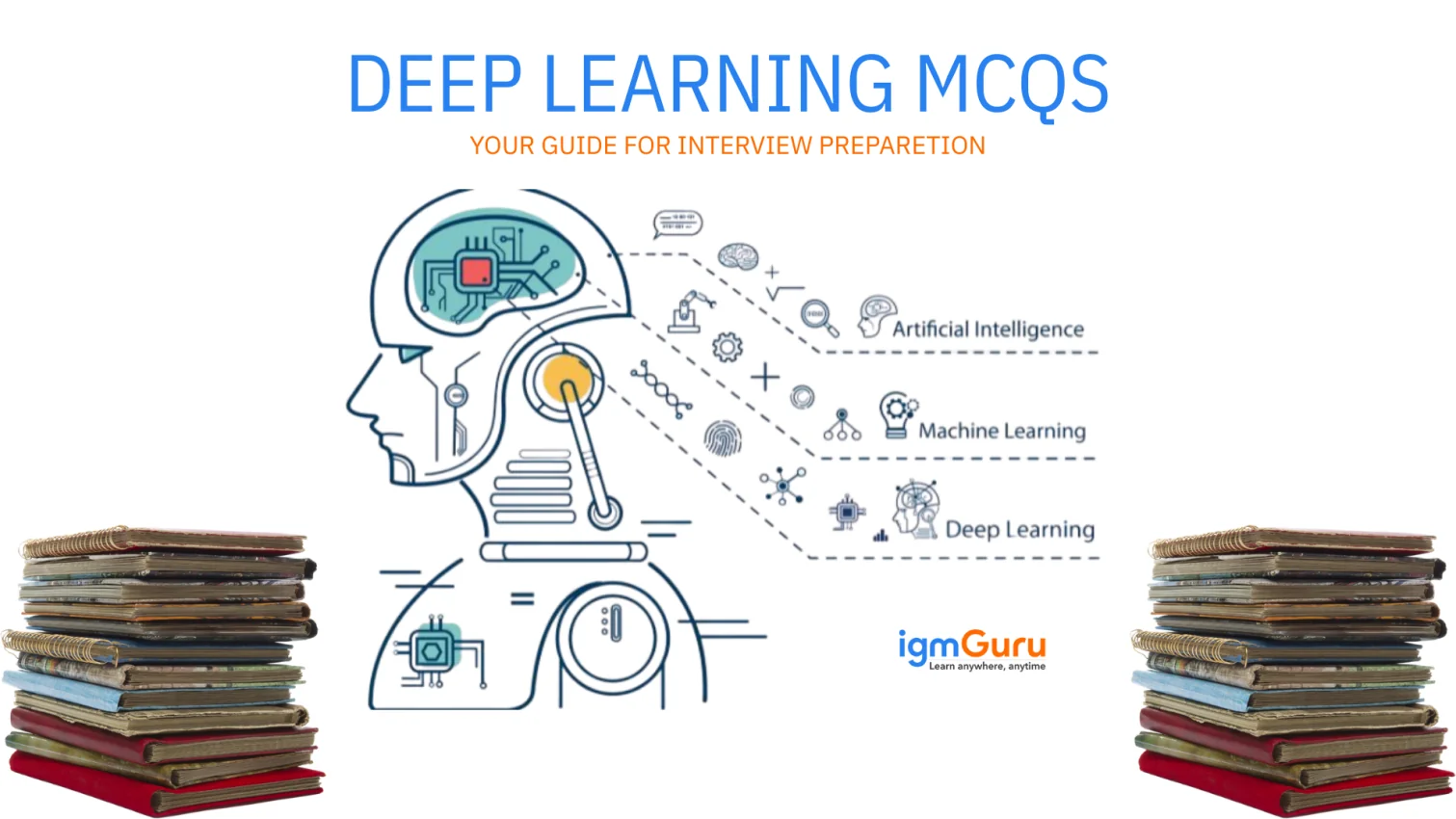
Preparing to become a Deep Learning Engineer? This Top 70 Deep Learning MCQs collection is your ultimate resource. It includes frequently asked multiple-choice questions, categorized for comprehensive learning, to evaluate your expertise and identify areas for improvement.
Note: Score 60% or higher to unlock an exclusive offer of up to 50% off on all self-paced Deep Learning courses.
Let's begin!
1. What is deep learning primarily based on?
2. Which activation function outputs values between 0 and 1?
3. What does backpropagation compute in a neural network?
4. Which loss is commonly used for binary classification?
5. What does 'epoch' mean during training?
6. Which optimizer uses momentum and adaptive learning rates?
7. Which problem does vanishing gradient primarily affect?
8. What is dropout used for?
9. Which metric is insensitive to class imbalance?
10. What does 'batch size' control during training?
11. What is a feedforward neural network?
12. Which architecture is best suited for image recognition?
13. Which model type is specialized for sequence data like text?
14. What is an autoencoder typically used for?
15. What is the Transformer architecture known for?
16. Which layer type reduces spatial dimensions in CNNs?
17. What does 'attention' allow models to do?
18. Which RNN variant helps mitigate vanishing gradients?
19. Which architecture is commonly used for image segmentation?
20. What is 'transfer learning'?
21. What is learning rate scheduling used for?
22. What is gradient clipping used to prevent?
23. Which technique augments training data by transforming inputs?
24. What does early stopping help prevent?
25. What is batch normalization's main benefit?
26. Which optimizer is generally recommended as a good default?
27. What is weight decay equivalent to in many implementations?
28. Why use learning rate warmup?
29. Which technique ensembles multiple models to improve performance?
30. What is mixed precision training?
31. What is overfitting?
32. Which method increases dataset variability to reduce overfitting?
33. What does L1 regularization encourage in weights?
34. Which regularization technique randomly drops connections instead of units?
35. Why use validation sets?
36. Which approach helps estimate model uncertainty?
37. What does 'generalization' mean?
38. Which validation technique helps when data is limited?
39. What role do validation curves (train vs val error) play?
40. Which is an implicit regularizer in deep learning?
41. What is IoU (Intersection over Union) commonly used for?
42. What does perplexity measure in language models?
43. Which metric suits imbalanced classification?
44. What does top-k accuracy measure?
45. Why use confusion matrix?
46. What metric is natural for regression tasks?
47. What does ROC AUC measure?
48. Why compute per-class metrics in multiclass problems?
49. What is calibration of probabilistic predictions?
50. When is using top-k error useful?
51. Which library is widely used for deep learning with a Pythonic high-level API?
52. Which deep learning framework is known for dynamic computation graphs?
53. What is ONNX used for?
54. What is CUDA primarily used for in deep learning?
55. Which tool helps track experiments and hyperparameters?
56. What is a GAN (Generative Adversarial Network)?
57. What is contrastive learning used for?
58. Which task uses sequence-to-sequence models?
59. What are attention heads in Transformers?
60. What does knowledge distillation achieve?
61. What is model serving?
62. Why is model monitoring important in production?
63. What is A/B testing used for in ML products?
64. What is model quantization?
65. Which format is commonly used to export trained deep learning models for production?
66. What does the gradient of the loss w.r.t. weights indicate?
67. What is the effect of using a very large learning rate?
68. What is the Jacobian matrix used for in deep learning?
69. Which concept explains why deeper networks can represent more complex functions?
70. Why is normalization of input features often recommended?
71. What is the primary purpose of residual connections in ResNet?
72. Which activation function is most commonly used in modern CNNs?
73. What does fine-tuning involve?
74. Which technique improves model robustness by adding noise during training?
75. What is pruning in deep learning?
76. Which model is commonly used for object detection?
77. What is the purpose of an embedding layer?
78. Which architecture introduced self-attention as the main computation mechanism?
79. What is catastrophic forgetting?
80. Which technique is used to explain model predictions?
81. What is reinforcement learning primarily based on?
82. Which model architecture powers most modern large language models?
83. What is tokenization in NLP?
84. Which metric is often used for machine translation quality?
85. What does beam search improve during text generation?
86. Which technique reduces model size while preserving much of its performance?
87. What is the main advantage of transfer learning?
88. Which company originally developed TensorFlow?
89. What is model drift in production systems?
90. What is federated learning?
91. What does ViT stand for in deep learning?
92. Which generative model is widely used for AI image generation today?
93. What is zero-shot learning?
94. What is the purpose of Retrieval-Augmented Generation (RAG)?
95. What is LoRA commonly used for?
96. What is few-shot learning?
97. What is self-supervised learning?
98. What does RLHF stand for?
99. Which database type is commonly used in RAG systems?
100. What is the primary purpose of embeddings in AI systems?
101. What is prompt engineering?
102. Which model can process text, images, and other data types together?
103. What is synthetic data?
104. What is Edge AI?
105. What is the main goal of MLOps?
106. What is Explainable AI (XAI)?
107. Which technique is commonly used for model interpretability?
108. What is concept drift?
109. What is data drift?
110. What is a foundation model?
111. What is Neural Architecture Search (NAS)?
112. Which optimization method is commonly used for hyperparameter tuning?
113. What is model checkpointing?
114. What is continual learning?
115. What is Graph Neural Network (GNN) primarily designed for?
116. What is a Sparse Mixture of Experts (MoE) model?
117. What is the primary goal of Responsible AI?
118. What is AI governance concerned with?
119. What is Agentic AI?
120. Why is human oversight important in advanced AI systems?
You Can Also Check:
1. Top Deep Learning Interview Questions And Answers
2. Deep Learning vs Machine Learning
3. Deep Learning Tutorial for Beginners
4. What are Deep Learning Models?