
Redux interviews are designed to test not only a candidate’s knowledge of syntax but also their understanding of state management concepts such as the store, reducers, middleware, asynchronous workflows and application architecture.
From my experience of both taking interviews as a candidate and conducting interviews as an interviewer, I have seen that strong candidates are those who can clearly explain why Redux is used, write clean and predictable state logic and think through real-world scenarios like performance bottlenecks, API failures and scalable code structure. Redux remains a widely used library for managing state in React applications, so interview questions often focus on fundamentals like actions, reducers, the store and data flow, along with modern tools such as Redux Toolkit and RTK Query.
In this blog, I have compiled the most commonly asked Redux interview questions for freshers, intermediate developers and experienced professionals, along with practical scenario-based questions.
Read Also: JavaScript Cheat Sheet
Learn React and Redux for building scalable frontend applications.

Here are some commonly asked Redux interview questions for freshers to help you understand the basic concepts of Redux.
Redux is an open-source JavaScript library used to manage and store application data in one central place. It helps different parts of an application access and update the same data easily. Redux is commonly used with React and Angular to manage application state in a simple, organized and predictable way.
Here is an example of how reducers are used in Redux:
| // 1. Create a reducer function function counterReducer(state = 0, action) { switch (action.type) { case "INCREMENT": return state + 1; case "DECREMENT": return state - 1; default: return state; } } // 2. Use the reducer console.log(counterReducer(0, { type: "INCREMENT" })); // 1 console.log(counterReducer(1, { type: "INCREMENT" })); // 2 console.log(counterReducer(2, { type: "DECREMENT" })); // 1 |
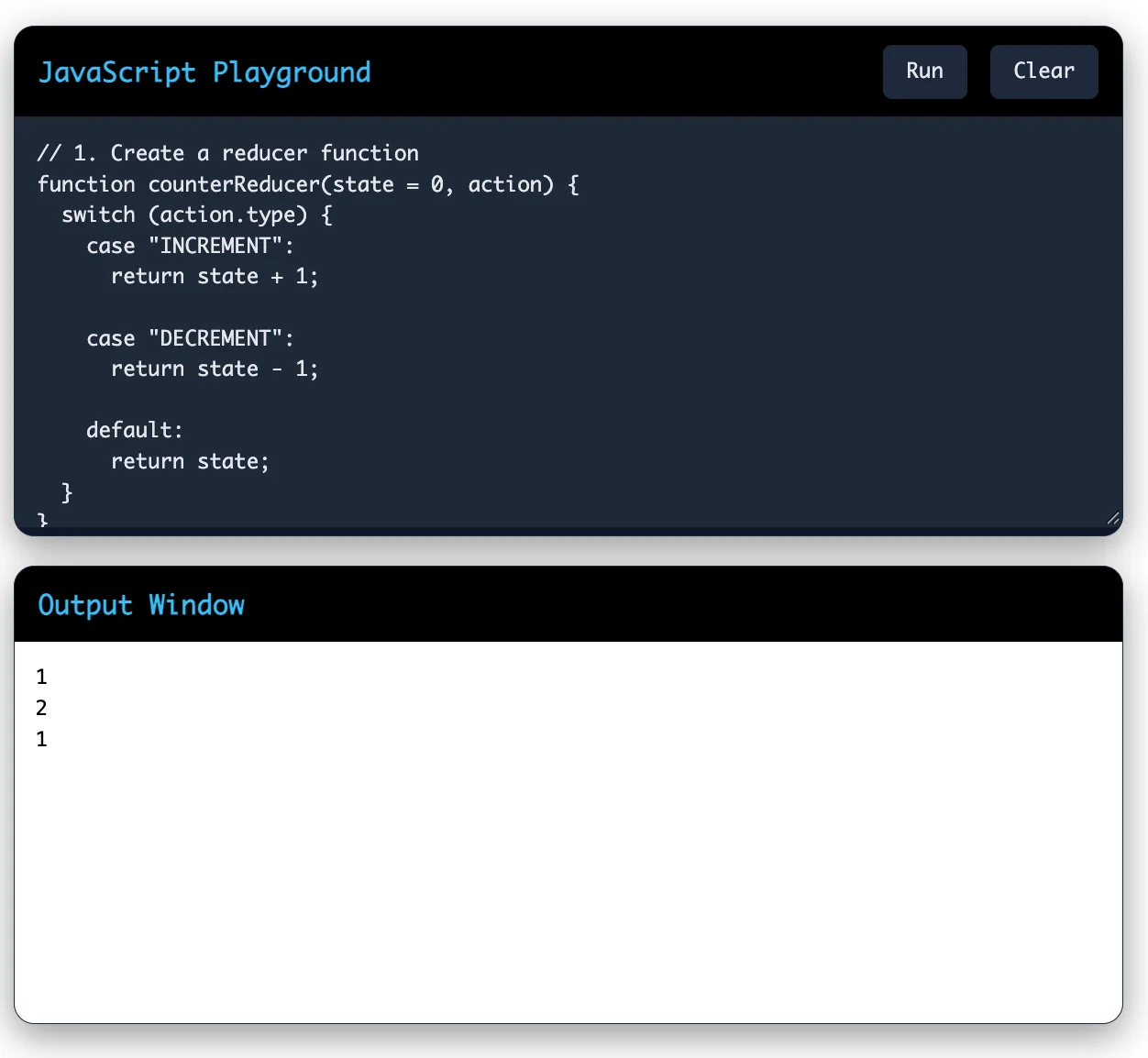
Test your JavaScript code here: Online JavaScript Compiler
How does it work?
Just like Model View Controller, Flux is an application design paradigm. It is a new kind of architecture that complements React and the concept of Unidirectional Data Flow.
The image given below illustrate how the workflow between dispatcher, stores and views components with distinct inputs and outputs are in Flux:
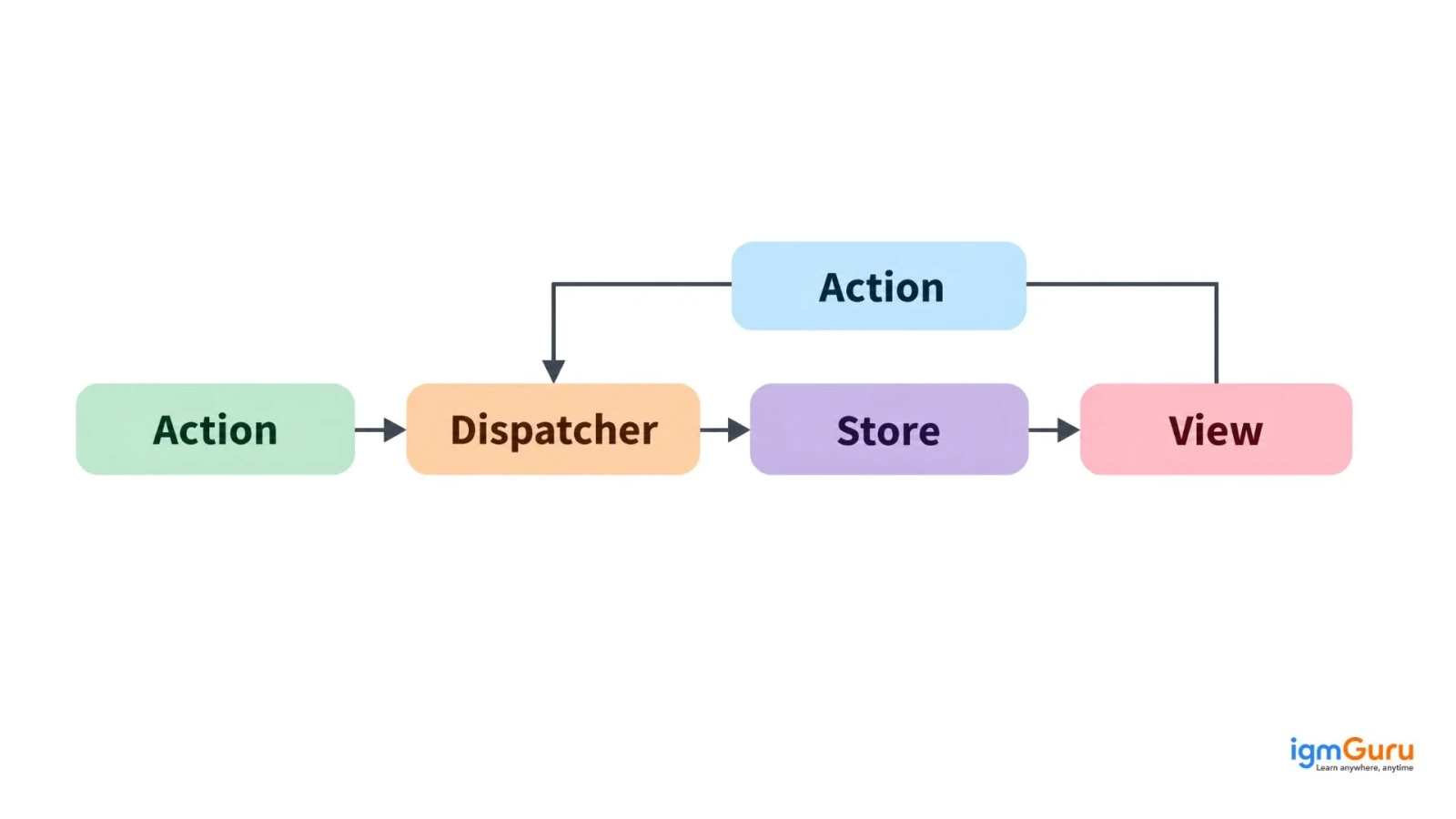
Redux and Flux are both used to manage data (state) in JavaScript applications. They follow a unidirectional data flow, meaning data moves in one direction.
Redux is a predictable state management library inspired by the Flux architecture, with a simpler structure for managing application state.
| Basis | Redux | Flux |
| Definition | Redux is a state management library for JavaScript applications. | Flux is an application architecture for managing data flow. |
| Store | Usually uses a single store to manage the application's state. | Can use multiple stores to manage different types of data. |
| Data Flow | Follows a unidirectional data flow. | Also follows a unidirectional data flow. |
| State Management | State is updated through reducers, which return new state based on actions. | Stores update their data in response to dispatched actions. |
| Dispatcher | Does not require a separate dispatcher; the store handles dispatched actions. | Uses a central dispatcher to send actions to registered stores. |
| State Updates | Encourages immutable state updates, making changes predictable. | Stores manage their own data and update it when they receive actions. |
| Debugging | Supports powerful debugging tools, including time-travel debugging. | Debugging depends on the implementation and available tools. |
| Complexity | Often simpler to organize because state management follows a consistent pattern. | Can require more setup when managing multiple stores and their dependencies. |
Redux in React JS is a state management library that helps store and manage an application's data in one central place. It allows different React components to access and update shared data without passing props through multiple components. Redux uses actions and reducers to manage state changes predictably.
The core principles of Redux are:
No, it is not true, as it can be used as a data store for many UI layers. There are bindings available in Redux for React, Angular, Angular 2, Vue and many more.
Redux helps manage application state in one central store, which makes data easier to manage and share across components. It also makes state changes predictable and easier to debug. However, Redux can add extra code, increase complexity in small applications and require developers to learn its concepts.
Redux Toolkit is the official, recommended way to write Redux code. It simplifies Redux by reducing boilerplate code and providing built-in functions to create stores, write reducers and handle actions. It also uses Immer to let developers write simpler update logic while keeping state updates immutable.
Reducers are functions that decide how the application state should change when an action is dispatched. They take the current state and an action as inputs, then return the updated state. Reducers should be pure functions, so they should not directly modify the existing state or produce side effects.
Also Explore: Python vs JavaScript: A Comparison Guide
Learn JavaScript programming and develop dynamic web applications.

Here are some important Redux interview questions for intermediate developers to help you strengthen your understanding of Redux concepts and workflows.
Relay and Redux are both used in React applications, but they solve different problems. Relay manages data fetching and state from GraphQL APIs, while Redux manages application state in a centralized store.
| Basis | Relay | Redux |
| Main purpose | Manages data fetching through GraphQL | Manages application state |
| Data source | Primarily GraphQL APIs | Any data source, including APIs and local data |
| State management | Manages server data through its store | Manages application state through reducers and a store |
| Data fetching | Provides built-in GraphQL data fetching | Usually needs middleware or other libraries for API requests |
| Best suited for | Applications that use GraphQL extensively | Applications that need predictable, centralized state management |
Example: If an application uses GraphQL to fetch user profiles, Relay can manage that data. If the application needs to share login status, theme settings and shopping cart state across components, Redux can manage that state.
Redux follows a predictable, one-way data flow. A user acts, Redux processes it and the updated state is shared with the React components that need it.
The typical Redux lifecycle has these steps:
Redux Saga is a middleware library that helps manage asynchronous operations and side effects, such as API calls, timers and background tasks.
Its mental model is based on using generator functions to describe tasks that run in response to Redux actions. These functions can pause while an operation is completed and then continue with the result.
Example: When a user logs in, a Redux action can trigger a saga. The saga calls the login API, dispatches a success action if the request succeeds, or dispatches a failure action if the request fails.
Some commonly used Redux Saga effects are:
A candidate should also understand that Redux Saga is useful for complex asynchronous workflows, but simpler applications may only need Redux Toolkit with Redux Thunk.
A Redux store is a centralized place where an application's Redux state is maintained. It allows components to access the state, dispatch actions and subscribe to state updates.
The store works with reducers to calculate the next state whenever an action is dispatched.
Example: In an e-commerce application, a Redux store can maintain the shopping cart items, logged-in user information and selected theme.
In modern Redux applications, Redux Toolkit's configureStore() is the recommended way to create a store.
A standard Redux store provides five main methods or properties that candidates should know.
| Method | Purpose |
| getState() | Returns the current state of the store. |
| dispatch(action) | Sends an action to the store so the state can be updated. |
| subscribe(listener) | Registers a listener that runs after the store has been updated. |
| replaceReducer(nextReducer) | Replaces the current reducer, which can be useful for code splitting or hot reloading. |
| observable() | Provides an observable interface for state changes. It is mainly used for interoperability with observable-based libraries. |
The following example shows how to create a Redux store, dispatch an action and read the updated state using Redux Toolkit.
| const state = { counter: { value: 0 } }; function increment(state) { return { ...state, counter: { ...state.counter, value: state.counter.value + 1 } }; } const updatedState = increment(state); console.log(updatedState); // { counter: { value: 1 } } |
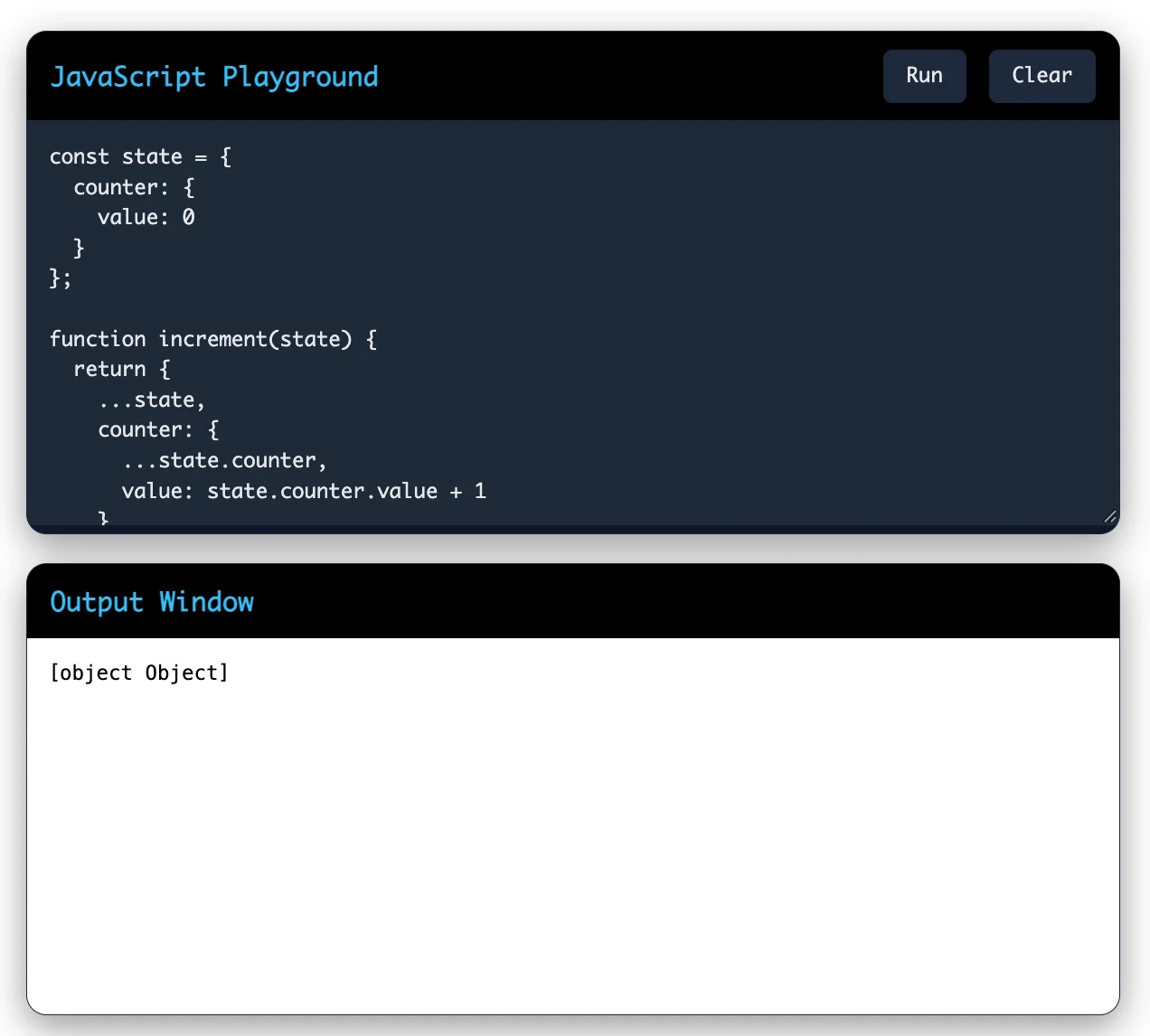
Explanation:
Redux Toolkit allows developers to write simpler Redux code while handling immutable state updates internally through Immer.
In Redux, initial state refers to the default values assigned to the application state when it starts. It helps define how the data should look before any changes occur.
| const initialState = { username: "", isLoggedIn: false, }; const state = { ...initialState }; console.log(state); |
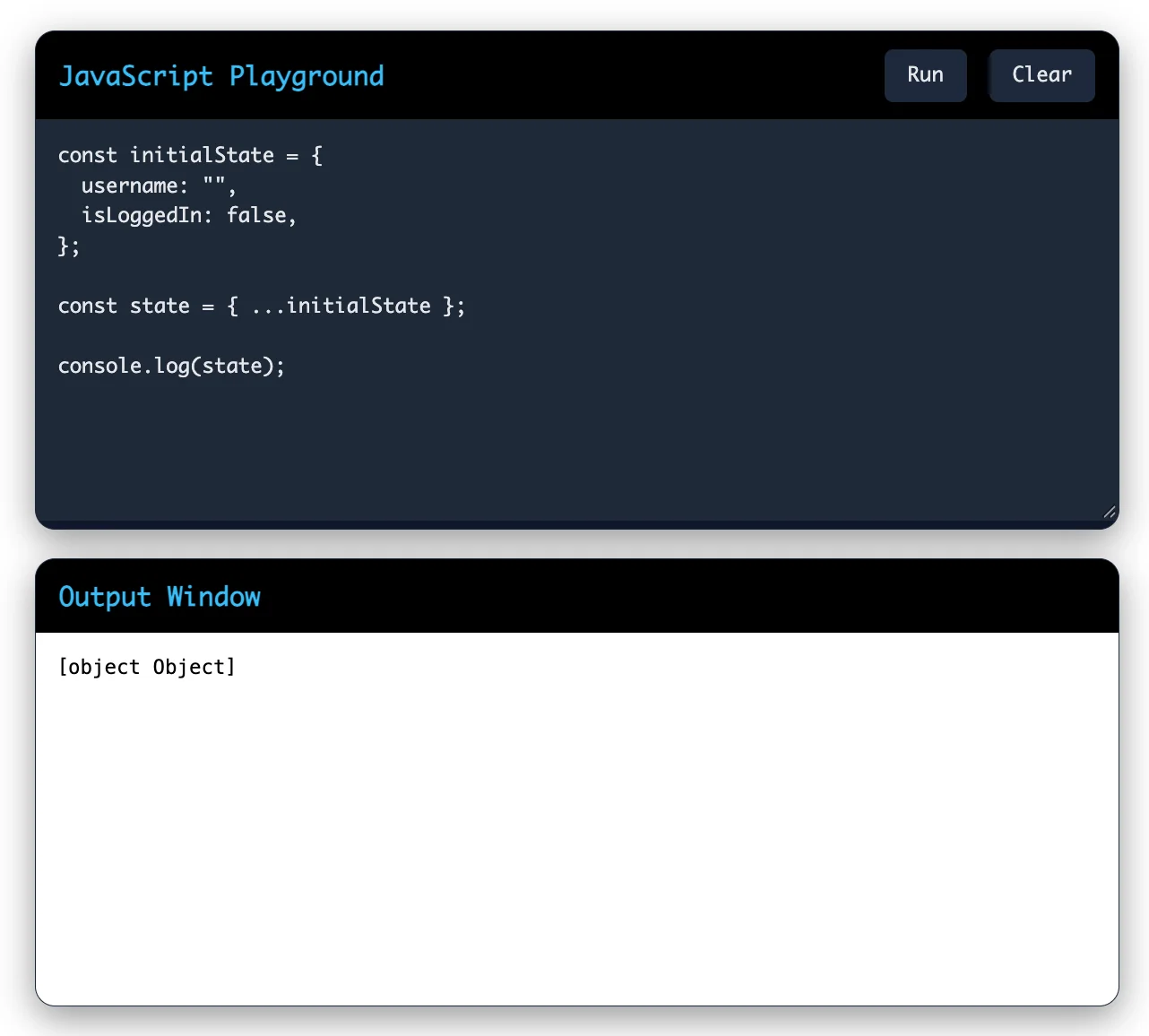
Explanation
Note: This example demonstrates how to initialize state using a JavaScript object. In Redux, the initial state is typically provided to a reducer, which uses it as the starting state when no previous state exists
Redux Thunk is a middleware in Redux that allows us to handle asynchronous operations, such as API calls, timers, or delayed actions. It lets us write action creators that return functions instead of action objects, which makes it easier to perform tasks like fetching data from a server and dispatching actions based on the result.
Redux supports a predictable workflow that helps developers manage application state in a structured way. Its main workflow features include the following:
Example: In a shopping cart application, a user adds a product, the component dispatches an action, the reducer updates the cart state and React displays the updated cart total.
The connect() function from React Redux connects a React component to the Redux store. It allows a component to read data from the store and dispatch actions.
It is commonly used with class components and older React Redux code. For modern function components, React Redux generally recommends hooks such as useSelector() and useDispatch().
The connect() function commonly uses two arguments:
Read Also: What is Node.js?
Learn React components, hooks, and state management through practical training.

Redux interview questions for experienced developers to test their knowledge of state management, performance optimization, and Redux Toolkit. Here are some of them:
I optimize Redux performance by identifying the actual cause of unnecessary renders, maintaining immutable state updates, selecting only the data a component needs and using memoization where it provides measurable benefits.
My approach have the following techniques:
Redux middleware provides a layer between dispatching an action and that action reaching the reducer. It lets us intercept actions, execute side effects, modify dispatch behavior, and handle cross-cutting concerns without putting that logic inside reducers.
Middleware is useful for logging, analytics, error reporting, and custom asynchronous workflows. For most API requests in modern Redux applications, I would prefer Redux Toolkit's createAsyncThunk or RTK Query rather than building a custom API middleware from scratch.
A basic logging middleware looks like this:
| const loggerMiddleware = (store) => (next) => (action) => { console.log("Dispatching:", action.type); const result = next(action); console.log("Next state:", store.getState()); return result; }; |
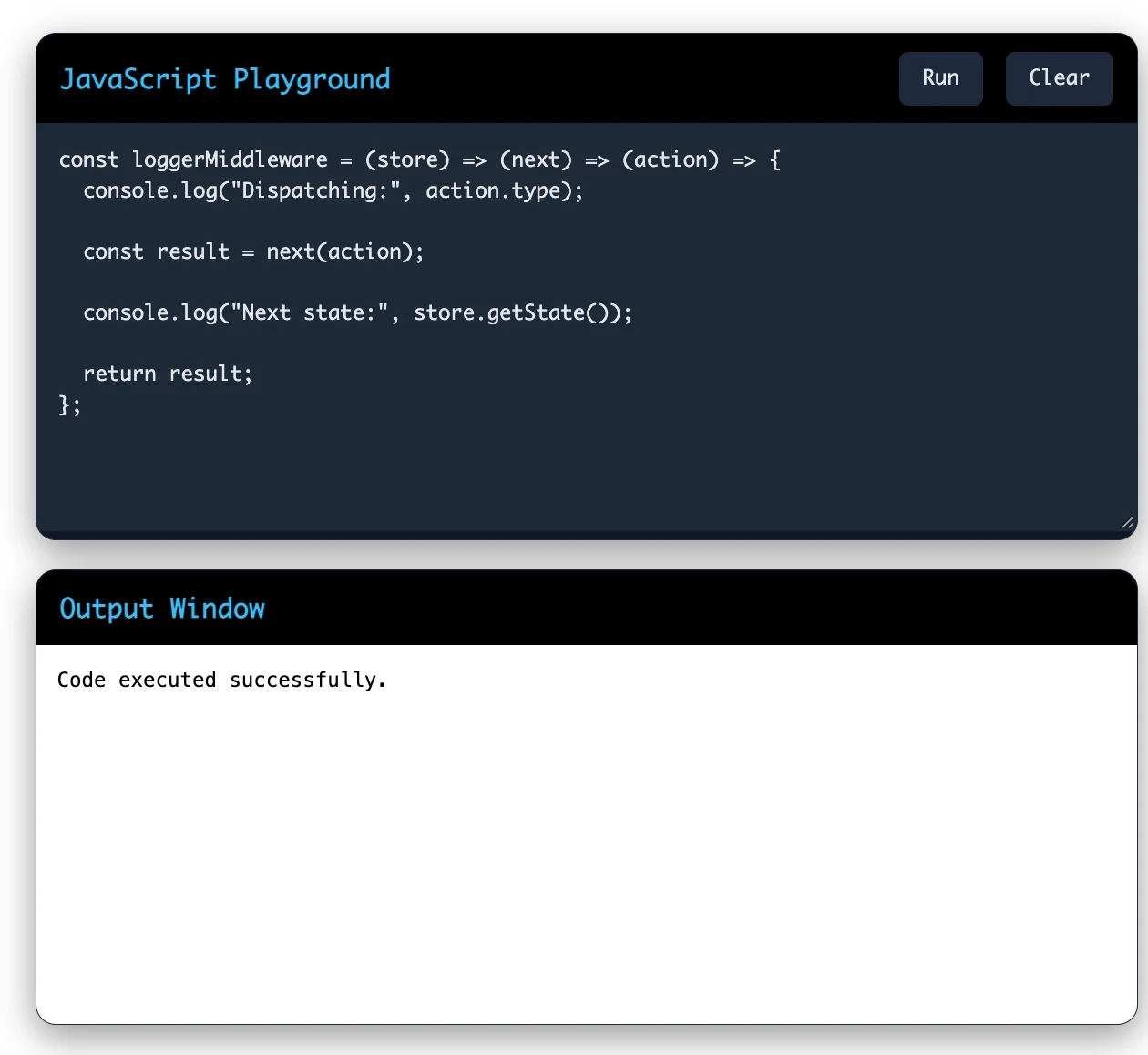
The important distinction is that next(action) passes the action to the next middleware or reducer, whereas store.dispatch(action) sends it back through the middleware chain.
For error tracking, I could create middleware that observes rejected actions and reports failures to an error-monitoring service.
| const errorTrackingMiddleware = (store) => (next) => (action) => { const result = next(action); if ( action.type.endsWith("/rejected") && action.meta?.requestStatus === "rejected" ) { // Replace with a real monitoring service. reportError({ actionType: action.type, error: action.payload ?? action.error, }); } return result; }; |
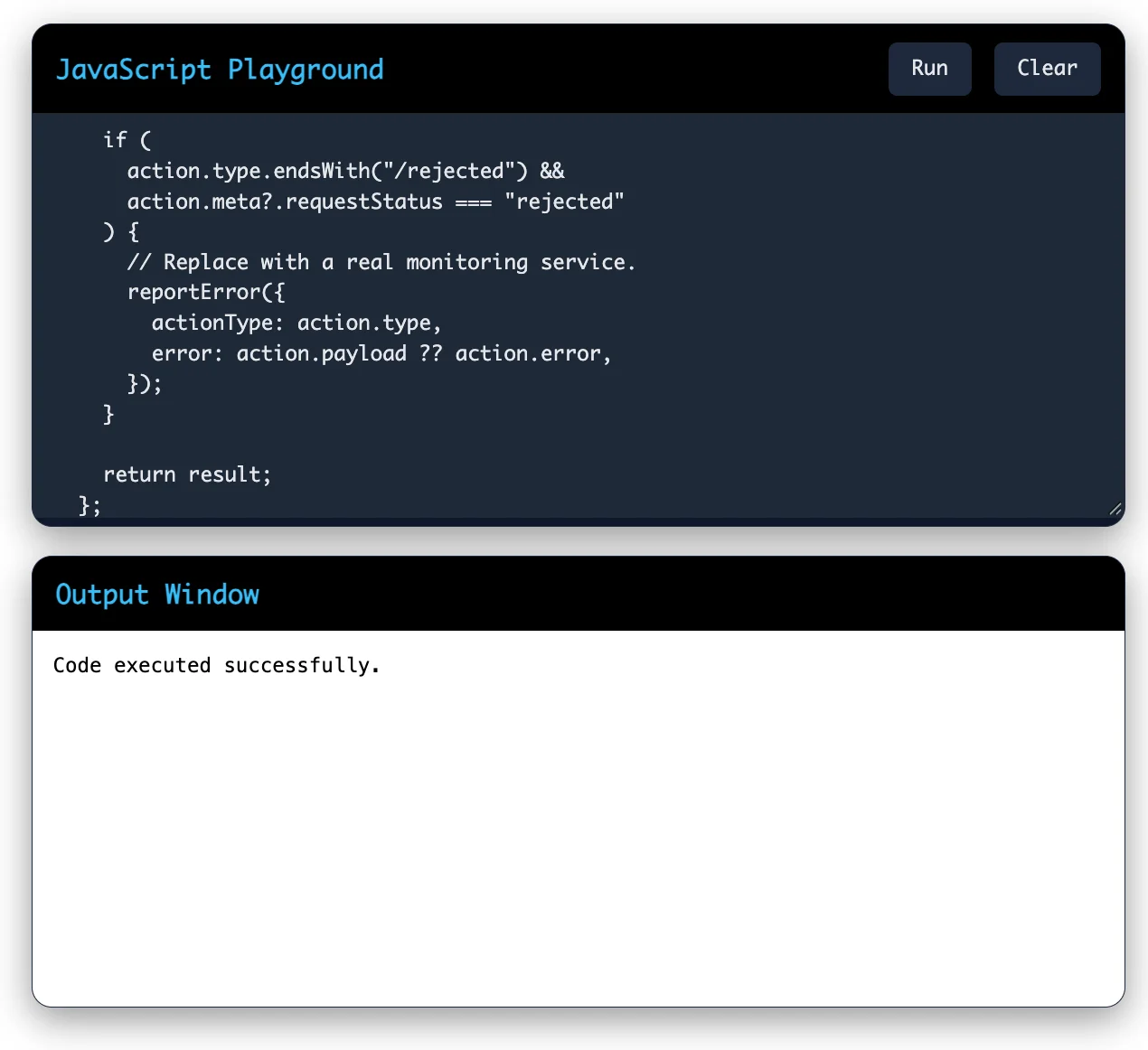
Here, reportError represents an application-provided monitoring function. In production, I would ensure that the monitoring service cannot crash the middleware, avoid sending sensitive data, and prevent duplicate error reports.
I would register the middleware using Redux Too
| // Simple Redux-like middleware demonstration const loggerMiddleware = (store) => (next) => (action) => { console.log("Dispatching:", action.type); const result = next(action); console.log("Updated state:", store.getState()); return result; }; const errorTrackingMiddleware = (store) => (next) => (action) => { try { return next(action); } catch (error) { console.error("Redux error:", error); throw error; } }; console.log("Middleware functions defined successfully!"); |
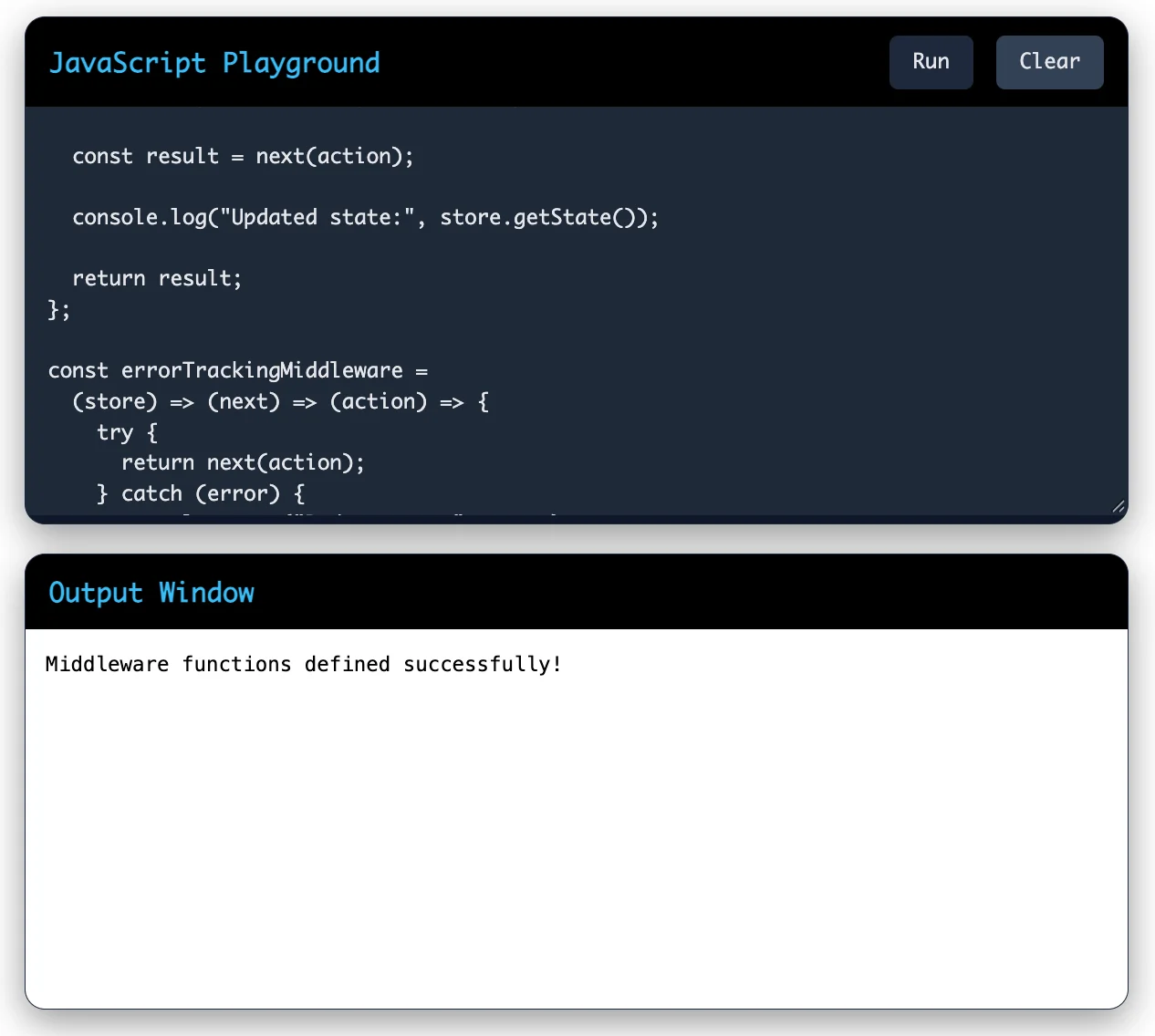
Redux Toolkit includes useful default middleware, such as development checks for accidental mutations and non-serializable values. I preserve those defaults unless there is a specific reason to change them.
What I would look for as an interviewer: A clear explanation of the middleware execution chain, the difference between next and dispatch, and an understanding that reducers should remain pure and side effects should be handled outside them.
In Redux Toolkit, I handle asynchronous operations using either createAsyncThunk or RTK Query, depending on the use case.
createAsyncThunk is useful when I need explicit control over asynchronous business logic, such as submitting a complex form, processing a multi-step operation, or coordinating an API request with other application logic.
It automatically generates three lifecycle actions: pending, fulfilled, and rejected. I handle these actions in the slice reducer to update the loading state, store the response, and manage errors.
For API failures, I distinguish between expected API errors, such as validation failures or unauthorized responses, and unexpected errors, such as network failures. I use rejectWithValue when I need to pass structured error information to the reducer. I also handle loading indicators, error messages, retries where appropriate, and cleanup of any related state.
RTK Query, on the other hand, is my preferred solution for most server-state operations, such as fetching lists, retrieving details, and updating records. It provides caching, request deduplication, automatic loading and error states, cache invalidation, and refetching.
For example, in an e-commerce application, I might use RTK Query for product listings and product details, while using createAsyncThunk for a complex checkout workflow that requires custom orchestration.
The key difference is that createAsyncThunk manages asynchronous logic, while RTK Query provides a more complete solution for fetching and caching server data. I avoid implementing the same API caching and request lifecycle logic manually when RTK Query already handles it.
These three APIs solve different problems within Redux Toolkit.
| API | Purpose | Typical use case |
| createSlice | Creates a slice of Redux state, its reducer, and associated action creators. | Managing authentication, cart, user preferences, or other feature state. |
| createReducer | Creates a reducer by mapping actions to state update logic. | Building a reducer with custom action handling or integrating with existing action creators. |
| createAsyncThunk | Generates lifecycle actions for asynchronous operations. | Handling API calls and other asynchronous business logic. |
Redux Toolkit also uses Immer internally, allowing me to write reducer logic that looks like mutation while preserving Redux's immutable state updates.
A strong architectural choice is to use createSlice for most feature state, createAsyncThunk for asynchronous workflows that need explicit lifecycle handling, and createReducer when its more flexible action-mapping approach is justified.
I use normalized state when an application manages collections of entities that multiple parts of the app reference, such as users, products, orders, or comments.
Instead of storing deeply nested objects, I maintain entities in a flat structure, typically using an object keyed by entity ID and a separate array of IDs to define the collection order.
For example, an application might store users by their IDs and let posts reference the corresponding user ID instead of duplicating the entire user object inside every post.
This approach provides several benefits:
Redux Toolkit's createEntityAdapter simplifies this pattern. It provides a standardized entity state structure, CRUD reducer helpers, and selectors for accessing entities and IDs. It can also maintain a sorted collection when a sorting configuration is provided.
I would use it for substantial collections of entities, especially when the same data is accessed and updated across multiple features. For small, simple state objects, normalization may introduce unnecessary complexity.
One important point is that normalization does not automatically guarantee better performance. I still need appropriate selectors and component subscriptions to ensure that components only react to the data they actually use.
Memoized selectors are functions that calculate derived data from Redux state and reuse previous results when their input values have not changed.
For example, an application may store all products in Redux but need to display only the products that match a search term, category, and price range. Instead of recalculating the filtered collection on every render, I can use a memoized selector.
Reselect is the selector library commonly used with Redux Toolkit. Its createSelector API allows me to define input selectors and a result calculation function.
When the input selector results remain unchanged, Reselect can return the previously calculated result rather than running the calculation again. This can also preserve the result's reference identity, helping prevent unnecessary rerenders when components use reference-based comparisons.
I typically use memoized selectors for:
I do not memoize every selector unnecessarily. A simple lookup of one property usually does not need memoization. I also pay attention to selector arguments and cache behavior, especially when the same selector is used with different component parameters.
The important distinction is that memoization optimizes derived calculations and reference stability; it does not replace proper state design or eliminate every unnecessary rerender.
I would implement undo and redo by maintaining a history of state snapshots or reversible changes.
A common approach is to wrap the relevant reducer with a history-management layer that maintains three parts:
When the user performs a normal action, I save the current present state in the past history and calculate the new present state. The future history is cleared because a new change creates a different timeline.
When the user performs undo, I move the most recent past state into the present and place the previous present state into the future.
When the user performs redo, I move the next future state into the present and update the past history accordingly.
For a production application, I consider several additional requirements:
For large documents or complex editors, I might store inverse operations or patches instead of complete snapshots to reduce memory usage.
The most important design decision is defining which actions are undoable and what constitutes a single user operation. The history mechanism itself is relatively straightforward; making it reliable and intuitive is the real challenge.
I approach persistence by first deciding which parts of Redux state genuinely need to survive a page refresh or application restart.
For example, user preferences, selected filters, and an unfinished draft may need persistence. Temporary UI state, loading flags, and many forms of server cache usually do not need to be persisted.
Depending on the requirements, I may use browser storage such as localStorage or sessionStorage, IndexedDB for larger datasets, or a persistence library such as Redux Persist.
During rehydration, the application restores persisted data and merges it with the current initial state. I make sure this process handles changes in the state structure across application versions.
The main challenges include:
I usually persist only a carefully selected subset of the state, version the persisted schema where necessary, validate restored data, and define a migration or reset strategy.
I also treat persisted data as untrusted input rather than assuming it is valid simply because the application originally wrote it.
My principle is to persist user intent and necessary client-side state, not blindly serialize the entire Redux store.
Race conditions occur when multiple asynchronous requests overlap and their responses arrive in a different order from the order in which they were initiated.
Consider a search box where the user types "React" and then quickly changes it to "Redux." If the response for "React" arrives after the response for "Redux," the UI could incorrectly display outdated search results.
I handle this by choosing a request-management strategy based on the use case.
With createAsyncThunk, I can use the generated requestId to identify a particular request and track the currently active request in Redux state. Before accepting a response, the reducer checks whether that request is still the current one. Stale responses can then be ignored.
createAsyncThunk also provides an AbortSignal to the asynchronous operation and supports cancellation of dispatched thunk tasks. When the underlying request supports cancellation, such as a fetch request, I can abort obsolete work.
With RTK Query, I rely on its cache keys, subscription management, and request lifecycle behavior where appropriate. I also use its cache invalidation and refetching mechanisms to keep server data synchronized. For search, I may combine debouncing with appropriate query arguments so that rapid input changes do not trigger excessive requests.
Other techniques I consider include:
An important distinction is that cancellation does not guarantee that a server has stopped processing a request. For mutations, I need to consider server-side effects separately.
I choose the strategy based on the operation: latest-request-wins for search, explicit concurrency control for conflicting writes, and cache-aware request management for server-state fetching.
I use a layered testing strategy that verifies Redux behavior at the unit, integration, and application levels.
I test reducers as pure functions by providing an initial state and an action, then verifying the resulting state.
I cover normal state transitions, edge cases, invalid or unexpected inputs, and important business rules. I also verify that the original state is not mutated.
For Redux Toolkit's reducers, I focus on observable state behavior rather than testing the internal Immer implementation.
I test selectors using representative state fixtures and verify the derived output.
For memoized selectors, I also test important caching or reference-stability behavior when it matters to application performance. I prioritize correctness and avoid tests that depend unnecessarily on implementation details.
For createAsyncThunk, I test successful requests, rejected requests, validation errors, loading transitions, and relevant cancellation or stale-response scenarios.
I mock the API boundary rather than making real network calls in unit tests. This allows the tests to remain deterministic and independent of external services.
For RTK Query, I test query and mutation behavior, loading and error states, cache invalidation, and refetching where those behaviors are important. Integration tests can use a mocked network layer to exercise realistic request and response flows.
I test custom middleware by verifying how it handles actions, calls the next middleware or reducer, and triggers intended side effects.
For middleware involving analytics, logging, or authentication, I verify both the expected behavior and relevant failure cases.
I configure a real Redux store with the relevant reducers and middleware, then render components using a Redux provider.
I test user-visible behavior, such as loading a list, displaying an error, updating a cart, or submitting a form. This helps catch issues that isolated unit tests might miss, including incorrect selector subscriptions and interactions between slices.
In a large application, I organize tests by feature and maintain reusable test utilities for store setup, fixtures, and API mocking.
I prioritize business-critical workflows, race conditions, regression-prone features, and error paths. I also run the appropriate test suites in CI and supplement automated tests with end-to-end tests for critical user journeys.
My testing philosophy is to test pure logic in isolation, asynchronous behavior at the appropriate boundary, and cross-feature interactions through integration tests. This provides strong confidence without making the test suite excessively slow or tightly coupled to implementation details.
Also Read: React Native Tutorial For Beginners
Some scenario-based Redux interview questions to help you understand how Redux concepts are applied to real-world React applications.
I would use useSelector to select only the specific state required by each component instead of selecting the entire Redux store.
I would also use React.memo to prevent unnecessary re-renders of child components, useMemo to memoize expensive calculations, and useCallback to memoize functions when needed.
For complex calculations, I would use memoized selectors with createSelector from Redux Toolkit. I would also ensure state updates follow immutable patterns and avoid creating unnecessary new object references.
This way, only the components that depend on the updated state will re-render, which improves application performance.
I would use createAsyncThunk to handle asynchronous API calls and manage their states using extraReducers.
I would avoid retrying requests for errors such as 400 or 401 unless there is a specific recovery mechanism.
I would also handle request cancellation and prevent duplicate requests when necessary. This makes API handling predictable and improves the user experience.
I would use RTK Query to define API endpoints and manage data fetching, caching, and loading states automatically.
When multiple components use the same endpoint with the same query parameters, RTK Query shares the cached data and avoids unnecessary duplicate network requests.
To keep the data up to date, I would use:
This reduces unnecessary API calls while keeping the application data consistent.
I would manage authentication using Redux Toolkit and a centralized API layer.
I would store authentication status in Redux and keep sensitive tokens in secure storage, preferably using secure, HTTP-only cookies where the backend supports them.
When an API request returns 401 Unauthorized, I would use a custom baseQuery with RTK Query or an equivalent centralized request handler to refresh the access token.
If multiple requests fail simultaneously, I would ensure that only one token refresh request runs at a time. Other failed requests would wait for the refresh to complete.
After a successful refresh, I would retry the failed requests. If the refresh fails, I would clear the authentication state, securely handle token cleanup, and redirect the user to the login page.
I would also prevent infinite retry loops and ensure that refresh requests themselves do not trigger another refresh attempt.
I would organize the Redux store by feature, with each feature having its own slice, selectors, and related logic.
For example, I would create separate features such as auth, users, products, and cart.
I would avoid direct dependencies between unrelated features and expose reusable selectors and actions through clear interfaces.
This structure makes the application easier to maintain, test, scale, and optimize.
Also Read: How To Become A React Native Developer?
The article discussed Redux interview questions with well-explained answers from the actions, reducers, and store to Redux toolkit, RTK query, middleware, and different situations. Keep practicing these concepts and developing projects to get ready for your next interview successfully.