React is a strong JavaScript library for developing powerful and interactive user interfaces. It was developed and is maintained by Meta (formerly Facebook) and a large community of developers. It lets developers craft fast and scalable web applications. Its amazing features like virtual DOM use rendering by updating only changed elements and provide high performance. Its declarative syntax makes code intuitive, while the component-based structure promotes modularity and maintainability.
Accepted by startups and tech giants alike, React.js, through its vibrant terrain and tools like Redux, gives power to developers for creating engaging, modern web experiences effortlessly. It is a complete game-changer that has become the backbone of numerous famous applications, whether it is Instagram or Netflix. In this blog, you will also understand what is React.js, why use React.js, core features, how it works, and much more.
React.js, also known as React, is a free and open-source JavaScript library for developing user interfaces (UIs). It was developed and is now managed by Facebook (Meta) itself and has a huge open-source community. React is usually used for creating interactive and dynamic web applications. It eases the creation of single-page applications (SPAs), focusing on performance and maintainability. Here is a short example of a simple ReactJS component to make things easier for you to understand.
import React from "react"; function Hello() { return <h1>Hello, React!; } export default Hello; |
As we know, ReactJS is a JavaScript library for developing user interfaces, usually websites. This permits you to create components such as building blocks, which can be reused. In this example, I made a component named 'Hello', which returns some HTML-like code such as <h1>Hello, React!</h1>. This shows the text on the page. ReactJS is just like LEGO, meaning every single component is a block, and you build your app by putting the blocks together.
The main features of React are the reason for its fame and effectiveness. Let's dive into the core features of React.js and understand the reasons behind its fame and efficacy.
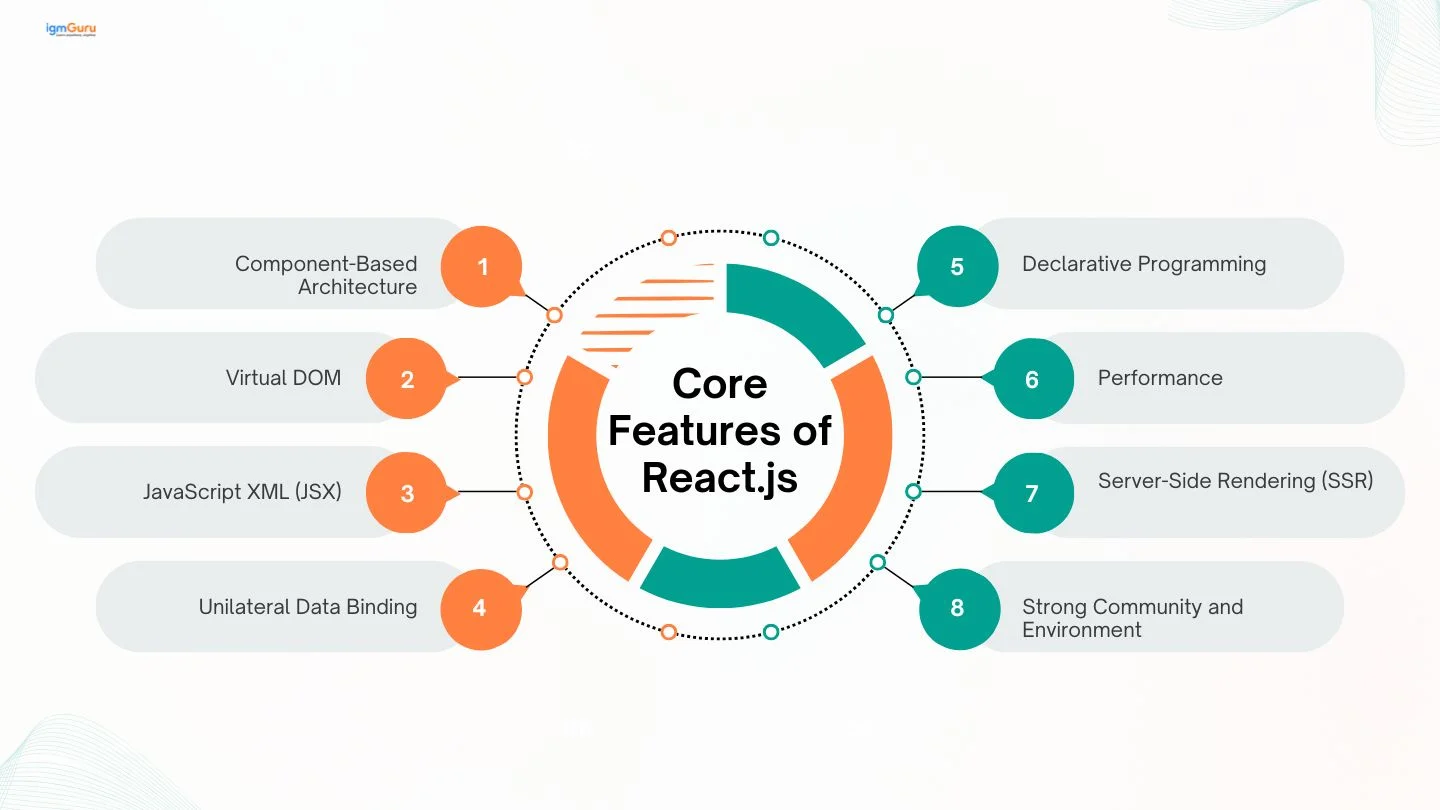
It promotes developing UIs as a collection of isolated and reusable components. This modularity eases the development, maintenance and scalability, letting developers manage tough UIs even more effectively.
ReactJS makes use of a Virtual Document Object Model (DOM), which is a lightweight copy of the actual DOM. When the changes take place in the application state, firstly React updates the Virtual DOM, then it expertly calculates the differences with the real DOM and then only updates the required parts of the real DOM. It minimizes direct manipulation of the browser's DOM, which leads to notable performance improvements.
The JSX is a syntax extension that allows developers to write HTML-like code directly within JavaScript. This enhances code readability and maintainability by keeping the UI logic and presentation together in components.
It enforces a unidirectional data flow, which means that data flows from parent components to child components. This makes data management and debugging easier, and helps to understand how data changes affect the UI.
React represents a declarative approach to UI development. Rather than explicitly defining how to change the UI, it describes the desired state of the UI. React also continuously updates the actual DOM to match that state.
The duo of Virtual DOM, structured reconciliation algorithms and component-based architecture contributes to ReactJS's powerful performance, especially in managing tough and energetic user interfaces.
It supports server-side rendering, which improves initial page load times for improving SEO by rendering components on the server and sending pre-rendered HTML to the client.
ReactJS is strengthened by a huge and active community, offering a wealth of resources, libraries, tools and support for developers. This massive ecosystem further improves its abilities and makes it easy to use.
Read Also: Top 8 Frontend Languages - A Beginner's Guide
You might be wondering how ReactJS works. It works by creating an in-memory virtual DOM instead of directly manipulating the browser's DOM. It does important manipulations within its virtual representation before making any changes to the actual browser DOM.
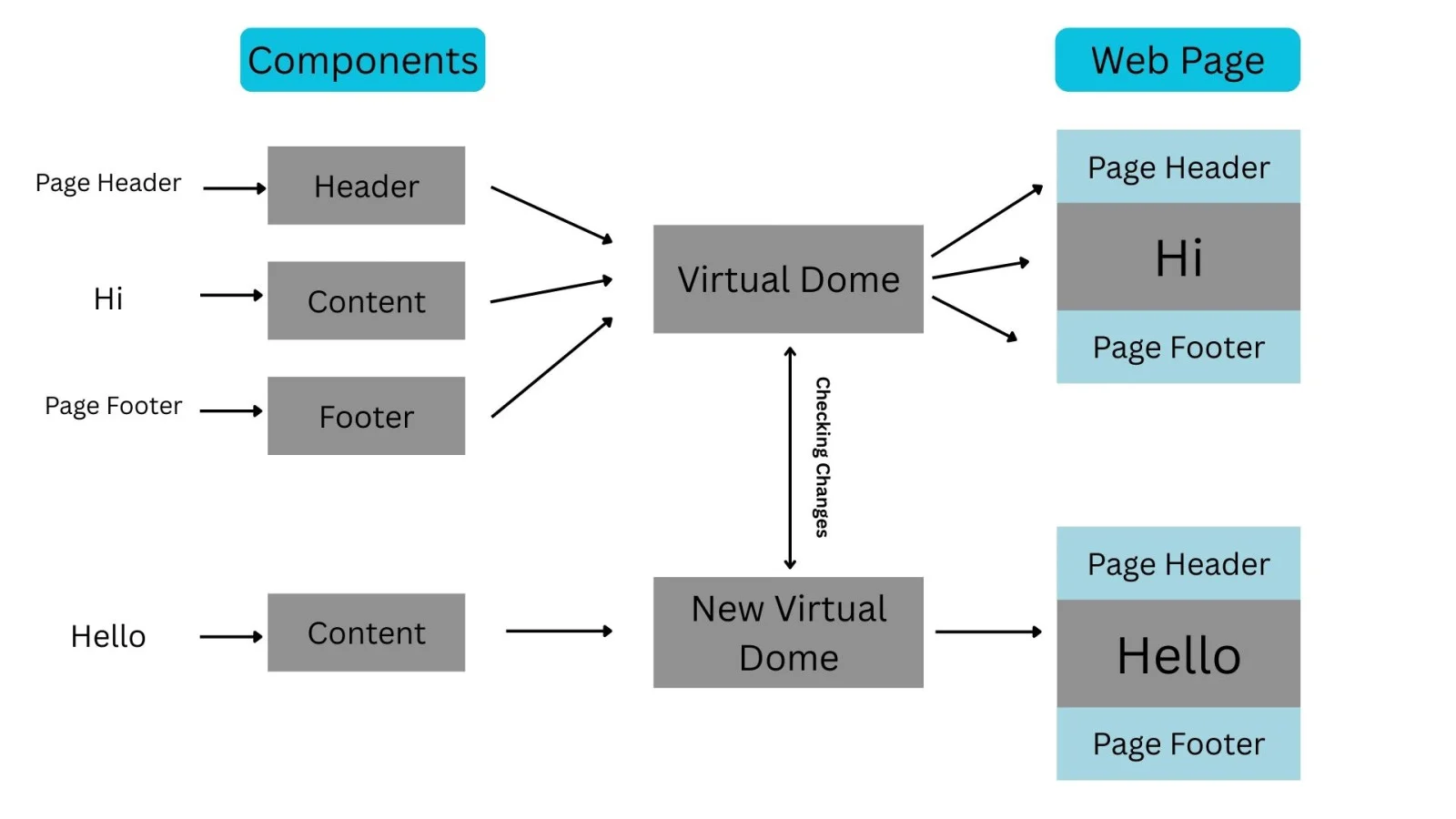
Now, let's understand exactly how ReactJS works:
The ReactJS apps are made from components, i.e., functions or classes. Every single component returns a UI representation (JSX), which looks like HTML, but it's actually JavaScript under the hood.
Basically, there's an Actual DOM having a div with two child elements called h1 and h2. React manages a previous Virtual DOM for tracking the UI state before any updates.
It compares the new Virtual DOM tree with the prior one, finding the minimum number of changes required for updating the real DOM. This procedure is known as reconciliation.
Here, the data that is passed from parent to child is called props, and the data handled inside a component is called state. Whenever the state or props change, React triggers a re-render of the parts that are affected.
ReactJS puts the calculated minimal changes from the Virtual DOM to the real DOM. It keeps the UI in sync with the application state, notably.
Now, the data flows downward- from parent to child components. It makes the apps even more predictable and easier to debug.
In short, ReactJS takes data -> builds a Virtual DOM -> compares it with the prior Virtual DOM -> then updates only the changed parts in the real DOM -> keeps the UI fast and systematic.
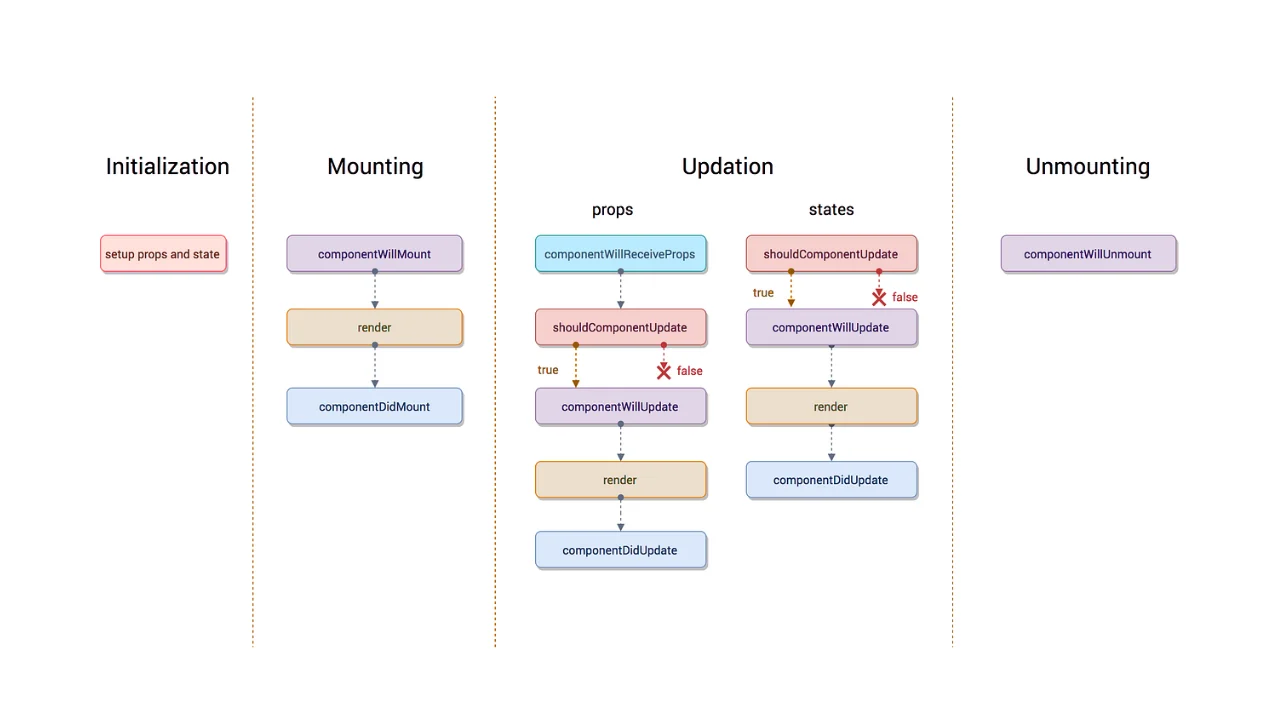
Every single React component has a lifecycle of its own. The lifecycle of these components is described as the chain of methods that are included in various stages of the component's existence. It automatically calls these methods at multiple points in a component's life cycle. Knowing these phases assists in handling the state, performing side effects and optimizing the components successfully. The lifecycle of ReactJS has four phases, and they are:
It is the stage where the component is made with the given Props and default state. It is done in the constructor of a Component Class.
This stage has the following three methods:
In this phase, there is one method that is called upon, and that is:
Let's go through an example of the counter component on the lifecycle of ReactJS to make things easier for you to understand.
import React, { useState, useEffect } from "react";

function Counter() {
  const [count, setCount] = useState(0);

  // Runs once when the component mounts
  useEffect(() => {
    console.log("Component mounted ");

    // Cleanup: runs when component unmounts
    return () => {
      console.log("Component unmounted ");
    };
  }, []);

  // Runs every time 'count' changes
  useEffect(() => {
    console.log(`Count updated: ${count}`);
  }, [count]);

  return (
    <div>
      <h1>{count}</h1>
      <button onClick={() => setCount(count + 1)}>Increase</button>
    </div>
  );
}

export default Counter; |
Here is an explanation of the example given above:
1. First render (Mounting)
2. Updating (when state/props change)
3. Unmounting (removed from DOM)
In short, the lifecycle of ReactJS is basically Mount-> Update -> Unmount in the easiest manner.
This JavaScript library is for building user interfaces, widely adopted all over multiple industries for its efficiency and component-based structure. Read on to know about the prominent real-world use cases of ReactJS.
This excels in making dynamic and fast-loading SPAs that provide a smooth, app-like experience in a browser. For instance, social media platforms, online learning platforms, and a lot of modern web applications.
It is ideal for developing interactive online stores with amazing product listings, real-time inventory management and customized user experiences.
Giant platforms like Facebook (creator), Instagram and Reddit grip ReactJS for their amazing news feeds, interactive user interfaces and real-time features such as chat and notifications.
This can be put to use for building PWAs which offer traditional app-like functionality involving offline abilities and push notifications, improving the user engagement.
Its scalability and component-based architecture make it perfect for developing strong and tough enterprise-level applications like CRM or ERP systems.
Its ability to consistently update and render UI components makes it suitable for developing interactive dashboards and visualizing huge datasets in applications such as analytics tools or financial platforms.
It can be put to use for SSR to enhance SEO and initial page load performance, basically for content-heavy websites such as news portals. For instance, The New York Times.
The applications needing real-time updates and synchronization, like online editors or chat applications, profit from ReactJS's systematic rendering and state management abilities.
Read Also: Top 30 React Interview Questions and Answers
ReactJS benefits us in multiple ways, like web development, specifically in building vigorous and interactive user interfaces. Let's have a look at the advantages of using ReactJS.
It promotes developing UIs with self-contained, reusable components. This modularity smoothens development, improves serviceability, and lessens code duplication, as components can easily be shared all over different parts of an application or even between projects.
React makes use of a Virtual DOM, which is a lightweight representation of the actual DOM. When changes come, it first updates the Virtual DOM and then expertly calculates the minimal changes needed to update the real DOM, which leads to a faster and more refined rendering performance.
Virtual DOM and an effective update mechanism contribute to the refined application performance, especially in applications with persistent data changes and tough UIs.
It makes use of JSX, which is a syntax extension for JavaScript that permits developers to write HTML-like code directly in JavaScript. It makes the UI development more intuitive and readable.
It has a huge and supportive developer community, offering abundant resources, tools, and libraries, which makes it easier to find solutions and support when required.
It provides strong developer tools that assist in debugging, inspecting components, and understanding the application flow. Moreover, it improves the development experience.
The ReactJS applications can be rendered on the server side, assisting in improving search engine optimization (SEO) as compared to the native client-side rendered JavaScript applications.
Here are some of the major updates and new features in React for 2026. Knowing this highlights your dedication and strong skills:
ReactJS is a revolutionary JavaScript library from Facebook that helps developers craft jaw-dropping, high-performance user interfaces. Through its component-based structure, lightning-fast virtual DOM, and declarative coding style, it empowers you to build dynamic, scalable web applications that captivate its users and dominate the digital landscape.
From reusable UI components to flawless state management, React opens another dimension of possibilities for developing responsive, engaging experiences that keep users coming back for more.
Whether you're launching a sleek single-page app or a strong enterprise platform, understanding what is React.js reveals the secret to modern web development success. Bite the bullet and harness the power of React to shoot up your projects and leave your audience in awe!
It is an AI agent that utilizes the 'reasoning and acting' framework to blend chain of thought (CoT) reasoning with external tool use.
React is a free and accessible front-end JavaScript library whose goal is to make building user interfaces predicated on components more seamless.
Some of the famous job titles for ReactJS developers are Business Systems analysts, System analysts, Technical Business analysts, Technical analysts, Configuration analysts, IT analysts, Healthcare data analysts, IT Systems analysts, and more.
ReactJS, a JavaScript library that is best for building user interfaces (UIs).
ReactJS is practically used for building user interfaces (UIs) for web applications. Its main goal is to make the development of interactive and strong front-ends easier.
React is popular, easy to start with and widely used in modern web development, which makes it valuable for career growth.