Node.Js has become a catchword among professionals in the technical world. Do you wonder what makes it so special that tech giants like PayPal and Netflix swear by it? because it's highly secure. This blog traverses through all aspects of heated topics by discussing its history, core concepts and real-world applications. This article, what is Node.js, is designed to ensure that the readers like you walk away with a clear picture of this robust tool. Whether you are a seasoned developer or someone filled with curiosity to learn about Node.js, this is your source to begin with.
Let's dive in.
Node.js, a setup that enables users to run JavaScript code outside a web browser. Usually, the main use cases of JavaScript include curating web pages or managing user interactions and other front-end tasks. With this programming language, JavaScript allows users to perform more tasks such as creating web servers, desktop apps, managing files and databases.
It is built on Google's V8 JavaScript engine, which is what makes Google Chrome work, so Node.js is quick and made to handle a lot of traffic. It's not a language or a framework but a platform that allows JavaScript to do new things, like handle server requests or run the behind-the-scenes logic.
Enroll in igmGuru's Node.JS training program to accelerate your career grwoth in development.
Node.js is the creation of Ryan Dahl, a developer who wanted to surpass the limitations of existing server-side technologies. Back in the time, most servers depended on multi-threaded systems such as Apache. Unfortunately, such heavy servers struggled to deal with real-time applications such as live data feeds or chat apps effectively.
Dahl took that as an opportunity to leverage JavaScript's simplicity and the power of Google's V8 engine. He aimed at developing a lightweight system, capable of handling thousands of simultaneous connections effortlessly.
The first version of Node.js was released at the JSConf EU in 2009, and it quickly gained traction. Over the years, the open-source community, backed by the Node.js Foundation (now part of the OpenJS Foundation), has kept it evolving with regular updates, new features, and a massive ecosystem of tools.
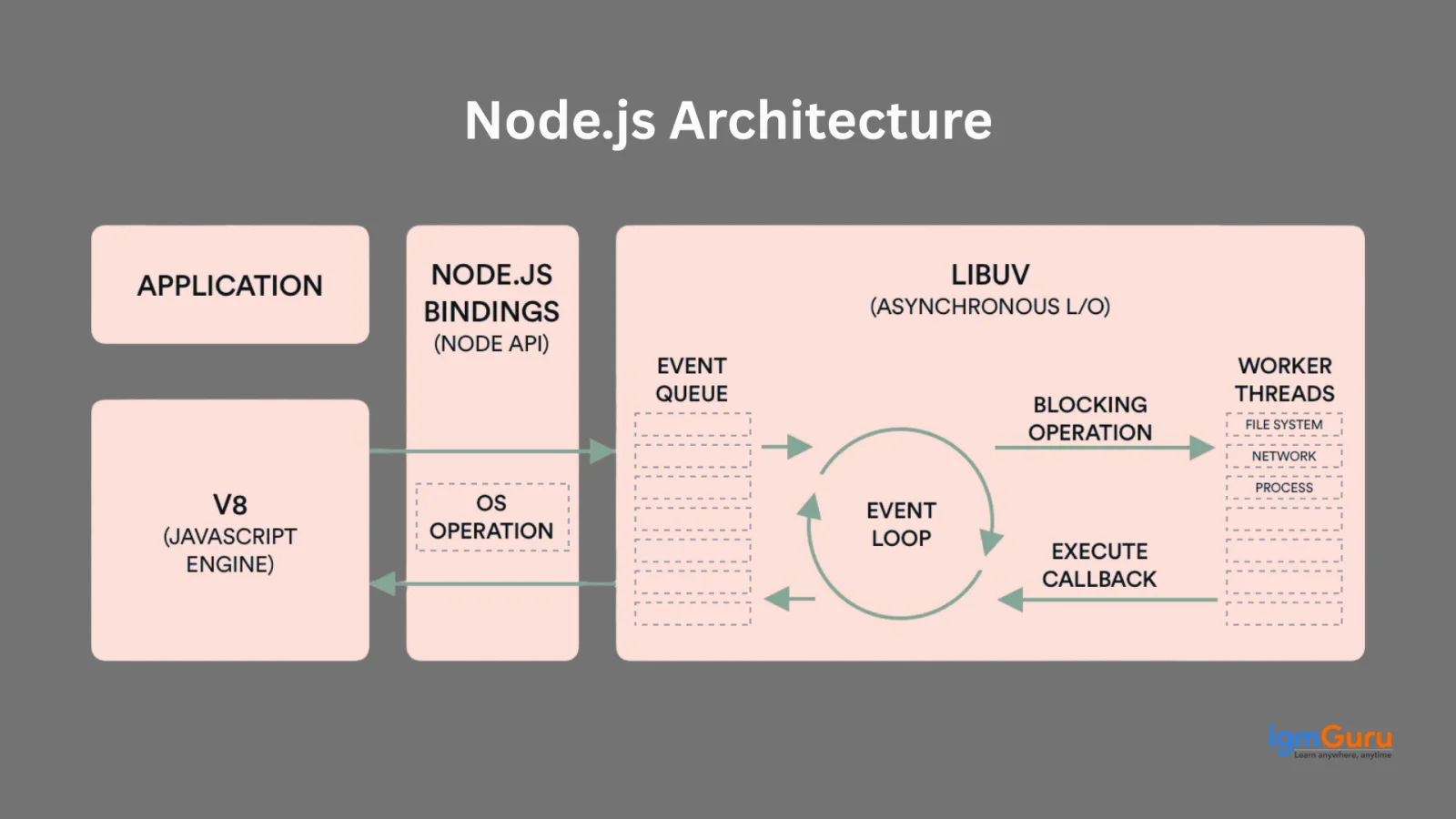
Node.js operates on a single-threaded, event-driven architecture, which is a fancy way of saying it's built to handle multiple tasks efficiently without getting bogged down. Unlike traditional servers that create a new thread for each incoming request (which can eat up memory and slow things down), it uses a single thread with an event loop. This loop processes tasks asynchronously, meaning it can handle one task while waiting for others to complete - like a chef preparing multiple dishes at once. The event-driven model relies on callbacks, promises, or async/await to manage tasks, making it ideal for I/O-heavy operations like reading files, querying databases, or streaming data. This architecture is why Node.js excels at real-time applications, such as live chats or collaborative tools, where speed and scalability are critical.
Read Also- Node.js Interview Questions
Node.js is a powerful multitool for developers, with applications across various domains:
Node.js works by running JavaScript with the V8 engine, which turns JavaScript into fast machine code. If you build an app with Node.js, you make a program that waits for things to happen, like someone asking for a page, and then answers.
Its main thing is that it doesn't stop and wait for tasks. Instead, Node.js starts a task, such as getting a file or info from a database, and then goes to the next thing. When the first task is done, it comes back to it. The event loop handles this by always checking for tasks waiting to finish. If someone uploads a big file, Node.js can still show web pages and handle other requests while the file is being uploaded. This keeps things running smoothly.
Read Also- Most in-demand Programming Languages
Node.js is packed with features that make it a go-to choice for developers building modern applications. Below, I'll explore its key features in detail, explaining why they matter and how they benefit developers.
Node.js is designed to handle asynchronous operations natively. Every I/O operation (e.g., reading files, querying databases, or making HTTP requests) is non-blocking, meaning the server doesn't wait for these tasks to complete. Instead, it uses an event-driven model where tasks are handled via callbacks or Promises. For instance, when a user uploads a file, Node.js can process other requests while the file is being read, making it ideal for real-time applications like video streaming or online gaming.
The V8 engine powers Node.js, compiling JavaScript directly into machine code for blazing-fast execution. This makes Node.js significantly faster than traditional interpreted languages like PHP or Ruby for certain tasks. For example, a Node.js server can handle API requests or process data-intensive tasks (like image resizing) with minimal latency, making it a favorite for performance-critical applications.
While Node.js runs on a single thread, its event loop and non-blocking I/O allow it to scale efficiently. It can handle thousands of concurrent connections with low memory and CPU usage. This scalability is why companies like Netflix and PayPal use Node.js for their high-traffic platforms. For CPU-intensive tasks (like complex computations), Node.js can offload work to a worker pool, ensuring the main thread remains free for handling requests.
This platform runs on Windows, macOS, Linux, and other operating systems, making it highly versatile. Developers can write code on one platform and deploy it on another without significant changes. This cross-platform support simplifies development and deployment, especially for teams working in diverse environments.
The Node Package Manager (NPM) is a treasure trove of over 2 million packages, offering pre-built solutions for nearly every use case. Need to connect to a MongoDB database? There's a package for that. Want to add authentication? There's a package for that too. This vast ecosystem accelerates development by letting developers or software engineers focus on building features rather than writing boilerplate code.
It follows a minimalist philosophy, providing only essential core modules (like fs for file operations or http for servers). Additional functionality can be added via modules, keeping the core lightweight. This modularity allows developers to build lean applications tailored to their needs, reducing bloat and improving performance.
Node.js shines in real-time applications like chat apps, collaborative tools, or live dashboards. Its event-driven nature and support for WebSockets (a protocol for two-way communication) make it perfect for applications requiring instant updates. For example, a stock trading app can push price changes to users in real time without overloading the server.
With Node.js, developers can use JavaScript for both client-side (browser) and server-side development. This eliminates the need to learn multiple languages, streamlining the development process. For instance, a developer can write a React front-end and a Node.js back-end, sharing code (like validation logic) between the two, which boosts productivity and reduces errors.
It has a vibrant community and is backed by the Node.js Foundation and major companies like IBM, Microsoft, and PayPal. This ensures regular updates, security patches, and a wealth of tutorials and resources. Whether you're a beginner or an expert, you'll find ample support to troubleshoot issues or learn new techniques.
Node.js is a natural fit for microservices architectures, where applications are broken into small, independent services. Its lightweight nature and fast startup time make it ideal for deploying microservices in containers (e.g., Docker). For example, a large e-commerce platform might use Node.js to handle user authentication, product catalog, and payment processing as separate microservices, improving scalability and maintainability.
Node.js has a lot going for it:
Node.js isn't flawless, though:
Read Also: Top Backend Languages For Web Development
No, Node.js is not a programming language, it's a runtime environment. JavaScript is a programming language, and Node.js provides the platform to execute it outside a browser. Think of JavaScript as the script and Node.js as the stage where it performs, enabling server-side tasks like handling HTTP requests or accessing databases.
It is primarily a backend technology, used to build server-side applications like APIs, databases, and file servers. However, its JavaScript roots make it a natural fit for full-stack development. Developers often pair Node.js with front-end frameworks like React, Angular, or Vue.js to create seamless, full-stack applications using a single language. This "JavaScript everywhere" approach simplifies workflows and reduces context-switching between languages.
Here are some real-world examples of Node.js in action:
This article 'what is Node.js' covers many important aspects that a developer should consider. This open-source, cross-platform is a powerhouse in modern web development, bridging the gap between front-end and back-end with JavaScript's versatility. Its speed, scalability, and vast ecosystem make it a go-to choice for everything from startups to tech giants. While it's not perfect for every task (like CPU-heavy workloads), its strengths in real-time, I/O-intensive applications are unmatched. Whether you're building a chat app, an e-commerce platform, or a microservice, this open-source, cross-platform offers the tools to get it done efficiently. If you're curious about coding or looking to level up your skills, Node.js is a fantastic place to start.
Yes! If you know basic JavaScript, Node.js is approachable, with tons of tutorials and a supportive community to guide you.
Definitely! Companies like Netflix, PayPal, and Walmart use it for large-scale, high-traffic systems.
Yes, it's open-source and free, with no licensing costs.
Unlike traditional servers (e.g., Apache), Node.js is lightweight, asynchronous, and uses JavaScript, making it faster for real-time tasks.
Absolutely. It works seamlessly with databases like MongoDB, MySQL, and PostgreSQL, thanks to dedicated NPM packages.
Node.js is used to build fast and scalable web applications. It’s ideal for real-time apps, APIs and server-side development using JavaScript.
Course Schedule
| Course Name | Batch Type | Details |
| Programming Language Certification Courses | Every Weekday | View Details |
| Programming Language Certification Courses | Every Weekend | View Details |