Quantum computers are no longer just a research topic. They are becoming real and they are getting stronger every year. This progress is exciting for science, but it creates a serious problem for digital security. The encryption that protects your emails, bank transactions and passwords today may not survive the quantum era. That is where post-quantum cryptography comes in.
In this guide, you will learn what post-quantum cryptography is, why it matters, how it works and what you can do to prepare for it. Let’s start!
Read Also: What Is Password Salting and How Does It Work?
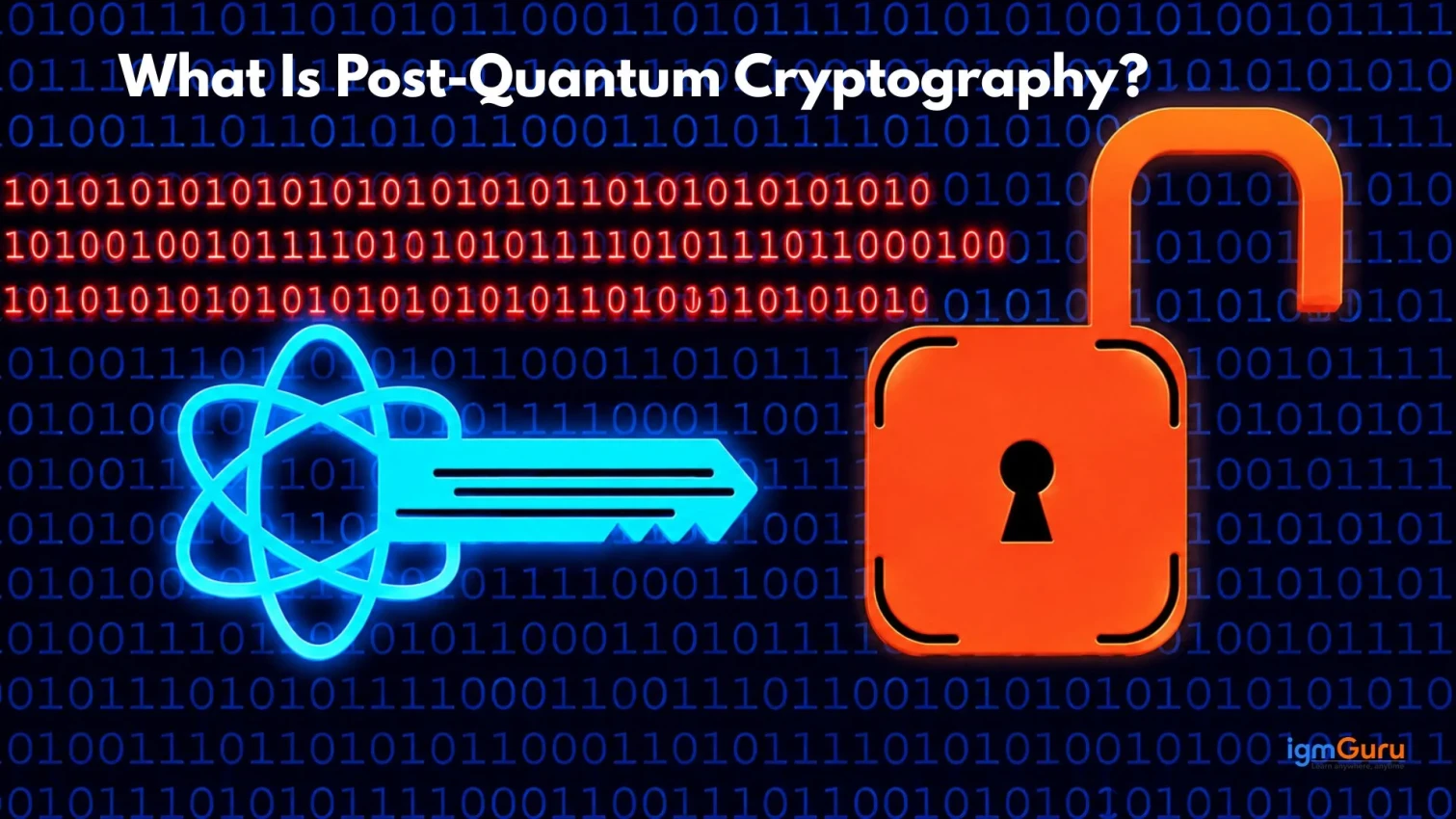
Post-quantum cryptography, or PQC, is a set of encryption methods built to resist attacks from quantum computers. These methods use math problems that are hard for both classical and quantum machines to solve. Unlike traditional encryption, which quantum computers can eventually break, PQC is designed to stay secure even after powerful quantum machines arrive.
In Simple words, you can say that PQC is a new type of encryption designed to protect data from future quantum computers, which could break today's encryption methods much faster than regular computers.
PQC is not quantum technology itself. It runs on the same classical computers, servers and devices we use today. The word "post-quantum" simply means it protects data in a world where quantum computers exist and are powerful enough to attack current encryption.
Most of today's encryption relies on math problems that are extremely difficult for regular computers to solve. Two examples are RSA and Elliptic Curve Cryptography, or ECC. These systems protect everything from online banking to secure messaging apps.
The problem is Shor's algorithm. This is a quantum algorithm that can solve the exact mathematical problems on which RSA and ECC depend. A large enough quantum computer running Shor's algorithm could break these encryption systems in a fraction of the time a classical computer would need. Grover's algorithm adds another layer of risk, since it speeds up attacks on symmetric encryption too, though it needs a smaller boost to stay safe.
Quantum computers capable of this kind of attack do not fully exist yet. Experts call a machine powerful enough to break current encryption a Cryptographically Relevant Quantum Computer, or CRQC. But the threat is not just about the future. It is about the present too.
Attackers do not need a quantum computer today to cause damage tomorrow. They can collect encrypted data right now, store it and wait. Once quantum computers become powerful enough, they can decrypt that stored data. This strategy is known as harvest now, decrypt later.
This risk is especially serious for information that needs to stay private for a long time. Medical records, government secrets, financial data and intellectual property often need protection for decades. If that data gets stolen today, it could still be exposed years from now. This is the main reason organizations are moving to post-quantum cryptography early, instead of waiting for quantum computers to become a real threat.
Post-Quantum Cryptography sound similar, but they solve security in completely different ways. Quantum Cryptography uses the principles of quantum physics to securely exchange encryption keys, while Post-Quantum Cryptography creates new encryption algorithms that can resist attacks from future quantum computers using today's devices.
People often mix up these two terms, so let me clear this up.
| Feature | Post-Quantum Cryptography (PQC) | Quantum Cryptography (QC) |
| What is it? | A new type of encryption designed to protect data from future quantum computers. | A communication method that uses the laws of quantum physics to exchange encryption keys securely. |
| Purpose | Protects today's encrypted data from being broken by quantum computers. | Ensures encryption keys are exchanged securely without interception. |
| How does it work? | Uses advanced mathematical algorithms that quantum computers are expected to find difficult to break. | Uses quantum particles (such as photons) to detect if someone tries to intercept the communication. |
| Requires Quantum Computer? | No. It works on existing computers, servers and smartphones. | No, but it requires specialized quantum communication hardware. |
| Hardware Needed | No special hardware is required. | Requires quantum devices like photon transmitters and receivers. |
| Deployment | Can be implemented by updating existing software and security protocols. | Requires dedicated quantum communication infrastructure, making deployment more expensive. |
| Main Advantage | Easy to adopt because it works with current systems while providing protection against future quantum attacks. | Extremely secure key exchange because any eavesdropping attempt is immediately detectable. |
| Limitation | New algorithms are still being standardized and gradually adopted worldwide. | High cost, limited communication distance and specialized hardware requirements. |
| Common Use Cases | Websites (HTTPS), banking, cloud security, VPNs, email encryption, digital signatures and government systems. | Highly secure military communications, government networks, financial institutions and scientific research. |
| Real-Life Example | A bank upgrades its online banking encryption to stay secure against future quantum computers. | Two government offices use a quantum communication network to exchange encryption keys securely. |
Also Read: What is Phishing?
PQC replaces the math problems in current encryption with new ones that quantum computers cannot solve efficiently. Researchers have studied several approaches and each one builds security on a different kind of hard problem.
This is the most widely used approach in modern PQC. It relies on problems involving lattices, which are grid-like mathematical structures in multiple dimensions. Finding certain values within these structures is extremely hard, even for quantum computers. Lattice-based methods offer a strong balance of speed, security and manageable key sizes, which is why most NIST-selected algorithms use this approach.
This method builds digital signatures using cryptographic hash functions. Hash functions are already well understood and trusted, so this approach offers a very conservative and reliable security foundation. The tradeoff is that signatures tend to be larger and slower compared to lattice-based options.
This approach uses error-correcting codes, a concept originally developed to fix data during transmission errors. The McEliece cryptosystem is a well-known example. It has been studied for decades and remains resistant to known quantum attacks, though it needs larger key sizes.
These methods use complex systems of equations or elliptic curve structures. They are less commonly used today, since some multivariate and isogeny-based schemes have been broken during testing. This shows why real-world evaluation matters before any algorithm gets trusted at scale.
The National Institute of Standards and Technology, or NIST, has led the global effort to standardize post-quantum cryptography. This process took eight years and involved cryptographers from around the world submitting and testing algorithms.
In August 2024, NIST finalized three major standards.
1. ML-KEM (FIPS 203): It is a key encapsulation mechanism based on lattices and CRYSTALS-Kyber. It replaces RSA and ECDH for secure key exchanges, i.e. establishing a shared key between two parties.
2. ML-DSA (FIPS 204): It is a digital signature algorithm based on lattices and CRYSTALS-Dilithium. It replaces RSA and ECDSA signatures, which are used for identity verification and data integrity.
3. SLH-DSA (FIPS 205): It is a digital signature algorithm based on hashing and SPHINCS+. It is a backup option, because its security is based only on hash functions and not lattice problems.
NIST later selected HQC as an additional key encapsulation standard, giving organizations another code-based option alongside ML-KEM. These standards give governments, businesses and software vendors a clear and trusted path to follow during migration.
Related Article: What Is a Firewall?
You might think this is only a concern for governments and tech giants, but that is not true. Every organization that handles sensitive data needs to pay attention to PQC. Here is why it matters across industries:
Banks, insurance companies and payment providers rely on encryption to secure online transactions, customer account details, payment card information and digital identities. A successful attack on these systems could result in financial fraud, data breaches and loss of customer trust.
Hospitals, clinics and healthcare providers store highly sensitive patient information, including medical histories, diagnostic reports, insurance records and research data. Since medical records often need to remain confidential for decades, organizations must adopt encryption that can withstand future quantum attacks.
Government agencies handle classified documents, national security information, citizen records and critical infrastructure data. Many of these records remain sensitive for decades, making them a primary target for "harvest now, decrypt later" attacks. PQC helps ensure this information stays protected well into the future.
Cloud service providers, SaaS companies and enterprise software vendors manage encryption keys that secure millions of users, applications and databases simultaneously. Migrating to post-quantum cryptography is essential to maintain trust, safeguard customer data and ensure long-term platform security.
Manufacturers and IoT companies produce connected devices that often remain in service for 10 to 20 years. These devices rely on secure firmware updates, encrypted communication and device authentication. Without quantum-resistant encryption, connected products could become vulnerable during their operational lifetime.
Telecom providers secure internet traffic, mobile communications and network infrastructure using cryptographic protocols. As 5G, 6G and connected ecosystems continue to grow, adopting PQC will help protect communication networks against future quantum-enabled cyber threats.
Online retailers process customer payments, personal information and order histories every day. Post-Quantum Cryptography can help ensure that payment systems, customer accounts and transaction data remain protected even as quantum computing evolves.
If any of these sectors delay their transition, they risk exposing sensitive data once quantum computers mature. Waiting is not a safe strategy, since migration itself takes significant time and planning.
Moving to PQC is not as simple as flipping a switch. Organizations face several real challenges during this transition.
1. Legacy system compatibility creates friction, since many older systems were not built to support new algorithms or larger key sizes.
2. Performance trade-offs can appear, since some post-quantum algorithms require more computing power, memory, or bandwidth compared to older methods.
3. Many organizations lack complete visibility into where encryption is implemented, making inventory gaps a common cause of slower team operations.
4. Standardization timing adds uncertainty, since some algorithms and use cases are still being finalized, which means best practices continue to evolve.
Despite these challenges, the shift to PQC is achievable with the right planning and the right priorities.
You do not need to migrate everything in one night. A structured approach works best.
1. Create a cryptographic inventory: Identify where and how your organization uses encryption, including software, devices, and third-party services.
2. Prioritize sensitive and long-lived data: Focus first on information that needs protection for many years, since this data faces the highest harvest-now, decrypt-later risk.
3. Adopt crypto-agility: Build systems that can switch algorithms easily, instead of hardcoding one encryption method permanently.
4. Test hybrid approaches: Many organizations combine classical and post-quantum algorithms during the transition period, which adds a safety net while confidence in new standards grows.
5. Follow NIST guidance: Stay updated with NIST publications and industry best practices, since standards and recommendations continue to develop.
6. Train your security team: Make sure the people managing your infrastructure understand PQC concepts and migration steps.
Starting early gives your organization time to test, adjust and roll out changes without rushing under pressure later.
Also Read: Growing Demand For Blockchain Developer
Post-quantum cryptography is not a distant, futuristic concept anymore. It is a practical response to a real and growing threat. Quantum computers may still be a few years away from breaking current encryption, but the harvest now, decrypt later risk means the time to act is now, not later.
Understanding what post-quantum cryptography is gives you a strong starting point. The next step is assessing your own systems, understanding where sensitive data lives and building a roadmap toward quantum-safe security. Organizations that start early will be far better prepared when the quantum era truly arrives.
Yes. NIST has already published finalized standards and major browsers, cloud providers and operating systems have started rolling out support for post-quantum algorithms.
No, not yet. Today's quantum computers are not powerful enough to break RSA or ECC. However, experts expect this capability to arrive within the coming years, which is why early preparation matters.
No. Post-quantum cryptography uses classical computers and new math problems. Quantum encryption, like QKD, uses quantum physics and specialized hardware.
Some algorithms require more processing power or larger keys than older methods. However, ongoing optimization continues to close this performance gap.