Passwords are the key or we can say the first line of protection to our data, money, identity or any sensitive digital information. Whether it is your system, a bank account, a website, or a digital business asset, it needs a strong password that can save it from unethical access. But these passwords can also be tampered with by hackers.
This is where we need methods like Password Salting. It is a Hashing type method that secures the stored password, so no one can access them through malicious activities. It is also a must-learn skill for cybersecurity professionals and administrators. Do you know what it is?
I will explain everything in this guide, from what is password salting to its importance, working, benefits, and more. We will also learn how you can implement it in a real-world scenario using the best practices. Let’s begin with the simple definition!
Also Read: Best Cybersecurity Tools in 2026
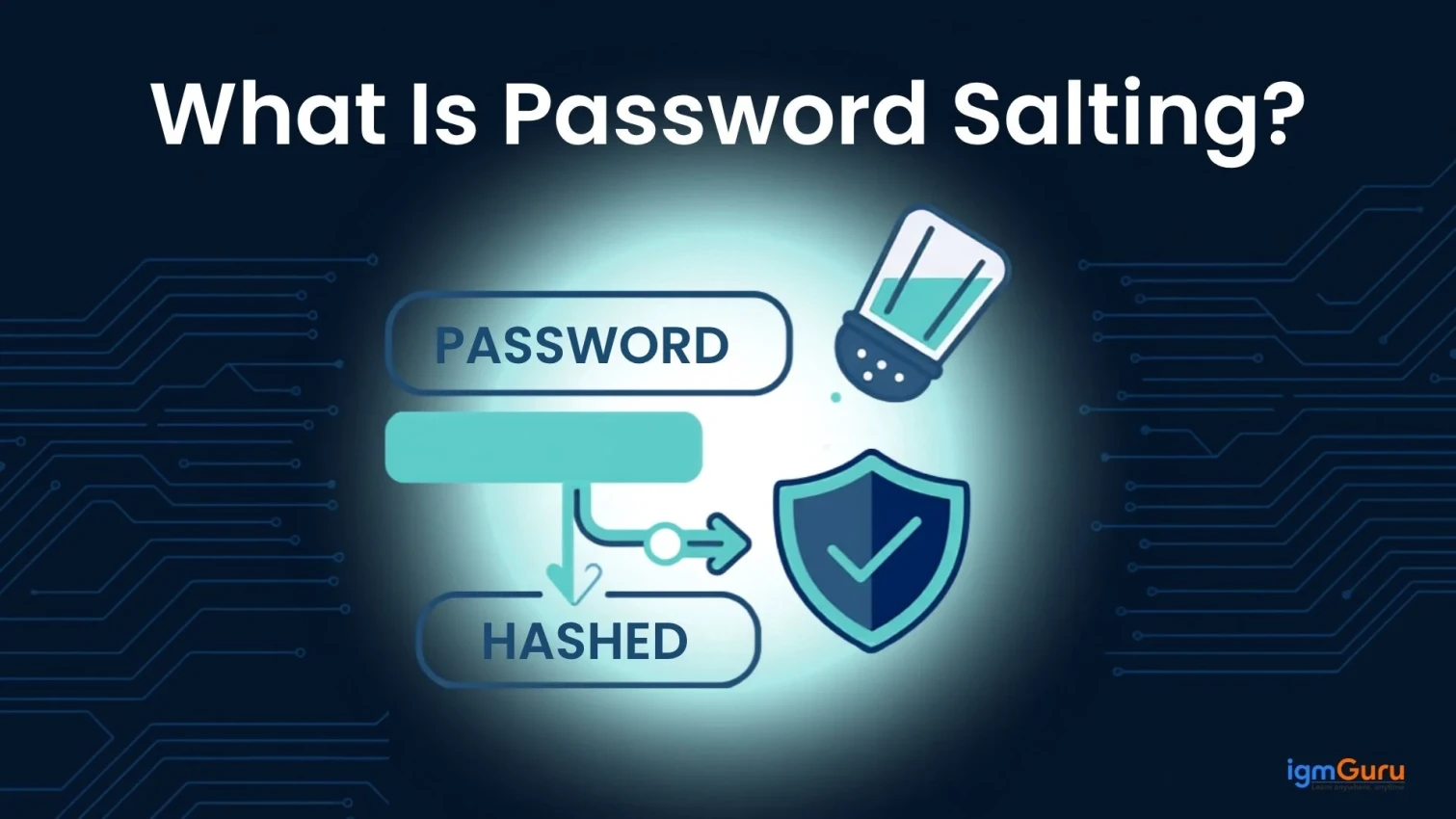
Password Salting is a security technique where a random and unique string of data called a "salt" is added to a user's password before it is hashed and stored in a database. It is a core concept in cryptographic security and almost every modern authentication system, from banking apps to social media platforms, relies on it to protect user credentials.
Let me make it simple for you. Imagine two people both use the password sunshine123. Both of these passwords will produce the exact same hash in the database without salting. This means if a hacker got one, he actually has two. On the other hand, salting gives a unique random value added to the password before hashing. This means the identical passwords will produce completely different hashes. Two people, same password, totally different stored values, which means the hacker's shortcut is gone.
The salt itself is not a secret key or something. It is stored alongside the hash in the database. Its job is not to be hidden. Its job is to make every hash unique and unpredictable that destroys any pattern a hacker could exploit.
Understanding the importance of password salting is essential before getting deeper insights. Well, it is not just useful but critical. Let’s explore the key reasons:
Implementing password salting is one of the backend practices that is visible to the end-user but gives protection. This is one of the best practices for platforms that come under banking and finance. Users also trust platforms that take security seriously.
Read Also: What is Imperva? A Guide For Beginners
Let me break down the entire process from the moment a user creates a password to the moment they log in again. It will make you understand how the complete process works.
When you create a new password, the system first generates a random string of characters called a salt. This salt is unique for every user created using a cryptographically secure random number generator. Even if two users choose the same password, their salts will be different.
Example:
The system then combines the original password with the generated salt. This salt will be added anywhere based on implementation. It may be added before, after or around the password.
Example:
This combined value becomes the input for the hashing algorithm.
Now the combined password and salt are passed through a secure hashing algorithm such as bcrypt, Argon2, PBKDF2 or scrypt. The algorithm converts the input into a fixed-length hash that cannot be reversed.
Example:
Here, even changing a single character in either the password or the salt produces a completely different hash.
Related Article: What is Ethical Hacking?
Now the system will store both the salt and the resulting hash in the database. This means your original password is never stored.
| Username | Salt | Stored Hash |
|---|---|---|
| John | X9kL2mP7 | 8f3b5c4d2a91e7d6c4b2f9a8e1d3f7... |
Here you might be thinking why the salt is stored alongside hash. Well, the salt is not secret, which means there is no security issue. Its purpose is to ensure that identical passwords produce different hashes.
Now comes the login part. When you enter the password, the system will retrieve the stored salt from the database and combine it with the entered password in the same way as before. It then hashes the result using the same algorithm.
If the newly generated hash matches the stored hash, the password is correct and the user is authenticated. If the hashes do not match, the login attempt is rejected.
Example:
Now you can see both hashes are the same, so the user can log in the system or account. These are the five steps where password salting ensures that even if attackers obtain the database, identical passwords cannot be easily identified and precomputed attacks like rainbow tables become ineffective.
Also Read: How to Become an Ethical Hacker?
Password salting is specifically designed to shut down certain types of attacks that are usually dangerous for unsalted hashing. Here are the main threats it protects against.
A rainbow table is a massive precomputed database that maps common passwords to their hash values. A hacker who steals a database just looks up the hash and instantly knows the password without any cracking needed.
Salting defeats this completely as the salt changes the input to the hash function. This means none of the precomputed entries in a rainbow table will ever match a salted hash. The attacker would need to rebuild a rainbow table per salt which is computationally impossible at scale.
A dictionary attack is really a hard working task. Here, a hacker takes a list of common passwords like password123 or qwerty and hashes each one, then compares them against stolen hashes.
Salting neutralizes this completely as every stored hash was produced with a unique salt. This means the attacker's dictionary hashes will never match. They would have to rehash the entire dictionary for every unique salt in the database.
Brute force attacks are not joke. It is a complete system that tries every possible combination of characters until the password is found. Even the salting does not stop brute force attempts entirely.
But if we combine it with a slow hashing algorithm like bcrypt or Argon2, it makes brute force attacks computationally expensive and time consuming. The system is still vulnerable to this attack, but the time the hacker will take often goes in years.
Credential stuffing involves taking leaked username and password pairs from one breach and trying them on other websites. It is just based on luck, but can be an issue if the attacker got succeeded. The feature of creating different hash for identical passwords wins here. It significantly limits how useful a stolen hash database can be in a credential stuffing campaign.
Read Also: CIA Triad: What Is It and Why Does It Matter?
Password salting is not just a hype. There are many benefits that make it an important practice for both individuals and organizations. Here are some of the common ones:
Related Article: Expert Tips on How to Pass CCSP Certification Exam?
This method is indeed a great practice, but it comes with many challenges. The challenges generally appear due to poor implementation of the technique. Here are some of the common ones:
Read Article: What is the Importance of Cybersecurity?
The challenges mentioned above clearly shows that password salting must be implemented carefully. If not, the system can be vulnerable to many cyber threats. Here are the best practices every developer or security professional should follow.
They should never use predictable values like timestamps, usernames, or sequential numbers as salts. The best thing is to use a cryptographically secure random number generator. In Python, that is os.urandom() or the secrets module.
There should not be any compromise with salt. Every user must get their own unique salt. Their salt should also change with the password. You can do it by making them at least 16 bytes or 128 bits length. The size guarantees unique salt for each user.
Basic hashing algorithms like MD5, SHA-1, or SHA-256 for passwords is not a good practice. The is recommended to use slow, memory hard algorithms designed specifically for password storage like bcrypt, Argon2, PBKDF2, or scrypt.
Good password libraries like bcrypt automatically embed the salt into the output hash string so you store one combined string per user and do not need to manage salt storage manually.
Here is a simple example in Python using bcrypt:
|
Notice that you do not manage the salt manually here. bcrypt.gensalt() handles generation and hashpw() embeds it in the output. This is exactly how it should be done.
Related Article: What Is SailPoint?
Password salting secures how passwords are stored where modern authentication has evolved to go beyond just passwords. Here is how salting fits in the bigger picture.
| Method | What It Does | Replaces Salting? |
|---|---|---|
| Password Salting | Secures stored password hashes | No, it is foundational |
| Multi-Factor Authentication (MFA) | Adds a second verification step | No, it complements salting |
| OAuth / SSO | Delegates authentication to a trusted provider | Partially, the provider handles password storage |
| Passkeys (FIDO2/WebAuthn) | Replaces passwords entirely with cryptographic keys | Yes, no password to store means no salting needed |
| Zero-Knowledge Proofs | Proves password knowledge without transmitting it | No, salting still protects server-side storage |
The trend is clearly moving toward passwordless authentication with passkeys, biometrics, and hardware tokens. But passwords are still dominant in the real world and for any system that stores them, salting remains non-negotiable.
Also Read: What is Network Security?
These three terms often get confused with each other. They are related but they serve very different purposes.
| Base | Hashing | Encryption | Salting |
|---|---|---|---|
| Definition | One-way conversion of data to a fixed-length digest | Two-way conversion, data can be decrypted | Adding random data to input before hashing |
| Reversible? | No | Yes, with the key | No |
| Primary Use | Password storage, data integrity | Data transmission, file protection | Strengthening password hashing |
| Key Required? | No | Yes | No |
| Example Algorithms | SHA-256, bcrypt, Argon2 | AES, RSA | Applied before bcrypt, Argon2, etc. |

Both salt and pepper are security techniques added to passwords before hashing but they behave very differently from each other.
| Base | Salt | Pepper |
|---|---|---|
| What it is | Random value unique per user | Secret value shared across all users |
| Where it is stored | In the database alongside the hash | Not in the database, stored in an environment variable or secret vault |
| Is it a secret? | No, it is stored openly | Yes, it must remain secret |
| Purpose | Prevents rainbow tables and mass cracking | Adds an extra layer even if the database is breached |
| Required? | Yes, industry standard | No, but recommended for high security systems |
Both of these practices are generally used collectively. The salt ensures each password hash is unique. The pepper ensures that even if your entire database is stolen, the attacker still cannot crack the passwords without also knowing the pepper which lives outside the database entirely.
Related Article: What is CCSP? Everything You Need To Know
Password salting is one of the best security practices that is easy to implement but provides great protective power. It directly mitigates the issue of rainbow table attacks, dictionary attacks and credential stuffing attempts. You just have to follow the best practices while implementing it.
This skill is mostly useful for both developers and cybersecurity professionals. If you also are also one of them or want to become one of them, you must also master the skill. It will help you impress the interviewers.
Salting is a process of adding unique random characters to a password before it gets scrambled into a code. This stops hackers from using pre-made lists to guess stolen passwords all at once.
A salt is a secret, random string of data created for each individual user account. It mixes with your password so that even identical passwords look completely different in a database.
This rule says to combine three random, unrelated words together to make a long passphrase. It is much easier for humans to remember but very hard for computers to guess.
Make it long by using at least twelve characters and mix in uppercase and lowercase letters. Add numbers, use special symbols, and never reuse the same password on different websites.