Want to Learn More About ML Models?
Dive Into Our Machine Learning Tutorial and Master Each concepts step by Step.


Most of the industries around the globe rely on ML (Machine Learning) models. These models brought transformation to how businesses function and prevail in the market. As per the latest trends of ML, the market is projected to grow at a CAGR of over 35% each year, reaching a total value of around $700 billion by 2033, according to leading industry forecasts. (NOTE: Please update this $700 billion projection with a verified number from a 2024/2025 market report to ensure complete accuracy.)
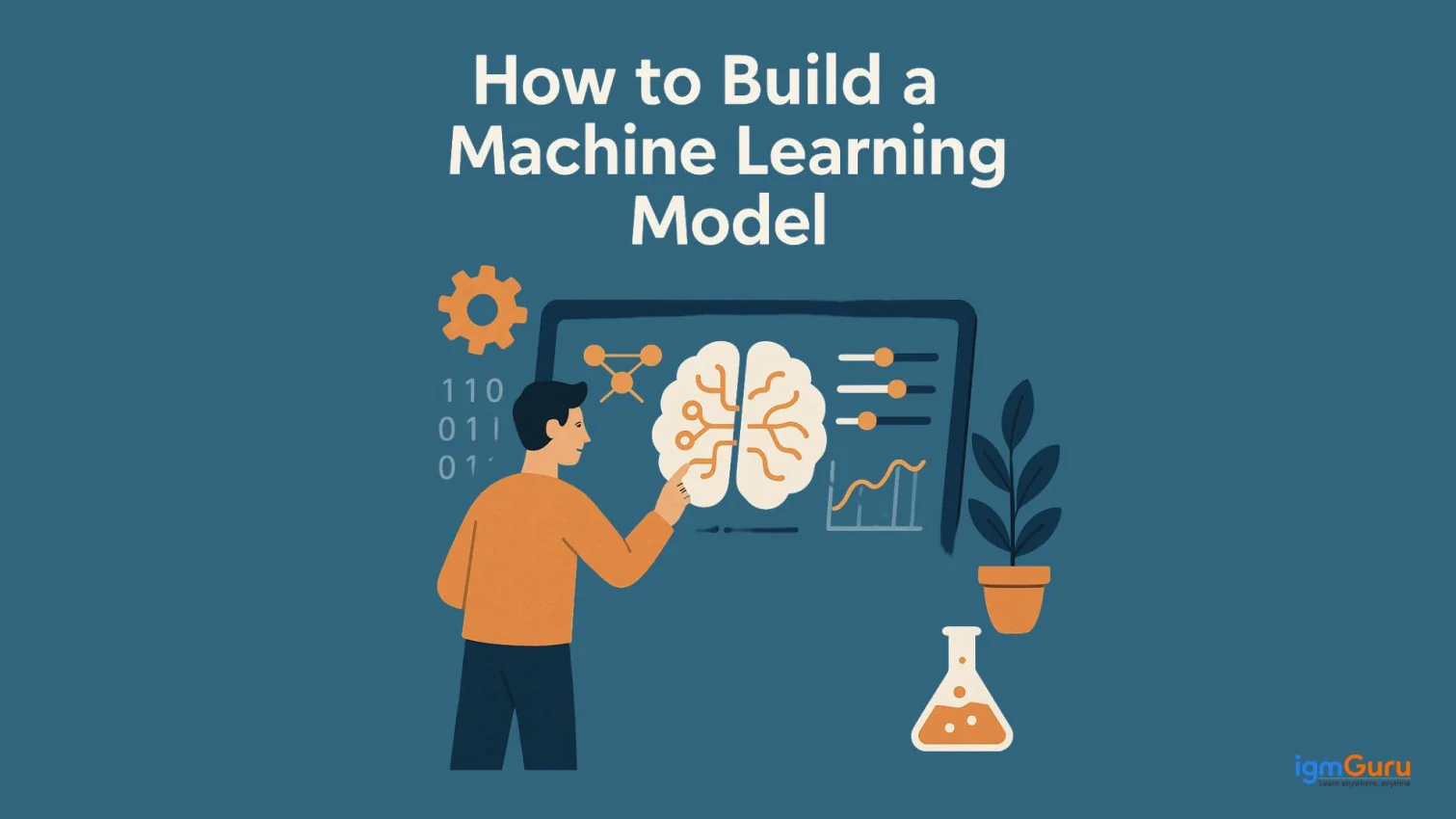
This article is curated to provide a comprehensive guide on how to build a machine learning model—from conceptual fundamentals to modern MLOps deployment. Let's get into it.
Explore igmGuru's Machine Learning Training program to become ML experts.
A machine learning model is a computational program that spots patterns or comes up with predictions using data. It is built by feeding a machine learning method a bunch of data, which lets it learn and make generalizations. Lots of fields use these models, such as medicine, banking, and shopping, to do jobs automatically, make better calls, and get useful info.
Before understanding how to build a machine learning model, you need to grasp its fundamentals. Machine learning is an integral subset of artificial intelligence, revealing concealed patterns within datasets through its algorithms. Its applications are widespread, including fraud detection, automating tasks, and speech recognition.
The main aim is to bring a revolution where machines learn from data to predict outcomes. Here are the key learning paradigms:
Supervised learning is all about teaching a model using labeled data. The algorithm maps input features ($X$) to known output labels ($Y$), such as classifying an email as 'spam' or predicting a house price. Common methods include Linear Regression and Support Vector Machines (SVMs).
Unsupervised learning works with data that doesn't have labels. Algorithms try to find inherent patterns or hidden structures on their own, often used for data compression or segmentation. Common methods include Clustering algorithms (K-means) and Dimensionality Reduction techniques (PCA).
Reinforcement learning is a type of machine learning where an agent learns to make decisions by interacting with its environment and figuring things out through trial and error. It uses a system of rewards and penalties, often applied in robotics, autonomous navigation, and gaming (e.g., AlphaGo).
SSL is a modern paradigm where the data itself provides the supervision. The model generates labels from the input data (e.g., predicting a masked word in a sentence) and trains on those automatically generated labels. This approach has been revolutionary for large models like BERT and GPT (Large Language Models), allowing them to learn massive amounts of context from unlabeled text.
This section details the structured, practical process for building a reliable ML model, often following the CRISP-DM or similar methodology. For demonstration, we'll use a simple classification problem.
The process begins with defining the project's goal and securing a high-quality, relevant dataset. The foundation of a reliable model is high-quality data. Define the output variable (the $Y$ you want to predict) and the input variables (the $X$ features).
Key Activities
Raw data is almost never clean. This crucial step involves tidying up the raw data and transforming it into a format suitable for training. It aims at removing unnecessary values and optimizing the data for the model's performance.
Key Activities
Checking for and imputing missing values in a numerical column:
|
Choosing the right model is determined by the problem type (e.g., classification, regression, or clustering) and the nature of your data (size, complexity, linearity). You must balance prediction power with interpretability and training speed.
Key Activities
The core training phase uses the preprocessed data to teach the algorithm. Before training, the data is split into Training (to teach the model) and Validation/Test sets (to evaluate it). The algorithm then adjusts its internal parameters to minimize the error (loss function).
Key Activities
Splitting data and training a simple Logistic Regression model:
|
This step assesses the model's capabilities using the unseen Test Data to ensure it generalizes well. A model that performs perfectly on training data but poorly on test data is overfit.
Key Activities
A key requirement for modern ML is understanding why a model makes a decision. Techniques like SHAP (Shapley Additive exPlanations) or LIME (Local Interpretable Model-agnostic Explanations) are used to explain individual predictions and the overall feature importance.
After initial evaluation, the model needs refinement. This involves adjusting hyperparameters—settings external to the model that are set before training (e.g., learning rate, regularization strength).
Key Activities
Before launching, it's critical to check the model's performance across different subgroups (e.g., gender, age, or region). If a model performs significantly worse for one group, it is biased and must be corrected—a key requirement for ethical and regulatory compliance in global markets.
Finally, the model is prepared for real-world use. This final step moves the trained model into a production environment, where it can serve real-time predictions.
Key Activities
The process of creating a robust machine learning model is an iterative cycle requiring effort from precise data collection to rigorous evaluation and deployment. By mastering these 7 steps, especially the modern demands of MLOps and interpretability, you gain the expertise required to successfully build a machine learning model capable of solving complex real-world problems.
Yes, ChatGPT is a segment of machine learning. It's an LLM (Large Language Model) based on deep learning, specifically trained using the Self-Supervised Learning paradigm.
The applications of machine learning are spread across distinct sectors. Some of its main applications include autonomous vehicles, predictive analysis, speech and image recognition, and personalized recommendation systems.
The key types of machine learning models include Supervised, Unsupervised, Reinforcement, Semi-Supervised, and Self-Supervised learning.
Popular tools to build a machine learning model are Python, Jupyter Notebook, scikit-learn, TensorFlow and pandas, as they simplify data processing, training and evaluation.