Artificial Intelligence, more commonly referred to as AI, is a transformative part of new technology trends. It holds the ability to revolutionize multiple facets of our lives. AI is a simulation of human intelligence in machines, crafted to learn and think like humans. These intelligent systems undertake tasks that usually require human intelligence, such as speech recognition, visual perception, language translation and decision-making.
AI roots go back to the 1950s, when pioneering computer scientists such as John McCarthy and Alan Turing started exploring concepts of machines that could simulate human intelligence. Since then, AI has evolved significantly, driven by advancements in neural networks, big data and machine learning. It covers subfields such as robotics, computer vision and natural language processing.
AI's capability to analyze huge amounts of data at high speed is one of its most compelling aspects. It helps uncover insights and patterns that humans might overlook, leading to breakthroughs in industries like finance, transportation and healthcare.
Artificial Intelligence simulates human intelligence within machines that can learn, solve problems and make decisions. It comprises technologies ranging from machine learning models to rule-based systems, enabling computers to perform tasks traditionally requiring human cognition. These include recognizing patterns, understanding natural language, learning from experience and making decisions.
AI is built on subfields including machine learning, neural networks and natural language processing. Machine Learning enables systems to learn from data, neural networks imitate the structure of the human brain and NLP helps machines understand human language. AI continues to evolve and promises to transform industries while posing societal and ethical challenges.
The idea of intelligent machines began in the mid-20th century. In 1950, Alan Turing introduced the Turing Test to evaluate whether a machine could exhibit human-like intelligence. This marked the early development of AI.
The term "artificial intelligence" was coined in 1956 at the Dartmouth Conference, considered the birthplace of AI research. The 1960s and 1970s saw AI research flourish, leading to symbolic AI and early neural networks.
The 1980s brought expert systems, using knowledge-based approaches to solve domain-specific problems. Funding later declined due to limited computing power and data.
AI surged again in the 1990s and 2000s with improvements in machine learning and access to large datasets. Deep learning further enhanced AI’s abilities in speech and image recognition. Today, AI drives innovation across domains such as healthcare, autonomous systems and finance.
Artificial intelligence is extremely important as it holds the potential to change almost every aspect of industries and our lives. It drives innovation, new possibilities and efficiency. AI is so important because-
AI automates everyday processes and tasks. This allows humans to work on more creative and complex aspects of their work. For instance, in manufacturing, AI-driven robots work on repetitive tasks with speed and precision. This reduces errors and production time. AI tools can easily handle administrative tasks in offices. These include data entry and scheduling.
AI systems analyze enormous data amounts rapidly and accurately. These offer insights that aid individuals and businesses in making informed decisions. AI algorithms are used to analyze medical records in healthcare. These can recommend personalized treatments, assist in diagnostics and predict disease outbreaks. AI models may assess credit risks and detect fraudulent transactions more effectively in finance.
AI facilitates highly customized user experiences. For instance, in e-commerce, these algorithms recommend products as on the individual's browsing history and preferences. This enhances customer satisfaction and increases sales. In the entertainment domain, streaming platforms like Spotify and Netflix employ AI to suggest content as per users' preferences.
AI works with complicated problems that go beyond human capabilities. For example, in climate science, these AI models are used to predict climate changes and weather patterns with high accuracy. These help in environmental protection and disaster preparedness. In scientific research, it fastens the discovery process by analyzing major datasets and finding patterns.
AI enhances security and safety in multiple domains. In cybersecurity, AI systems may detect as well as respond to threats in real-time. This helps in protecting infrastructure and sensitive data. In the transportation field, AI powers autonomous vehicles, which reduces the chances of accidents otherwise caused by human error.
AI is a big name that's affecting economic growth. It has created many new job opportunities, especially in various tech industries. It has initiated innovation across many sectors. Various businesses utilize AI technologies to gain a competitive edge, which helps in boosting profitability and productivity.
Read Also- What is AI Project Cycle? Everything You Need To Know
Artificial intelligence depends on core concepts and technologies that allow machines to do tasks that need human intelligence. Read on to know the core concepts of AI.
ML is basically a subset of AI, focusing on developing systems that can learn from and make decisions derived from the data. ML models make use of algorithms for identifying patterns in data and improving their performance with time without any human intervention.
Our very own GenAI is designed for creating new content, whether it's text, images, music, or video. Unlike native artificial intelligence, which only focuses on analyzing and differentiating data, Generative AI goes a step further through patterns it learned from huge datasets to create the latest original outputs. Basically, it 'creates' instead of just 'recognizing'.
NLP permits machines to understand and interact with human language in a natural way. It allows speech recognition systems such as Siri or Alexa to interpret what we say and respond suitably. NLP blends linguistics and computer science to assist computers in working, understanding and creating human language, permitting for tasks such as language translation, sentiment analysis, and real-time conversation.
The expert systems are created to stimulate the decision-making capability of human experts. These systems make use of a set of predefined 'if-then' rules and knowledge from specialists in particular sectors for making informed, similar decisions to how a medical expert would diagnose an illness. Expert systems are useful in sectors where expert knowledge is essential but isn't easily accessible.
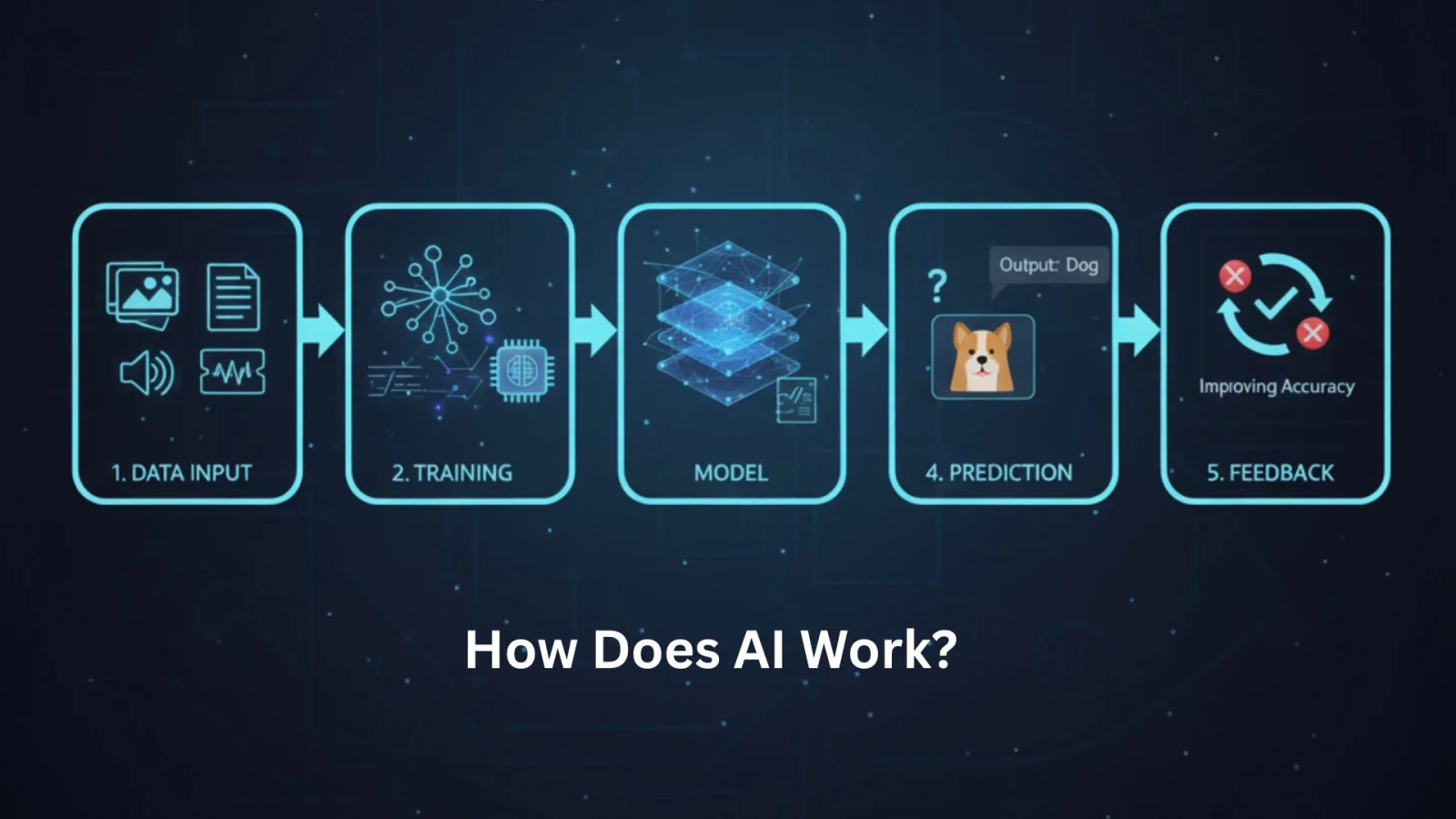
AI systems learn from large datasets, recognizing patterns and relationships that humans may miss. Learning involves algorithms that follow rules guiding analysis and decision-making.
Machine learning models train on data (labeled or unlabeled) to classify or predict outcomes. Deep learning uses neural networks with multiple layers to process complex data.
The AI systems depend on huge datasets, which might involve images, text or sensor readings. For instance, teaching AI to identify dogs, we gather a dataset of labeled dog images.
Artificial intelligence makes use of algorithms for analyzing data and identifying patterns. For instance, it learns to identify main features like a dog's shape, ears or whiskers, assisting it to understand the data.
The artificial intelligence model is trained on the data, adjusting its internal settings to improve its predictions. Through more data, the model becomes more accurate and better at identifying the latest examples, such as unseen images of dogs.
Once it is trained, AI can use what it has learned for decision-making. For instance, it can determine whether a new image has a dog depending on the patterns it learned while getting trained.
AI can improve via feedback, especially in methods such as reinforcement learning. Here, artificial intelligence gets rewards or penalties, improving its capability to make better decisions with time.
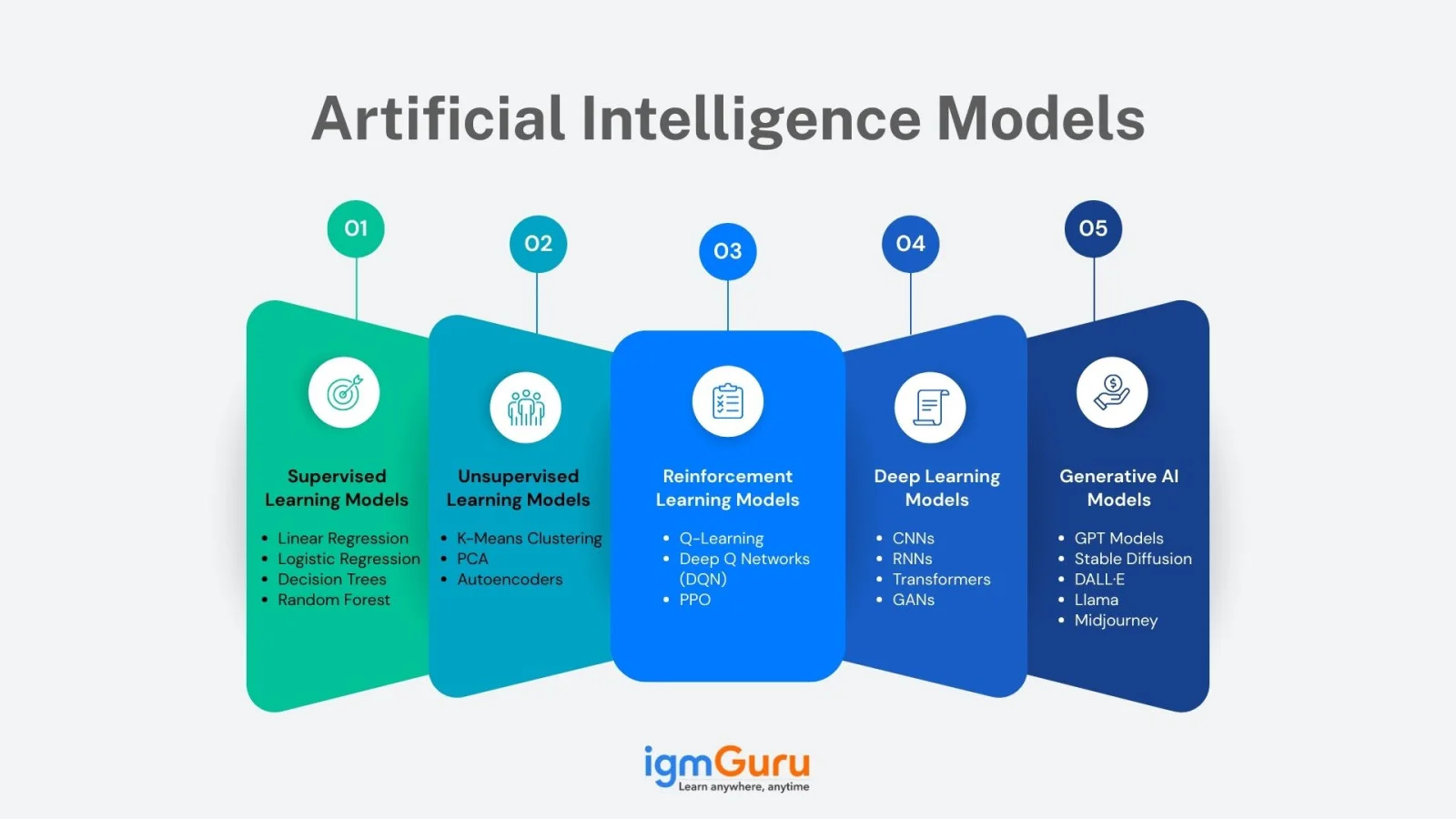
Artificial Intelligence models are programs designed to learn from data and make predictions or decisions based on what they have learned. These models identify patterns in information the same way humans learn from experience. AI uses different types of models depending on how the system is trained and what kind of task it needs to perform.
AI models fall under several major categories. The three learning approaches you mentioned earlier (supervised, unsupervised, and reinforcement learning) are correct, but they represent learning methods, not the full set of AI model types. Below is the corrected and complete explanation.
In supervised learning, models are trained using labeled data where both the inputs and correct outputs are provided. The model learns the relationship between the two and uses it to make predictions.
Common supervised models include:
Used for: image classification, spam detection, and medical diagnosis.
Unsupervised models work with unlabeled data. They discover hidden patterns, groupings or structures without being told what the correct output should be.
Common unsupervised models include:
Used for: customer segmentation, fraud detection, and dimensionality reduction.
Reinforcement learning models learn by interacting with an environment. They receive rewards or penalties based on their actions, improving their decision-making over time.
Common RL models include:
Used for: robotics, gaming, and autonomous systems.
Deep learning is a subset of AI that uses multi-layered neural networks capable of learning complex patterns from massive datasets.
Examples of deep learning models:
These models excel in high-dimensional data like images, videos and natural language.
Generative AI focuses on creating new content such as text, images, audio, or video by learning from existing datasets.
Popular generative models:
Used for: text generation, creative design, chatbots, code generation, and image creation.
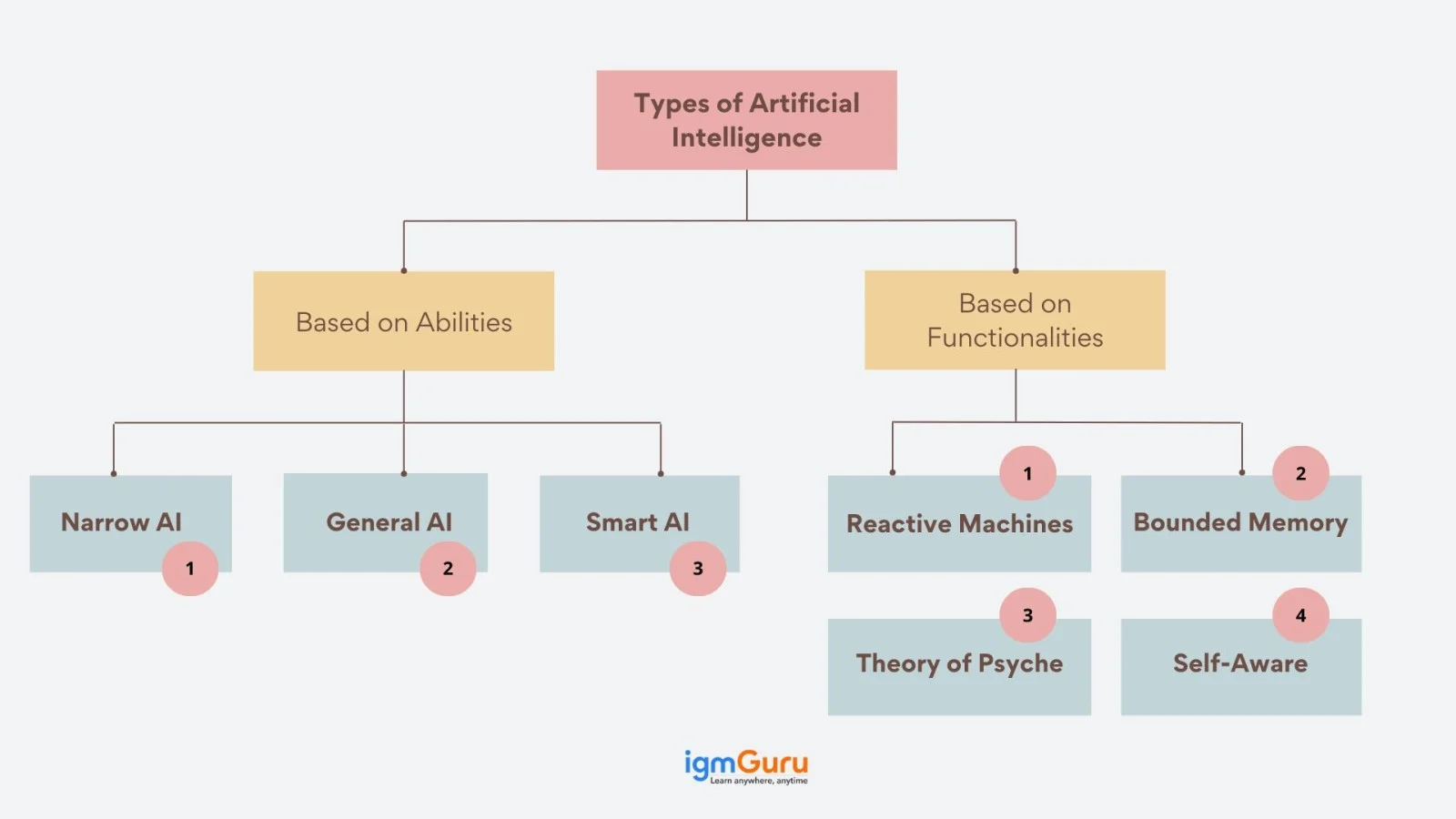
Artificial intelligence can be grouped according to its abilities and functionalities. So let us now take a peek at the types of artificial intelligence.
Related Article- Generative AI Roadmap
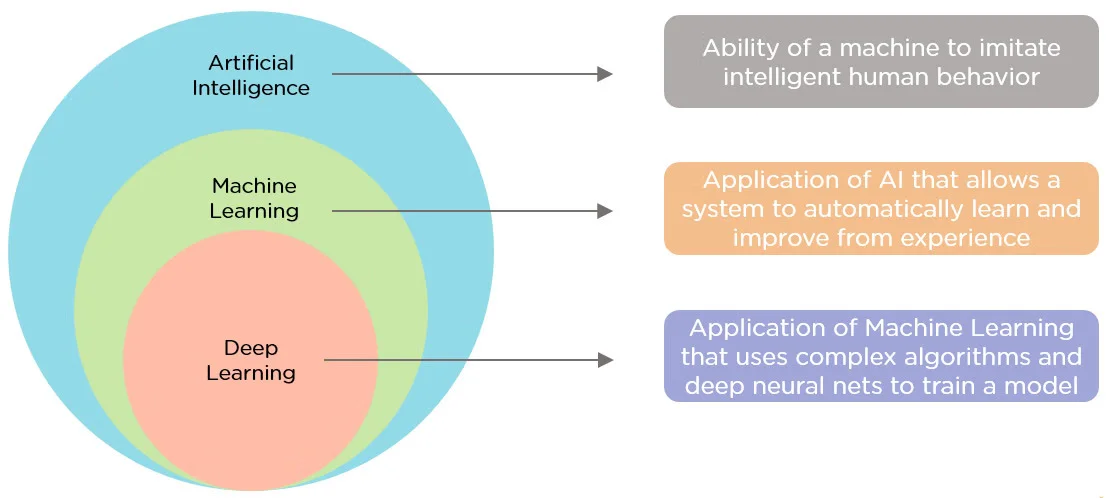
As we know that AI is a vast field of creating systems that can mimic human intelligence like reasoning, problem-solving, and learning. Whereas, machine learning (ML) is a subdivision of AI that lets systems learn from data and enhance performance with time without any explicit programming. Then comes deep learning (DL), a special subset of ML that makes use of artificial neural networks (inspired by the human brain) for processing huge amounts of data and solving complicated issues like image and speech recognition. So, what is the difference between ML, DL and AI? I have made a table differentiating these three to make things easier for you to understand.
| Characteristics | Artificial Intelligence (AI) | Machine Learning (ML) | Deep Learning (DL) |
| Introduction | It is the science of creating machines 'intelligent' to mimic human behavior. | This is a subset of AI where machines learn from data and improve with time. | This is a subset of ML that uses neural networks with various layers for advanced learning. |
| Extent | It is the broadest including ML, DL, robotics, expert systems and more. | It is narrower, focusing on algorithms that learn from data. | This one is the narrowest, focusing on deep neural networks. |
| Data Dependency | It can work with limited data (rule-based systems). | This one requires structured data for training. | This one requires massive datasets for effective learning. |
| Complexities | Differs from simple rules to complex reasoning. | It is moderate and depends on feature engineering and algorithms. | It is very high, involving multi-layered neural networks. |
| Hardware Requirements | This can operate on traditional systems. | It works on normal machines, but might require more power for big data. | This one needs high-performance GPUs/TPUs for training. |
| Instances | Chatbots, autonomous robots, expert systems. | Spam filters, recommendation systems, and fraud detection. | Image recognition, natural language processing, and self-driving cars. |
The artificial intelligence technologies have moved beyond the early adopter phase and are now mainstream in multiple business applications. Today, industries take out measurable benefits from building AI in their core business procedures. Let us now go through the benefits of AI.
What is artificial intelligence without automating workflows and procedures or working independently and automatically from a human team? For instance, AI can assist in automating aspects of cybersecurity through constantly monitoring and analyzing network traffic. Also, a smart factory might have dozens of various kinds of AI in use, like bots using computer vision for navigating the factory floor or to investigate analytics for measuring efficiency and results.
Artificial intelligence can remove manual errors in data processing, analytics, assembly in manufacturing and other tasks via automation and algorithms that follow the same procedure each time.
This technology can be put to use for performing repetitive tasks, freeing up human capital to work on higher-impact issues. It can be used for automating procedures such as verifying documents, transcribing phone calls or answering easy questions such as "what time do you open?".
Artificial intelligence can process more information faster than a human, locating patterns and exploring relationships in data that a human might miss.
This technology is not limited by time of day, the requirement of breaks or other human hindrances. While operating in the cloud, AI and ML can be 'always on', constantly working on their assigned tasks.
As artificial intelligence represents extraordinary opportunities, it also comes with risks and challenges which need to be identified and mitigated to prevent harm to individuals, groups, businesses and humanity as a whole. Let us take a look at the AI challenges and risks that consumers, businesses and governments should be taking care of.
Artificial intelligence's scope and accessibility of the latest enterprise AI make it useful for multiple fields. We will now take a look at a few examples of AI use cases all over different industries, including:
The medical data sets are some of the largest and most complicated in the world. The main focus of AI in healthcare is leveraging that data to locate bonds between diagnosis, treatment protocols, and patient results. Also, hospitals are turning to artificial intelligence solutions to support operational initiatives like workforce satisfaction and improvement, patient satisfaction, and cost reduction.
Financial service organizations have been among the earliest to adopt AI at scale, particularly to push the speed of transactions, customer service and security response. Common applications involve AI bots, digital payment advisers and detecting fraud.
The smart factory of today is a network of machines, IoT sensors and computing power. It is an interconnected system that makes use of this technology and ML for analyzing data and learning as it goes in real time. This technology constantly improves and informs the automated procedures and smart systems within a smart factory, whether it is monitoring equipment conditions to predicting supply chain problems to allow predictive manufacturing.
The online shoppers are engaging all over a wide variety of touchpoints and creating huge amounts of complicated and unstructured data sets than ever before. For understanding and making use of this data, retailers are making use of this technology to process and analyze disparate data sets, enhancing marketing and giving better shopping experiences.
Artificial Intelligence is a transformative technology that helps to mimic human intelligence in machines. It originated in the 1950s and has significantly evolved in neural networks, big data, and machine learning. Its capabilities have stretched across multiple subfields, including robotics and natural language processing. Its importance surely indicates that it has now become an essential part of almost every industry.
Explore These Trending Articles:
Artificial Intelligence (AI) is a technology that enables machines to mimic human intelligence, allowing them to perform tasks like learning, problem-solving, decision-making, and understanding language or visuals. AI simulates human brain functions through systems like machine learning, neural networks, and natural language processing, enabling applications such as speech recognition and recommendation systems.
Unlike traditional programming, where developers explicitly code rules for a computer to follow, AI systems learn from data to make decisions or predictions. For example, instead of programming a system to recognize a cat in a photo, AI uses machine learning to analyze thousands of images and identify patterns that define a cat.
AI is embedded in many daily activities, such as:
Course Schedule
| Course Name | Batch Type | Details |
| Artificial Intelligence Courses | Every Weekday | View Details |
| Artificial Intelligence Courses | Every Weekend | View Details |