Google DeepMind, also known as just 'DeepMind,' is a progressive artificial intelligence (AI) company. This name is known for contributing some of the most innovative work to the domain of machine learning. It has developed some extraordinary AI systems which are capable of matching almost human-like performance in games such as GO.
However, let's not confuse it with just an asset for tech wizardry or games. It involves the development of capable artificial intelligence that can match humans in learning and performing. All this technological innovation is implemented across diverse fields to solve problems in energy, healthcare, climate, and much more.
In 2023, Google merged DeepMind and Google Brain into a single AI division called Google DeepMind, combining research and product AI teams under one unified organization. But it has its own identity, team, and ambitious mission: to solve intelligence and then use that to solve everything else.
Google DeepMind is Google's advanced artificial intelligence research and development division. Formed in 2023 through the merger of DeepMind and Google Brain, it develops AI systems such as Gemini, AlphaFold, and other technologies focused on scientific discovery, machine learning, robotics, and artificial general intelligence (AGI).
DeepMind was founded in 2010 in London by Demis Hassabis, Mustafa Suleyman, and Shane Legg. Hassabis, a child prodigy in chess and a neuroscientist by training, envisioned a future where machines could learn from experience like humans do.
In the early days, DeepMind focused on creating learning algorithms that could master video games by observing and playing - just like a human child would. The first major breakthrough came when DeepMind's AI system learned how to play classic Atari games, like Breakout, without being told how. It is simply learned by trial and error.
In 2014, DeepMind was acquired by Google (now Alphabet Inc.) for around $500 million. While the move raised eyebrows, it also gave DeepMind access to massive computing power and global talent.
Since then, DeepMind has grown into a team of hundreds of researchers and engineers working on everything from healthcare AI to language models, climate modeling, and robotics.
Now, let's break down the technology behind DeepMind. What makes it tick? How do its AI systems learn, adapt, and perform?
DeepMind is known for its generalist approach to AI - it doesn't just build one model for one task. Instead, it focuses on building general-purpose learning algorithms.
Unlike traditional software, where rules are hand-coded, DeepMind's systems learn from data and experiences. They adjust themselves over time, getting better the more they interact with a task. This is inspired by how human brains learn - from environment, feedback, and repetition.
Their focus has always been on learning systems that are adaptable, scalable, and most importantly, safe.
DeepMind heavily relies on deep learning, a subset of machine learning that uses neural networks with many layers (hence "deep").
Think of a neural network like a very complex web of nodes (neurons) that process information. Each layer processes data and passes it to the next layer, learning to identify patterns like edges in an image, or grammatical structures in text.
What sets DeepMind apart is how they apply deep learning not just to images or text - but to complex problem-solving, decision-making, and even biological simulations.
At the heart of many DeepMind systems is decision-making. Their AI models don't just classify images - they choose actions, make plans, and solve puzzles.
This is where reinforcement learning comes in (more on that below). In simple terms, the AI tries something, gets a reward or penalty, and adjusts its behavior accordingly - just like how we learn.
Whether it's a game of chess or predicting a disease, DeepMind's models evaluate the best possible action at any given time based on data, rewards, and learned behavior.
This is one of DeepMind's signature innovations - the reinforcement learning loop.
Here's how it works:
The AI tries different strategies, gets feedback, and gradually learns the best way to achieve its goal. It's similar to how animals and humans learn - through rewards and consequences. This technique powered their breakthroughs in Atari games, AlphaGo, AlphaZero, and AlphaFold.
Related Article- The Best AI Chatbots
If you're wondering how everyday users can "use" DeepMind, here's the scoop: While DeepMind itself operates primarily as a research division, many of its technologies, such as Gemini, are now directly integrated into consumer products used by millions worldwide. You won't find it in the App Store or Play Store. However, its technology powers tools and platforms you probably already use:
The emergence of DeepMind marks a significant shift in how we think about artificial intelligence. Before DeepMind, much of the AI world was focused on narrow AI - models that could only do one thing well. DeepMind challenged that with its work on general AI systems capable of learning from scratch.
Their achievements in gaming - especially AlphaGo's 2016 victory over world champion Lee Sedol didn't just show off technical prowess. It sparked global conversations about the future of machine intelligence. Since then, DeepMind has consistently released models that push the boundaries - not just of what machines can do, but what humans can understand about themselves, nature, and intelligence.
Read Also- How To Start A Career in Artificial Intelligence
DeepMind's mission is bold yet crystal clear: "Solve intelligence, and then use that to solve everything else."
This isn't just about smarter machines. It's about creating tools that can accelerate human progress in nearly every domain - from curing diseases to understanding the universe.
Their vision includes:
As AI systems grow more powerful, concerns around misuse, bias, safety, and societal impact become increasingly important. Google DeepMind places strong emphasis on responsible AI development and long-term safety research.
DeepMind conducts dedicated research in AI alignment, ensuring that advanced AI systems behave according to human values and intentions. This includes studying reward modeling, control mechanisms and interpretability.
Large AI models can reflect biases present in training data. DeepMind works on reducing harmful bias in language models and improving fairness across demographics and languages.
Unlike some private AI labs, DeepMind has historically published much of its research openly in scientific journals. This transparency builds trust within the research community.
DeepMind collaborates with policymakers, academics, and ethics boards to shape global AI governance discussions. The company emphasizes that powerful AI systems must be deployed cautiously and responsibly.
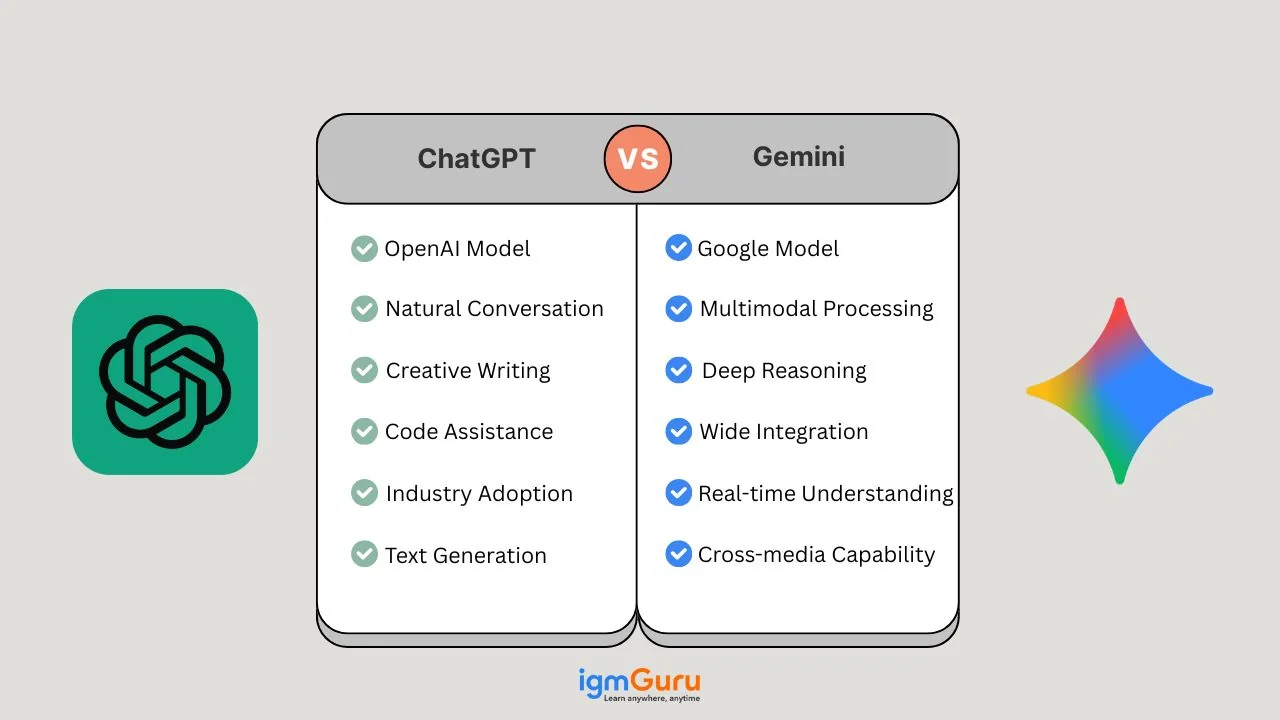
Also Explore: Gemini vs. ChatGPT
Google DeepMind has moved far beyond research experiments and into large-scale deployment of advanced AI systems. From next-generation Gemini models to scientific breakthroughs in genomics and robotics, the recent two years marks one of the most aggressive innovation phases in the company’s history.
| Area | Major Update | Why It Matters |
|---|---|---|
| Language Models | Gemini 1.5, Gemini 2.0, Gemini 3.5 evolution | Massive context window and stronger reasoning |
| Multimodal AI | Native text, image, audio, and video understanding | True cross-modal intelligence |
| Open Models | Gemma model family expansion | Developer-friendly lightweight AI |
| Scientific AI | AlphaGenome | DNA and gene regulation prediction |
| Robotics | AI-powered embodied agents | Real-world interaction capability |
| Long Context AI | 1M+ token context window | Enterprise and research-level analysis |
One of the biggest milestones was the expansion of the Gemini model family. Gemini 1.5 introduced an ultra-long context window capable of processing up to 1 million tokens. This means the model can analyze extremely long documents, entire codebases, research papers, or hours of transcripts in a single prompt. This significantly improves:
Earlier AI systems processed text separately from images or audio. Recent Gemini versions are natively multimodal. This means the model understands and reasons across:
Instead of converting everything into text first, the system processes multiple data types together. This allows more advanced reasoning such as analyzing diagrams while explaining text, or interpreting video context in real time.
Google DeepMind expanded its lightweight open model series called Gemma. These models are designed for researchers and developers who want strong AI capabilities without needing massive infrastructure. The newer Gemma versions improved:
After the global success of AlphaFold, DeepMind introduced AlphaGenome. While AlphaFold predicted protein structures, AlphaGenome focuses on understanding how DNA sequences regulate gene activity. This development is important because:
Between 2024 and 2026, DeepMind significantly expanded work in robotics. Instead of training AI only in simulations, newer systems are learning to operate in physical environments. Key focus areas include:
This represents a major step toward embodied AI, systems that interact with the physical world rather than just digital data.
DeepMind continued expanding AI use in climate modeling, material discovery, and advanced simulations. Recent work includes:
These systems are designed not just for commercial use but for global scientific advancement.
Recent years also marked deeper integration of DeepMind research into Google products. Gemini models are now embedded across:
This transition shows how DeepMind research is no longer isolated. It directly powers large-scale consumer and enterprise platforms.
Gemini 3.5 Pro's rollout became a notable case study in how competitive the frontier AI race has gotten. Google scrapped the model's existing 2.5 Pro-based architecture in mid-2026 for a ground-up rebuild aimed at closing gaps in mathematical reasoning and image generation, pushing general availability to July 17, 2026.
The rebuilt model is reported to carry a 2 million token context window, which is double Gemini 2.5 Pro's cap, along with a Deep Think Reasoning Layer for multi-step logic and autonomous workflow chaining. The redesign came alongside a wave of senior researcher departures from DeepMind in June 2026, including Gemini co-lead Noam Shazeer and AlphaFold lead John Jumper, underscoring how tightly talent, timelines, and model quality are linked at the frontier of AI development. As of early July, some of these specifications came from reporting rather than an official Google model card, so figures may be refined at launch.
Google DeepMind and OpenAI are two leading AI research organizations shaping the future of artificial intelligence. While both aim to advance AI capabilities and work toward Artificial General Intelligence (AGI), their structure, research priorities and product strategies differ significantly. Understanding these differences helps clarify how each organization contributes to the AI ecosystem.
div class="table-responsive"><
| Feature | Google DeepMind | OpenAI |
|---|---|---|
| Ownership | Operates as Google’s unified AI division | Independent organization with Microsoft partnership |
| Core Focus | Scientific AI, reinforcement learning, AGI research | Generative AI products and large language models |
| Major Products | Gemini AI, AlphaFold, AI for science | ChatGPT, DALL·E, API-based AI services |
| Integration | Integrated across Google products | Standalone AI tools and enterprise APIs |
| Long-Term Vision | “Solve intelligence” for scientific advancement | Build AGI that benefits humanity |
DeepMind is already shaping what AI will look like in the next decade - but they're not slowing down.
Some future directions include:
Working at Google DeepMind is a goal for many AI researchers and engineers. The organization hires across research, engineering, science and operational roles.
If someone aims to work at DeepMind, they should focus on:
So, what is Google DeepMind? It's a pioneering AI research lab that's redefined what artificial intelligence can achieve. From beating world champions at Go to predicting how proteins fold, DeepMind has consistently shown that AI can go beyond human capabilities in specific domains. But more importantly, DeepMind is trying to ensure that this power is used responsibly, ethically, and for the benefit of everyone.
With projects in healthcare, climate, science, and more, DeepMind isn't just building machines - it's helping us reimagine the future. The road ahead is exciting, and perhaps a bit uncertain. But if there's one AI Company you should keep an eye on, it's this one.
Not exactly. DeepMind operates as Google DeepMind, the unified AI division of Google, following the merger of DeepMind and Google Brain in 2023. While both work on AI, DeepMind focuses more on research and general AI, whereas Google AI powers products like Search and Translate.
AlphaGo is DeepMind's AI system that defeated top Go players using deep reinforcement learning. It was the first AI to beat a world champion in the ancient game of Go.
Some technologies like AlphaFold's protein structure database are open to the public. But most DeepMind systems are research-focused and not available as APIs.
Both are AI research labs. DeepMind is owned by Alphabet (Google), while OpenAI is an independent entity (with investments from Microsoft). DeepMind leans more towards scientific discovery and AGI, while OpenAI also builds commercial products like ChatGPT.
DeepMind impacts healthcare, science, energy, language modeling, robotics, and climate change modeling.
DeepMind has a strong focus on AI safety, fairness, and ethics. They've created internal ethics boards and publish regular research on making AI safe and beneficial.
Google DeepMind aims to “solve intelligence,” and AGI research is part of its long-term mission. However, true Artificial General Intelligence has not yet been achieved and it remains an ongoing scientific challenge.