This article 'What are machine learning models' will give you a clear understanding of ML models and how they are used to identify patterns in data and make predictions or decisions.
As the world is moving forward and technology is advancing, more companies are realizing the need to embrace machine learning (ML) and artificial intelligence (AI) in their work. This is especially true for repetitive jobs that can be done without any human intervention. The aim is to free useful human resources to look after more critical tasks.
While there are various types of machine learning, today we are going to take a look at the different machine learning models. The path to learning them and understanding them better comes by enrolling in the right machine learning training program. This blog will give you an overview of this much-talked-about aspect.
Machine learning models refer to computer programs that work towards recognizing patterns in data to make predictions and gather insights. These are created from machine learning algorithms that undergo an extensive training process involving all sorts of data, be it labeled, unlabeled, or mixed.
A data scientist trains a model over a data set by providing it with the required algorithm to get reasoning and then learn. These patterns that the data scientist strives to find might involve associations, trends, or correlations. Neither of these is immediately findable by humans and requires model intervention.
Also Read - Machine Learning Roadmap
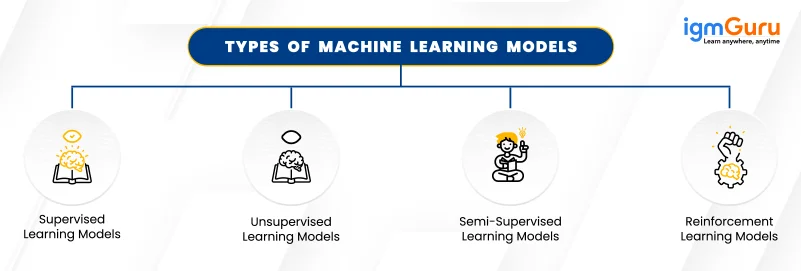
Different types of machine learning models aid in targeting specific difficulties and tasks. Let us take a look at the most often used types of machine learning models.
Supervised Learning consists of a machine learning algorithm that learns from labeled data (comprising input features as well as corresponding known outcomes). The supervised learning model trains of this data set to help establish a relationship between inputs and outputs. Once this model has been trained, it gains the ability to make predictions on unseen and new data.
Supervised learning is segregated into two categories-
Unsupervised Learning Models are aspects of the machine learning algorithms that work with data that does not explicitly provide the target variable (output). The goal in terms of Unsupervised Learning models is to find structures, patterns, and relations within the data itself. Such models are used for tasks, but are more explicitly used for dimensionality reduction and clustering.
There are a few types of unsupervised learning, including-
The semi-supervised learning model involves training a model by using both unlabeled and labeled data. The basic thought behind semi-supervised learning stems from the fact that a combination of both these data holds the potential to improve model performance as compared to the use of only labeled data. This approach is also a plus in cases when obtaining a humongous amount of labeled data can be costly or time-consuming.
A subfield of machine learning, reinforcement learning models are focused on developing models and algorithms. These ultimately enable agents in learning how to take actions and make decisions in any environment to yield the maximum reward signal. In reinforcement learning models, an agent interacts with an environment to get into the process of trial and error. This aids this model in learning how to optimize its actions to get to its goals.
Related Article- Reasons Why Python is Good for AI and Machine Learning
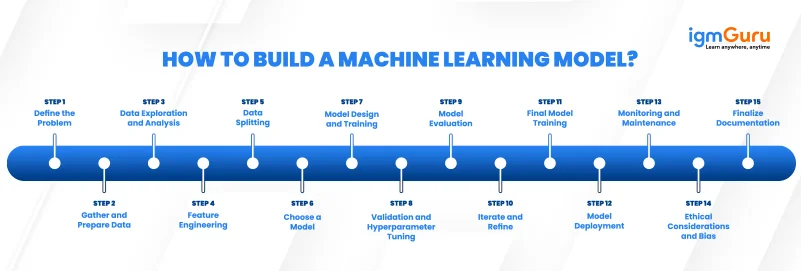
When you think about steps to build a machine learning model, these are the points that will sum up the entire process.
It is best to clearly define the problem that needs to be solved.
Gather and prepare the data essential for the problem. This can include dealing with missing values, data collection, data transformation, and data cleaning.
Get to know more about your data's characteristics via EDA or exploratory data analysis. Visualize anomalies, correlations, and data distributions.
Figure out different features that can aid the model in learning patterns from the data.
Segregate the data set into validation, testing, and training sets.
Choose the right ML algorithm based on the problem type. It can be random forests, neural networks, linear regression, etc.
Design your model's architecture and train it with the training data available.
Use the validation set to tune hyperparameters that aid in improving the model performance.
The testing set should be used to evaluate the model's performance on metrics like precision, Mean Squared Error, accuracy, etc.
According to the evaluation results, make adjustments to your model architecture, feature engineering strategy, or approach.
Use the complete labeled dataset to train the final model if you are completely satisfied with its performance.
Once your model is completely ready for production use, it's time to deploy it to a production environment by integrating it into an API, web application, etc.
Monitor the performance of the model in the real world continuously and retain periodically.
Consider the potential biases in your data as well as the model predictions.
Documentation is an essential aspect. Keep a track of the entire process from the beginning till the very end.
There are a lot of ways in which a machine learning model benefits an organization. Here are the key advantages that tag along when a machine learning model is used.
We know that machine learning is a field that is constantly evolving as it is influenced by the changing trends. Here are a few noteworthy future machine learning model trends to look out for -
AI systems will be able to better generalize from limited data when models become capable of learning from -
The need for interpretability expands as models become more complex. Future models are expected to offer clear explanations for their decisions.
GANs are advancing creative AI to enable the generation of realistic videos, music, images, etc.
More focus is being diverted towards models with the potential to learn incrementally over a period of time without forgetting pre-learned knowledge.
Machine learning models have gained a lot of momentum in the past few years. They have changed incredibly and grown a lot too. These models can today be found in a lot of industries across the globe, including finance and healthcare. When it comes to human progress, these machine learning models play a very important role. Thus, earning a machine learning certification is sure to help you a lot too.
Ans. Yes, we can combine ML models by employing any of the two approaches named 'Hybrid Models' and 'Ensemble Models.'
Ans. Various libraries are available for machine learning, including Pandas, TensorFlow, NumPy, PyTorch, Matplotlib, and Keras.
Ans. In Machine Learning, KNN stands for k-Nearest Neighbor and SVM stands for Support Vector Machine. Both of these are common ML algorithms.
Course Schedule
| Course Name | Batch Type | Details |
| Machine Learning Training | Every Weekday | View Details |
| Machine Learning Training | Every Weekend | View Details |


Top Advantages And Disadvantages of Artificial Intelligence (AI)
October 16th, 2026
File Handling in Python: Understand Step-by-Step With Examples
October 16th, 2026