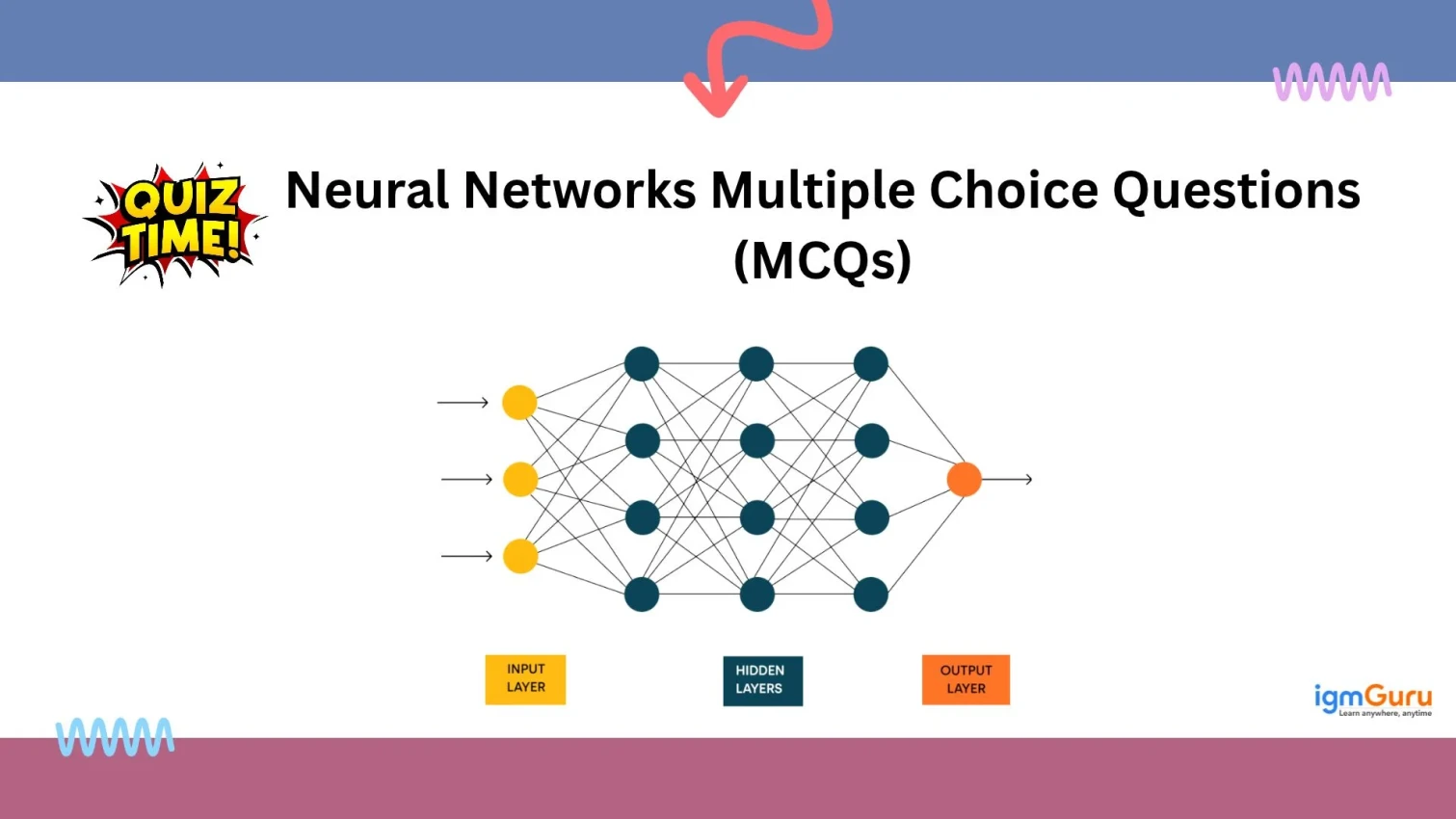
Preparing for a neural network certification, AI/ML interview, or technical assessment? This Neural Networks MCQs collection includes the best multiple-choice questions covering neural network fundamentals, activation functions, backpropagation, loss functions, regularization, CNNs, RNNs, Transformers, embeddings, autoencoders, generative models, optimization, deployment, and practical best practices.
Note: Score 60% or higher to unlock an exclusive offer of up to 50% discount on our self-paced AI and Deep Learning courses.
Let’s begin!
1. What is the primary purpose of a neuron in a neural network?
2. What does a weight represent in a neural network?
3. What is the role of a bias term?
4. Which layer receives the original features of a supervised learning example?
5. What makes a neural network 'deep'?
6. What is a forward pass?
7. What is a trainable parameter?
8. Why are nonlinear activations important in multilayer networks?
9. What is an epoch?
10. What is a mini-batch?
11. Which activation function outputs max(0, x)?
12. What is the output range of the sigmoid function?
13. Which activation is commonly used in the output layer for multiclass single-label classification?
14. What is a major problem with sigmoid in deep hidden layers?
15. What is the output range of tanh?
16. What is the main idea behind Leaky ReLU?
17. Why can GELU be useful in modern neural networks?
18. What does softmax produce?
19. Which activation is typically appropriate for a regression output with unrestricted real values?
20. What is an activation function's key job?
21. What is backpropagation used for?
22. What does gradient descent attempt to do?
23. What is the learning rate?
24. What happens if the learning rate is extremely large?
25. What is a gradient?
26. Why is the chain rule important in backpropagation?
27. What is stochastic gradient descent (SGD)?
28. What is an optimizer such as Adam responsible for?
29. What does an optimizer's momentum term generally help with?
30. What is gradient clipping commonly used for?
31. What does a loss function measure?
32. Which loss is commonly used for binary classification with sigmoid logits?
33. Which loss is commonly used for multiclass single-label classification?
34. What is mean squared error (MSE) commonly used for?
35. What does accuracy represent?
36. Why can accuracy be misleading on imbalanced datasets?
37. What does precision measure?
38. What does recall measure?
39. What is F1 score?
40. What does a confusion matrix summarize?
41. What is overfitting?
42. What is dropout?
43. Why can dropout reduce overfitting?
44. What does L2 regularization encourage?
45. What is early stopping?
46. What is data augmentation?
47. What is a validation set used for?
48. What is the purpose of a test set?
49. What is a generalization gap?
50. Which practice helps prevent data leakage?
51. Why is weight initialization important?
52. What is Xavier/Glorot initialization designed to help maintain?
53. What is He initialization particularly suited to?
54. What is batch normalization?
55. What is layer normalization?
56. Why is normalization often helpful during training?
57. In a normalized layer, why are learnable scale and shift parameters useful?
58. Which normalization is especially common inside Transformer blocks?
59. What is covariate shift in the traditional normalization discussion?
60. What can poor initialization cause in a deep network?
61. What is the key operation in a convolutional layer?
62. What does a convolutional filter learn?
63. What does stride control in a convolution?
64. What does padding do in a convolutional layer?
65. What is a feature map?
66. What is pooling commonly used for?
67. What does max pooling select from a local region?
68. Why do CNNs reuse the same filter weights across locations?
69. What is a receptive field?
70. What is global average pooling?
71. What is the main purpose of an RNN?
72. What does an RNN hidden state represent?
73. Why can vanilla RNNs struggle with long-term dependencies?
74. What problem does an LSTM address?
75. What are the main gates in a standard LSTM?
76. What is a GRU?
77. What is bidirectional recurrence?
78. What is teacher forcing in sequence modeling?
79. What is sequence-to-sequence modeling used for?
80. Why did Transformers reduce reliance on RNNs for many NLP tasks?
81. What is self-attention designed to compute?
82. What are the three main projections in standard scaled dot-product attention?
83. What does attention weight represent?
84. Why is the dot product in scaled dot-product attention divided by the square root of key dimension?
85. What is multi-head attention?
86. Why do Transformers need positional information?
87. What is an encoder in the original Transformer architecture?
88. What is a decoder in an autoregressive Transformer?
89. What is causal masking used for in autoregressive language models?
90. What is cross-attention?
91. What is a word embedding?
92. Why are embeddings useful in NLP?
93. What is tokenization?
94. Why are subword tokens useful?
95. What is an embedding dimension?
96. What is an OOV problem?
97. What is a contextual embedding?
98. What is sequence padding used for?
99. What is an attention mask in NLP commonly used for?
100. What is language-model perplexity intended to measure?
101. What is an autoencoder trained to do?
102. What is the encoder in an autoencoder?
103. What is the decoder's role?
104. What is a bottleneck representation?
105. What is a denoising autoencoder trained for?
106. What is a variational autoencoder (VAE)?
107. What does the VAE reparameterization trick enable?
108. What is the latent space?
109. What is representation learning?
110. Why can autoencoders be useful for anomaly detection?
111. What is a GAN composed of?
112. What does a GAN generator do?
113. What does a GAN discriminator do in the standard setup?
114. What is mode collapse in GANs?
115. What is diffusion modeling based on?
116. What is denoising in a diffusion model?
117. What is a Transformer-based language model generally trained to learn?
118. What is fine-tuning a pretrained neural network?
119. What is transfer learning?
120. What is knowledge distillation?
121. What is a residual connection?
122. Why do skip connections help deep networks?
123. What is a residual block commonly associated with?
124. What is model pruning?
125. What is quantization?
126. What is sparsity in a neural network?
127. What is a hyperparameter?
128. What is an ablation study?
129. What is calibration in classification?
130. What is catastrophic forgetting?
131. Why should input features often be scaled for neural networks?
132. What is batch size?
133. What is a learning-rate schedule?
134. What is a checkpoint?
135. Why use mixed-precision training?
136. What is inference?
137. What is batch inference?
138. What is latency in model serving?
139. Why might a smaller neural network be preferred in production?
140. What is model monitoring used for after deployment?
141. Which neural network architecture is strongly associated with image classification?
142. Which architecture is commonly used for autoregressive text generation?
143. What is data drift?
144. What is concept drift?
145. Why should a production model be evaluated on data representative of real use?
146. What is class imbalance?
147. What is transfer learning especially useful for?
148. What is explainability intended to provide?
149. Why is reproducibility important in neural network experiments?
150. Which practice is most appropriate before deploying a neural network?