Generative AI models are powerful deep learning systems designed to create content rather than just analyze it. Instead of only sorting data or predicting outcomes, these models learn patterns from massive datasets and then use that learning to produce new text, images, video, music, and even functional code. You've probably interacted with several of them already without realizing it.
Unlike traditional AI systems that focus on classification or prediction, Generative AI works a little differently. It relies on architectures such as transformers, GANs (Generative Adversarial Networks), and diffusion models to generate outputs that feel surprisingly human. You give them a prompt, and they respond with something original. It almost feels creative, although technically it's pattern prediction at scale.
The field also moves fast, faster than almost any other area of tech. In this blog, updated for July 2026, I'll walk through the generative AI models I actually use and test regularly across text, code, images, video, and audio, along with their capabilities, strengths, and where each one fits best.
A generative AI model is a form of artificial intelligence used to create new content, such as text, images, video, audio, or code, based on patterns learned from previously analyzed datasets. Essentially, the difference between generative AI and traditional AI is that traditional AI mostly analyzes data, whereas generative AI produces new outputs that resemble what a human might create.
These models use advanced deep learning methods to "understand" the context of a request, generate new content efficiently, and help users solve problems or complete tasks, improving productivity and effectiveness across industries like education, marketing, design, and software development.
Large language models remain the most widely used category of generative AI. Here are the frontier text and reasoning models leading the space right now.
OpenAI's flagship line has moved quickly through 2026, from GPT-5.2 in December 2025 through GPT-5.4, GPT-5.5, and now GPT-5.6, positioned as OpenAI's frontier model for professional and agentic work. GPT-4o, which many guides still reference, was retired from ChatGPT earlier this year. The current generation focuses heavily on reasoning depth, long-running agent tasks, and lower per-token cost relative to the intelligence it delivers.
Type: Transformer-based Multimodal Reasoning Model
Google's Gemini line (originally launched as Bard in 2023, rebranded to Gemini in 2024) has advanced to Gemini 3.1 Pro, its most capable generally available model as of mid-2026, with the next-generation Gemini 3.5 Pro rolling out from preview to general availability. Gemini remains a force multiplier for tasks that involve huge amounts of context, like analyzing entire codebases or lengthy research documents.
Type: Multimodal Transformer-based Foundation Model
Claude is designed to be safe, honest, and helpful through Anthropic's constitutional AI approach, and its reasoning capabilities are consistently ranked among the top-tier LLMs. Claude 1.0 launched in March 2023; the current generation includes Claude Opus for maximum capability and Claude Sonnet for a faster, more cost-efficient option, both widely used for enterprise and long-document workflows.
Type: Safety-focused Transformer-based Large Language Model
Read Also- Claude Code: An AI Code Assistant From Anthropic
Mistral AI has rapidly become one of Europe's leading AI companies, offering powerful foundation models for enterprise, research, and software development. Its flagship Mistral Large model delivers strong reasoning, multilingual understanding, and coding capabilities while emphasizing efficiency and enterprise deployment. Alongside Mistral Large, the company also offers specialized models such as Codestral for programming and Magistral for advanced reasoning tasks.
Type: Transformer-based Large Language Model
Grok began as "the chatbot on X," built to answer questions using real-time platform activity. With Grok 4.5, released in July 2026, xAI has repositioned it as a broader system for coding, AI agents, and knowledge work, trained in part on real developer activity through its Cursor-style coding tools. It's positioned as a fast, token-efficient alternative to Claude Opus-class models.
Type: Transformer-based Reasoning and Agentic Model
Open-weight models have closed much of the gap with closed, proprietary systems in 2026, and they matter for teams that need self-hosting, fine-tuning, or full control over data. The three families below lead the open-source landscape.
Llama 4 (Scout and Maverick) is Meta's open-weight family, notable for offering one of the longest context windows available in any model, open or closed. Unlike closed models, Llama ships with accessible weights, letting developers customize, fine-tune, and run it locally or on-premise.
Type: Open-weight Mixture-of-Experts Language Model
DeepSeek shook up the open-source landscape with its efficient Mixture-of-Experts architecture, and its V4 release pushed coding and reasoning benchmarks close to top proprietary models — all under a permissive MIT license.
Type: Open-weight Mixture-of-Experts Reasoning Model
Kimi K2 is the latest flagship large language model from Moonshot AI, a Chinese AI company known for building models with exceptionally long context windows. Kimi K2 is designed for advanced reasoning, coding, research, and document analysis, making it particularly useful for developers and enterprises working with large datasets and lengthy technical documents.
Type: Transformer-based Large Language Model
Alibaba's Qwen 3.5 family ships under a fully permissive Apache 2.0 license, with no usage caps, and has become known for leading scientific and mathematical reasoning benchmarks among open-weight models, alongside strong multilingual performance.
Type: Open-weight Multilingual Reasoning Model
Image generation was one of the first generative AI categories to go mainstream, and two names still dominate creative and design workflows.
Midjourney generates images from natural-language prompts and has moved beyond Discord to its own full web app. V7 is the current default model, with sharper hands, bodies, and object coherence than earlier versions, and V8 rolling out in alpha with faster, higher-resolution rendering. Midjourney remains best known for cinematic, artistic, and often surreal visuals.
Type: Diffusion-Based AI Image Generation Model
Stability AI's Stable Diffusion converts text prompts into high-quality visuals through a latent diffusion process. It remains the leading open-source option in image generation, letting developers and creators run it on their own hardware and fine-tune it for specific styles or products.
Type: Open-Source Latent Diffusion Image Generation Model
Video generation is the category that has changed the most since last year, moving from short, glitchy clips to near-production-ready footage with synchronized audio.
Veo 3.1 remains the reference point for native, synchronized audio-and-video generation, producing cinema-grade footage with matched dialogue and sound effects in a single pass. It also supports reference-image input for keeping characters and settings consistent across multiple shots.
Type: Multimodal Text/Image-to-Video Generation Model
Other video models worth knowing: Seedance 2.0 (ByteDance) leads in multi-shot storytelling with consistent characters across scenes, Kling 3.0 is known for realistic, physics-based motion, and Runway Gen-4 remains a favorite for professional video-editing workflows and API integrations. OpenAI's Sora line helped pioneer the category but has seen reduced consumer availability as competitors have caught up on quality and pricing.
Audio generation has matured alongside video. ElevenLabs leads in realistic voice cloning, multilingual dubbing, and text-to-speech for narration and dubbing workflows, while Suno generates full, radio-ready songs — vocals, instrumentation, and lyrics — from a short text prompt.
Jasper AI is an AI writing platform built to help companies generate marketing content — ads, blog posts, social captions, and email campaigns — at scale. It lets teams customize a brand voice so content stays consistent across every channel and collaborates on projects as a shared workspace.
Type: AI Writing and Marketing Assistant Platform
| AI Model | Best For | Access / Cost | Ideal Industry/Users |
| GPT-5.6 (OpenAI) | Reasoning, coding, agentic workflows | Closed / Paid, free-tier available | Software Development, Enterprise AI |
| Gemini 3.1 Pro (Google) | Long-document and multimodal analysis | Closed / Paid, free-tier available | Research, Productivity, Business Intelligence |
| Claude (Anthropic) | Safe AI assistance, long-document analysis | Closed / Paid, free-tier available | Legal, Corporate Governance, Documentation |
| Grok 4.5 (xAI) | Coding, agents, real-time knowledge | Closed / Subscription (SuperGrok, X Premium) | Software Engineering, Real-Time Research |
| Llama 4 (Meta) | Custom, self-hosted AI development | Open-weight / Free with usage limits | Open-source AI, NLP Research, Internal AI Systems |
| DeepSeek V4 (DeepSeek AI) | Self-hosted coding and reasoning | Open-weight / MIT license, free | Software Engineering, Cost-Sensitive Deployment |
| Qwen 3.5 (Alibaba) | Multilingual and scientific reasoning | Open-weight / Apache 2.0, free | Global Enterprises, Research |
| Midjourney V7 | Cinematic and artistic visuals | Closed / Subscription only | Branding, Film, Advertising |
| Stable Diffusion (Stability AI) | Self-hosted image generation | Open-source / Free | Marketing, Gaming, Content Creation |
| Veo 3.1 (Google) | Synchronized audio-video generation | Closed / Paid, usage-based | Advertising, Media Production |
| Jasper AI | Marketing and SEO content | Closed / Subscription | Content Marketing, E-commerce, Social Media |
The best generative AI model for your organization depends on your intended use, how it fits into existing workflows, and the performance characteristics you need most — accuracy, creativity, speed, or cost. Some models are optimized for specific tasks like coding or engineering, while others are stronger for image generation, research, or long-document understanding.
I personally use Gemini to analyze large PDF files, summarize long videos, and assist live during work, thanks to its long-context capabilities. Developers tend to favor OpenAI's and Anthropic's models for coding and structured content, while open-weight models like DeepSeek and Qwen are gaining ground fast for teams that want to self-host or avoid per-token costs. Creative professionals still lean on Midjourney and Stable Diffusion for images, and increasingly on Veo and Seedance for video.
When evaluating and selecting a generative AI model, consider the following:
1. Purpose: Coding, content writing, image/video generation, research, or automation
2. Context Window: Ability to process large files and long conversations
3. Multimodal Support: Whether it can understand text, images, audio, or video
4. Accuracy and Reasoning: Important for research, business, and technical tasks — check independent leaderboards such as Artificial Analysis or Epoch AI's Capabilities Index rather than relying only on vendor claims
5. Customization: Open-source vs. closed-source flexibility
6. Speed and Cost: Response speed and API pricing for large-scale usage
7. Privacy and Deployment: Cloud-based or local/on-premise deployment options
Choose a generative AI model based on your actual workflow needs rather than market hype. Each model has specific strengths, and in practice, most teams end up using a combination — for example, one model for reasoning and code, another for images, and a third for video or audio.
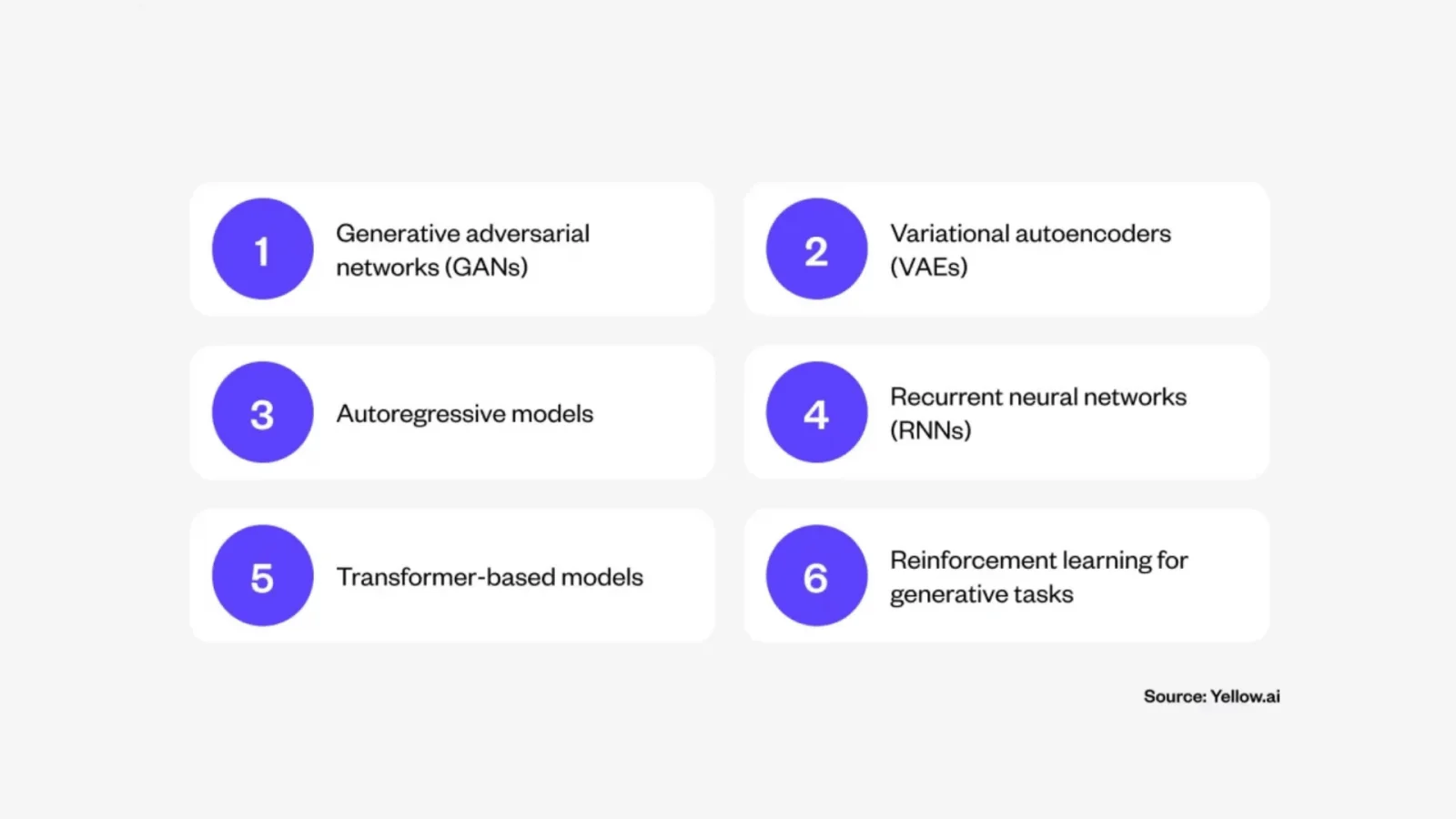
Image Source: Yellow.ai
Beneath every model above sits one (or a mix) of a handful of core architectures. Here's a quick primer on the technology, not a repeat of the models themselves:
Every generative AI model brings its own strengths to the table, and continuous advances in AI research keep pushing these architectures further, promising more capable and efficient models in the years ahead.
Generative AI models have transformed content production and innovation by letting machines produce genuinely useful, human-like outputs. From frontier LLMs like GPT-5.6, Gemini 3.1 Pro, and Claude, to open-weight challengers like Llama 4, DeepSeek V4, and Qwen 3.5, to creative engines like Midjourney, Stable Diffusion, and Veo 3.1 — the landscape has never been broader or more competitive. As we move through 2026, expect this pace of change to continue, so revisit your model choices every few months rather than locking in once and forgetting about it.
Read Our Trending Articles:
Generative AI models are systems trained to create new content such as text, images, video, music, or code. They learn patterns from massive datasets and generate outputs that resemble human-created work using neural network architectures like transformers or diffusion models.
As of mid-2026, the leading models include OpenAI's GPT-5.6, Google's Gemini 3.1 Pro, Anthropic's Claude, xAI's Grok 4.5, and open-weight models like Meta's Llama 4, DeepSeek V4, and Alibaba's Qwen 3.5. For visuals, Midjourney, Stable Diffusion, and Google's Veo 3.1 lead image and video generation.
Generative AI models are used for content creation, software development, marketing, design, education, and data analysis. Businesses use them to automate repetitive tasks, enhance creativity, and improve productivity through AI-generated outputs.
It depends on the model. Closed models like GPT-5.6, Gemini 3.1 Pro, and Claude typically offer a limited free tier with paid plans for higher usage. Open-weight models like Llama 4, DeepSeek V4, and Qwen 3.5 are free to download and self-host, though you'll pay for the compute needed to run them.
Open-source (or open-weight) models publish their model weights, so anyone can download, fine-tune, and self-host them, offering more control and lower long-term cost. Closed-source models are only accessible through a provider's API or app, generally with less setup and stronger managed infrastructure, but less flexibility.
For enterprises prioritizing safety, compliance, and long-document analysis, Claude and Gemini 3.1 Pro are strong choices. For teams that need full control over deployment and data residency, self-hosted open-weight models like DeepSeek V4 or Llama 4 are often preferred.
Given how quickly this space moves, with major model releases roughly every one to three months in 2026, it's worth revisiting your model choice every quarter, especially for cost-sensitive or performance-critical workloads.