Salesforce has become one of the most powerful platforms for businesses worldwide, and with its growth, two roles often stand out: Salesforce Admin and Salesforce Developer. At first glance, both might seem similar since they work on the same platform, but their responsibilities, skills, and career paths are quite different. Understanding these differences is key if you're considering a career in Salesforce or planning to hire the right professional for your team.
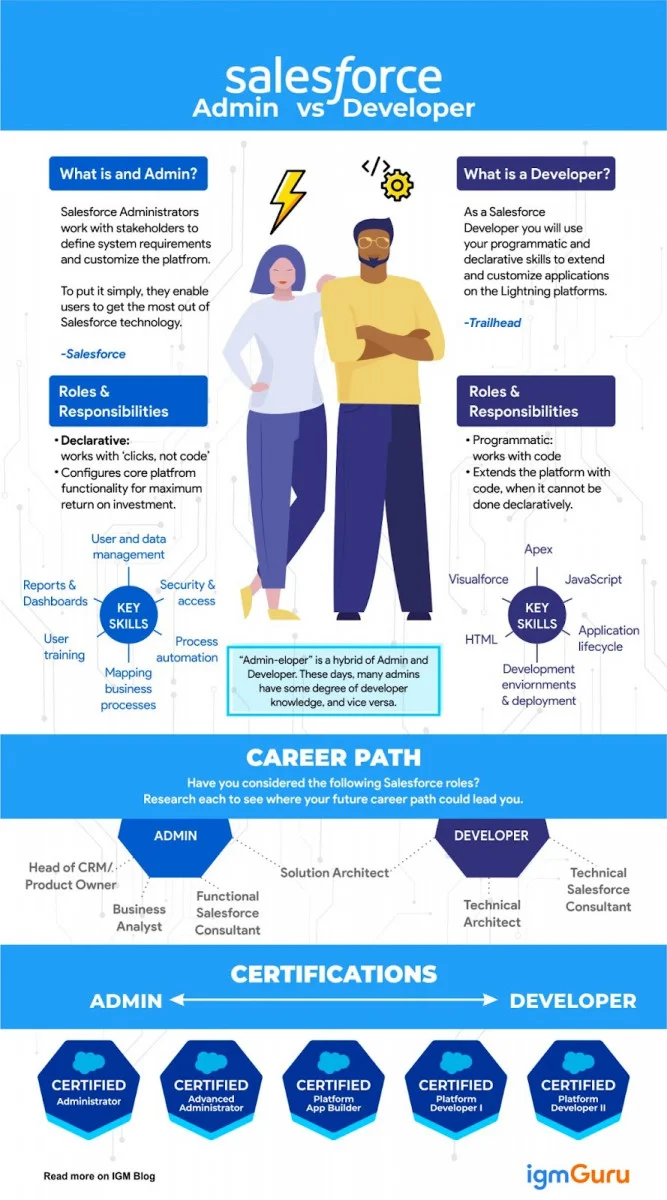
A Salesforce admin is a professional who is an expert in business operations. These specialists collaborate with business stakeholders to understand and implement current procedures. They also gather requirements for more, implementing them successfully in Salesforce. Their core responsibility revolves around securing data and safeguarding the privacy of their users. Generating dashboards and reports is also on their task list.
Go through our Salesforce admin certification course to accelerate your career in Salesforce.
Some of the top career opportunities that a Salesforce admin can pursue are-
Related Article- Salesforce Developer Skills
A Salesforce developer is a professional with knowledge related to development for the organization. Previous coding knowledge and some technical skills are important to help them establish their career.
Since Salesforce uses Apex, having some knowledge of Java will be beneficial. They are responsible for developing, integrating, configuring, reporting and troubleshooting, among other tasks.
Some of the top career opportunities that a Salesforce developer can pursue are-
Here is a line of difference to understand Salesforce admin vs developer in a better light.
| Basis | Salesforce Administrators | Salesforce Developers |
| Key Role | The key role of an admin is to manage and configure the Salesforce platform. | The key role of a Salesforce developer is to code custom solutions. |
| Skill Set | Understanding of Salesforce's security protocols, data management, and core features. Data analysis and implementation. Stay updated with the latest changes and updates. Communication and collaboration skills. Technical expertise. Problem-solving capabilities. | Skills in creating custom workflows, integrations, and apps. |
| Collaboration | These professionals collaborate with the end users and give them. | These professionals collaborate with stakeholders to outline technical solutions. |
| Tools and Techniques | Data Loaders, Salesforce Setup AppExchange, etc. | IDEs, Apex Developer Console, etc. |
| Problem Solving | They are in charge of managing system functionality and user issues. | They are in charge of integrating systems and fixing code bugs. |
| Certifications | Salesforce Admin Certification, Salesforce Certified Platform App Builder, Advanced Admin Certification, etc. | Salesforce Platform Developer 1, Salesforce Platform Developer 2, etc. |
Choosing between a Salesforce Admin and Developer role really comes down to your skills and what excites you more. If you enjoy organizing data, creating reports, managing users, and improving processes without much coding, the Admin path is a great fit. On the other hand, if you like problem-solving with code, building custom applications, and handling technical integrations, then the Developer role is better suited for you.
Think about where your strengths lie: Admins lean toward business and operations, while Developers lean toward technology and programming. Both paths have strong career opportunities, so the right choice is the one that matches your interests and long-term goals.
Read Related Articles
Both Salesforce Admins and Developers play vital but distinct roles in any Salesforce ecosystem. Admins focus on managing users, data, reports, and day-to-day platform operations, while Developers handle custom coding, automation, and advanced integrations. The choice between the two depends on your career interests- whether you prefer working with business processes and user needs or building technical solutions behind the scenes. In reality, most successful Salesforce teams rely on both roles working together, ensuring the platform not only runs smoothly but also evolves to meet business demands.
Course Schedule
| Course Name | Batch Type | Details |
| Salesforce Admin Training | Every Weekday | View Details |
| Salesforce Admin Training | Every Weekend | View Details |