One thing I have noticed through my own experiences conducting interviews is that Java interfaces are among the many types of questions that are asked in all kinds of job interviews at every level, from entry-level to senior-experienced workers. This blog on Java interface interview questions will help you prepare for your next Java interview by providing you with simple and practical sets of questions about Java interfaces that could be helpful across all levels. Let’s begin!
This section covers basic Java interface questions for beginners. These questions are asked to check your understanding of basic concepts. Here are some of them:
An interface in Java is a blueprint of a class that defines a set of abstract methods and constants. It specifies what a class should do, not how it does it. From Java 8 onwards, interfaces can also have default and static methods with implementation.
For example:
|
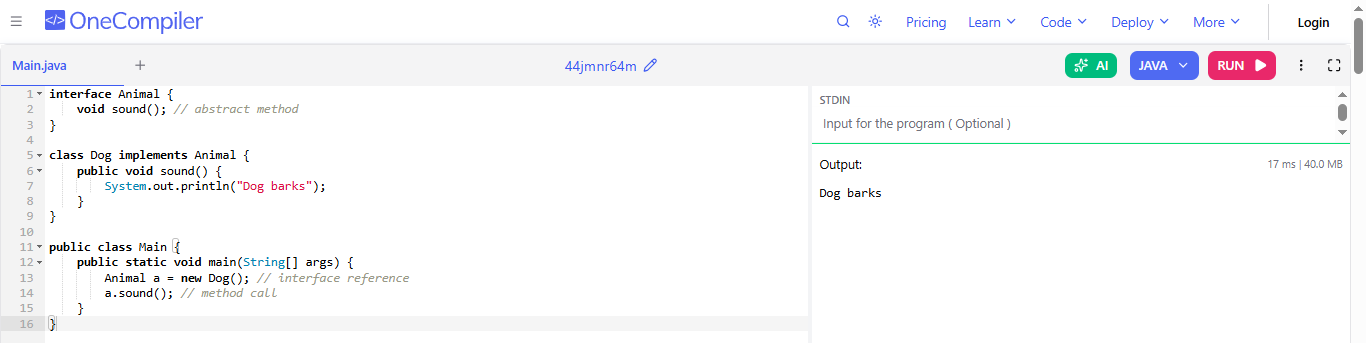
Interfaces are used to achieve abstraction, multiple inheritance and loose coupling. They allow different classes to follow the same contract while having different implementations.
For example: a Payment interface can be implemented by CreditCard, UPI or NetBanking, which have their own behavior.
An interface cannot have a constructor because it cannot be instantiated. Constructors are used to initialize objects and interfaces do not create objects.
We cannot create an object of an interface directly. However, we can create a reference of an interface that points to an object of a class that implements it.
For example:
|
In Java, both interfaces and abstract classes are used to achieve abstraction, but they have different purposes in design and implementation. Below is their brief differentiation:
| Features | Interface | Abstract Class |
|---|---|---|
| Purpose | Defines a contract (what to do). | Provides partial implementation (what + how) |
| Methods | By default abstract; can have default & static methods (Java 8+) | Can have both abstract and concrete methods |
| Multiple Inheritance | Supports multiple inheritance (can implement multiple interfaces) | Does not support multiple inheritance (can extend only one class) |
| Constructors | Cannot have constructors | Can have constructors |
| Variables | Only constants (public static final by default) | Can have instance variables |
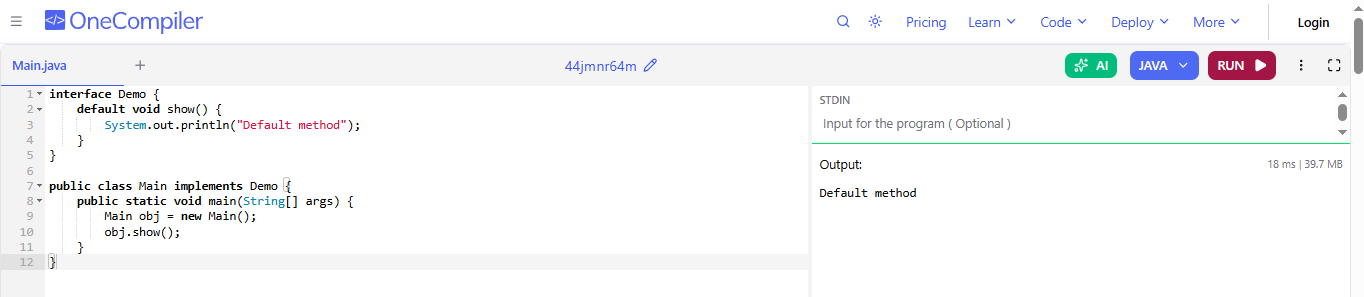
Default methods are methods with a body inside an interface, which was introduced in Java 8. They allow adding new functionality to interfaces without breaking existing implementations.
Example:
|
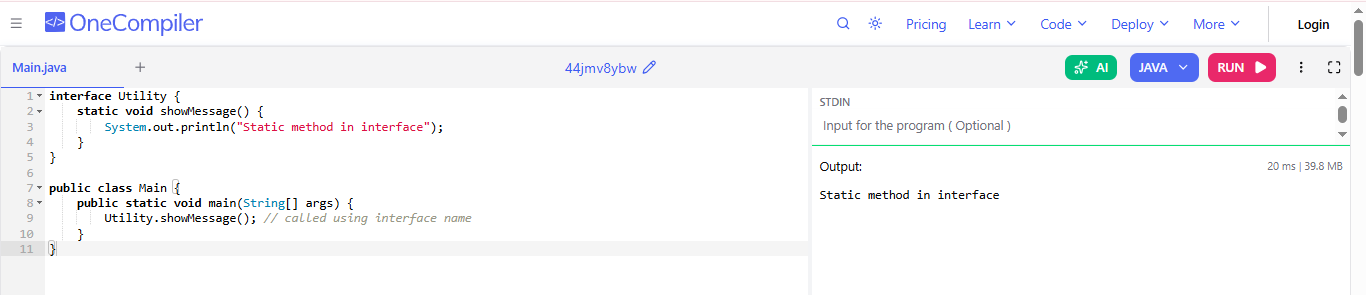
Static methods in interfaces belong to the interface itself and are not inherited by implementing classes. They are called using the interface name.
For example:
|
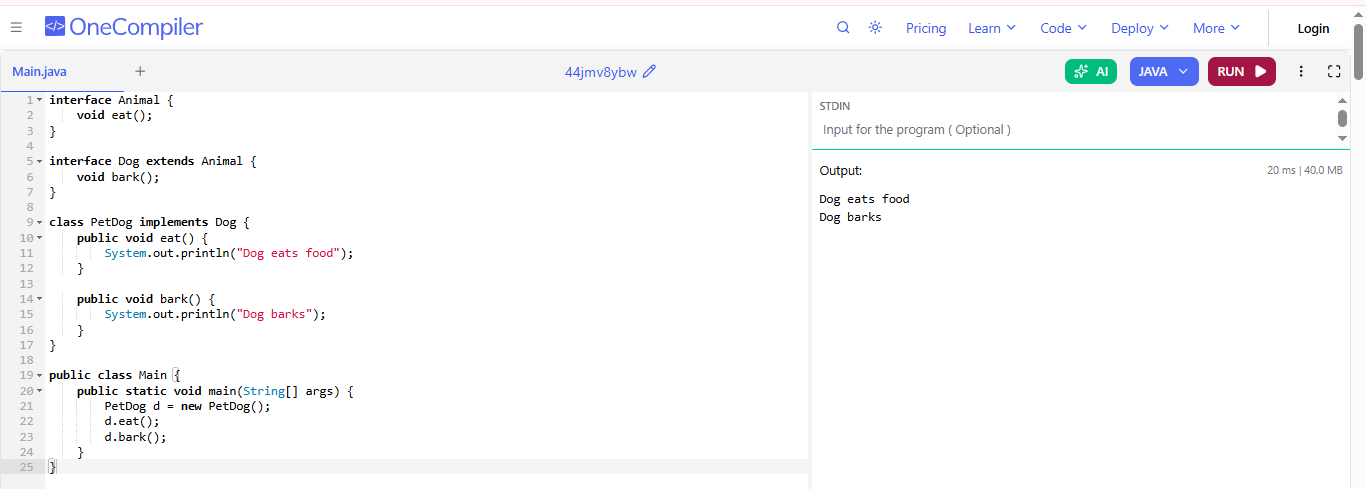
Yes, an interface can extend one or more interfaces using the extends keyword. This allows multiple inheritance in interfaces.
For example:
|
If multiple interfaces have the same abstract method, the implementing class only needs to provide one implementation. However, if multiple interfaces provide default methods with the same signature, the class must override the method to resolve the ambiguity.
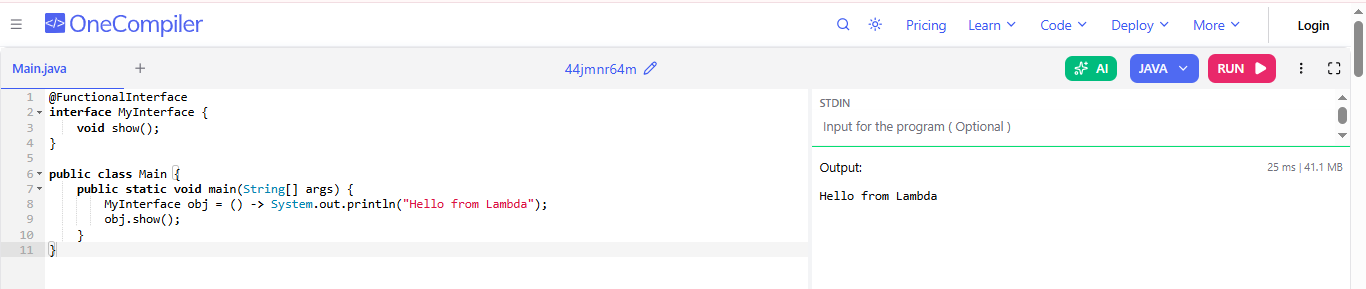
A functional interface is an interface that contains exactly one abstract method. It is mainly used for lambda expressions and can be annotated with @FunctionalInterface.
For example:
|
Read Also: Java Tutorial
This section includes questions for those with some experience in Java. These questions are asked to check your knowledge of features like default methods, static methods and how interfaces are applied in real world coding.
Marker interfaces are empty interfaces used to “mark” a class. The JVM or frameworks check for this marker and alter behavior accordingly.
For examples:
You can now use default methods on interfaces to add new capabilities without interfering with existing implementations. For instance, if the Payment interface has just one method, pay and then later you want to add a default refund method, classes that implement the Payment interface do not need to be changed because they have access to the default implementation. This provides you with both backward compatibility and a way for interfaces to change and grow over time.
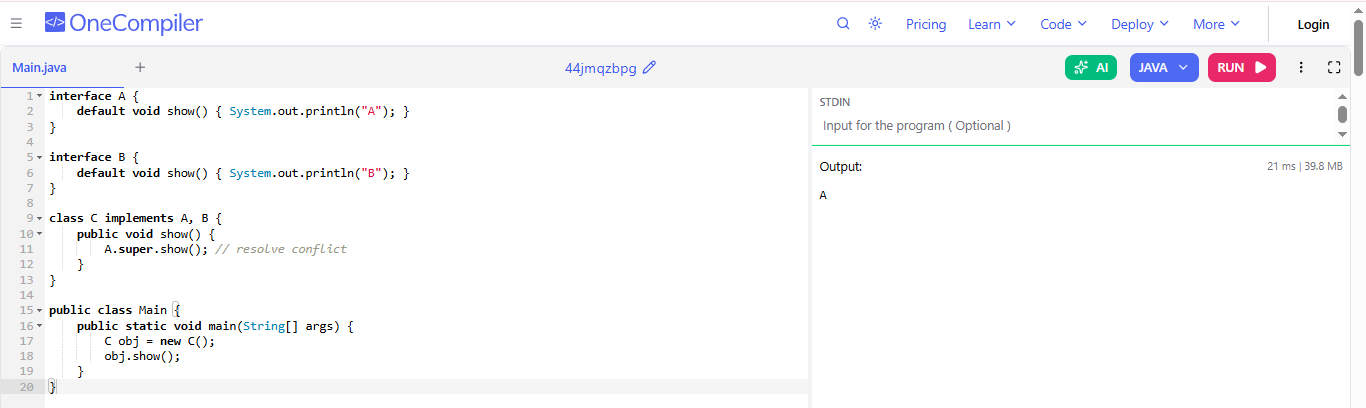
The diamond problem occurs when a class implements two interfaces that provide same default method. We can resolve the problem by overriding the method in the implementing class and explicitly deciding which implementation to use.
For example:
|
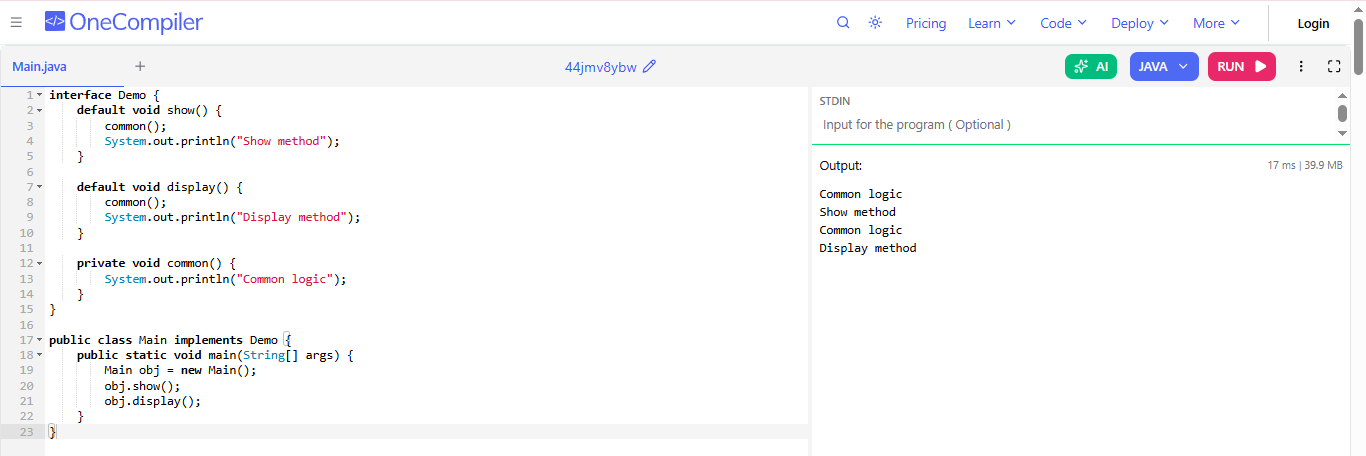
The addition of private methods in Java 9 was designed to allow for the extraction of duplicate code from multiple instances of default or static method implementations within an Interface.
This prevents code from being repeated when the same logic is contained in different default methods by having a function that performs the same logic in a private method within the same interface.
For example:
|
In Java interfaces, both default methods and abstract methods define behavior that implementing classes must deal with. Here is their brief differentiation:
| Features | Default Methods | Abstract Methods |
|---|---|---|
| Definition | Methods with a body defined using the default keyword | Methods declared without a body |
| Implementation | Already provide implementation inside the interface | Must be implemented by the implementing class |
| Purpose | Introduced to support backward compatibility (Java 8+) | Define a contract that classes must follow |
| Keyword Usage | Declared using default keyword | No keyword required (implicitly abstract) |
| Override Requirement | Optional to override in implementing classes | Mandatory to override in implementing classes |
| Flexibility | Allows adding new methods to interfaces without breaking existing code | Less flexible, as all implementations must change when modified |
Java does not support multiple inheritance with classes, but it does support it with interfaces. A class can implement multiple interfaces, which allows it to inherit behavior from multiple sources. They do have some limitations, such as:
If multiple interfaces have methods with the same signature, it can create ambiguity.
Java resolves this by forcing the class to explicitly override and define which behavior to use.
This creates a situation similar to a diamond problem. However Java will not make a decision without requiring that the conflict between classes is resolved by explicitly overriding the method in question. This will force the class to ultimately implement its own functionality, but may call an implementation of a given interface’s method by using InterfaceName.super.methodName. This will remove all ambiguity; ultimately the developer will have complete control over the behaviour.
Yes, an interface can contain fields. However, all fields in an interface are implicitly public, static and final, even if these modifiers are not explicitly mentioned. This means they act as constants whose values must be assigned at the time of declaration and cannot be changed later. They are typically used to define shared, fixed values.
For example:
|

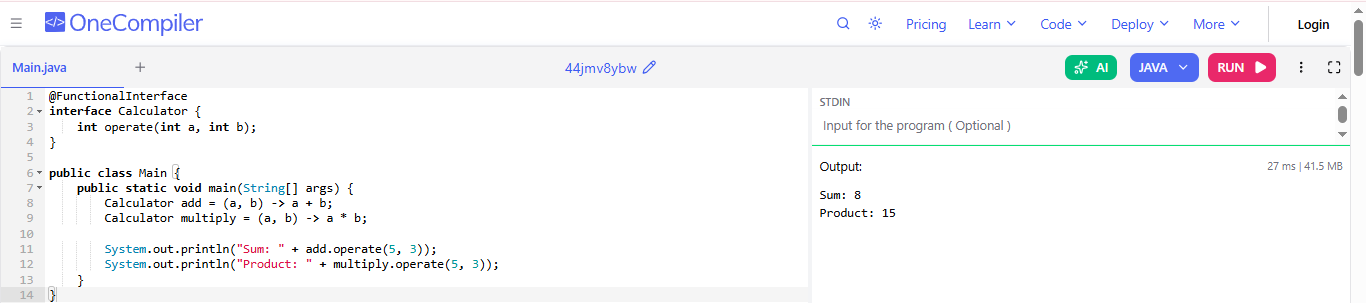
Functional interfaces have exactly one abstract method and are commonly used with lambda expressions for concise implementations. Instead of creating a separate class, a lambda provides the method body inline.
For example: A calculator interface with one method can be implemented as (a, b) -> a + b, making the code shorter, cleaner and more readable.
For example:
|
Both Comparable and Comparator are used for sorting in Java, but they differ in how and where the sorting logic is defined. Following is their differentiation in detail:
| Features | Comparable | Comparable |
|---|---|---|
| Package | java.lang | java.util |
| Purpose | Defines natural/default ordering | Defines custom/external ordering |
| Methods | compareTo() | compare() |
| Implementation Location | Inside the class itself | Outside the class |
| Flexibility | Supports only one sorting logic | Supports multiple sorting logics |
| Modification Requirement | Requires modifying the class | No need to modify the original class |
| Use case | When a single natural order is enough (e.g., ID sorting) | When multiple criteria are needed (e.g., name, salary, age) |
Read Also: Java Multithreading Interview Questions and Answers
This section is for advanced learners and professionals. These questions are asked to assess your ability to design systems, make architectural decisions and use interfaces for scalable and maintainable applications.
Interfaces enable API evolution through default and static methods (introduced in Java 8). Default methods allow adding new behavior without breaking existing implementations. This ensures backward compatibility while extending functionality. In large-scale systems, it helps teams evolve APIs gradually without forcing all clients to update immediately, which reduce the deployment risks.
Interfaces offer multiple inheritance, loose coupling and flexibility with default methods. Abstract classes provide shared state, constructors and better code reuse. Interfaces are ideal for defining contracts, while abstract classes suit partial implementations. Post Java 8, interfaces became more powerful, but abstract classes are still preferred when state or lifecycle control is required.
Define a common interface with required methods. Each plugin implements this interface independently. Use a Service Loader, reflection or dependency injection to dynamically discover and load implementations at runtime. This ensures extensibility, as new plugins can be added without modifying core logic.
Interfaces enable loose coupling in dependency injection. In Spring, components depend on interfaces rather than concrete classes. The framework injects the appropriate implementation at runtime. This promotes flexibility, easier testing and better maintainability by allowing implementations to be swapped without changing dependent code.
Dynamic proxies allow creating objects at runtime that implement one or more interfaces. Using java.lang.reflect.Proxy, method calls are intercepted and handled by an InvocationHandler. This is useful for cross cutting concerns like logging, security or transactions without modifying actual implementations, commonly used in frameworks like Spring AOP.
Use default methods to introduce new functionality without breaking existing implementations. Alternatively, create a new version of the interface while maintaining backward compatibility. Deprecation strategies and adapter patterns can also help transition clients gradually without disrupting the system.
Yes, indirectly. Interfaces can define only getter methods (no setters), which ensures the implementations expose read-only behavior. Combined with immutable classes (final fields, no setters, constructor initialization), interfaces enforce immutability at the contract level. It prevents modification through the interface reference.
Sealed interfaces restrict which classes can implement them using the permits keyword. This provides controlled extensibility and better security. They are useful in domain modeling where only a fixed set of implementations is allowed, such as representing a closed hierarchy (eg. payment types or shapes).
For example:
|
Interfaces enable functional programming via functional interfaces (single abstract method), used with lambda expressions and streams.
For example: Runnable and Comparator. They allow passing behavior as data, enabling concise, declarative code and supporting patterns like higher order functions.
Use design patterns like Strategy or Factory. Maintain a registry (eg. Map of keys to implementations) or use dependency injection frameworks to resolve implementations dynamically. Selection can be based on configuration, user input or context, which ensures scalability and flexibility without hardcoding logic.
For example:
|
Read Also: Java Collections Interview Questions and Answers
This section includes practical, real-world scenarios. These questions are asked to test how well you apply interface concepts in real situations.
I would use a sealed interface to restrict which classes can implement the payment contract, like UPI, Card and Cash. Each class would implement a common method like process. Instead of using instanceof, I would rely on polymorphism, where the correct method is called automatically. This keeps the design clean, safe and easy to maintain.
I would create a functional interface with a single method to send notifications. Then I would use lambda expressions for Email, SMS and Push implementations. I would store them in a map or registry and then the new notification types can be added easily without changing existing code, keeping the system flexible and maintainable.
I would define a Task interface with an execute method. Then I would use an ExecutorService with virtual threads to run tasks concurrently. Virtual threads are lightweight and efficient, allowing thousands of tasks to run smoothly. This approach keeps the code simple, improves performance and ensures good scalability in high-load systems.
I would create a repository interface that defines data operations like save and find. Then I would provide separate implementations for MySQL and MongoDB. The business logic would depend only on the interface. Using dependency injection, I can switch implementations easily and mock them for testing, making the system flexible and maintainable.
I would define a Plugin interface with a method like execute. Each plugin would implement this interface. I would use ServiceLoader to load plugins dynamically at runtime. This allows new features to be added without changing the core system, keeping the design loosely coupled, scalable and easy to extend.
Sealed interfaces can be combined with pattern matching for switch to create type-safe and exhaustive handling of a fixed set of implementations. Since a sealed interface explicitly defines which classes or interfaces can implement it, the compiler can verify that all permitted types are handled.
For example:
|
Here, the switch expression uses pattern matching to determine the actual implementation of the Payment interface. Because Payment is sealed and all permitted implementations are covered, an additional default case is not required.
This combination is useful when modeling a fixed set of domain types, such as payment methods, order states, commands, or event types. It provides stronger compile-time safety and makes code easier to maintain because adding a new permitted implementation can require the relevant switch statements to be updated.
This blog has covered most asked Java Interface interview questions with detailed explanations. After reading this blog, you should practice concepts and explore modern system-level technologies to remain industry-ready and technically strong, which will guide you toward achieving your career goals.
Yes, many companies now focus on scenario based questions to check real world understanding.
For experienced roles, interviewers expect deeper knowledge like API design, dependency injection, dynamic proxies and system design using interfaces. You should also understand how interfaces help in scalability and maintainability.
The best way is to first understand basic concepts like abstraction, default methods and multiple inheritance. Then practice scenario-based questions and try writing small code examples. This helps you explain answers clearly during interviews.