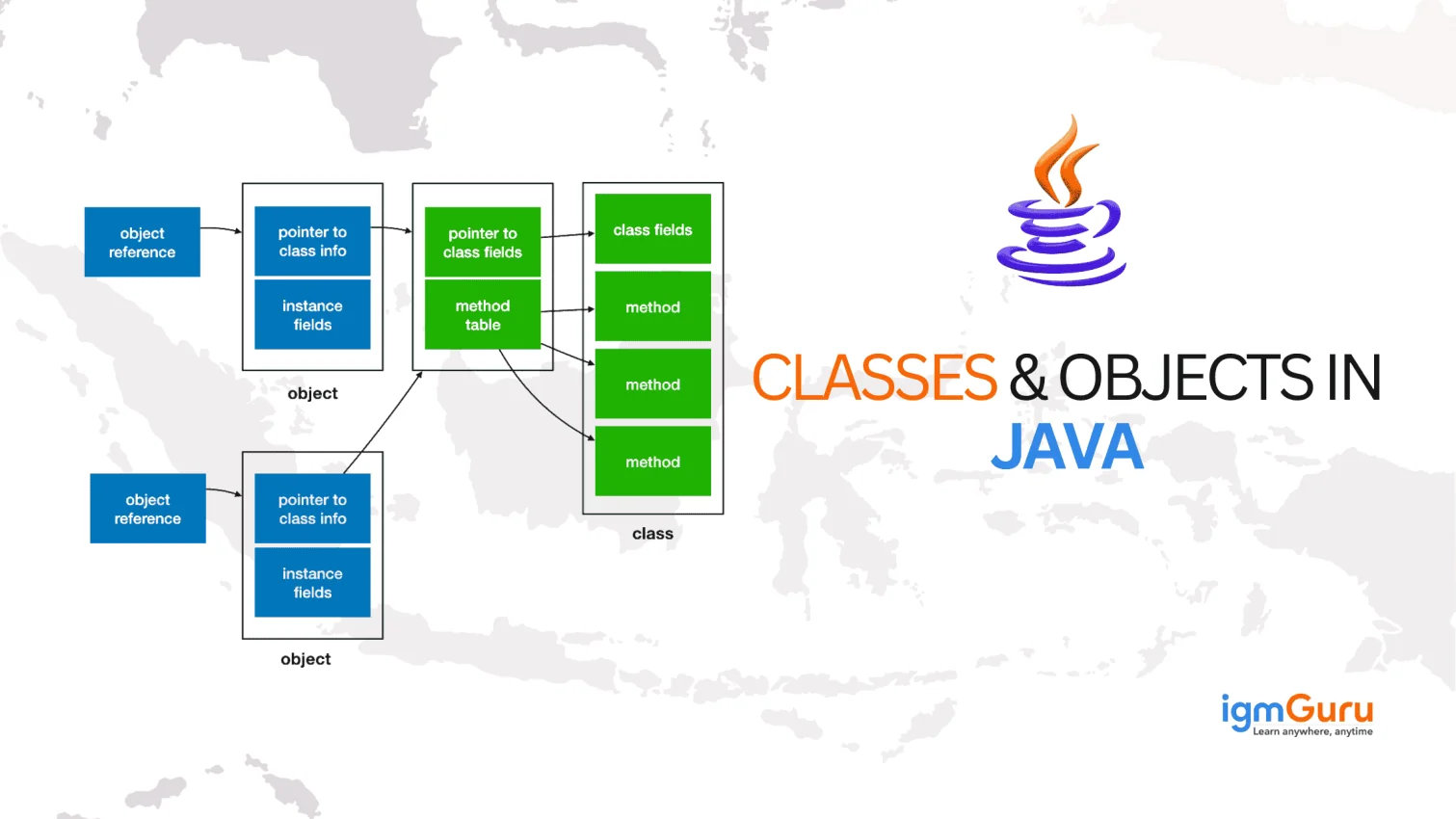
Everything in Java is related to classes and objects from the attributes to methods. It incorporates a variety of features due to these two crucial concepts. The object is responsible for the behavior and states whereas class is the blueprint of that object. With its object orinted programming nature, it has become essential for every developer to understand what are classes and objects in Java.
This guide includes everything one should know about these concepts from their definition and significance to their properties and syntax. It also explains the types of variables they use, their differences as well as a comprehensive example showing how to use them. Let's begin with understanding what are classes in Java.
Classes in Java works as a fundamental building block to create an object. It is also referred to as a blueprint or template of an object. It helps to encapsulate behaviors (methods) and data (fields) into a single unit.
It helps developers specify the behaviors and attributes of an object. These attributes are fields or instance variables that show how the object is going to be. On the other hand, behaviors defined by methods explain what that object will do.
Do you know how to use classes in Java? There are certain properties of Java classes that are important to know before using them. Understanding them will not only help you understand their use but also how to make good use of them.
Classes in Java has the following properties:
1. It is not an actual entity. Think of it as a template or a prototype built to create objects.
2. It does not require any memory location.
3. It is a group of methods or suite of variables of different data types.
4. It can contain:
Let's underand what is the basic syntax of a Java class. It includes the following components:
|
[access_modifier] class ClassName { // Fields (variables) [access_modifier] dataType fieldName; // Constructor(s) [access_modifier] ClassName(parameters) { // Initialize fields } // Methods [access_modifier] returnType methodName(parameters) { // Method body } } |
So, what are objects in Java? It is an instance of a class that represents the blueprint with its own unique group of values for the data fields. They are created using a new keyword like the class name and essential arguments that initialize the state of them. Each object s developer creates from a class always has its own separate memory space.
This memory contains its fields, which allows it to manage its own state independently. This way other objects created from the same class do not affect its functions. It also includes both data and behavior into a single unit. They allow classes to interact with each other. Wondering what are the properties of Java classes?
Also Explore: Java 21 Features
Java objects have the following properties:
1. It is an actual entity or a concrete instance created from a class.
2. It requires memory allocation to store its state (instance variables).
3. It represents a specific state and behavior. Each object holds unique values for its attributes and can perform actions through its methods.
It can contain:
Let's underand what is the basic syntax of a Java object. It includes the following components:
|
ClassName objectName = new ClassName(constructor parameters); |
Variables in Java can be categorized into three main types including local, instance and static. Each type has its own purpose and a specific scope within a class and its objects. Let's understand them:
Local variables are declared inside a method, constructor or block. They are accessible only within the same place where they are declared. They only exist during the execution of the method, constructor or block. It is important to initialize them before use as they do not have default values.
Instance variables are defined inside a class and outside any method. They are accessible throughout the class and can be accessed by any method within the class. They can only exist as long as the object of the class does. Each object of the class has its own copy of the instance variable and they can be initialized when the object is created.
Static variables or class variables are declared with the static keyword inside a class but outside any method. They can be accessed throughout the class by directly using the name or any object of the class. They exist as long as the class is loaded into memory. These are shared among all instances of the class meaning there is only one copy of the static variable.
Related Article- How to Learn Java from Scratch
These concepts are closely related but can lead to confusion using them. Let's explore some of the common differences between classes and objects in Java to avoid this confusion.
| Feature | Class | Object |
| Concept | Blueprint/Template | Instance/Real-world entity |
| Nature | Logical entity | Physical entity |
| Memory | Doesn't occupy memory (directly) | Occupies memory |
| Existence | Defined once in code | Created at runtime, multiple times |
| Data | Defines what data objects will have | Stores actual data for its attributes |
| Creation | Declared using the class keyword | Created using the new keyword and constructor |
| Example | class Car { String make; int year; } | Car myCar = new Car(); |
Now that you know everything about classes and objects in Java, let's explore a real-world example of using them. It will help you understand how to implement this knowledge on a real-time instance. Here is a simple instance of using a car class:
|
public class Car { // ClassName: Car // Fields (variables) - Represent the state of a Car object private String make; // fieldName: make private String model; // fieldName: model private int year; // fieldName: year private double speed; // fieldName: speed // Constructor - Initializes a new Car object public Car(String make, String model, int year) { // Constructor this.make = make; this.model = model; this.year = year; this.speed = 0.0; // Default starting speed } // Method - Defines a behavior for the Car object public void accelerate(double increment) { // methodName: accelerate if (increment > 0) { this.speed += increment; System.out.println(this.make + " is accelerating. Current speed: " + this.speed + " km/h."); } } // Another method to display information public void displayInfo() { // methodName: displayInfo System.out.println("Make: " + this.make + ", Model: " + this.model + ", Year: " + this.year + ", Speed: " + this.speed + " km/h"); } // Getter method for 'speed' public double getSpeed() { // methodName: getSpeed return this.speed; } } |
Explanation:
Classes and objects in Java are very crucial concepts for developers and this article has given a detailed explanation on them. By understanding their purpose of use, properties and syntax, you can easily learn how to use them effectively. Additionally, the car example shows how you can implement this knowledge. Learn more about this programming language by exploring the Java tutorial or online course to become a proficient developer.
A copy constructor builds a new object as a replica of an existing object of the same class. It is used to initialize a new object by replicating the values of another object.
Constructors are unique methods that are automatically invoked while creating an object of a class. They play an important role in object-oriented programming by ensuring that an object is properly initialized and ready for use.
An immutable class is a special instance that cannot be modified after they are created. This means that once an object of an immutable class is instantiated, its state remains constant throughout its lifecycle.
Java uses classes and objects to structure programs clearly. They help group related data and functions together, making code easier to manage and reuse.
Course Schedule
| Course Name | Batch Type | Details |
| Java Training | Every Weekday | View Details |
| Java Training | Every Weekend | View Details |