Prompt tuning is a method in artificial intelligence that involves customizing the input algorithms to make pre-trained models suitable for a specific task.
The ongoing development in large language models (LLMs) requires adaptation of robust strategies like prompt tuning to stay ahead of everyone. Techniques like these help to retrain any model with a few customizations. These also improve the model performance without having to pay high computational costs. This article here is all about what is prompt tuning and how it works.
Here we will discuss the benefits, applications, working, best practices, challenges, and future of prompt tuning. By the end of this article, you will know how this technique can benefit your skills and career. Let's start with an introduction to prompt tuning.
Explore igmGuru's Machine Learning Training program and learn with industry experts.
Prompt tuning is a robust method used in artificial intelligence to improve the performance of a model without changing its core architecture. The idea involves altering the initial (input) prompts to train the model according to the new requirements. It is inspired by the introduction of soft prompts, which is a suite of tunable parameters specified at the start of the input sequence.
Prompt tuning can be described as the improved version of model tuning. While model tuning involves using different models for each task, soft prompting only uses one model for all tasks. The diagram given below shows their working approach:
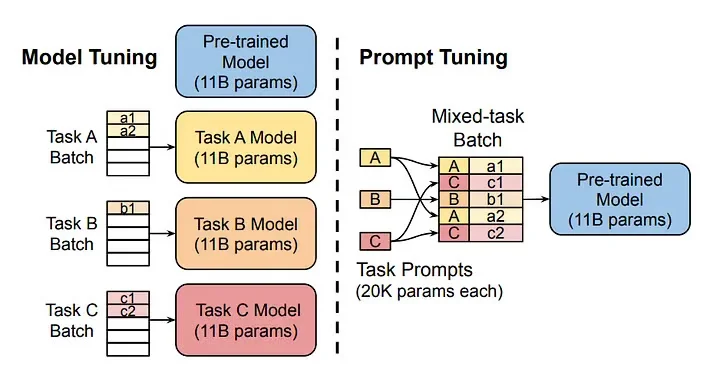
It is time to understand how does prompt tuning work. We know that soft prompting is dedicated to adapting large language models to specific tasks without fully retraining the model's parameters. It does it by adding learnable soft prompts to the model's input, which are then adjusted to improve performance on the target task.
Let's understand its working in detail.
Soft prompts are robust artificial tokens added to the input sequence of a model. There are numerous methods to implement these methods. One common method is the random initialization that guides the model to the desired output without modifying its weights.
Heuristic initialization is another method that involves using pre-existing knowledge or patterns to guide the initial values of the soft prompt embeddings, rather than randomly initializing them. Despite choosing any method, soft prompts will be attached to the input data after the initialization. This way, the model will consider both soft prompts and input during data processing.
After the implementation of soft prompts, the forward pass phase begins. During this phase, the combined sequence is fed directly into the pre-trained large language model. The LLM processes this entire sequence by leveraging its extensive pre-trained knowledge to generate an output. The LLMs core parameters remain frozen and only the soft prompts are dynamic in this process.
Here, the model's generated output is compared to the desired output for the specific task. This is where the loss function occurs that quantifies the discrepancy between these two. This computed loss then serves as a crucial error signal, which is used during backpropagation to iteratively adjust and refine the soft prompt parameters. This process improves the performance of the model on the target task without changing the LLMs vast original weights.
Prompt tuning has a variety of applications across different natural language processing (NLP) tasks. Some of them are mentioned below:
One of the best uses of soft prompting is content creation. It can generate AI narratives, scripts, and poetry with specific styles, characters, and topics. For instance, you can generate a romantic or fantasy story by specifying the character and story types in your prompts. It also helps generalists to identify their target audience and summarize investigation reports in bulletins.
You may have interacted with chatbots when using websites and applications. These chatbots are part of NLP that are trained with prompt tuning to answer specific queries. These are almost used in every industry like finance, healthcare and travel. For instance, a bank chatbot can solve your account-related queries, a healthcare chatbot can schedule appointments, etc.
There are many language translation tools and chatbots out there. Most of them are powered by LLMs using prompt tuning. This technique helps chatbots understand the cultural subtleties, local expressions and idioms. This ensures that responses are always culturally suitable and linguistically correct. It is also used in technical fields like engineering and medicine to document searches in multiple languages.
Soft prompting can also create educational content based on specific curricula. This curriculum is specified by the users and can be anything such as history, algebra, research, practice problems, discussion topics, tests and many more. It can be one of the best learning approaches due to its ability to understand user and student requirements.
Let's explore a step-by-step approach to prompt tuning. Here, we will implement soft prompting to a large language model using BigScience's bloomz-560m model within the Hugging Face ecosystem and the PEFT (Parameter-Efficient Fine-Tuning) library.
Begin with loading the pre-trained language model as well as its corresponding tokenizer. The tokenizer is crucial for processing text inputs, converting them into a format the model can understand, while the foundational model handles the core language modeling tasks.
from transformers import AutoModelForCausalLM, AutoTokenizer model_name = "bigscience/bloomz-560m" tokenizer = AutoTokenizer.from_pretrained(model_name) model = AutoModelForCausalLM.from_pretrained( model_name, trust_remote_code=True # Use with caution and only for trusted sources. ) |
Before any tuning, it is important to establish a baseline by running inference with the untuned foundational model. This allows you to observe the initial behavior of the model and provides a reference for comparing improvements after tuning.
We'll use a helper function generate_text for convenience:
def generate_text(model, tokenizer, prompt_text, max_tokens): prompt_inputs = tokenizer(prompt_text, return_tensors="pt") outputs = model.generate( input_ids=prompt_inputs["input_ids"], attention_mask=prompt_inputs["attention_mask"], max_length=max_tokens, repetition_penalty=1.5, eos_token_id=tokenizer.eos_token_id ) return tokenizer.batch_decode(outputs, skip_special_tokens=True) initial_output = generate_text(model, tokenizer, "I want you to act as a logistician. ", 100) print("Initial model output:", initial_output) |
Example of Initial Output:
| ['I want you to act as a logistician. You will be able to: Analyze the data'] |
The dataset is a critical component for soft prompting. We will use the awesome-chatgpt-prompts dataset, which provides diverse prompts that will help the model adapt its responses accordingly.
from datasets import load_dataset dataset_prompt = "fka/awesome-chatgpt-prompts" data_prompt = load_dataset(dataset_prompt) # Tokenize the dataset and prepare a small subset for training data_prompt = data_prompt.map(lambda x: tokenizer(x["prompt"]), batched=True) train_prompts = data_prompt["train"].select(range(50)) |
This is the core of the soft prompting process, where we configure the tuning parameters using the PromptTuningConfig class from the PEFT library.
from peft import get_peft_model, PromptTuningConfig, TaskType, PromptTuningInit tuning_config = PromptTuningConfig( task_type=TaskType.CAUSAL_LM, # Indicates the model will generate text. prompt_tuning_init=PromptTuningInit.RANDOM, # Virtual tokens are initialized randomly. num_virtual_tokens=4, # Number of virtual tokens to add and train. tokenizer_name_or_path=model_name ) peft_model = get_peft_model(model, tuning_config) |
Now, we define the training arguments using the TrainingArguments class:
from transformers import TrainingArguments training_args = TrainingArguments( use_cpu=True, # Necessary for CPU clusters. output_dir="./", auto_find_batch_size=True, # Automatically finds a suitable batch size. learning_rate=0.005, num_train_epochs=5 ) |
Finally, we initialize and run the Trainer object, which manages the training process. The DataCollatorForLanguageModeling ensures proper formatting of training samples.
from transformers import Trainer, DataCollatorForLanguageModeling trainer = Trainer( model=peft_model, # The PEFT version of the foundation model. args=training_args, # Training arguments. train_dataset=train_prompts, # Dataset used for training. data_collator=DataCollatorForLanguageModeling(tokenizer, mlm=False) # mlm=False for causal language modeling. ) trainer.train() |
After training, the tuned model is accessible via trainer.model. We can now use our generate_text function to observe the improvements.
tuned_output = generate_text(trainer.model, tokenizer, "I want you to act as a logistician. ", 100) print("Tuned model output:", tuned_output) |
Example of Tuned Output:
| ['I want you to act as a logistician. You will be responsible for the logistics of your business.'] |
As demonstrated, the tuned model now exhibits a better understanding of the prompt context. This way, you will get a more relevant and accurate response. Feel free to experiment with different prompts, models and datasets to explore the capabilities of soft prompting!
The use of prompt training brings a variety of benefits to the table, which makes it a go-to technique for large language models optimization. A few of them are as follows:
Efficiency is one of the major questions raised about this technique due to its simple approach. Prompt tuning provides efficient models even better and computationally lighter than fine-tuning. This efficiency comes from its approach of using a few prompt parameters, which results in quicker training and deployment times.
It also excels in flexibility with the rapid task adaptation behavior. It adds task-specific prompts without requiring retraining the entire model. This means a single model can handle multiple tasks by simply switching prompts, enhancing its versatility.
Soft prompting also preserves the original knowledge and architecture of the pretrained models. This ensures that the model retains its general-purpose capabilities while adapting to new tasks. This is critical when working with a variety of applications at the same time.
In this technique, only the task-specific prompt parameters need to be stored. This minimizes the overall storage requirements. Research shows that this technique is way better than traditional ones, and its performance further improves with the model size.
Prompt tuning can effectively adapt large language models to specific tasks even when limited training data is available. This makes it suitable for organizations with smaller datasets. This way, it can be a great choice for both small and large organizations.
While prompt tuning has a variety of advantages, it has some limitations and challenges too. One must be aware of these challenges before adopting this practice.
The limitations and challenges of this practice are not inevitable. It is possible to neglect them by leveraging the best practices. You can consider the following for the same:
AI chatbots quickly adapt to the instructions mentioned in the prompts. If there is any confusion window, it will make assumptions for that part. Therefore, you have to be specific while writing the prompts, covering all the relevant instructions. It will provide the balance to achieve your goal and prevent extensive or unrelated responses.
Sometimes the instruction may not work as desired. This is where one should give an example as a reference to AI. The AI will then evaluate the example and provide the responses accordingly. It is one of the best and quickest ways to train the AI chatbot.
Some AI chatbots like ChatGPT provide multiple outputs for the same query while training or interacting. Choose the best one to give the right direction. You can also give them a detailed report, bullet point, summary, or narrative. This way, one can produce the best suitable information.
It is also important to understand the flaws of the chatbot. It helps to set realistic AI prompts that can acknowledge the limits of the model. It also neglects the issue of hallucinations, which occur due to forcing AI to communicate with external databases.
Understanding what is Prompt tuning vs. fine tuning vs. prompt engineering is also essential as all of them are close topics and most of the individuals get confused choosing one of them. Here is a detailed comparison:
| Feature | Prompt Engineering | Prompt Tuning | Fine-Tuning |
| Definition | It involves crafting effective text inputs (prompts) to guide a pre-trained LLM to perform specific tasks without altering its weights. | It involves learning a small, task-specific set of soft prompts (continuous vectors) that are prepended to the input. | It involves adjusting all or a subset of the parameters of a pre-trained LLM on a new, task-specific dataset to improve performance on that task. |
| Model Modification | None | Minimal | Significant |
| Data Requirement | Minimal to moderate | Moderate | High |
| Computational Cost | Low | Low to Moderate | High |
| Flexibility | High | Moderate | Low |
| Performance | Good for general tasks. | Often achieves competitive performance. | Generally achieves the highest performance. |
| Interpretability | Comparatively high | Low | Low |
| Use Cases | Chatbots Content generation Q&A Summarization, Creative writing | Text classification Chatbots Sentiment analysis Named entity recognition Summarization Machine translation. | Domain-specific language models Highly accurate task-specific models Specialized chatbots. |
As an adaptable method for fine-tuning large language models (LLMs), prompt tuning has become integral to AI development. It offers a cost-effective and flexible alternative to traditional full fine-tuning, especially as models become larger and more complicated.
The global prompt engineering market is projected to see significant growth, with some predictions estimating a value of over $6.5 trillion by 2034. This growth is driven by advancements in AI and the increasing need for effective prompt design to enhance AI model performance and usability.
This article has explained what is prompt tuning and its significance, with the required information one should know to leverage this practice. With this guide, you are all set to implement it in real-time to train your models for specific tasks. You just have to consider the best practices while adapting them. However, it is recommended to consider some more sources if you have any doubts in your mind.
Soft prompts are dynamic vectors used to guide the model to achieve the best response. Due to its dynamic nature, users can change them to modify the responses according to their requirements.
Visual Prompt Tuning (VPT) is an efficient technique for adapting large pre-trained Transformer models to perform vision tasks.
Prompt tuning is used in machine learning to adapt pre-trained language models to new tasks or domains without retraining the entire model.
Course Schedule
| Course Name | Batch Type | Details |
| AI and ML Certification Courses | Every Weekday | View Details |
| AI and ML Certification Courses | Every Weekend | View Details |