On July 9, 2026, the company Meta introduced a new version of its second product from the Meta Superintelligence Labs dubbed Muse Spark 1.1. This new model is an upgrade from the original version of Muse Spark announced in the previous April. The release opened up the Meta Model API for developers in the public preview and put Meta on the same paid-API platform as other companies such as Anthropic and OpenAI.
The launch of Muse Spark came just 2 days after the unveiling of Muse Image, the first image creation model from the Superintelligence Labs.
Muse Spark 1.1 is a multimodal reasoning model that is made for agentive tasks and has a capacity to accommodate 1 million tokens and better tool utilization, computer use, coding and understanding related to multimodal tasks.
Read Also: What is Agentic AI? Key Benefits & Features
Muse Spark 1.1 is Meta's new multimodal reasoning model, which means it can plan and coordinate actions across many applications beyond only responding to inquiries. It is more advanced than Llama, the company’s previous open-source models.
While Llama can be downloaded for free and modified for local use, Muse Spark is exclusively available under strict licensing agreements and there are no options for individual fine-tuning.
Regarding coding, Meta states that the new model significantly outperforms the previous version of the model on the internal Meta Internal Coding Bench and is good enough to compete with the best models available. However, other independent studies suggest the effectiveness of the new model is less remarkable than advertised and I will refer to them in the benchmarks section.
The app has a “thinking” mode. Besides, Meta has taken measures for the proper establishment of Muse Spark as a strong competitor to the already existing models like GPT-5.5, Claude Opus 4.8 and Gemini 3.1 Pro with the help of the Meta AI app and service.
Here are the standout features that make Muse Spark 1.1 different from a regular chatbot model.
Muse Spark 1.1 can work as a lead agent that plans a project and delegates parts of it to subagents. It can also work as a subagent that sticks to its assigned task and hands control back when needed. This structure lets it complete complex, multi-part projects faster than the original model.
The model actively manages a 1 million token context window. Instead of simply storing everything, it remembers key actions, retrieves details from much earlier in a task and compacts information so the important steps stay available for later use.
Muse Spark 1.1 handles bug fixes, feature builds and large code migrations across enterprise codebases. It supports planning mode, goal conditioning, subagent delegation and context compaction and it adapts to popular coding harnesses like OpenCode.
The model decides when to write a script for speed and when to click directly through an interface. It generates batches of actions at each step instead of reasoning through every single click, which makes it faster at real-world computer tasks.
Muse Spark 1.1 accepts text, image and audio input. It is strong at visual-to-code generation and highly descriptive image and video captioning. One thing to keep in mind is that its output is text-only for now. It does not generate images or videos directly.
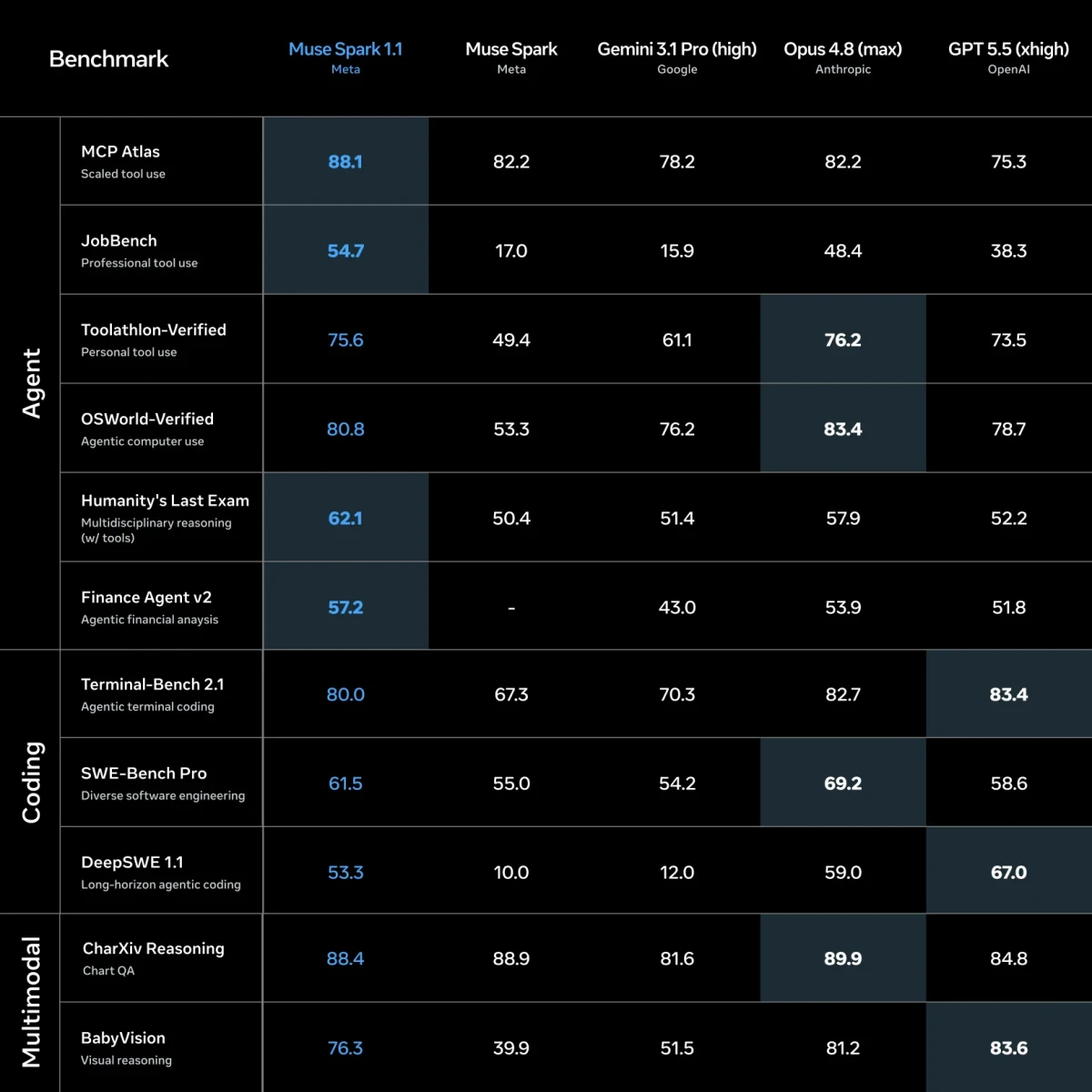
Meta reports gains in multidisciplinary reasoning and tool-augmented problem solving. This shows up clearly in benchmarks like Humanity's Last Exam and Finance Agent v2, where Muse Spark 1.1 scores well above the original Muse Spark.
Muse Spark 1.1 works by combining planning, delegation and context management into a single loop.
When you give it a task, it first breaks the task into steps. If the task is complex, it can act as the main agent and split the work across several subagents that run in parallel. Each subagent understands its available tools and knows exactly when to escalate a problem back to the main agent.
While doing this, the model keeps track of its 1 million token context window. It does not just dump information into memory. It compacts older details and keeps only what matters for the next step, so it does not lose track of a long project.
For computer-use tasks, Muse Spark 1.1 decides between two approaches. If a script gets the job done faster, it writes one. If a direct click through the interface is simpler, it does that instead. Meta also says the model can zero-shot generalize to new tools, MCP servers and custom skills, so you do not need to fine-tune it for every new integration you connect.
This is what makes Muse Spark 1.1 an agentic model rather than a simple chatbot. It does not wait for step-by-step instructions. It figures out the steps on its own.
Related Article: OpenAI's Codex: A Complete Guide with Practical Examples
Compared to the original Muse Spark, the 1.1 version brings real, measurable upgrades, not just marketing claims. Here is what changed:
Multi-agent orchestration, where the model can lead or support other agents on a task
Active context management across a 1 million token window
Major jumps in professional and scaled tool-use benchmarks
Stronger coding performance on real-world tasks like bug fixes and migrations
Better computer-use workflows across multiple apps with changing information
Improved multimodal perception combined with action, like reading a video and then completing a task based on it
Early partners have backed up these claims. Saoud Rizwan, CEO of Cline, said Meta is building seriously for agentic coding, with strong tool use at a price point that makes real coding workloads viable. Amjad Masad, CEO of Replit, praised its coding ability, especially for frontend and design work, along with its OpenAI-compatible setup.
This is where I recommend you slow down and read carefully, because the real picture is more balanced than Meta's own announcement suggests.
Meta's official numbers rely heavily on its internal Meta Internal Coding Bench, which outside researchers cannot verify. The more useful numbers come from independent, third-party benchmarks that compare Muse Spark 1.1 with Muse Spark, Gemini 3.1 Pro, Claude Opus 4.8 and GPT-5.5.
Source: https://ai.meta.com/blog/introducing-muse-spark-meta-model-api/
There are three ways to use Muse Spark 1.1, depending on whether you are a casual user or a developer.
If you already use the Meta AI app on your phone, Muse Spark 1.1 is available inside it for free. You just need to switch to "Thinking" mode to access the model's full reasoning ability.
You can also access Muse Spark 1.1 for free through the meta.ai website. Simply log in with your Meta account and select Thinking mode. It accepts text, image and audio input, though the output remains text-only for now.
Developers can access Muse Spark 1.1 through the Meta Model API, which is currently in public preview. US developers can sign up and start building immediately, while broader international access is on a waitlist.
To use the Meta Model API, you will need:
A Meta developer account
An active API key generated from the developer portal
A US-based account for immediate access, since the preview is currently limited by region
An OpenAI-compatible SDK setup, since the Meta Model API follows the same request format
Muse Spark 1.1 is built for agentic work, so its real value shows up once you go beyond simple chat. Here are the areas where it fits best.
It can plan a coding task, write the code, test it, and fix bugs along the way as an AI coding assistant, without needing you to break the task into tiny steps first.
Beyond writing new code, it handles diagnosing complex bugs, adding features to existing enterprise systems and running large code migrations across a codebase.
With its strong reasoning scores and large context window, it can gather information, cross-check sources and compile findings into a usable summary.
Businesses can use it to automate multi-step internal processes, like pulling data from one system, processing it and updating another system, all without manual handoffs.
Since Muse Spark 1.1 is expected to power chatbots across WhatsApp, Instagram and Facebook, it is well suited for handling customer queries with context that carries across long conversations.
Its multimodal input lets it read and reason over PDFs, images and other documents, extracting the details you need without manual review.
It can look at an image or video, understand the details and take an action based on it, like extracting product photos from a video and using them to create a listing.
For anyone building AI agents, Muse Spark 1.1's ability to lead or support other agents makes it a strong base model for orchestrating complex multi-agent systems.
Once you look past the marketing, a few genuine strengths stand out. Here is what Muse Spark 1.1 does well.
Free consumer access through the Meta AI app and meta.ai
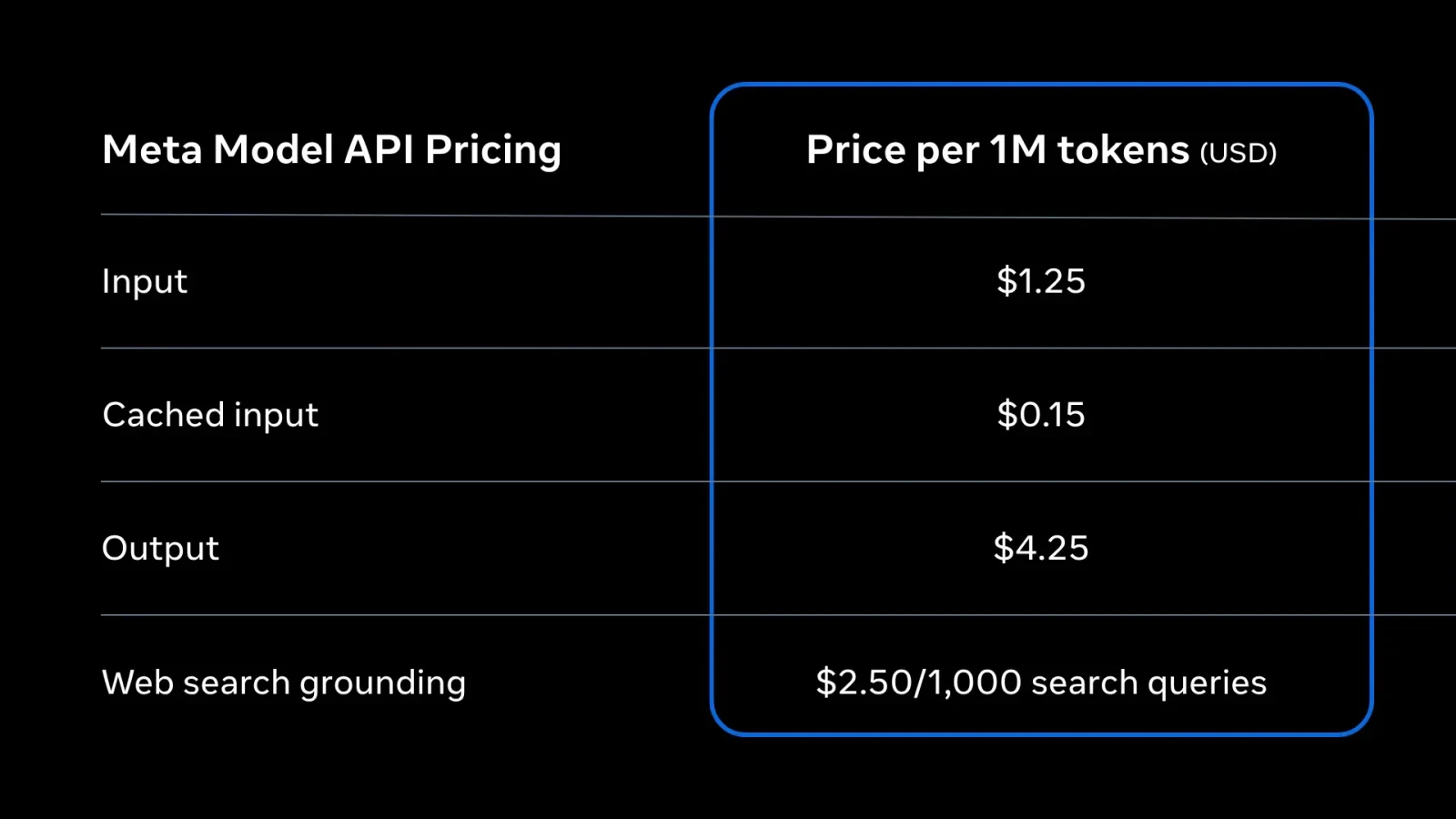
Aggressive, competitive API pricing compared to OpenAI and Anthropic
Leading scores on tool-use and agentic benchmarks like MCP Atlas and JobBench
Large 1 million token context window with active memory management
Multimodal input support across text, images and audio
OpenAI-compatible API, which makes migration simple for existing developers
Major performance gains over the original Muse Spark in just a few months
Read Also: What is Claude Sonnet?
No model is perfect and Muse Spark 1.1 has a few real gaps you should know before you commit to it.
Not open-weight, so no local deployment or custom is fine-tuning like Llama offers
Trails Claude Opus 4.8 and GPT-5.5 on pure coding and long-horizon coding benchmarks
Output is text-only for now, with no direct image or video generation
The Meta Model API public preview is currently limited to US developers
Documentation is still sparse, with no detailed official model card yet
The evaluation-awareness findings from Apollo Research need further independent verification
Numbers are useful, but a side-by-side view makes the differences easier to spot at a glance. Here is how Muse Spark 1.1 stacks up against the other frontier models.
| Feature | Muse Spark 1.1 | GPT-5.5 | Claude Opus 4.8 | Gemini 3.1 Pro |
| Developer | Meta | OpenAI | Anthropic | |
| Context Window | 1 Million tokens | ~1.05 Million tokens | 1 Million tokens | 1 Million tokens |
| Multimodal Support | Yes | Yes | Yes | Yes |
| Coding Capability | Excellent | Excellent | Excellent | Very Good |
| Reasoning | Advanced | Excellent | Excellent | Very Good |
| Agentic AI | Excellent | Excellent | Excellent | Good |
| Tool Calling | Yes | Yes | Yes | Yes |
| Open Source | No | No | No | No |
| Best For | AI agents & automation | General AI tasks | Enterprise coding | Google ecosystem |
Muse Spark 1.1 follows a simple, two-tier pricing structure.
Consumer access through the Meta AI app and meta.ai is completely free, though heavy use will likely run into rate limits since it requires a Meta login.
Source: https://developer.meta.com/ai/resources/blog/build-with-muse-spark/
Meta's direction with Muse Spark 1.1 gives a clear signal about where the company is headed with AI.
Meta appears to be moving away from open-source Llama as its primary AI strategy and shifting toward a proprietary, paid-API model, closer to how OpenAI and Anthropic operate. Muse Spark 1.1 is expected to gradually replace the Llama models currently powering chatbots across WhatsApp, Instagram, Facebook and Meta's smart glasses.
Given the size of the jump between the original Muse Spark and version 1.1, further updates are likely to focus on closing the coding gap with Opus 4.8 and GPT-5.5, along with expanding output beyond text.
Meta is clearly betting on agentic capability as its main differentiator. Expect future versions to push further into multi-agent orchestration and longer, more independent task execution.
With an OpenAI-compatible API now in public preview, third-party tools, coding harnesses and developer platforms are likely to add native support for Muse Spark 1.1 fairly quickly, which should grow its developer ecosystem over the coming months.
Muse Spark 1.1 is Meta's clearest signal yet that it wants a real seat at the frontier AI table, not just as an open-source contributor, but as a paid model provider competing directly with OpenAI, Anthropic and Google.
It is not the strongest model on every benchmark. Claude Opus 4.8 and GPT-5.5 still lead on pure coding tasks. But Muse Spark 1.1 genuinely stands out for agentic and tool-use work, backed by a large context window, competitive pricing and free consumer access.
If you are building agents, automating workflows, or simply exploring what a Meta-built frontier model can do, Muse Spark 1.1 is worth testing for yourself.
Also Read: Claude Fable 5: Anthropic's Most Powerful AI Model
No, Muse Spark 1.1 is not open source. Unlike Meta's Llama family, it is proprietary and closed-source. You cannot download it, deploy it locally, or fine-tune it for your own use. It is only available through the Meta AI app, meta.ai, or the paid Meta Model API.
Muse Spark 1.1 adds strong agentic capabilities that the original model did not have. It can lead or support multi-agent systems, actively manage a 1 million token context window and handle computer-use tasks across multiple apps. Independent benchmarks show major gains over the original, especially in tool use and long-horizon coding.
Yes, Muse Spark 1.1 is strong at coding. It can diagnose bugs, build new features and handle large code migrations across enterprise systems. It also supports popular coding harnesses like OpenCode. That said, on pure coding benchmarks, Claude Opus 4.8 and GPT-5.5 currently score higher.
Muse Spark 1.1 accepts images and audio as input, along with text and it can reason over visual content in detail. However, its output is currently text-only. It does not generate images or videos directly. For image generation, Meta offers a separate model called Muse Image.