Natural language processing (NLP) is a very important aspect of artificial intelligence (AI), which itself is ruling the world today. An important question today is 'what is natural language processing' and it is equally important to get a good answer. This is the technology that gives computers the ability to understand human language, be it spoken or written.
AI-powered systems are getting more embedded in our daily lives. This has led to a direct increase in the demand for people with skills in related technologies, tools and platforms. Since NLP is one term that's closely related, this article taps into everything one must know about it. Let's begin with its definition, and move on to its components, techniques, uses and challenges.
NLP (Natural Language Processing) is a machine learning technology. Computers can interpret, comprehend and manipulate human language with this tech. Most organizations today have gigantic text and voice data volumes. This is collected from different communication channels like social media newsfeed, audio, text messages, video, emails and much more.
Companies use the natural language processing technology to automatically process this data, analyze the message's intent and consequently respond in real time. The input does not have to be perfect for this software to work, just like day-to-day conversations.
Explore igmGuru Machine Learning Course Online for the best career opportunities in this field.
NLP is known for its enriching history, made up of distinct ideas gathered from linguistics and computer science since the mid-20th century. This section highlights some major moments in its development.
1950s
The foundation for NLP was established as Alan Turing came up with the Turing Test. This test was invented to examine whether a computer is capable of displaying human-like intelligence by understanding human language.
NLP followed a set of rules laid by linguists. Another standout moment is considered to be the Georgetown-IBM experiment. This experiment was done in 1954, which successfully translated more than 60 russian sentences to English.
1980s - 90s
During this period, experts worked on how computers could understand language through semantics, parsing, and morphology. In the 1990s, developers switched to statistics instead of a rules-first approach. This shift happened due to advancements in computing power. As computers evolved, the focus shifted from linguistics to a wide range of scientific fields.
2000 to 2020s
NLP gained massive popularity, and applications like virtual assistants and chatbots emerged due to advanced computing capabilities. Today, NLP combines traditional linguistics with statistical techniques to improve its effectiveness. It has become an integral part of humans' interaction with technology.
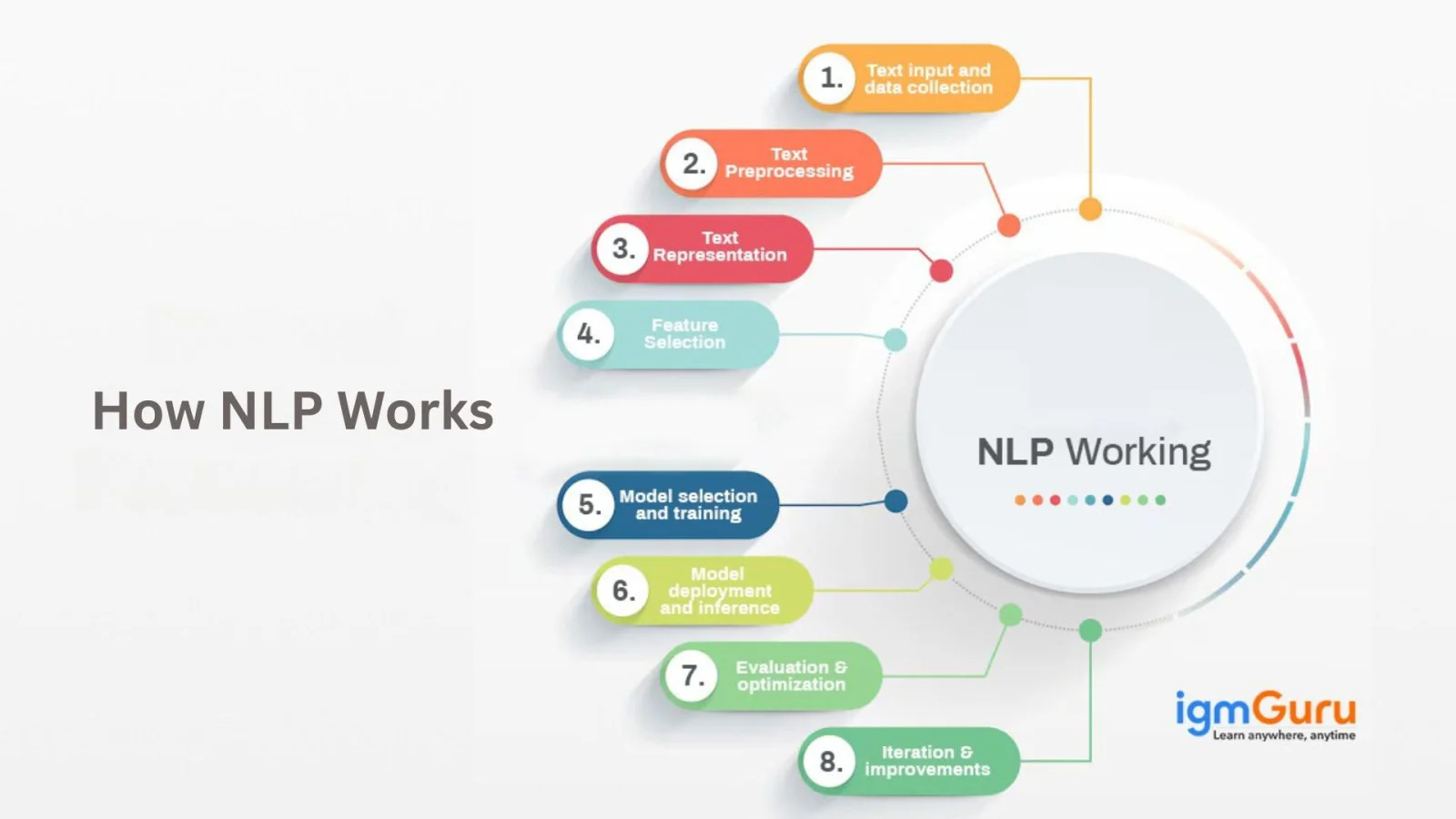
There are some mechanisms behind learning how NLP works. One must have a comprehensive understanding of this to move forward in this field. Let's take a closer look at its working, involving learning about its components.
Collecting text from different sources like books, private databases, social media or websites.
Storing the text in a database or documents in an organized manner.
The raw text must be clean and prepared for analysis. Here are some common steps to achieve that.
It allows you to convert words into numerical formats like Bag-of-Words, TF-IDF, or embeddings. The following are the points below-
It identifies meaningful patterns or attributes from text for model input. Here is how it works, as given below-
In this, you can choose and train a machine learning or deep learning model for specific tasks.
You can integrate the trained model into applications to make predictions on new text. Here are the processes below-
It allows you to measure performance using metrics and fine-tune the model for better accuracy.
Related Article - Deep Learning vs Machine Learning
There are many NLP methods and techniques for analyzing human language. These techniques are like the backbone of this technology. Individuals must devote a good amount of time in learning about these and then implement those learnings in the real world. Some of the best NLP techniques are -
NLP is used in many different industries as well as in our everyday lives. Plenty of tasks that we do every day involve advancements that are possible only because of NLP, artificial intelligence and machine learning.
NLP enables people to work with machines through their regular language, benefiting them across various fields.
Search engines get a grasp of what users are asking for through NLP, providing them with relevant results. Users can get useful information even when their search is not clear as these smart systems also look at the meaning behind words. It's really helpful whether one is searching online, looking for documents or sorting through company data.
NLP automates many tasks like data entry, document management and customer support. For example, chatbots powered by NLP can take care of customer queries. This enables human workers to look after complex tasks. In document work, NLP tools can sort, pull out important details, and summarize content, which cuts down on the time and mistakes that come with doing it all by hand. It also helps with translating text from one language to another while keeping the meaning and subtleties intact.
NLP consists of advanced tools that are capable of generating human-like texts. Models like GPT-4 can whip up reports, descriptions, articles, marketing materials, product descriptions and even creative writing based on what is being asked. They can also help with writing social media posts, creating legal documents or drafting emails. By understanding the context and tone, NLP ensures the content makes sense and fits the intended message, saving you time and effort while keeping it high-quality.
NLP enhances data analysis by pulling useful information from text data like social media updates, customer reviews and latest articles. Text mining is another technique to highlight patterns and trends in large datasets. People's opinions or sentiments can be analyzed through sentiment analysis to discover what they are feeling. This information is useful to direct the message to the right system or person for the next response.
Read this ChatGPT Tutorial to understand how this leading gen AI model works.
Understanding 'what is natural language processing' or its techniques is not enough. One must take time to understand the challenges of NLP to be able to learn about it in depth. Its future is bright but a lot of work has to be done to get there.
Fortune Business Insights has projected the NLP market to grow at a CAGR of 23.2% between 2024 and 2032. The value is expected to go from USD 29.71 billion to USD 158.04 billion during this tenure. This clearly indicates the future of NLP being bright, even for related experts.
Customers are very much accustomed to being greeted by chatbots, whether they visit a website or raise a query. These bots can swiftly answer queries and direct customers to the right solutions at any time of the day. Bots' full productivity can only be reached through optimum use of NLP, which is not very far in the future.
Improved searching abilities have been on the block for quite some time but it's finally time to experience it. Smarter search includes smarter chatbots that are not restricted to just keywords or phrases. They would rather focus on topics using natural language and speech. Google Drive has NLP capabilities for searching for content and documents with human-like language.
Human communication (written and oral) is the basis of every connection between humans and machines. The future includes a zero or invisible user interface that relies on direct communication between the machine and the user. This communication could be done through text, voice or both together.
Many questions are still to be answered even after learning 'what is natural language processing'. This is only the basic question that leads to hundreds and thousands of other related, and even sometimes distant, questions. This one technology has changed the way interaction happens between humans and machines. The outcome is certainly more intuitive communication.
This one technology has begun to work as an umbrella term with many different technologies, methods and aspects under it. Many industries that use artificial intelligence a lot have also realized the need to explore this tech further. The demand for experts with related knowledge and skills is also rising because of this.
The best examples of this technology include email/ spam filters, predictive text, smart assistants and language translation. There are actually endless uses and examples of the uses of this tech.
It is a technology that computers use for reading, understanding and translating the user's language.
Yes, ChatGPT is an NLP model that delivers outcomes using different techniques like sentiment analysis, tokenization and part-of-speech tagging.
Explore Our Trending Articles:
Course Schedule
| Course Name | Batch Type | Details |
| Machine Learning Training | Every Weekday | View Details |
| Machine Learning Training | Every Weekend | View Details |