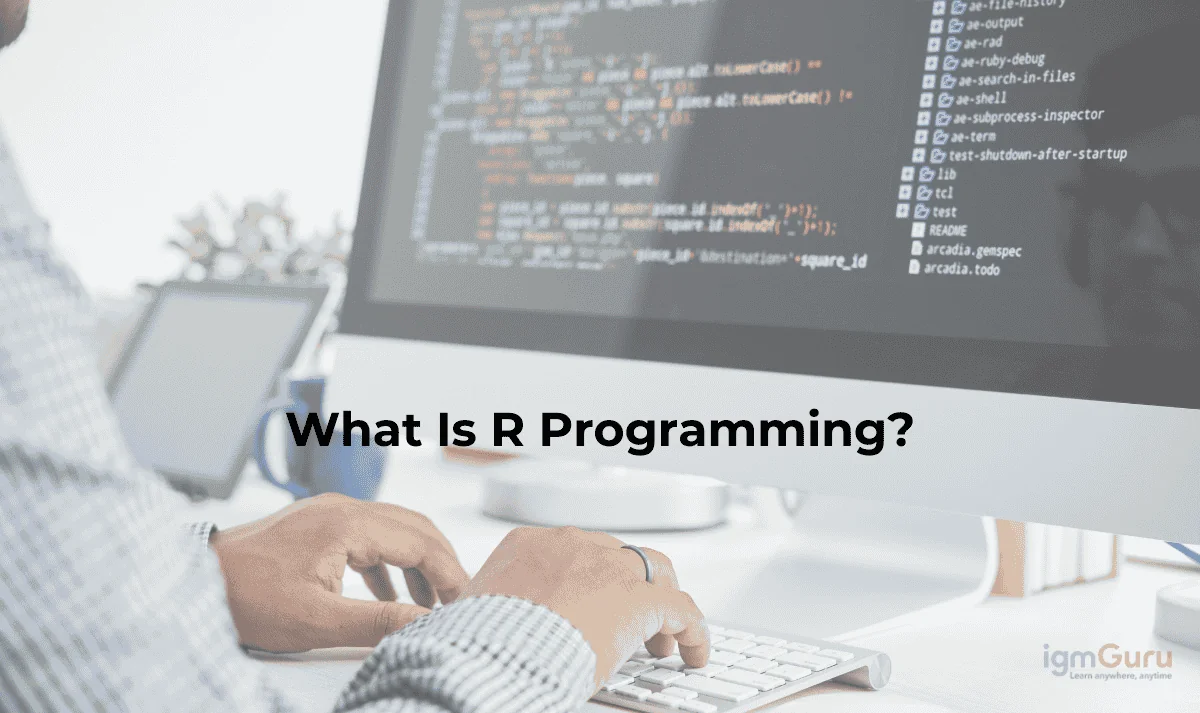
This modern age of data analysis has a powerful tool called the 'R' language. It is greatly loved by every professional from statisticians to researchers. Its impressive libraries and packages are curated for many tasks like visualisation, data manipulation and statistical modeling. This article covers everything about what is R programming language.
The popularity of this programming language has certainly increased in the latest data from last year. Everything from its benefits, how people use it in different jobs to why many data professionals can't imagine working without it is discussed in this blog.
R came into existence in the early 1990s. It was introduced as an open-source implementation of the S programming language. The latter programming language was created at Bell Laboratories in the 1970s. Its design aimed at bringing in concepts, graphics and statistical computing which would later mould R's functionality.
The year of 1997 brought major transformations by forming the R Core team to look after R development. Later, CRAN (Comprehensive R Archive Network) was launched to host R and its library of packages.
The first step is to know what is R programming language. It comes from the S programming language. The R project started in 1992 and the first version came out in 1995. A stable beta version was ready by 2000. It uses ideas from Scheme in how it manages variables. R is a popular tool for machine learning, statistics and data analysis. It makes it simple to create objects, functions and packages.
Ross Ihaka and Robert Gentleman developed this programming language at the University of Auckland. Anyone can use it for free on any operating system as its open-source. It stands out as more than just a statistics package and works well with other languages like C and C++. It connects with different data sources and tools easily. The rise in data science jobs is making people go for this programming language.
Explore igmGuru's Data Science and BI Certification Courses and choose the best one that meets your requirements.
People use it when they need to dig into data, build models, and create clear visuals. It's great for managing tough datasets and doing advanced math with them. Here's a detailed view of what is R programming language used for.
Academics and the research sector commonly use this progressive programming language. One example is Cornell University that teaches this programming language in courses that need statistical computing. The University of California teaches students statistics and data analysis by introducing them to R and many other universities do as well.
Social media is all about data. Users are tracked every time they go online. Every click and scroll is saved somewhere for experts to analyze later. Social media platforms mainly make money from the data they collect on users and through targeted advertisements. This tool is for analyzing social media data, figure out customer groups and target ads effectively.
Data journalism is all about using data for storytelling. They are a perfect combination of journalism and data science. They analyze public data to find interesting facts about our lives. This data can come from local government reports or crime statistics.
It can also include financial information that shows how a country's economy is doing. They search for patterns in data to make people understand the world better.
R is great at showing data visually. It has tools like ggplot2 and lattice that let users make clear and detailed plots. These visuals are super helpful for looking at data and sharing what users find. It is useful to make graphs, charts and maps that show trends and patterns in the data.
This programming language has some great tools for working with data. One can use packages like dplyr and tidyr to clean up and transform their data. This makes it a lot easier to analyze it. It can handle big datasets and perform complicated tasks. This makes it useful for data scientists and analysts.
Now, let's take a look at the key features of R programming to attain a better understanding of this incredible language.
With R, one can generate top-notch data visualizations with ease. Here is the list of what users can create using R packages like plotly or lattice -
New packages are continuously developed by the community along with already existing packages available through CRAN. This affability enables users to-
A variety of statistical techniques are supported by R including-
R consists of its core data structures such as data frames, matrices, lists and vectors. These data structures highly support data handling and transformation tasks. The following tasks are efficiently performed with packages like tidyr, dplyr, etc.
Explore our detailed guide on R Tutorial
It is growing fast and comes with a lot of benefits. Its simple syntax makes it easy to use. That's why many people like its interface better than other in-demand programming languages. Learners must know what are advantages of the R programming language to remain aware of how fruitful learning this tool could be.
R is a programming language that works on any operating system. One can write the code just one time and it will run on Windows, Linux and Mac. It makes it simple for developers to create software for different platforms without starting from scratch for each one.
One of the best advantages of this programming language is the fact that it is open-source. This means that it's absolutely free for anyone to use and share. Anyone from students to researchers can easily access it without worrying about costs. It also has a great community of users and developers.
There are many helpful forums and tutorials out there for users. Websites like Stack Overflow and R-bloggers are great places to ask questions and keep up with new information.
R works well with other programming languages and tools. This makes it a great option for analyzing data. Users can run its functions in Python using a package called rpy2.
It can handle many data types like CSV, Excel, SQL and JSON. This means users can easily import and export different kinds of data. It also connects well with databases and big data systems like Hadoop and Spark using packages like dplyr and sparklyr.
It has a huge collection of packages made by users from all over the world. These packages work well with many things like stats, machine learning, data visualization and analyzing time series. One can easily add new features to this programming language by installing the packages one needs. The Comprehensive R Archive Network or CRAN has more than 18,000 packages created by the community. These packages cover lots of needs in stats, graphics and data handling. This big library saves a lot of time.
Just like any programming language, it has its cons too. Learning is all about understanding both negative and positive aspects of something. Let's shed some light on what are disadvantages of the R programming language.
Its different syntax and data structures can be unfamiliar for people with no experience in statistics or data science. Some examples are data frames, vectors and lists. It could take considerable time to understand ideas such as functional programming and vectorized operations. Basic R can be relatively straightforward. It takes much more effort to master advanced features and packages.
It is slower than compiled languages like C or C++ as it's an interpreted language. Dealing with large datasets or performing intensive tasks can cause many setbacks to its performance. Take an example of complicated simulations or real time analytics. This may need performance optimizations or alternative approaches. The R programming language needs substantial memory and may not be able to efficiently manage it.
R isn't the best choice for software development as it's mainly made for data analysis and making charts. Other programming languages work better to create apps or web pages. It isn't easy to develop user interfaces either using this programming language.
R's memory management isn't the best when compared to other programming languages. It uses lots of memory while handling big datasets and temporary objects. This might cause slow performance or even crashes. Users should keep an eye on how much memory they're using. There are different methods like breaking data into smaller chunks, keeping check on memory usage, and cleaning up useless objects to avoid problems.
Explore the comparison- Python Vs R Programming
Python and R are two of the most popular programming languages for data science. Both have their unique strengths and are well-suited for various data science tasks. Here's a comparison of both the languages.
| Criteria | R | Python |
| Community | Large and Active | Large and Active |
| Statistics | Excellent | Good (with libraries) |
| Data Visualization | Excellent | Good (with libraries) |
| Versatility | Limited | Strong |
| Cross Platform | Yes | Yes |
| Ease of Learning | Moderate | Easy |
| Open Source | Yes | Yes |
R is frequently used for statistical computing, machine learning algorithms, data analysis, and data science. It's a go-to tool for data science professionals due to its capabilities of cleaning, importing and visualizing data. Let's discuss some more common use cases for R-
R programming offers impressive data visualization features and strong statistical capabilities. The entire ML workflow is supported by it, from cleaning the data to exploring it with data packages like dplyr. Both supervised and unsupervised learning is handled by R. It also offers tools for evaluation, reporting and tuning.
R is capable of designing the best quality and appealing data visualizations. This includes a wide array of options from basic plots to engaging dashboards. This helps in exploratory data analysis and communication of insights.
R is a vital tool for evaluating medical data, performing genetics research, conducting clinical trials along with proving to be useful for epidemiological studies.
R's applications are also apple for predictive modeling of consumer behaviour, customer segmentation and evaluating the effectiveness of market campaigns.
Organizations make the best out of R's capabilities by using it to evaluate customer feedback, enhance product designs based on received feedback and optimize product decisions.
R is ideal for a number of statistical modeling tasks such as time series analysis, hypothesis testing, clustering, regression analysis, etc., with its comprehensive suite of statistical functions.
It's safe to conclude that readers are now aware what is R programming language. It is an all in one tool for data work. Professionals like data scientists and researchers go for it as it has many stats methods and cool ways to display data. Another great benefit is the fact it gets along well with other languages. There's a growing community to support users as this tool sparks new ideas in many areas.
R is created for statistical analysis and graphic visualizations. It is not just a language but also a system composed of the R language itself. It's a run time environment in which users perform tasks through the command line.
The term is coined from the first letter of the names of developers who created this programming language. It has no such full form for it.
The system is written in the R dialect of S. This makes it easy for users to follow the algorithmic choices made.
Course Schedule
| Course Name | Batch Type | Details |
| R Training | Every Weekday | View Details |
| R Training | Every Weekend | View Details |