Have you ever wondered what powers blockbuster video games, self-driving cars, or even NASA's Mars Rover? That's C++ for you. C++ is a strong, general-purpose programming language developed by Bjarne Stroustrup in 1979 as an extension of the C language. It was made by Bjarne Stroustrup. C++ combines raw speed with unmatched control, making it the go-to choice for everything from AI to unicorn apps. Whether you are a fresher or a tech junkie, this blog will guide you into what makes C++ a game-changer. We will read about what is C++, why to use it, how to use C++, what it is used for, and so much more. So, are you ready to unleash its secrets? Let's begin!
C++ is a strong, general-purpose programming language developed by Bjarne Stroustrup in 1979 as an extension of the C language. This language supports multiple programming paradigms, object-oriented, procedural, and generic programming. The C++ programming language is highly valued because of its speed, performance, and the capability to offer a high level of control over system resources and memory.
This language is the backbone of high-performance computing, where speed and control aren't just 'nice to have', they are non-negotiable. Gaining knowledge about C++ is not just knowledge; it's your ticket to unlocking elite-level innovation.
As we know, C++ is among the world's most famous programming languages. It can be found in today's operating systems, graphical user interfaces and embedded systems. It is an object-oriented programming language that gives a clear structure to programs, permits code to be reused, and lowers development costs. It is portable and can be put to use for developing applications that can be adapted to various platforms. C++ is pretty fun and easy to learn! As it is close to C, C#, and Java which makes it easier for programmers to switch to C++ or vice versa. Here are the reasons why we use C++.
Read Also: What is Software Development? Models And Types Explained
There are multiple paths to learn the C++ language, such as online tutorials, courses, and interactive exercises. For starting programming in C++, developers require a C++ compiler that translates code into machine-readable instructions. These compilers include Clang, GNU Compiler Collection, and Microsoft Visual C++. Once the compiler is installed, developers can make use of the text editor or an integrated development environment (IDE) for writing C++ code.
The IDEs provide features like code completion, debugging tools, and management abilities.
The C++ programs are generally structured into functions. The 'main ()' function is the beginning point of the computer program where execution starts. Developers can make use of control structures like loops and conditionals for controlling their program's flow. This language offers a set of libraries that provide prebuilt functions and data structures for common tasks.
To use C++, you require:
Here is an example showing how to use C++ to make things easier for you to understand.
This is the classic starting point for any programmer. This prints "Hello, World!” onto the screen.
|
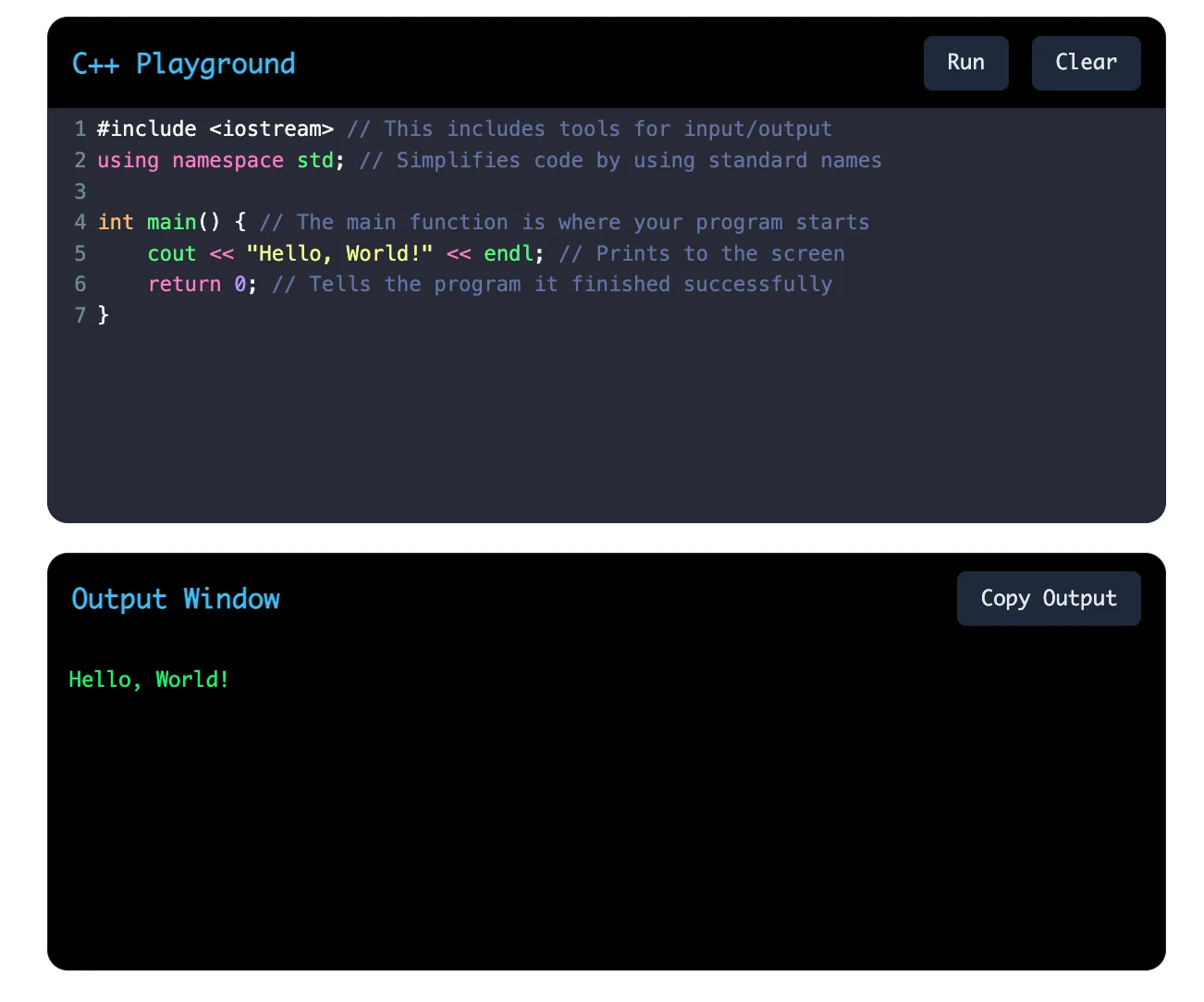
Test Your C++ Code Here: Online C++ Compiler
What's happening here is that '#include
C++ and C are both strong programming languages, but they serve us slightly different purposes. C was created in the 1970s and is a procedural language focusing on simplicity and low-level control, which makes it ideal for operating and embedded systems. Whereas C++ was made in the 1980s as an extension of C, it has object-oriented features such as classes and inheritance, which makes it even more versatile for tough applications like games and software. I made a table on the differences between C++ and C to make things easier for you to understand these slight differences.
| Features | C | C++ |
| Paradigm | This is Procedural programming. | This is Procedural and Object-Oriented. |
| Object-Oriented | No it's not as it has no classes or objects. | Yes it is as it supports classes, objects, inheritance. |
| Standard Library | Has a basic library such as stdio.h, stdlib.h. | Has a rich library such as iostream, string, vector. |
| Memory Management | Is Manual(malloc/free). | It is manual and has features like new/delete. |
| Function Overloading | Not supported | Supported (same function, different parameters) |
| Use Cases | OS, embedded systems. | Games, GUI apps, high-performance software. |
C++ is widely used for developing high-performance and resource-constrained applications. This language's versatility and control over system resources make it completely suitable for multiple realms. Here are the areas where C++ is used for:
As we know that C++ is strong, and is used as a general-purpose programming language and is used all over a vast variety of applications and industries, all because of its performance, efficiency and control over system resources. Let us take a look at the use cases of C++.
The main parts of operating systems such as Windows, macOS and Linux kernels are written in C++ because of its capability to interact closely with hardware and handle resources efficiently.
This language is basically a cornerstone of the gaming industry, giving power to the game engines like Unreal Engine, Unity's core, graphics rendering and complicated game logic for high-performance and visually rich games.
This language is crucial for developing software for embedded systems, microcontrollers, and Internet of Things (IoT) devices, where resource constraints and real-time performance are critical.
This language is used in the development of multiple database systems involving open source options such as MySQL for its performance in managing huge datasets and tough/complicated queries.
The main components of famous web browsers such as Chrome, Firefox and Safari are developed through C++ for speed and efficient rendering of web content.
This language is put to use in 3D modeling software, animation tools and visual effects in industries such as film and design for its capability to manage complicated computations and huge data sets.
Read Also: 20 Best Programming Languages To Learn in 2026
C++ is a strong programming language for building everything from video games to operating systems. It is fast, efficient and provides you control over how your computer works under the hood.
Writing code includes creating programs through a powerful, general-purpose programming language famous for its performance and versatility. This language is widely used for system programming, game development and applications needing high efficiency. Let us take a look at an example showing a program that generates a colorful ASCII art pattern.
C++ programs are basically written in plain text files with a '.cpp' extension. They basically involve:
Let us make a program that prints a vibrant diamond pattern, making use of ANSI color codes.
|
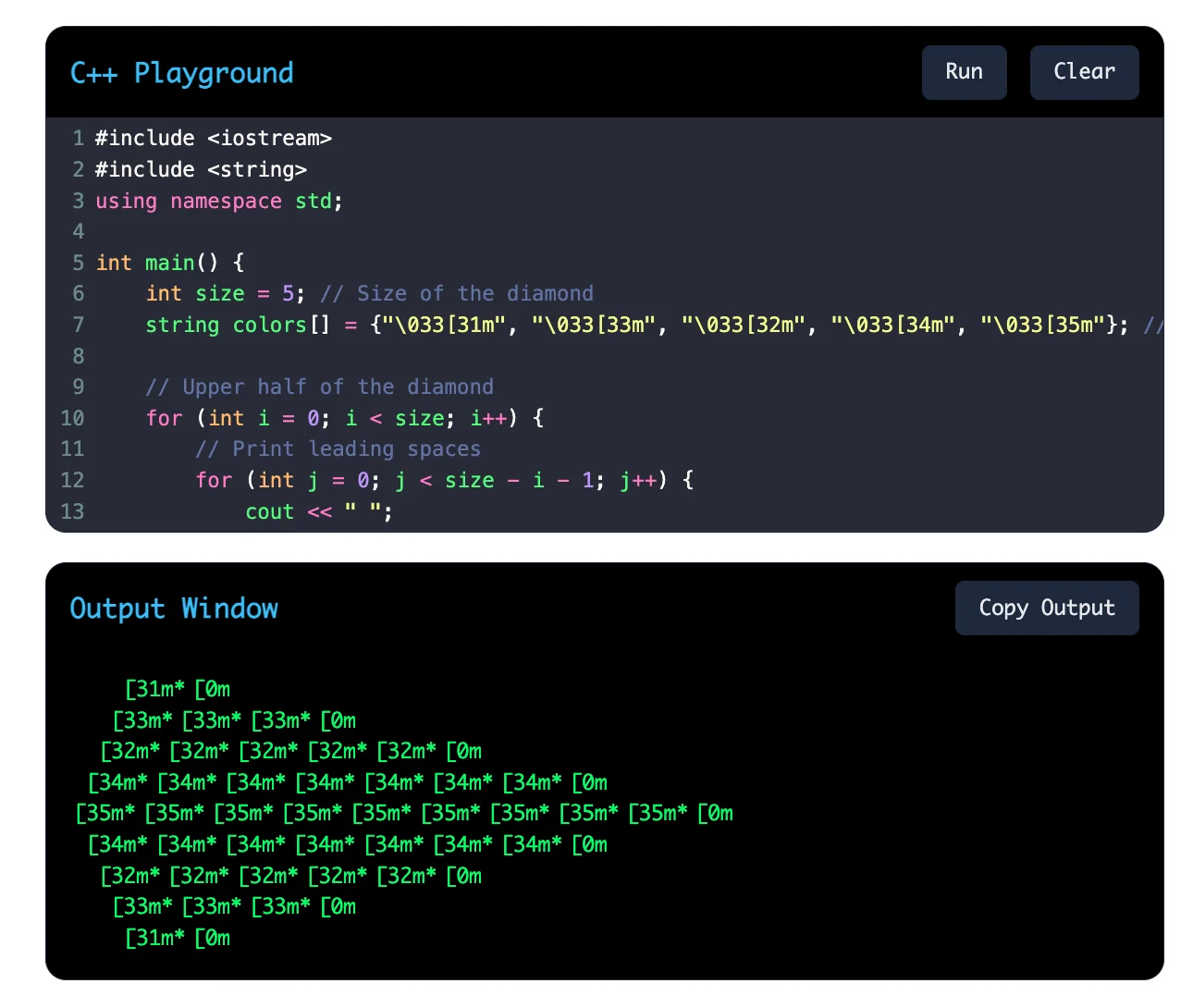
Basically, this program makes use of nested loops for printing a diamond-shaped pattern of asterisks (*). Every row of the diamond is colored using ANSI escape codes, which makes it visually striking when it runs in a terminal that supports colors. The 'colors' array cycles through red, green, yellow, purple, and blue to give a strong effect. You can compile and run this code through a C++ compiler like 'g++', for instance, 'g++ diamond_pattern.cpp -o diamond &&./diamond' on Linux/Mac or similar on Windows.
As we read about this powerful, high-performance programming language, which is widely used, it also has both advantages and disadvantages. Its versatility makes it famous among developers, but it also has many complications, which can pose challenges and obstacles. Read on to take a look at the advantages and disadvantages of the C++ programming language.
Here are some of the advantages of C++
C++ is compiled directly to machine code, which makes it one of the fastest programming languages. It's perfect for performance-critical applications like game engines like Unreal Engine or real-time systems.
This language gives developers direct access to memory management and hardware resources. This low-level control allows for optimized code, ideal for building operating systems or embedded systems. It's like having the keys to a race car, you've total control and maximum power!
It supports multiple programming styles like procedural, object-oriented and generic programming. Whether you're building a simple script or a complex class-based game, C++ adapts to your needs, which makes it a Swiss Army knife for coders.
The C++ Standard Template Library (STL) provides ready-to-use tools for data structures, algorithms and much more. Also, countless third-party libraries like Boost expand their capabilities, letting developers develop strong apps quickly.
From game development (Unity, Unreal) to finance and scientific computing, C++ is everywhere. Learning C++ opens doors to exciting careers, as it's a cornerstone of tech giants such as Google, Microsoft and Adobe.
Here are some of the disadvantages of C++
C++'s complexity, with features such as pointers, memory management and templates, can overwhelm beginners. It's like learning to juggle flaming torches; it's powerful but tricky to master.
Unlike languages like Python or Java, C++ needs developers to manually allocate and free memory. Leading to errors such as memory leaks or dangling pointers, which are like leaving the fridge door open, as things can get messy real fast.
Writing C++ code usually takes longer due to its low-level nature and lack of built-in features like garbage collection. For fast prototyping, languages such as Python might outshine C++.
Its syntax is strict, and small mistakes like forgetting a semicolon may cause cryptic errors. This can frustrate newbies, as debugging feels like solving a puzzle with missing pieces.
This language doesn't hold your hand. Features like unchecked array bounds or raw pointers might lead to crashes or security vulnerabilities if not handled carefully, unlike safer languages like Rust.
C++ becomes even more powerful when combined with frameworks and libraries that simplify development. These tools help developers build desktop applications, games, networking systems, and high-performance software faster and more efficiently.
| Framework/Library | Used For |
| Qt | GUI desktop application development |
| Boost | Advanced libraries for networking, threading, and utilities |
| OpenCV | Computer vision and image processing |
| SFML | 2D graphics and game development |
| TensorFlow C++ API | Machine learning applications |
| POCO Libraries | Networking and internet applications |
The C++23 standard introduces a number of important language and library enhancements designed to make C++ code more expressive, safer, and easier to maintain. Some of the standout updates include:
| Feature | What’s New | Why It Matters |
| Standard Library Modules | Adds modules like std and std.compat. | Faster compilation and better code organization. |
| <expected> Type | A new alternative to exceptions for error handling. | Cleaner, safer, and more readable error-handling patterns. |
| Range Extensions | New adaptors: zip, chunk, slide, etc. | Enables expressive, modern, functional-style coding. |
| New Containers | Includes std::flat_map and std::flat_set. | Provides faster lookups and better cache efficiency. |
| Unicode & Text Updates | UTF-8 is the default encoding; new escape sequences added. | Better global text and Unicode handling. |
| <print> Library | Functions like std::print and std::println. | Simplifies console output—less boilerplate. |
| Improved constexpr | More features and library components usable at compile time. | Enables safer, optimized compile-time computations. |
| Pattern Matching Preview | Foundations for future pattern-matching capabilities. | Moves C++ toward more expressive modern language features. |
Tip for beginners: You don’t need to adopt every new feature immediately. A practical approach is:
That way, you can take advantage of C++23 without disrupting your whole codebase or learning curve.
C++ is more than just a programming language; it's a gateway to building lightning-fast, versatile, and impactful software that powers everything from blockbuster games to cutting-edge AI. Its unmatched performance and refined control makes it a favorite for developers who crave precision. Whereas its rich terrain and multi-paradigm flexibility inspire endless creativity. Sure, it comes with a precipitous learning curve and demands careful handling, but mastering C++ is like taming a dragon, it's definitely challenging, but the rewards are legendary and worth it.
Absolutely! C++ is the go-to language for game development because of its speed and control. It powers engines like Unreal and Unity's core components. It handles graphics, physics, and real-time rendering easily.
It can be challenging for beginners because of its complicated syntax and manual memory management, but it is incredibly rewarding. It teaches core programming concepts like pointers and object-oriented design, which sets a strong foundation.
The C++ language provides unmatched speed and low-level hardware control, whereas Python's simplicity or Java's automatic memory management. Even though Python is great for rapid prototyping and Java for cross-platform apps, C++ shines in performance-critical tasks like game development.
C is a procedural language, while C++ supports both procedural and object-oriented programming features.