Businesses have moved to using newer and more impressive solutions for keeping up with the customer expectations that are changing at a rapid rate. These solutions deliver seamless digital customer experiences for retaining brand loyalty. Salesforce Commerce Cloud is incomparable for offering one-to-one experiences on a single platform. But what is Salesforce Commerce Cloud exactly? It is a cloud-based provider for e-commerce businesses for driving more automation and setting up e-commerce sites for a never-before-like shopping experience.
There is a reason why this provider is becoming so popular these days. The e-commerce sector is forecast to step up as a $7+ trillion industry by 2025. The quantity of online shoppers will reach approximately 289 million by 2027 and over a quarter of global retail sales will be from e-commerce. As more retailers use this provider, its demand spikes up, leading to this article.
Understanding what is Salesforce Commerce Cloud can only be done right by stepping into its backstory first.
Salesforce acquired Demandware, an e-commerce cloud-based provider, in 2016. Bringing together Demandware and the Salesforce platform changed the way e-commerce companies now connect with their customers. Demandware technology created the new Salesforce Commerce Cloud (SFCC).
The SDCC ecommerce platform has many different out-of-the-box features, commerce portals and useful tools for growing an online business. It streamlines the purchasing process, personalizes the buying experience, gives a mobile-friendly shopping experience and connects B2C and B2B.
It is a part of the integrated Salesforce Customer Success Platform. SFCC powers all apps connected to Salesforce. Different business-to-business (B2B), business-to-consumer (B2C) and even direct-to-consumer (D2C) companies use its different e-commerce capabilities.
Explore the most popular Salesforce Certification Courses for career advancement.
Salesforce Commerce Cloud is used by businesses to build and manage their online stores. It's designed to handle everything that goes into selling products digitally, from showcasing items on a website to processing payments and managing inventory. The platform is especially popular with medium and large companies that need a system capable of supporting heavy traffic, complex product catalogs, and global sales.
One of its biggest strengths is unifying the shopping experience. Let's say, if a customer is buying on a laptop, through a mobile app, or even in a physical store, Commerce Cloud helps brands deliver a consistent and connected journey. It also plugs into Salesforce's wider ecosystem, so businesses can use data from marketing, sales, and service to deliver a personalized experience.
In simple terms, Salesforce Commerce Cloud is used for running eCommerce operations at scale. It gives companies the tools to launch, grow, and manage digital storefronts while keeping customer experiences smooth and data-driven.
Ever feel like your e-commerce platform is holding your brand back? If you're struggling with traffic spikes, trying to manage different storefronts for different countries, or feel like you can't give customers the personalized experience they expect, you might be ready for a more powerful solution.
Salesforce Commerce Cloud (SFCC) isn't for everyone. It's a premium, enterprise-level platform designed for businesses with specific goals and challenges. Let's break down who benefits most from it.
If you're a mid-market or large-scale business, you've likely outgrown simpler platforms like Shopify or WooCommerce. You're dealing with high volumes of traffic, a massive product catalog, and the need for a system that can handle thousands of orders an hour without breaking a sweat, especially during peak seasons like Black Friday. SFCC is built for this level of scale and reliability.
SFCC shines for companies managing complex operations. This includes:
If your goal is to make every shopper feel like your store was designed just for them, SFCC is a strong contender. Its built-in AI, Einstein, helps you:
It moves beyond basic personalization to create truly one-to-one shopping journeys.
If your company already uses Salesforce Sales Cloud or Service Cloud, adopting Commerce Cloud is a natural and powerful next step. It allows you to create a unified view of your customer. Your marketing, sales, commerce, and service teams can all work from the same data, ensuring a smooth and consistent customer experience from the first ad they see to the support they receive after a purchase.
Salesforce Commerce Cloud features are the main reason behind its super success amongst leading e-commerce names. While there are innumerable features that tag along with this platform, here are the top seven that make it such a widely used one. Getting an in-depth understanding of these features is needed to move further in this field.
2024 witnessed the introduction of the next generation of Commerce Cloud by Salesforce. This new platform unifies all the main commerce elements like B2B, B2C and DTC Commerce, Payments, Order Management and others. Modular microservices and APIs that Salesforce relies upon has made all this possible. Real-time synchronization is now possible between the backend and frontend systems. Unified commerce generates $1.5 trillion opportunity for retailers on a global level.
Salesforce Checkout brings a unified and single-click checkout experience that is connected to the customer's data available on the Einstein 1 platform. It has different built-in merchant services for shipping and paying taxes. It increases buyer conversion rate through a consistent experience, irrespective of the platform or touchpoint.
Salesforce is making continuous efforts to refine its features around composable commerce. Businesses use these features for rapidly building and deploying customizable B2C commerce experiences. Developers use these new and advanced APIs and personalization options for tailoring solutions as per customer requirements. This approach gives added scalability and flexibility.
SFCC improved composable storefront architecture makes up a flexible and powerful solution for businesses adopting headless commerce. Companies create Progressive Web Apps (PWAs) with composable storefronts. This architecture is a great pick because it has built-in security, modern web technology and supports auto scaling. All these give robust protection, better scalability and 99.9% uptime.
Einstein GPT brings together Salesforce's proprietary AI models, having generative AI technology with Salesforce Data Cloud's real-time data. This combination transforms customer experiences like never before by automating and customizing the main shopping journey aspects. Businesses pair it with Page Designer for Composable Storefronts. All this creates headless commerce and dynamic landing pages for highly personalized shopping experiences.
Salesforce recently introduced three new AI Agents for commerce. These are named Merchant, Buyer and Personal Shopper. These agents autonomously manage many different tasks like order lookup and product recommendation. These do not need any direct human intervention to work properly. They use external data, metadata and CRM data for autonomously managing tasks while keeping privacy guidelines and security in check.
Headless commerce is a business-to-business architecture with separation between the frontend (customer interface) and the backend (online sales, payments, product data, orders, etc.). This lets the business independently make frontend updates without disrupting any backend activities. Such an architecture is also easily scalable. Commerce APIs, different AI-powered tools and composable architecture support headless architecture.
SFCC uses Salesforce Data Cloud to give real-time insights into the inventory levels throughout different locations. This gives a highly accurate stock availability for both in-store and online customers. Businesses can optimize their inventory management and fulfill consumer expectations through real-time consumer data. This real-time aspect is very useful in a prompt response to the changing demand.
This platform integrates well with Slack for getting commerce teams to collaborate without any problems. Team members can directly share real-time updates on customer insights, inventory levels, and order statuses within different Slack channels. Issues are thus resolved faster with a better response rate to customer needs.
Digital 360 was launched in 2020 for commerce, digital and marketing leaders. It is an all-around solution that lets business owners change their business according to the changing digital needs and demands. This is done through personalized customer experiences and the digitization of brand-customer relationships. This platform simplifies the payment process while securing the checkout experience further.
Learn more about the top Salesforce Career Opportunities for 2026.
There is a strong reason to get an answer to what is Salesforce Commerce Cloud list of benefits. Every company using this platform is well aware of the benefits that this platform brings along. It is quite a long list and almost all the users get the most out of it. Let's move further to understand the benefits.
Data is a highly valuable asset that is only helpful when it is read and interpreted correctly for better decisions. The growth of a business is directly proportional to the growth of new data and also indicates the need to correctly use it all. SFCC has different AI tools for data analysis. These tools integrate with the business for analyzing and automating various digital marketing efforts.
Merchants can manage and share product content, images and information amongst different categories, sites and catalogs within this platform. These things can be merged across different sites, languages and currencies. Businesses connect easily with customers through the right product, offer, content, price and variety at the right time. This pushes the conversion rate and may lead to higher order value.
Shopping through smartphones is the new norm now and further instigates the need for a more mobile-intuitive e-commerce store. Google has already stated mobile responsiveness, page load speed and mobile-first indexing as important parameters for ranking well. A mobile-friendly e-commerce store is thus a prerequisite to shine out in the crowd. SFCC puts the mobile-first approach at the very top to ensure an unprecedented shopping experience delivery.
This platform is known for its unlimited and around-the-clock support to its merchants. This unprecedented support is to make sure the user's business runs smoothly and thrives. This support has a thorough meaning out and out. This means that it covers all issues like making security concerns better and fixing code.
Salesforce has built Einstein AI, a higher-level artificial intelligence platform that grandly implements AI for e-commerce businesses. This platform takes out the need for manual data analysis or third-party extensions. Merchants previously had to use third-party integrations for replicating new attributes and managing different platform activities. Such integration is no longer applicable.
Companies manage different storefronts at different locations globally with this platform. E-commerce stores can manage product data sets for distinct stores without any obstacles. It also manages different intricacies like product availability, pricing, billing and others.
This platform empowers retailers in managing their business across different channels from one platform. Retailers get different processes like order management, marketing campaigns, sales, inventory management, etc. in a line. These omnichannel functionalities give high-level flexibility to retailers.
Explore this Salesforce tutorial to learn more about this platform.
Every platform comes with its own limitations, and Salesforce Commerce Cloud is no exception.
Salesforce Commerce Cloud works on a revenue share model, which means the bigger your sales, the higher your fees. For smaller businesses, this pricing can be difficult to sustain compared to platforms with fixed monthly costs.
Although the platform allows customization, most meaningful changes require a skilled Salesforce developer. This makes the process of building or tweaking features slower and more expensive.
With so many built-in capabilities, Commerce Cloud can feel overwhelming for teams that are new to it. Without training or expert guidance, businesses often end up using only a fraction of their potential.
The system integrates well within the Salesforce ecosystem, but connecting it to third-party tools or external apps isn’t always straightforward. Sometimes, it requires additional development or external connectors.
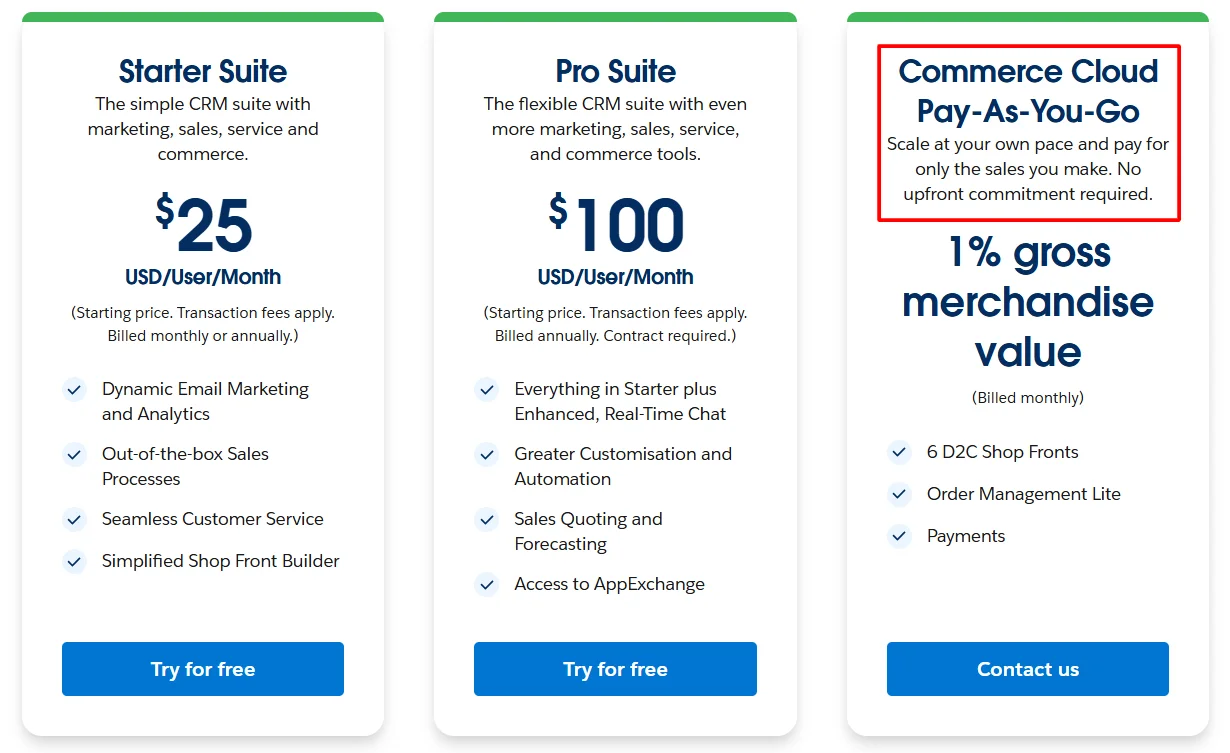
Salesforce Commerce Cloud doesn't have a flat, one-size-fits-all price tag. Instead, its cost is tied directly to how much business you're doing online. The platform usually works on a revenue share model, where Salesforce takes a percentage of your gross merchandise value (GMV). For most businesses, this sits somewhere between 1% and 3%, but the exact rate depends on your contract and sales volume.
Many popular brands rely on SFCC for their operations or services. Here are some real-world examples of how companies use Salesforce Commerce Cloud (SFCC).
Adidas uses SFCC to run its global online stores. The platform helps them manage multiple regional websites, handle huge traffic during product launches, and give customers a consistent shopping experience whether they’re on desktop, mobile, or in-store.
Puma leverages Commerce Cloud to streamline its digital storefronts across different countries. They rely on it to manage product catalogs, scale during seasonal sales, and personalize shopping experiences for different regions.
Lacoste uses SFCC to create a unified brand experience across its e-commerce and physical retail. For example, customers can check online product availability in local stores, making the shopping journey more connected.
It is a long way to completely understand what is Salesforce Commerce Cloud. It is definitely a leading cloud-based platform that creates highly intelligent and integrated buying experiences across different channels. Its widespread features and benefits are the reason behind its unprecedented success today. Its only purpose is to help businesses grow the brand, convert more customers and explore unknown business opportunities.
Explore These Trending Articles:
Businesses use SFCC for creating highly customized experiences with the purpose of growing revenue.
SFCC is a cloud-oriented platform for developing and selling different e-commerce capabilities. Salesforce Service Cloud is an app with a focus on workflows related to services for customer communication and experience.
SFCC is highly versatile and serves both B2B and B2C models. It has different versions for each of these, namely Salesforce B2C Commerce Cloud and Salesforce B2B Commerce Cloud.
Course Schedule
| Course Name | Batch Type | Details |
| Salesforce Commerce Cloud Training | Every Weekday | View Details |
| Salesforce Commerce Cloud Training | Every Weekend | View Details |