Artificial intelligence has completely altered the way businesses operate and this has mainly taken place because of intelligent agents. An intelligent agent is an autonomous program in AI that communicates with environments for meeting certain goals. These agents make decisions, adapt from prior experiences and perceive their environment for improved performances over time. Getting an answer to 'what are AI agents', their key components, types and benefits is important.
These focus on innovative solutions to human problems and their working is discussed to understand their behind-the-scenes better.
AI Agents are intelligent systems that completely understand and accordingly respond to customer inquiries without any human intervention. These agents rely on natural language processing and Machine Learning (ML) to handle different tasks. These tasks can be answering simple questions, resolving complicated issues or even multi-tasking.
These are continually improving their performance through self-learning. Traditional AI requires human input for tasks, but this system does not. Now that we have covered 'what are agents in AI', let's take a look at its components.
Explore igmGuru's Generative AI Course program to learn about AI Agents.
AI agents are intelligent software systems designed to perceive their environment, make decisions, and take actions autonomously to achieve specific goals. They are built upon advanced AI models, often Large Language Models (LLMs), which serve as their "brain" for understanding and reasoning.
Here's a breakdown of the complete process of how AI agents work:
AI agents begin by gathering information from their surroundings. This can involve various methods depending on the agent's purpose:
The raw data collected from the environment needs to be processed and transformed into a format the AI agent can understand. This often involves:
AI agents maintain an internal representation or "model" of their environment. This knowledge base stores facts, relationships, and learned experiences.
The agent continually updates and refines its knowledge base through learning from new experiences, user input, and environmental data.
AI agents are given specific goals or objectives to achieve.
For complex goals, the agent breaks them down into smaller, manageable sub-tasks. It then designs a strategic plan, outlining the necessary steps and evaluating potential actions. This involves:
Large Language Models are crucial here, acting as the "brain" for reasoning, problem-solving, and generating coherent thoughts or responses. They help the agent:
Once a decision is made, the AI agent takes action to execute its plan. This can be:
AI agents often integrate with various external software tools to extend their capabilities. This allows them to perform tasks beyond their core AI model's direct abilities (e.g., a search tool to retrieve up-to-date information, a code interpreter to run programs, a calculator for numerical operations).
AI agents learn by observing the outcomes of their actions and receiving feedback. This feedback can come from:
Based on the feedback and learning, the AI agent refines its internal models, decision-making processes, and action strategies. This continuous learning cycle allows agents to adapt to new situations, improve their accuracy, and become more effective over time without requiring explicit reprogramming for every new scenario.
In essence, AI agents are designed to emulate a simplified version of human cognitive processes: they perceive information, think (reason and plan) based on their knowledge, act upon their decisions, and then learn from the results to continuously improve. This cyclical process enables them to operate autonomously and tackle increasingly complex tasks.
Related Article- Generative AI Interview Questions And Answers
Three key components of AI agents are a must learn for the complete knowledge of these programs. The three modules are named the perception module, reasoning module and action module.
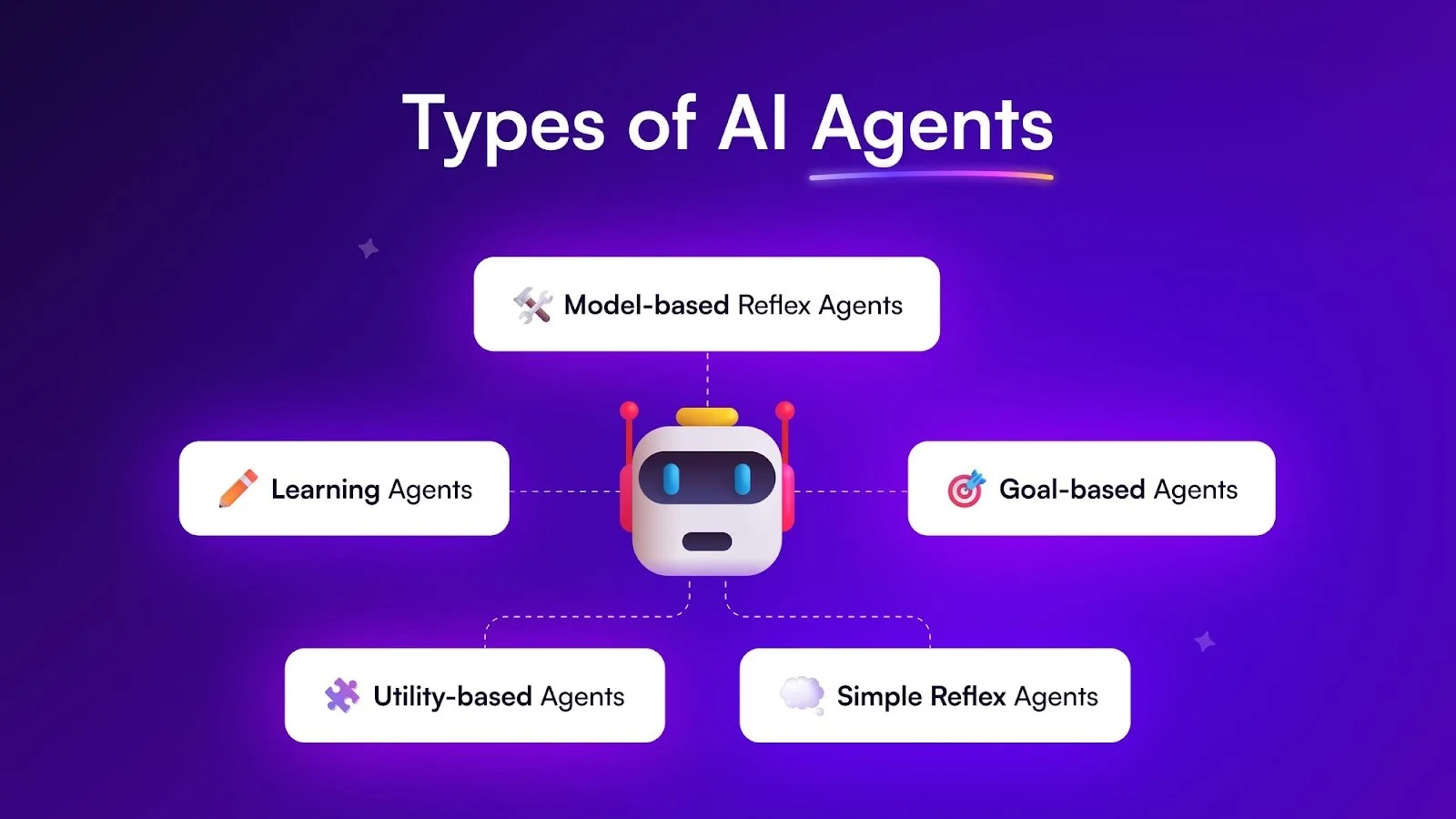
An answer to 'what are AI Agents' is incomplete without a discussion on the different types of AI Agents. There are a lot of forms but these five are the most important ones to learn about -
They function on the 'condition-action' principle and react only to the current perceptions. They don't have a deep understanding of the surrounding world. It's great in some scenarios like a customer chatbot but is not useful in complicated industry environments.
They have an internal model of the surrounding world and can perceive the environment to see things that aren't that obvious. They fill in the missing information to make autonomous decisions according to the context. These agents are more agile and complicated as compared to simple reflex agents.
They make decisions by using a utility function. Different actions are evaluated according to an expected utility measure for picking the optimal approach. It's ideal when there are multiple solutions to a single problem, and it has to decide on the appropriate one.
These tools achieve specific goals by considering their actions' consequences. They make decisions as to whether the action is usable for achieving its objective. They navigate complicated scenarios autonomously and use sensors to revert to the environment.
Reinforcement learning improves these agents over time. Agile industries where a business must stay trendy use these agents.
Related Article- What Is RAG, Or Retrieval Augmented Generation?
There are many benefits of AI agents that have led to more companies adopting it at quite a rapid pace. Some key perks it offers today are -
It handles many customer interactions simultaneously for reduced response times and better efficiency of customer service operations. Businesses can handle higher inquiry volumes without disturbing the service quality.
AI agents are available at all times of the day unlike most human agents. This is how customer inquiries get addressed promptly irrespective of business hours or time zones. Customer expectations are met with continuous availability and also leads to better customer loyalty.
These agents give quick and accurate responses for better customer satisfaction scores. Data is used for personalizing interactions and making the overall customer experience better. These agents learn over the period of time and gear toward continuous improvement.
Valuable data is generated on the go on customer preferences, behaviors and interactions. This data is then used to gain valuable insights into trends and customer needs.
AI agents aren't just futuristic concepts anymore- they're already shaping how businesses and people work every day. They've made it possible to handle complex, time-consuming tasks with little or no human effort. Let's look at a few real-world examples where AI agents are making a real difference.
You've probably already interacted with AI agents without realizing it. Think of Siri, Alexa, or Google Assistant- they listen, understand, and respond almost like humans. In businesses, AI chatbots do something similar. They answer customer questions, solve common issues, and stay available 24/7 so customers always get quick support. This not only saves time but also keeps customers happy and engaged.
In the financial world, AI agents are quietly keeping everything safe and efficient. They help detect fraud by spotting unusual transactions and instantly warning users. Then there are Robo-advisors like Betterment and Wealthfront, which act like digital financial planners. They analyze user goals and give investment suggestions that make sense for each person's risk level and long-term plans.
AI agents are becoming the doctor's new best friend. Virtual health assistants can remind patients to take medicines, schedule appointments, and even check basic symptoms. Tools like IBM Watson Health go a step further- they sift through thousands of medical reports and images to help doctors diagnose diseases faster and more accurately. The result? Quicker treatments and better care for patients.
Self-driving cars are a perfect example of AI agents in action. They "see" the road using cameras, sensors, and LiDAR, make split-second driving decisions, and safely navigate traffic. In factories, robots powered by AI agents work tirelessly on precision manufacturing, packaging, and quality checks- boosting production while reducing errors.
Ever wondered how Netflix always seems to know what you want to watch next? That's an AI agent at work. The same goes for Amazon and Spotify- they study your preferences, past choices, and browsing behavior to suggest exactly what you might like. Over time, these agents learn from every click and recommendation, giving you a more personalized experience.
Here is the comparison table showing the difference between AI Agents, AI Assistants, and Bots.
| Aspect | AI Agents | AI Assistants | Bots |
| Definition | Autonomous systems that can perceive their environment, make decisions, and take actions to achieve specific goals. | Intelligent digital helpers designed to assist users with tasks, answer questions, or provide information using natural language. | Rule-based or scripted programs that automate simple, repetitive tasks or respond to specific commands. |
| Level of Intelligence | Highly intelligent and adaptive- can learn from experience and improve over time. | Moderately intelligent- relies on NLP and predefined knowledge but is limited in self-learning. | Basic intelligence- follows preset rules or scripts without true understanding or learning. |
| Autonomy | Fully autonomous; can make independent decisions and act without human input. | Semi-autonomous; performs tasks based on user prompts or voice commands. | Not autonomous; works only when triggered by a user or event. |
| Learning Capability | Uses machine learning and reinforcement learning to self-improve. | Limited learning- may adapt responses using historical data but requires updates for new knowledge. | No learning- must be manually updated to change behavior. |
| Decision-Making | Makes complex, goal-driven decisions using reasoning, planning, and prediction. | Makes simple task-oriented decisions, such as scheduling or retrieving information. | Executes predefined actions without decision-making or reasoning. |
| Examples | Self-driving cars, autonomous drones, AI trading systems, and industrial robots. | Siri, Alexa, Google Assistant, Cortana. | Chatbots for customer service, social media bots, and website pop-up bots. |
| Interaction Type | Interacts with environments, systems, or other agents to complete tasks. | Interacts directly with users via voice or text interfaces. | Limited interact |
The future of AI agents looks exciting, with advances in AI agent frameworks, autonomous reasoning, and multi-agent systems already reshaping how these systems operate. Soon, AI agents won't just respond to what we say; they'll understand how we feel.
Imagine a world where your smart home automatically adjusts the lights, temperature, and music based on your mood. Or where businesses run smoothly because AI agents handle scheduling, data analysis, and customer care on their own. That's where we're headed.
As AI blends with the Internet of Things (IoT), we'll see smarter cities, workplaces, and homes that adapt in real time. Of course, ethical AI will stay at the forefront- ensuring systems are transparent, fair, and used responsibly.
At the end of the day, AI agents won't replace humans; they'll work alongside us, making our jobs easier, our lives more convenient, and our decisions smarter. The future is not just automated- it's collaborative.
An answer to 'what are AI agents' includes learning about their components, types, working and benefits too. It is still in its growing phase, but it is forecast that around 33% enterprise software apps will have it by 2028. A majority of the everyday work decisions will be made autonomously by these systems and that means more demand for skilled professionals.
Explore Our Trending Articles
ChatGPT is an AI chatbot and not an agent. It doesn't take actions or make decisions on its own. Instead, it only responds to the prompts queried into it.
Alexa and Siri are the most common examples of agents in AI. AI agents are also being used in finance, healthcare, AI-driven chatbots and recommendation engines (like Netflix, Google, etc.).
AI agents are used to automate tasks, make decisions, and interact with environments or users. They power virtual assistants, chatbots, recommendation systems, self-driving cars, and more. In businesses, they're used for customer support, data analysis, fraud detection, and process automation.
Course Schedule
| Course Name | Batch Type | Details |
| Generative AI Training | Every Weekday | View Details |
| Generative AI Training | Every Weekend | View Details |