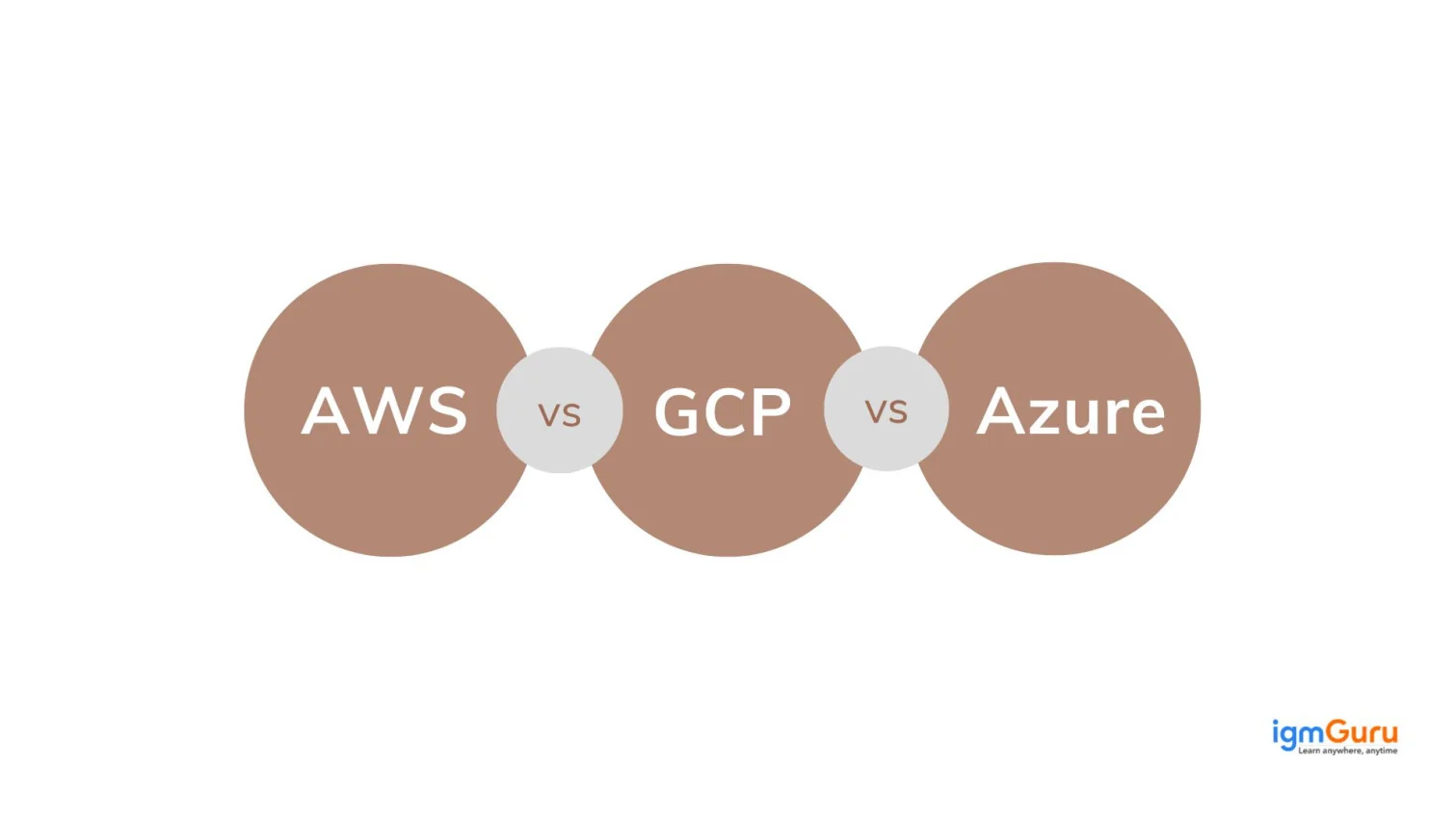
Cloud computing exists to store valuable data, run applications and process large datasets. It's a contest of AWS vs Azure vs Google Cloud as these are top cloud providers in the market today. This blog is created to compare these three's merits, drawbacks, to allow readers to make an educated decision while choosing one of these.
Cloud computing is a convenient way of accessing and storing data on remote servers. Companies no longer need to keep their data in a local server or computer's hard drive with this. One can also call it internet based computing as resources are provided as a service through the web. The stored data can be any other storable document, images or files.
Cloud computing can perform diverse tasks like software delivery on user's demand, streaming videos or audios and much more. It is also easier to store, backup and recover data with cloud. New services and applications can be developed with zero troubles.
Explore igmGuru's cloud computing certification courses to build your career in cloud technology.
Amazon came up with this amazing cloud computing platform called Amazon Web services. This platform gives a large selection of services like storage, databases and computing power. These services let businesses take care of their IT resources. There are different services for different functions which makes it appear organized and convenient.
There is S3 for flexible storage, RDS to manage databases and Lambda for serverless computing. Companies can touch great heights with AWS by easy deployment of applications worldwide and low infrastructure costs.
Microsoft Azure is a cloud computing platform which is known for its wide range of services, including computing, storage, networking, analytics, and more. It helps businesses build, deploy, and manage applications and services over the cloud, ensuring flexibility and scalability. This also means users can store their data and change it to meet their needs. Users do not need anything but a connection to the internet and Azure portal to get these services and resources.
This Platform was launched on February 1 2010 which is a bit later than AWS. It's free of cost to start and then users can pay only for the services they select for themselves. There are a large number of data centres located in the world.
Google Cloud Platform (GCP) is a suite of cloud computing services by Google that helps businesses and developers build, deploy, and manage applications on a secure global network. This covers managing infrastructure with GCP, email and teamwork tools from Google Workspace, Google Maps, and Google Ads.
Amazon Web Services (AWS) is the leader in cloud services right now. They offer storage, networking, servers, mobile tools, and security solutions. Microsoft Azure is their main competitor, known for solid software options. Then there's Google Cloud Platform (GCP). They're really good with big data and make it easy to work with other tools.
Related Article- What Are Google Cloud Platform Services
A concise comparison of the top three cloud providers highlighting their features, strengths, and pricing to help businesses choose the best fit.
| Feature | AWS (Amazon Web Services) | Microsoft Azure | Google Cloud Platform (GCP) |
| Launch Year | 2006 | 2010 | 2011 |
| Market Share | Largest (~32%) | Second (~23%) | Third (~11%) |
| Core Strength | Scalable compute and storage services | Integration with Microsoft products | Big Data & AI/ML |
| Free Tier | Yes (12-month free tier) | Yes (30-day trial + 12-month popular services) | Yes (90-day trial + always free tier) |
| Ease of Use | Moderate (steep learning curve) | Moderate (good UI, integration with Windows) | User-friendly for developers |
| Hybrid Cloud Support | Limited native options | Strong (Azure Stack, hybrid capabilities) | Developing (Anthos improving it) |
| Best For | Startups, enterprises, and high-scale applications | Enterprises using Microsoft stack, hybrid apps | Data analytics, ML workloads, container apps |
| Global Reach | Extensive (200+ edge locations) | Global (60+ regions, growing) | Global (35+ regions) |
| Machine Learning Services | Amazon SageMaker, Deep Learning AMIs | Azure ML, Cognitive Services | Vertex AI, AutoML, TensorFlow support |
| DevOps Support | AWS CodePipeline, CodeDeploy | Azure DevOps, Pipelines | Cloud Build, Cloud Deploy |
| Security & Compliance | Strong (many certifications and compliance options) | Strong (compliance with major standards) | Excellent (secure-by-design infrastructure) |
| Pricing Model | Pay-as-you-go, Reserved, Spot pricing | Pay-as-you-go, Reserved Instances | Per-second billing, sustained use discounts |
| Integration Ecosystem | Wide (third-party tools, enterprise software) | Excellent with Microsoft ecosystem | Great for open-source tools and APIs |
| Support for Open Source | High (supports many OSS platforms) | Good (but less than AWS/GCP) | Excellent (uses and supports OSS heavily) |
| Enterprise Adoption | Widely adopted by Fortune 500 | Common in traditional enterprise environments | Popular among tech companies and startups |
It's extremely crucial to be conscious of making the right decision while choosing a cloud service provider. The number of IT systems moving to the cloud are increasing and many services are available in the vast IT market. This section discusses all the major components which contribute to the right selection of a cloud service provider.
One must test the track record of the provider to decide whether services are trustworthy or not. There are different other things to look at like response time of the provider and storage performance. It's important to select the instance type with care as it affects the processing speed. It's the speed of the network which allows easy data transfer and communication between an application and its users. Check the provider's network infrastructure to make sure that it is possible.
Cloud services can really affect how much money a company spends. Different cloud providers have their own pricing plans. They also break down costs for the resources you might use. One must consider its resource and data transfer costs to match their budget. Billing transparency is also important as it shows that the provider is giving detailed and clear billing statements.
This means whether a cloud provider can take care of its performance while experiencing changes. This shows that a cloud provider can switch and change resources to meet their customer's needs easily without significant disruptions. There are different scaling methods like horizontal, vertical and global to achieve that. These processes are all about upgrading, downgrading and adding resources.
Security and data goes hand in hand and this is why it's an important factor while choosing a cloud provider. Data applications need to be protected from risks and threats. A cloud provider must follow encryption practices to keep the data safe. Their tools need to resonate with the privacy regulations like masking and anonymization of the data.
AWS vs Azure vs Google Cloud are top three biggies in the tech industry.This could be very confusing when it comes to selecting any of these giants. A cloud platform where all the business applications are kept safe. It's the budget and business needs which decides the platform that works the best for a company.
AWS is adaptable to changes while Azure is good for big data solutions and Google Cloud gives progressive data processing. Choosing the right platform comes from what needs and expectations one have from it.
Google Cloud has grown really fast and its revenue jumped by 35 percent compared to 2023 in the third quarter of 2024.
There's no clear winner when it comes to which one is easier. There is a learning curve with Google cloud while AWS and GCP are equally challenging and easy. This depends on the learner's interest and skills.
Couse Schedule
| Course Name | Batch Type | Details |
| Google Cloud Platform Training | Every Weekday | View Details |
| Google Cloud Platform Training | Every Weekend | View Details |