Big data refers to humongous, complex datasets that cannot be managed with traditional data processing techniques. These kinds of datasets grow at extreme rates and come from both structured (such as spreadsheets) and unstructured (such as videos and social media posts) sources. It is analyzed to uncover insights, trends, and patterns, which help businesses in making better decisions, improving processes, and personalizing customer experiences.
But how can it help you? It can help you in many ways. You can become a big data engineer, use it in your business, analyze market trends to invest, and more. Basically, it is not important to have a technical background to benefit from it; anyone can use it. This guide will show you how. Let’s get started with a simple question: What is Big Data?
Big data is gigantic and complicated set of information that is usually difficult to analyze or manage through traditional processing tools. These datasets are growing continuously and are complicated in variety, velocity and volume. It has structured information, like lists or inventory databases (DBs); semi-structured information, like the ones that train LLMs; and unstructured information, like social videos or posts.
Digital technology advancements are having a domino effect on the amount and availability of it. Artificial intelligence, mobility, connectivity and Internet of Things are the main factors that are influencing the current changes. A lot of new tools have also come forth for collecting, processing and analyzing this information at god speed. Its evolution has been quite a journey and the next section explores the same.
Explore igmGuru's Hadoop Training program to start building your career in Big Data.
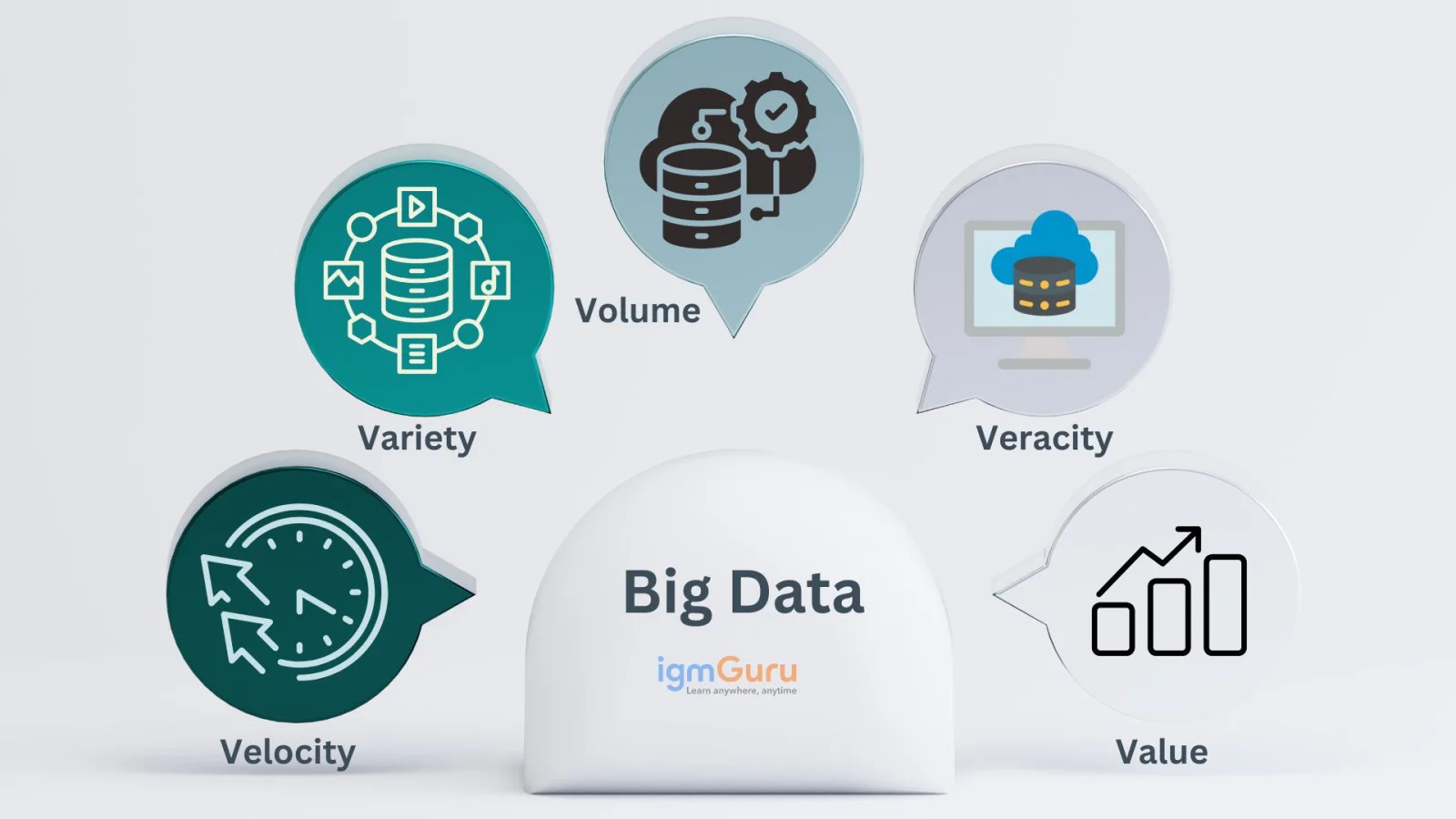
Big data is traditionally proclaimed by its three characteristics called the ‘three Vs', variety, volume, and velocity. Over time, two new Vs have been added to the list: value and veracity. Having extensive knowledge of these 5 V's is essential to becoming a true expert in managing and working with it.
Velocity refers to the rate at which data is generated, captured and acted on. The highest velocity flows directly into memory versus being written to disk.
Variety is a term used for the various data types available in the market. The growth of heaps of information brought new unstructured and semistructured types through audio, video and text. These types need extra preprocessing to support metadata and extract meaning.
The quantity of data is an important aspect and processing high volumes of low-density, unstructured data is unavoidable here. This information can consist of an untold value like X data feeds, clickstreams on a mobile application or web page. This could be tens of terabytes for organizations and hundreds of petabytes for others.
Veracity deals with functional concepts like the reliability, quality and integrity of data. These concepts assist organizations to serve accurate, highest quality and dependable data to extract valuable insights and lead effective decisions.
Data has immense value in business, which needs to be discovered with due process and analysis. Innumerable insights are hidden within this value that can profit an organization in many ways. Internal value like operational processes and external value like customer profile suggestions, can be optimized to enhance engagement.
While the notion of big data is somewhat new, it's essential to note that the requirement of managing large data has always been there. The earliest data centers and relational DB development were established in the 1960s and 70s.
People understood the amount of data being produced by users through online services like YouTube, Facebook and many more in around 2005. This year witnessed the development of Apache Hadoop, along with the growing popularity of NoSQL.
Open source frameworks like Apache Spark and Apache Hadoop make it simple to work with gigantic sets and store it in cost-effective ways. This makes the development of such frameworks an essential process for the growth of this field. The volume of big data has been increasing as a large quantity of information is being produced by users, both humans and non-humans.
There has been a sudden surge because of newer technologies like Internet of Devices (IoT), machine learning and generative AI. The coming years will be brimming with new information that will probably become stale in seconds.
There is still a long way to go for this field, especially due to the growing use of cloud computing and generative AI within enterprises. The cloud provides developers with impressive scalability adaptability, allowing them to plainly spin up ad hoc clusters to evaluate a part of data. Graph databases are gaining importance for its knack in displaying large quantity information, which makes analytics quick and inclusive.
As of now, 402.74 million terabytes of data is created every single day. This number is sure to multiply in the coming time. The gigantic quantity cannot contain all the information in a structured manner. Therefore, it is divided into three different types categories on the basis of the structure, simplicity, and complications.
Structured data and its components can be easily organized, allowing professionals to interpret simple algorithms for analysis. It includes machine logs, financial info and demographic details. Structured info does not appear as big data even if it exists in expansive volumes because it does not meet all the criteria and is easier to manage.
Unstructured data includes images, social media posts, open-ended customer comments and audio files. These are difficult to capture in standard row-column relational DBs. It is stored in warehouses, data lakes and NoSQL DBs instead of relational DBs and spreadsheets. Back in the time, laborious manual processes were executed to analyze and manage this unstructured lot, often leading to obsolete results irrespective of the time it took.
Semi-structured data is made up of both unstructured and structured information. One can take an example of emails, as they include organizational properties like sender, recipient and subject, along with unstructured details in the body of the message.
Related Article: What is Data Manipulation?
Many different sources like IoT sensors, social media, transactions, mobile apps and emails produce magnanimous quantities of information. The constant increase in its number has made it a little difficult to actually get any tangible value or insights from it. This means the company has to use systems and tools that are especially designed for it. There are three main actions in which big data works.
The first thing is to gather info from different sources by accessing warehouses, logs, DBs and APIs. This is then ingested into a pipeline architecture for processing after collection. The newly collected info is usually raw and unprocessed. Processing it means cleaning, aggregating and transforming it for storage and analysis.
This is then stored and managed on on-premises or cloud storage servers after being processed. This usually needs NoSQL DBs for storing it in a scalable manner without having to stick to a fixed model. This scalability keeps it flexible for cohesively analyzing different sources. The final extraction is an eagle eye's view of the happenings, the way to act on it and the time to act on it.
The final step in this lifecycle is analysis wherein these sets moves on for exploration and analysis. Analysis brings out the applicable patterns, insights and patterns according to the intended question. Different tools and systems are put to use for bringing out important results. The findings are then communicated to stakeholders through data visualization.
It is a revolutionary tool that is already bringing waves of change in many different industries. Learning about its use in different domains is important to fully understand an answer to what is big data used for.
The entertainment domain has a big use for it for gleaning insights from endless sources. They predict audience interests, produce target marketing campaigns and optimize programming schedules through this huge amount of data. Netflix is a great example here that recommends shows according to individual users after studying their watch pattern. Spotify is another name that offers personalized music suggestions.
Most individuals are somehow dependent on GPS smartphone apps for getting across and these get their fuel from such huge sets. Its sources include government agencies and satellite images. Aviation analytics systems ingest all the enormous stats that airplanes generate. They analyze fuel efficiency, weather conditions, and passenger and cargo weights with this.
There are many uses for data analytics in banking and other financial services. The first one is detecting fraud by monitoring the credit card holder's purchasing pattern. Another is optimizing customer relationships to learn about converting prospects into customers. Personalized marketing and risk management are other areas that use such large sets.
The healthcare industry benefits by collecting patient information from wearable sensors and devices. This information is added to the individual's electronic health records in real time for many additional uses. Many of the biggest organizations are using this for real time alerting, telemedicine, prediction of epidemic outbreaks and much more.
Huge collected information is a big help in making curricula better, optimizing student experience and attracting best talent. Faculty members, stakeholders and administrators are all equally interested in working with it. It reduces dropout rates, makes student outcomes better, makes it possible to customize the curriculum and much more.
Get a complete roadmap to Become a Big Data Engineer.
A lot has changed in the way companies extract insights and then use them for making decisions to their advantage. There are many benefits of big data and there could possibly be more in the coming times.
Companies can make their pricing strategies better according to market conditions in the real time. An airline company is a great example here. It can take insights from this info to adjust the ticket prices as per competitor pricing and demand shifts.
Understanding customer behavior at a more minute level becomes easier by studying it. Better analysis of customer behavior means being able to put out highly personalized suggestions and interactions. A brand can use it for finding out more about the demographics of their customers and then churn out ads accordingly.
Companies can use these findings for developing products and services according to customer suggestions and pain points. If multiple customers are demanding a particular product in a different color, the company can work to fulfil their demand.
Many healthcare providers use data for decoding the patient's records and genetic information from wearable devices. Devices like continuous glucose monitors can track blood sugar levels in real time for detecting dangerous drops or spikes. The treatments can also be adjusted accordingly.
Companies analyze gigantic sets for uncovering trends and patterns that may lead them to making better decisions. A local grocery chain can study these patterns to forecast the demand for seasonal products and stock up according to that. This will reduce wastage and increase profits.
Related Article - How To Become A Data Analyst
The science of big data analytics involves applying progressive analytic techniques to massive and varied sets. Extracting significant insights from great repositories of information and deciphering it is almost impossible due to its size. Emerging technologies allow accurate analysis, manipulation and comprehension of data.
Artificial intelligence and machine learning are standing at the forefront of these technologies. The capacity of these tools are unmatchable for the application of complicated algorithms to analyze large quantities of info in no time. Machine learning algorithms, for example, can examine social media data to study public sentiment towards any given brand or detect fraudulent activity by scrutinizing financial transactions.
BDM is a systematic process that includes collecting, processing and analyzing it. Companies then transform this info into highly actionable insights and then make decisions according to them. Here is a complete dive into what is big data management.
This is where humongous volumes of information are captured from different sources. Different processes and technologies like Apache Kafka manage the large scale diversity and speed of this incoming information. Data integration tools unify datasets from multiple sources to create a single view that supports analysis.
The main aspect at this point is maintaining high quality. Most large sets have inaccuracies and errors that can negatively affect the reliability of the insights. Cleansing and validation procedures can address these errors and even resolve inconsistencies.
Collection alone is useless unless its storage is done well. There are three main storage solutions that an engineer resorts to.
Data warehousing is aggregating info from different sources onto a central and consistent store. It is transformed into a relational format here for making it ready to use. These warehouses support business intelligence, analytics and data science efforts.
These are low-cost storage environments that can work with gigantic raw structured and unstructured data quantities. They do not validate, normalize or clear it but rather store it in its native format. It is usually preferred where real time performance is not an important factor but variety, velocity and volume are high.
Data lakehouses bring together the querying capability of warehouses and the flexibility of lakes. These are recent developments but are gaining popularity because they eliminate having to maintain two separate systems.
Companies use a process for extracting insights and values from their gigantic datasets, and that process is analytics. Here mining, statistical analysis and machine learning tools come together for pinpointing trends, correlations and patterns. This is their chance to move ahead of traditional reporting.
There are many different tools that a company can use. Different companies can also pick different ones according to their needs, quantities and intended outcome. The primary technologies here are Hadoop, NoSQL DBs and Apache Spark.
Great amount of information is constantly produced from social media, which makes it difficult to keep information accurate and connect data points. For instance, a logistics company may find it difficult to integrate GPS data from its fleet of warehouse inventory and customer feedback for a crisp view of delivery performance.
Certain skills in analytics, engineering and data science are needed to work with big data. It's difficult for companies to find skilful professionals to handle and decipher large sets. For example, financial institutions may find it difficult to on-board a data scientist skilled in both financial modeling and ML for evaluating transaction data and foretelling market trends.
Effective security and data privacy steps like encryption and powerful access controls are important to block unauthorized access to records and sensitive information. Following these directives can be difficult when sets are enormous and constantly evolving.
It takes a lot to combine various types from multiple sources, For example, a retail chain may grapple to stabilize structured sales record with semi-structured supplier data and unstructured customer reviews for a detailed view of product performance.
Organizations are supposed to enlarge processing systems and storage to keep up with growing data. For example, a streaming platform must continuously add to its compute power to handle the high demand of millions of viewers.
Many beginners get confused between traditional data and big data because both deal with storing and analyzing information. The main difference lies in the volume, variety, and speed at which data is generated and processed. Traditional data systems are designed to handle structured information in manageable quantities, whereas big data technologies are built to process massive datasets from multiple sources in real time.
| Feature | Traditional Data | Big Data |
| Data Volume | Small to moderate | Extremely large (terabytes to petabytes) |
| Data Type | Mainly structured | Structured, semi-structured, and unstructured |
| Storage | Relational databases | Data lakes, NoSQL databases, distributed systems |
| Processing Speed | Batch processing | Real-time and near real-time processing |
| Scalability | Limited | Highly scalable |
| Examples | Customer records, payroll systems | Social media data, IoT sensor data, streaming data |
For example, a small retail store storing customer purchase records in a database is dealing with traditional data. However, when a global e-commerce company collects millions of customer interactions, product views, reviews, videos, and transaction records every day, it requires big data technologies to store, process, and analyze that information efficiently.
This article has provided a deep understanding of Big Data. It also brings the learner to the point of realization that a strong skill set and knowledge base are a must to get started as a data analyst. But there is still a lot more to learn about what is big data. You can explore our other guides to know more about it.
Structures, semi-structured and unstructured are the three types.
This is a procedure for systematically processing and analyzing humongous quantities to gain useful knowledge.
Hadoop is an open source framework that stores and processes massive amounts for different applications.
The popular tools in big data include Hadoop, Spark, Hive, Kafka and NoSQL databases.
Yes, beginners can start with basic data concepts and gradually learn Big Data tools and platforms.
Course Schedule
| Course Name | Batch Type | Details |
| Big Data Courses | Every Weekday | View Details |
| Big Data Courses | Every Weekend | View Details |