Google is not just a search engine to find information. It is far beyond what you can imagine, and Google Cloud Platform (GCP) is also one of its emerging parts that comes with a comprehensive suite of cloud computing services and tools. It provides developers and enterprises with scalable infrastructure, databases, AI/ML tools and analytics to build, deploy, and manage workloads globally.
It offers many exceptional Google Cloud Platform services crafted to fulfill the diverse needs of a business. Be it computing, storage, data analytics or machine learning, it offers exceptionally secure, reliable, and scalable solutions. Explore this blog to understand everything about these services, from what they are to how they can help you in your business.
Cloud computing refers to the delivery of computing services through the internet. It helps users in accessing and using shared resources like servers, databases, storage, software, analytics and networking on-demand. This model also eliminates the requirement for physical infrastructure and promotes flexibility, cost-efficiency and scalability.
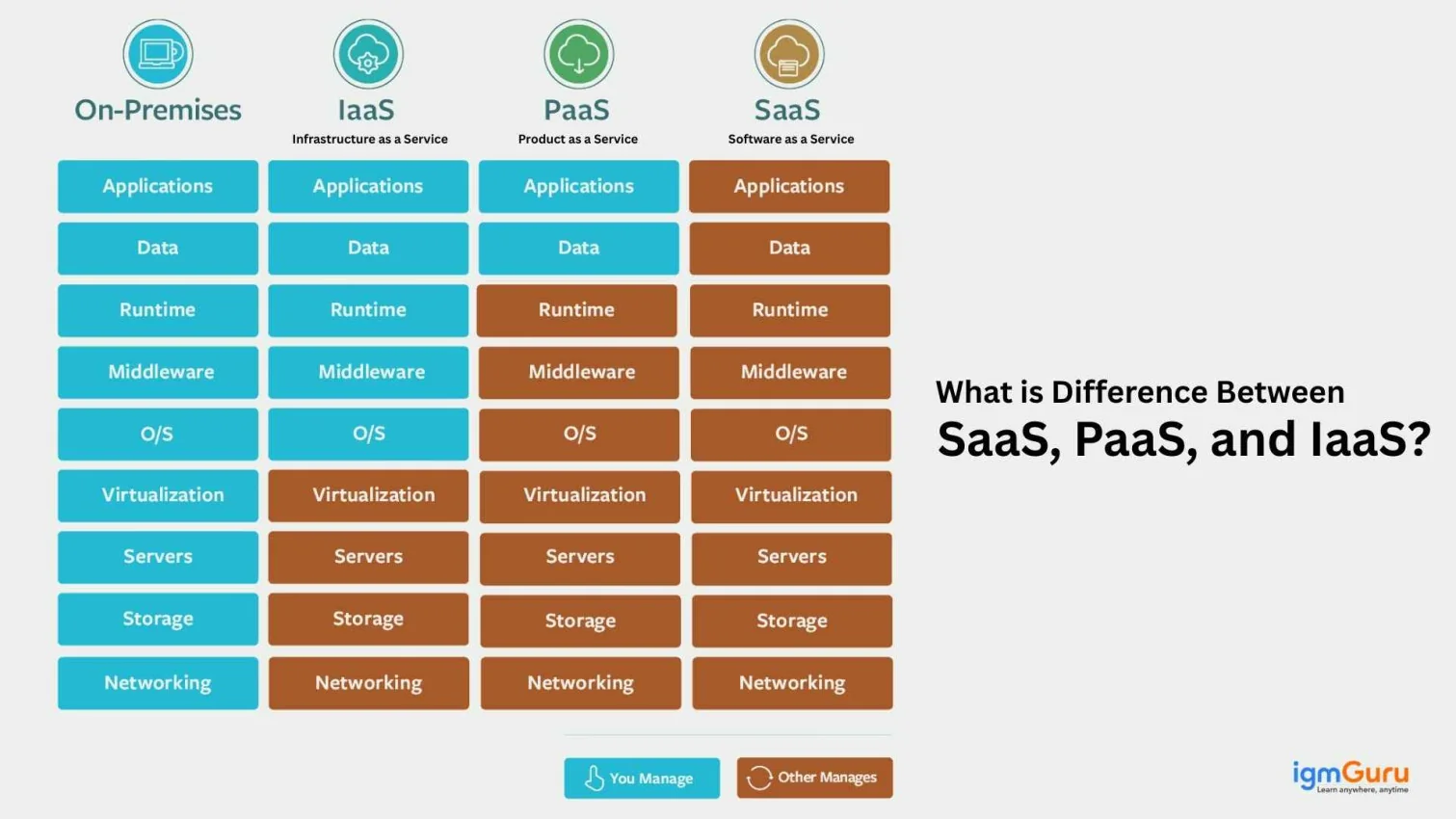
Cloud computing is segmented into three key service models. These are Infrastructure as a Service (IaaS), Platform as a Service (PaaS) and Software as a Service (SaaS). IaaS offers virtualized computing resources, PaaS presents a development environment to build apps and SaaS delivers software apps over the internet.
Top cloud providers today are Google Cloud Platform (GCP), Amazon Web Services (AWS) and Microsoft Azure. Each of these exhibit various services that render support to different business needs. Be it storage solutions or complex ML capabilities, cloud computing tends to do it all. It has truly revolutionized the IT sector as it has enabled businesses to scale efficiently, reduce operational costs and innovate faster.
Many people wonder why choose Google Cloud Platform for their business. Here are some compelling reasons why it stands out-
It offers many powerful tools such as BigQuery and TensorFlow. The former is great for real-time data analytics and the latter for ML. These help businesses leverage AI for innovation and gain valuable insights.
GCP provides auto-scaling capabilities to help businesses handle different workloads efficiently. It offers flexible services like virtual machines and serverless computing that helps organizations in tailoring solutions.
Google provides robust security infrastructure including identity management, compliance with standards and encryption. This guarantees data protection and meeting regulatory requirements.
Seamlessly integrates with Google Workspace and different third-party services to improve collaboration and productivity. This ecosystem supports different workloads and applications.
It employs Google's extensive global network to deliver high performance, reliability and low latency. The global reach guarantees fast and consistent access to services globally.
GCP offers flexible cost management tools and pricing models, which effectively optimizes business cloud expenditures.
| Also Read- Google Cloud Platform Interview Questions |
Google Cloud Platform provides multiple ways for users to interact with its services based on their technical expertise and business requirements. Whether you are a beginner managing resources through a graphical interface or a developer automating deployments using command-line tools and APIs, GCP offers flexible options for accessing and controlling cloud resources efficiently. Here the most common methods:
Google Cloud Console is the easiest way to interact with Google Cloud services. It is a web-based dashboard that allows users to create virtual machines, manage databases, configure networking, monitor resources and track billing through an intuitive graphical interface. It is suitable for beginners as well as experienced cloud administrators.
The Google Cloud Command Line Interface (CLI), also known as the gcloud CLI, enables users to manage cloud resources directly from the terminal. Developers and system administrators use it to automate repetitive tasks, deploy applications, configure services and manage projects faster than using the graphical interface.
Google Cloud provides client libraries for popular programming languages such as Python, Java, Node.js, Go, C#, PHP and Ruby. These libraries simplify application development by allowing developers to access Google Cloud services through familiar programming interfaces without handling low-level API requests.
Almost every Google Cloud service exposes REST APIs that allow applications to communicate with cloud resources over HTTP. Developers can integrate GCP services into websites, mobile applications and enterprise software, making it easier to automate workflows and build custom cloud-based solutions.
Cloud Shell is a browser-based terminal that comes preconfigured with the Google Cloud CLI, development tools and programming languages. Since no installation is required, users can securely manage projects, run commands and deploy applications directly from their web browser.
Google Cloud also supports Infrastructure as Code (IaC) through tools like Terraform and Deployment Manager. Instead of manually creating resources, users can define their infrastructure using configuration files, making deployments consistent, repeatable and easier to maintain across multiple environments.
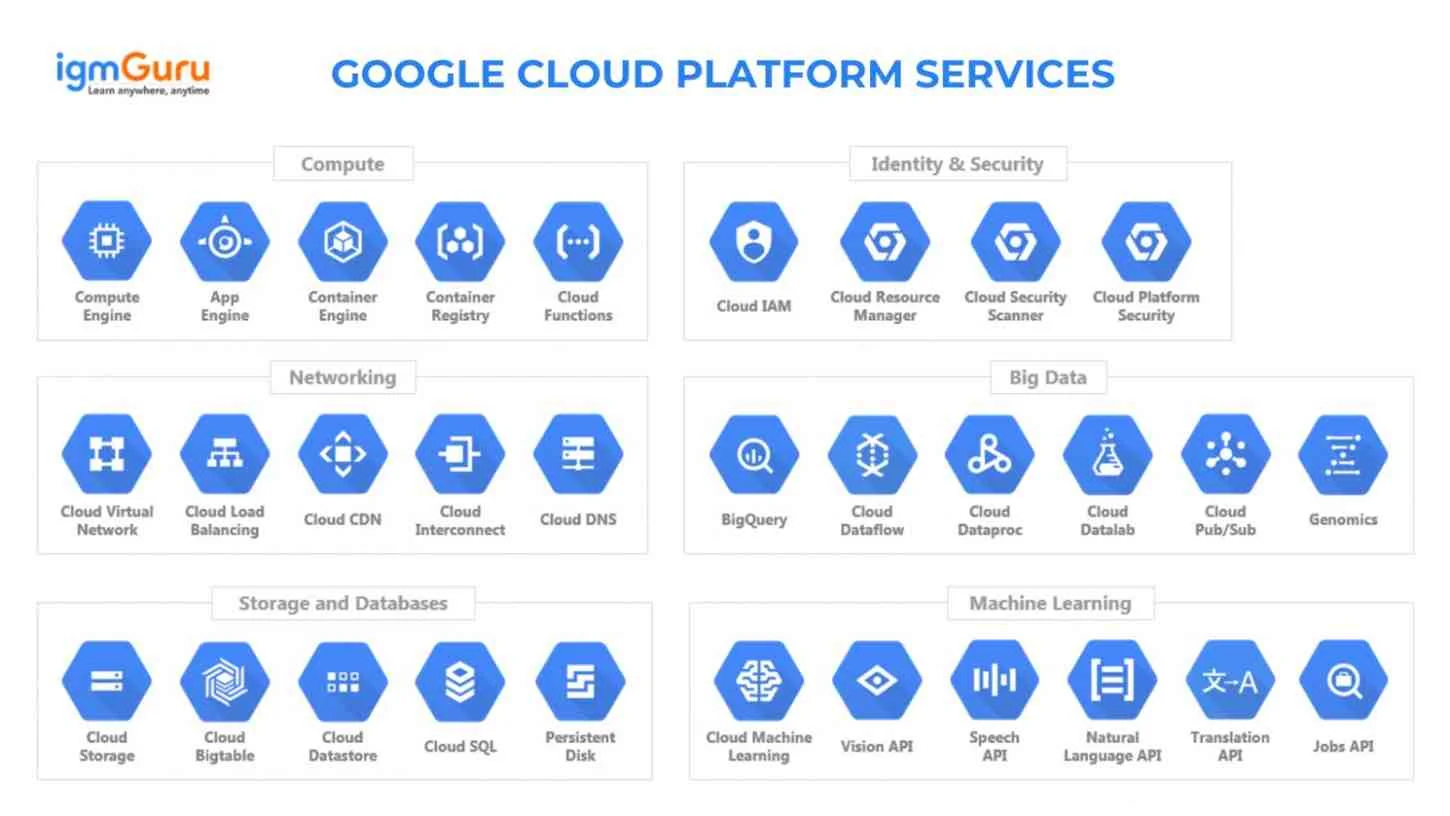
There are many Google Cloud Platform services that are crafted especially to cater the various business needs. The must-knows are -
It provides many storage options like Cloud Storage, Cloud SQL and Cloud Bigtable. It ensures efficient and reliable data management.
It lays deep emphasis on security with features like encryption, compliance with regulatory standards and Identity and Access Management. All these ensure data privacy and protection.
Many robust computing options are provided. These include Google Kubernetes Engine for containerized apps, App Engine for a completely managed PaaS and Compute Engine for VMs. These aid in building and deploying apps without managing the infrastructure.
Tools like BigQuery, which is a fully managed data warehouse, helps GCP in real-time data insights and analysis. Dataflow renders streams as well as batch data processing. Dataproc eases big data processing via Spark and Apache Hadoop.
Its global network infrastructure guarantees high-performance connectivity. Top services are Cloud Load Balancing, Cloud CDN and Virtual Private Cloud for optimized content delivery.
Its AI Platform offers various tools for training, deploying and building Machine Learning models. AutoML and TensorFlow help businesses in leveraging AI for predictive modeling and advanced analytics.
It also supports developers with Cloud Build, Google Cloud Functions and Cloud SDK. It helps in serverless computing, which promotes deployment speed and development efficiency.
Read Also: How To Become A GCP Data Engineer
Google Cloud Platform products cater to various business needs, which ensures scalability, robust performance and flexibility. These products come together to empower businesses to scale, maintain robust security and innovate.
Related Article - Google Cloud Platform Tutorial
Google Cloud Platform offers a wide range of tools that help developers, administrators and businesses build, manage, monitor and secure cloud applications efficiently. These tools simplify development, automate deployments, improve collaboration and provide better visibility into cloud resources. Here are some of the common ones:
Google Cloud Console is a web-based interface that enables users to manage all Google Cloud resources from one place. It can help you create virtual machines, configure storage, monitor services, manage billing and access security settings through an easy-to-use dashboard.
Cloud SDK is a collection of command-line tools that allows developers to interact with Google Cloud services directly from their local systems. It includes the gcloud, gsutil and bq commands for managing resources, storage and BigQuery services efficiently.
Cloud Shell is a browser-based command-line environment that comes preconfigured with Google Cloud development tools. It eliminates the need for local installation and allows developers to manage projects securely from anywhere using a web browser.
Cloud Build is Google's continuous integration and continuous delivery (CI/CD) service. It automates software building, testing and deployment, helping development teams release applications faster while maintaining consistent quality across different environments.
Artifact Registry provides a secure repository for storing and managing Docker images, language packages and build artifacts. It integrates seamlessly with Cloud Build and Kubernetes services, making application deployment more organized and secure.
Cloud Monitoring helps businesses track the health and performance of their cloud infrastructure. It collects metrics, visualizes system performance through dashboards and generates alerts whenever unusual activities or performance issues are detected.
Cloud Logging collects logs from applications, virtual machines and cloud services in one centralized location. Developers can analyze logs, troubleshoot problems quickly and gain better visibility into application behavior and system performance.
Google Cloud Platform is used across different industries to solve various business challenges. From hosting websites to training artificial intelligence models, GCP provides scalable and secure services for organizations of every size. Its extensive range of cloud solutions enables businesses to reduce operational costs, improve efficiency and accelerate digital transformation.
Businesses use Google Cloud Platform to build, deploy and host web applications, mobile backends and enterprise software. Services such as Compute Engine, App Engine and Google Kubernetes Engine provide the flexibility to run applications with high availability and automatic scaling.
Organizations store structured and unstructured data securely using Cloud Storage, Cloud SQL and Cloud Spanner. GCP also offers reliable backup and disaster recovery solutions, ensuring business continuity even during unexpected failures or data loss incidents.
Companies generate massive amounts of data every day, and GCP helps them analyze it efficiently. Services like BigQuery, Dataproc and Dataflow enable businesses to process large datasets, generate real-time insights and make data-driven decisions without managing complex infrastructure.
Google Cloud Platform provides AI and machine learning services that help businesses automate tasks, build predictive models and develop intelligent applications. Organizations use Vertex AI, AutoML and TensorFlow to create solutions such as recommendation systems, image recognition, fraud detection and customer behavior analysis.
Many businesses host websites, online stores and customer portals on Google Cloud Platform because of its high availability, security and global infrastructure. Features like Cloud Load Balancing and Cloud CDN help websites handle heavy traffic while maintaining fast loading speeds.
Streaming platforms and digital media companies use Google Cloud Platform to deliver videos, images and other digital content with minimal latency. Cloud CDN distributes content through Google's global network, providing users with a faster and more reliable viewing experience.
Businesses rely on Google Cloud Platform to create backup environments and disaster recovery strategies. Its global infrastructure and automated backup capabilities help organizations restore applications and data quickly, minimizing downtime during system failures.
Organizations use Google Cloud Platform to collect, process and analyze data generated by connected devices. This helps industries such as manufacturing, healthcare and logistics monitor equipment, improve operational efficiency and make informed decisions based on real-time data.
Google Cloud Platform pricing is pretty flexible and transparent. It is crafted to accommodate different business budgets and needs. GCP pricing is reliant on a pay-as-you-go model. This enables its users to pay just for what they consume. It's a cost-efficient approach that gives scalability as an added perk.
Google Cloud Platform has evolved from a few cloud-based services into one of the world's leading cloud computing platforms. It has consistently introduced new technologies, infrastructure improvements and AI innovations to meet the growing demands of businesses and developers. Today, GCP serves organizations across industries by providing secure, scalable and reliable cloud solutions.
| Year | Milestone |
| 2008 | Google launched App Engine, marking its entry into cloud computing. |
| 2011 | Google Cloud Storage became available for enterprise users. |
| 2012 | Compute Engine was introduced to provide virtual machine services. |
| 2014 | Google Kubernetes Engine was launched to simplify container orchestration. |
| 2016 | TensorFlow became widely integrated with Google Cloud for machine learning workloads. |
| 2018 | BigQuery and AI services received major enhancements for enterprise analytics. |
| 2020 | Anthos expanded hybrid and multi-cloud management capabilities. |
| 2023–Present | Google continues investing heavily in AI, Vertex AI, generative AI services and enterprise cloud infrastructure. |
Many people use the terms Google Cloud and Google Cloud Platform interchangeably, but they are not exactly the same. Google Cloud is the broader ecosystem that includes Google Cloud Platform, Google Workspace and various enterprise cloud services. Google Cloud Platform is one part of this ecosystem that specifically focuses on cloud infrastructure, computing, storage, networking, databases and AI services.
| Feature | Google Cloud | Google Cloud Platform (GCP) |
| Definition | Google's complete cloud ecosystem | Cloud infrastructure and development platform |
| Includes | GCP, Google Workspace, enterprise solutions and APIs | Compute, storage, networking, databases, AI and analytics services |
| Primary Users | Businesses, enterprises and organizations | Developers, cloud architects and IT teams |
| Purpose | Complete cloud business solutions | Building, deploying and managing cloud applications |
| Examples | Google Workspace, Gemini for Workspace, Google Maps Platform and GCP | Compute Engine, Cloud Storage, BigQuery, Cloud SQL and Vertex AI |
Google Cloud Platform has become one of the most trusted cloud computing platforms for businesses of every size. Its extensive portfolio of services covers computing, storage, networking, databases, analytics, artificial intelligence, security and application development.
Its flexible pricing, strong security, global infrastructure and continuous innovation enables organizations to build scalable and reliable cloud solutions while reducing operational complexity. If you want a cloud platform that can meet you organization’s requirements, it can be a good choice for you.
Google Cloud Platform is Google's cloud computing platform that provides services such as virtual machines, storage, databases, networking, analytics, artificial intelligence and application development over the internet.
Yes. Google Cloud Platform offers a free tier with limited usage for several services along with free credits for new users. Once the free limits are exceeded, users are charged based on the resources they consume.
Some of the most popular GCP services include Cloud Storage, Compute Engine, BigQuery, Cloud SQL, Google Kubernetes Engine, Vertex AI, Cloud Functions, Cloud CDN and Identity and Access Management.
Google Cloud is the complete cloud ecosystem that includes business productivity solutions and enterprise services, whereas Google Cloud Platform specifically provides cloud infrastructure and development services for building and managing applications.