Amazon SageMaker is a unified service for building, training and deploying ML models confidently and quickly into a production-ready hosted environment. Organizations no longer have to build or manage their own servers. Businesses can build ML models with SageMaker's machine learning capabilities. These models can analyze data in detail, obtain important understandings and even make decisions for company's benefit.
Machine learning is widely adopted today, but that has not simplified the task of building and deploying machine learning models. Experts make it seem easier with their skills and knowledge of the right tools like this one. This article covers answers to questions like what is Amazon SageMaker.
Amazon SageMaker is a managed ML service that simplifies the phases of building, training and deploying ML models. It automates different labor-intensive tasks around the different stages of this deployment to reduce workflow complexity and accelerate its lifecycle phases. Users get all the necessary tools for creating predictive analytics apps and automating the heavy lifting required to craft a production-ready AI pipeline.
It is an all encompassing collection of different machine learning tools and APIs. Developers and data scientists use these APIs to create production-ready solutions to make SageMaker ML tools present across different integrated development environments (IDEs). They do not have to worry about dealing with the complexity of infrastructure management. It has many benefits for its users and the company at large.
Explore our complete list of Cloud Computing Certification Courses for better employment opportunities.
This service has gained an unprecedented amount of popularity in recent years because of its features. Each of these supports distinct machine learning pipeline stages. Here are a few of the most important components that render it an often-picked platform for developers.
Notebooks fabricate a unified working space for users to write, evaluate and execute ML code. It enables users to build models without complex setups as it provides impressive customization options along with essential ML libraries based on Jupyter Notebooks. Code can be created, shared and deployed with ease within a team. Its integration with version control streamlines collaboration among teams.
Autopilot is an automatic tool suitable for developing, training and tuning the models. It receives the data, performs experiments, and produces different kinds of models. Users without expertise in ML can use its automatic features to boost the model development and achieve quality outcomes. Users looking for a hands-off approach and robust models for their applications must go for this one.
The crucial process of creating labeled datasets for instructing supervised ML models is simplified with Ground Truth. It delivers productivity and accuracy by blending automatic and human labeling. Considering that the labeling process takes a surprising amount of time, the automation capabilities of Ground Truth save time and serve top-quality datasets.
Experiments reduce the challenges faced by users while tracing multiple ML experiments. It allows users to handle associated data, contrast results and track experiments across different runs. Users can reproduce experiments anytime as all the variations in models are caught by Experiments, including code versions, training data and parameters.
Studio is curated for machine learning development, providing a setup for various ML tasks with one click. This is an integrated development environment (IDE) fabricating a collective space for users. Here, they can develop, train, debug and deploy models from one interface. Users are not required to set up environments manually with tools like data processing, ML models and model tuning. All these tools are supported by Studio to save time and efficiently manage the model's life cycle.
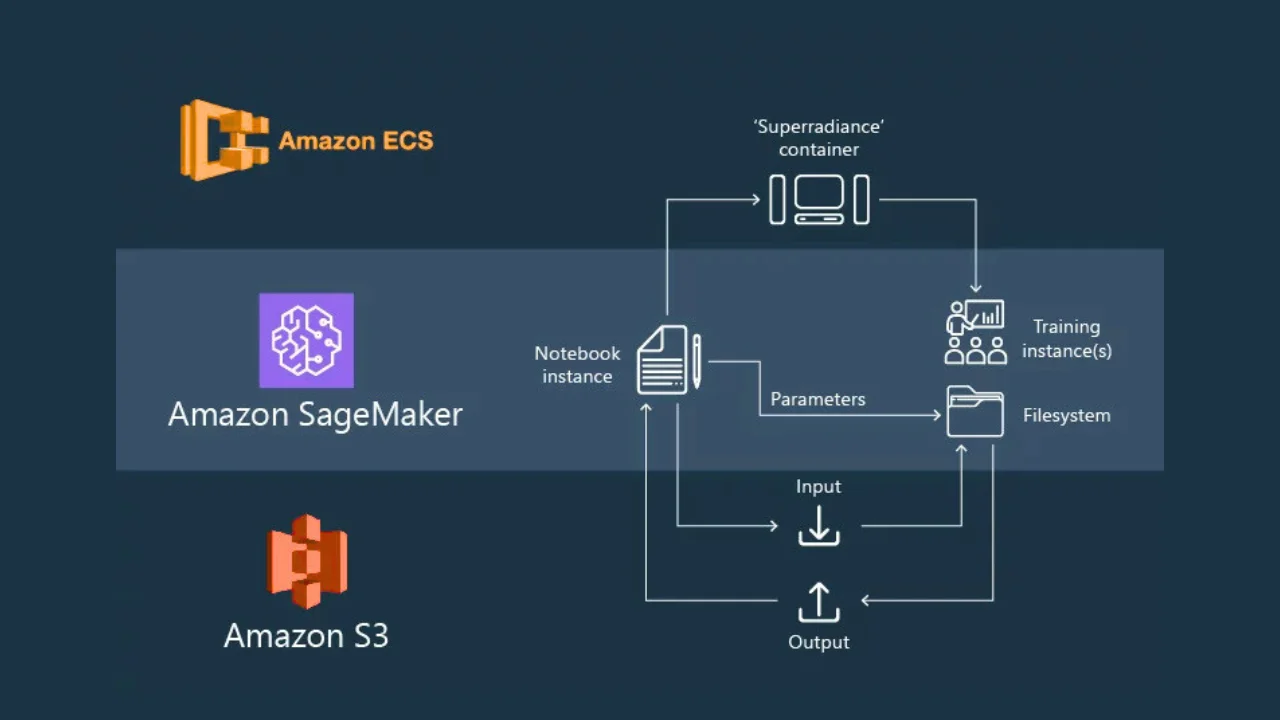
SageMaker simplifies the machine learning lifecycle with a structured approach. This approach has different phases like training, generation of example data and deployment. Developers use instances for managing computing and database resources, provisioning needed IT infrastructure, setting configuration parameters and more. Here are the three aspects of its working.
Building ML models and getting them ready to be trained becomes easy. This is because it offers everything needed to swiftly connect to the training data, selecting it and optimizing the best framework and algorithm for the app. It encompasses hosted Jupyter notebooks for easy exploration and visualization of training data that's stored on Amazon S3.
One can also directly connect to data in S3. Alternatively, one can use AWS Glue to shift data from Amazon DynamoDB, Amazon Redshift and Amazon RDS into S3 for notebook analysis. The 10 most common ML algorithms are pre-installed and optimized to help pick the algorithm for delivering up to 10x the performance. It's pre-configured to run Apache MXNet and TensorFlow, two widely popular open-source frameworks.
Developers use pre-trained base models or algorithms for fine-tuning their machine learning models on certain datasets in the training phase. They define data locations with regard to Amazon S3 buckets and pick suitable instance types for optimization of the process. SageMaker Pipelines are orchestration tools that automate complete ML model processes for lining up the workflow straight.
Amazon SageMaker JumpStart lets developers use pre-built models with a no-code interface. They can thus collaborate easily without much technical expertise. Its hyperparameter tuning optimizes large language models for improving performance across different apps. Data scientists get a simplified debugging process for analyzing trends, setting automated alerts and identifying issues quickly for proactive management.
It autonomously scales and manages the foundational cloud infrastructure once the training is complete. This paves the way for a smooth deployment and is dependent on different instance types. It gets deployed across different availability zones for better reliability. Secure HTTPS endpoints and health checks make app connectivity better.
Amazon CloudWatch metrics then monitor production performance, set deviation alerts and get insights in real time after deployment. High-level monitoring capabilities support at par governance across the lifecycle. Organizations can thus maintain compliance and control while using machine learning to its true potential.
Related Article - Data Scientist vs Machine Learning Engineer
With a market share of around 9.7%, this one service is changing a lot of things related to the ML lifecycle. It has been possible because of the different features of Amazon SageMaker. This section takes a look at some of the main features that are behind the staggering growth and success of this service.
Machine learning models tune automatically. Thousands of algorithm parameters and combinations are adjusted to halt at the most accurate prediction model capable of producing. This further saves many hours of effort and labor. A ML technique quickly tunes the model.
Managed Spot Training reduces the training cost by a great percentage. Training jobs run automatically as computer capacity comes into availability. These jobs are made to become resilient to interruptions that any changes in the capacity may cause.
It is perfectly optimized for leading deep learning frameworks like PyTorch, TensorFlow, MXNet, Apache and others. These supported frameworks are at par with the latest version and do wonder for performance on AWS.
It trains models by specifying the data location, indicating SageMaker instance types and beginning with one click. It also performs training, tears down the cluster, sets up a distributed compute cluster and outputs results to Amazon S3. The training time goes down by almost 90%.
Users can perform distributed training at a good pace by segregating the data across different GPUs. This also achieves near-linear scaling in an efficient manner. The model is split across different GPUs by partitioning and profiling the model automatically with fewer than 10 code lines.
Amazon SageMaker Debugger entices profiles and metrics training jobs in real time. Users can thus quickly correct any performance issues prior to deploying the model to production.
It supports reinforcement learning along with the traditional ones - supervised and unsupervised. SageMaker comes with built-in and completely managed reinforcement learning algorithms.
Amazon SageMaker Autopilot builds, tunes and trains the finest ML models automatically. This is done through the user data but while maintaining complete visibility and control. The model is deployed with a single click.
Take a closer look at different Machine Learning Engineer Jobs and Career Paths.
There are plenty of use cases of Amazon SageMaker because of its cost-efficiency, scalability and end-to-end support. Businesses of all sizes are looking to implement ML models because of their endless support and benefits.
Forecasting is an important aspect for companies to make informed decisions about the future. It can develop resilient models to foretell predictions about future demand, sales and other criteria. It takes historical data and extracts information to predict future occurrences. Built-in and optimized algorithms like DeepAR are offered for time series forecasting. These models can learn patterns in the data.
Prebuilt ML models are easily accessible and deployable with a basic setup. This tool does not require training the pre-trained large language models to get deployed for text generation. It offers prebuilt configurations and containers for developers to train solid generative models without establishing an infrastructure for it.
Companies face a number of fraudulent cases with the growing use of transactions and payments. Wrongdoers can easily commit fraud. Effective security measures must be implemented to prevent them and this platform is creating models with capabilities to detect fraud. Anomaly detection is an effective principle that trains models to decide between an unusual and a usual transaction. It has its own drawbacks like imbalanced data fraud, which can lead to obsolete results.
Machine learning is tagged as an interaction method where specialized hardware and workflow tools process data collections. Data science teams ideally build ML models in two pipelines, namely training and inference.
Data training teaches the machine about how it should behave according to the recurring patterns within the dataset. Software development teams transform the finished model into service or product APIs after data scientists have tuned it.
Hiring a specialist or maintaining the required resources is a problem for many companies. This is where AWS SageMaker comes as a savior. It has integrated tools for automated common labor-intensive manual processes to bring down hardware costs and human errors. Its toolset packs many different ML modeling components.
Answering the question of what is Amazon SageMaker is quite an important phase in moving ahead in this field. One can begin with this article and then eventually move on to further online training. A career in Amazon is bound to yield productive results because of its growing demand and use. The United States, India, and the United Kingdom are the top three geographies using this service.
Explore These Trending Articles:
Amazon SageMaker is a part of AWS and is a managed service. It automates tasks around building, training and deploying of machine learning models.
Its purpose is to build, train, manage and deploy ML models with ease. It can also create pipelines and analyze text.
The average AWS SageMaker salary in India is around INR 31.8 LPA.
The actual learning time depends on the amount of time one dedicates per day, prior knowledge and learning abilities.
Course Schedule
| Course Name | Batch Type | Details |
| Amazon SageMaker Training | Every Weekday | View Details |
| Amazon SageMaker Training | Every Weekend | View Details |