Concurrency in Golang is the capability of a language to manage multiple tasks through running parts of a program in overlapping time periods. It's accomplished primarily via lightweight goroutines and channels for communication. In this blog, we will understand what concurrency in Go is, its importance, concurrency in Go with Goroutines and so much more. So let's dive in!
Read Also: Control Statements in Go language
Concurrency is Go is the language's in-built support for managing various tasks or operations smoothly at the same time. This allows for more efficient and responsive programs. It is different from parallelism, including truly simultaneous execution on various processor cores. Concurrency is all about structuring a program to deal with a lot of things, all of them at once, perhaps interleaving their execution on a single core. Go concurrency has two major features and they are-
They're lightweight, independently executing functions handled by the Go runtime. Concurrency in Go is analogous to threads but takes way less memory and resources, allowing the making of thousands or even millions of goroutines with one program. The latest goroutine is launched by simply making use of the 'go' keyword before a function call.
These make the way for goroutines for communicating and synchronizing with one another securely. These are typed conduits via which values can be sent and received. Channels assess communication by making sure that the data is passed between goroutines in a controlled way. This assists in preventing common currency problems like deadlocks and race conditions.
Concurrency in Go is important to make writing scalable, efficient, and high-performance applications, allowing various tasks to operate simultaneously rather than in sequence. Golang accomplishes this via lightweight goroutines and channels, which remove the complexities of traditional thread-based models. It prevents common problems such as race conditions and deadlocks, which lead to stronger and more manageable software. Here is why concurrency in Go is important-
Also Read: Strings in Golang
Concurrency is Go is a major feature which lets various tasks operate freely, making organized use of system resources. As we read above, Goroutines are lightweight threads handled by the Go runtime and not the OS. This allows concurrent execution with minimal overhead. Goroutines are cheaper to create and they have a small initial stack size which grows as required. They allow functions to operate concurrently, communicating via channels/shared memory.
Now let us look at how concurrency in Go is done with Goroutines with examples. Also, note that in these examples,the 'time.Sleep' in these examples is for demonstration to make sure Goroutines are complete. In real applications, make use of synchronization tools like 'sync.WaitGroup' or channels for proper coordination.
package main import ( "fmt" "time" ) func sayHello() { fmt.Println("Hello from Goroutine!") } func main() { go sayHello() // Start a Goroutine fmt.Println("Hello from main!") time.Sleep(time.Second) // Wait to see Goroutine output } |
Here, the 'go' keyword launches 'sayhello' as a Goroutine, operating concurrently with 'main'. Without 'time.Sleep', the program might exit before the Goroutine runs, as they're nonsimultaneous. Output might vary, such as 'hello from main!' followed by 'Hello from Goroutine!'.
package main import ( "fmt" "time" ) func delayedTask(id int) { time.Sleep(time.Second * 2) // Simulate work fmt.Printf("Task %d completed\n", id) } func main() { for i := 1; i <= 3; i++ { go delayedTask(i) // Start multiple Goroutines } fmt.Println("Started all tasks") time.Sleep(time.Second * 3) // Wait for Goroutines } |
Here, each and every 'delayedTask' Goroutines simulates a 2 second task. The 'for' loop launches three Goroutines which operate concurrently. 'time.Sleep' in 'main' makes sure that the program waits for Goroutines to complete. 'Started all tasks' followed by 'Task X completed' (orders might vary because of concurrency).
package main import ( "fmt" "time" ) func main() { go func() { // Anonymous Goroutine fmt.Println("Hello from anonymous Goroutine!") }() fmt.Println("Hello from main!") time.Sleep(time.Second) // Wait for Goroutine } |
An anonymous function launched as Goroutine through using 'go func(){...}()'. This operates concurrently with 'main', printing its message. The 'time.Sleep' makes sure that the Goroutine completes before the program exists.
It's likely 'Hello from main!' then 'Hello from anonymous Goroutine!'.
Concurrency is the ability of a program to handle various tasks which can run freely, but not necessarily at the same time. It focuses on task interleaving, where tasks make progress through sharing resources like CP, through context switching. Goroutines empower the concurrency by letting tasks run in a cooperative manner, handled by the Go runtime.
Whereas, Parallelism is the synchronic execution of various tasks, typically on multiple CPU cores. It focuses on physically running tasks at the same time to improve performance, needing hardware support like multicore processors. Below is a table representing comparison between Parallelism and Concurrency, to make this easier to understand.
| Features | Concurrency | Parallelism |
| Definition | This manages multiple tasks which can start, run and complete in overlapping periods. | It executes various tasks simultaneously on separate processors/cores. |
| Execution | Here, tasks interleaved on a single core or multiple cores. | Here, tasks run physically at the same time on multiple cores. |
| Goals | Its goal is to improve responsiveness by multitasking. | Its goal is to improve speed by leveraging multiple processors. |
| Hardware Dependency | This works on single or multiple cores. | This requires various cores or processors. |
| Go Examples | Goroutines sharing a single CPU core, scheduled by Go runtime. | Goroutines running on multiple CPU cores (set through GOMAXPROCS). |
| Use Cases | Its use cases are handling I/O-bound tasks like web servers and async operations. | Its use cases are CPU-bound tasks like heavy computations and data processing. |
| Resource Usages | Lightweight, efficient resource sharing. | Higher resource demand because of the simultaneous execution. |
| Complexities | It requires synchronization like channels, mutexes. | This also requires synchronization but focuses on splitting work all over cores. |
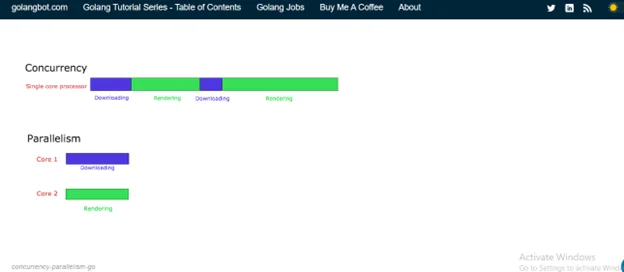
So basically here, concurrency is about managing multiple tasks, while parallelism is about executing multiple tasks at the same time. Concurrency can occur on a single core, but parallelism needs multiple cores.
Read Also: Top 50+ Golang Interview Questions And Answers
As we read, Go's concurrency model is built around goroutines and channels. It offers a strong and elegant way to manage concurrent programming. Through leveraging lightweight goroutines for parallel executions and channels for a secure, synchronized communication. By embracing these features, developers can write clean, concurrent code which completely makes use of modern multi-core systems. This makes Go an excellent choice for building high-performance software.
Related Articles On Go
This raises the performance by letting a program continue processing other tasks while waiting for particular operations to be done.
Firstly, find the point of intersection of any two lines by solving their equations algebraically. Secondly, substitute the coordinates of that intersection point into the equation of the third line. Then, if the third equation holds true, the three lines are concurrent, which means they all intersect at that one common point.
You can find the point of concurrency by identifying the concurrent lines(three or more lines sharing the same point) and then locate their intersection.
Concurrency is managing multiple tasks at once, while parallelism is running them simultaneously on multiple cores.
Course Schedule
| Course Name | Batch Type | Details |
| Golang Training | Every Weekday | View Details |
| Golang Training | Every Weekend | View Details |