Do you know that every bank transaction, Instagram post, YouTube view, or product added to a shopping cart is being stored securely somewhere? Millions of these interactions happen every second across the world. So how do companies store this massive information in a clean, organized, and easily accessible way without chaos? The answer is RDBMS: Relational Database Management System.
RDBMS helps structure data into tables, making retrieval, updates, and storage fast and efficient. It is the backbone of banking applications, business tools, mobile apps, and every digital service that relies on organized information. In this guide, we’ll dive into what is RDBMS, how it works, its components, features, benefits, and even SQL queries to help you understand it practically.
Let’s break it down in the simplest way possible.
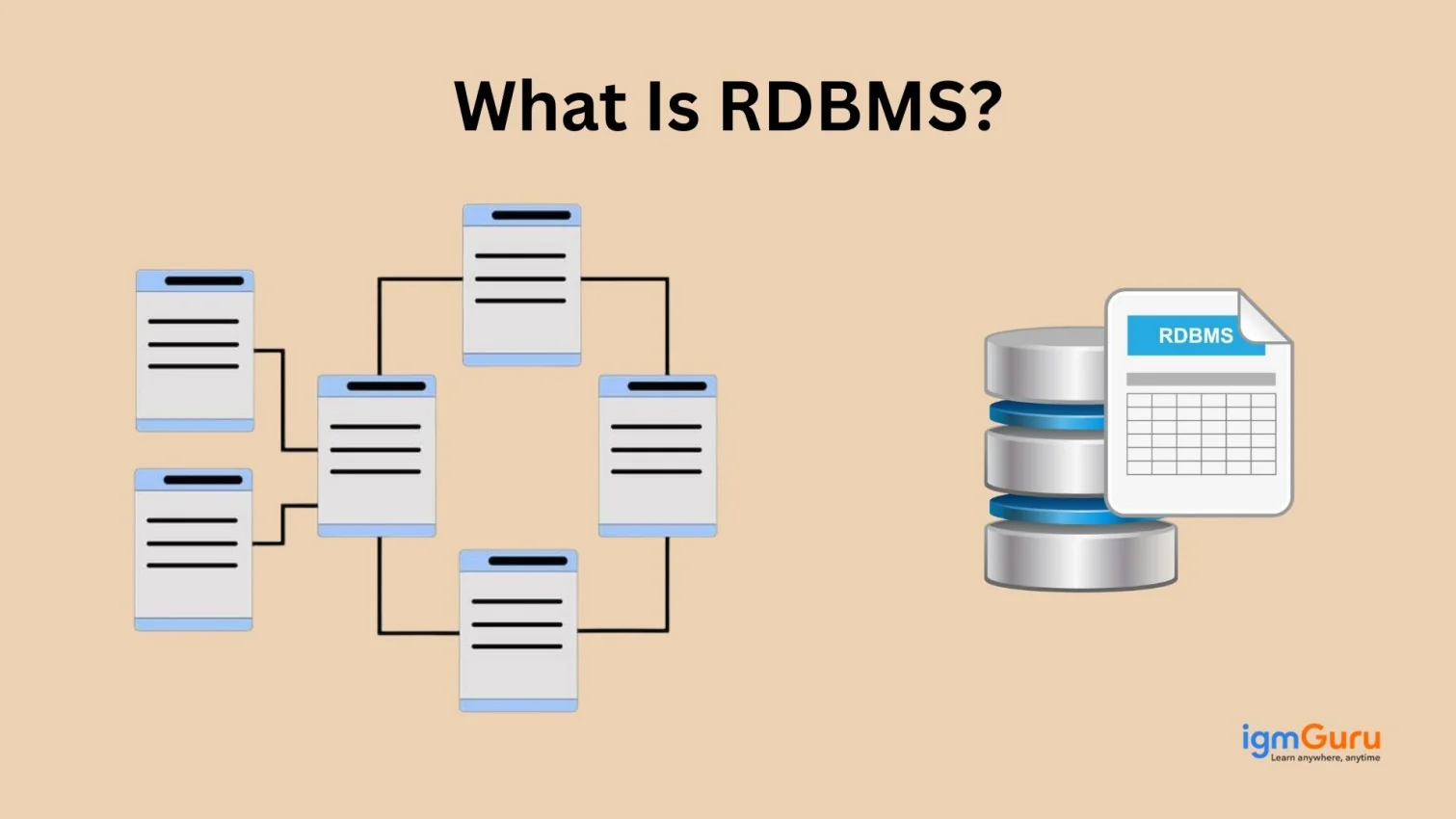
A Relational Database is a type of database that stores data in tables. These tables are called relations. Each table has rows and columns. Rows are called records and columns are called fields or attributes. In a relational database, each table holds data about one subject (like customers' orders or products). The tables are linked using keys, which are primary keys and foreign keys.
For example, think of a business database- One table can store customer details and another table might store order details. Then, these two tables can be linked using a customer ID.
This makes relational databases organized, structured and easy to manage.
An RDBMS is a software that helps in managing relational databases. It allows users to store, organize, retrieve and manage data in the form of tables. These tables are related to each other with the help of keys. It makes the data easy to access and maintain.
The main purpose of an RDBMS is to provide a simple and consistent way to handle large amounts of structured data. It uses SQL (Structured Query Language) to perform tasks like inserting, updating, deleting and retrieving data from the database.
The Functions of an RDBMS are:
The idea of Relational Databases was introduced by Dr. Edgar F. Codd in 1970 while he was working at IBM. In one of his research papers, named- A Relational Model of Data for Large Shared Data Banks, he proposed organizing data into tables, where relationships could be maintained using keys. This concept changed the future of data storage and management.
Before DBMS came into light, the databases were based on hierarchical or network models, which were harder to manage. The relational database systems made data handling more logical, efficient and accessible.
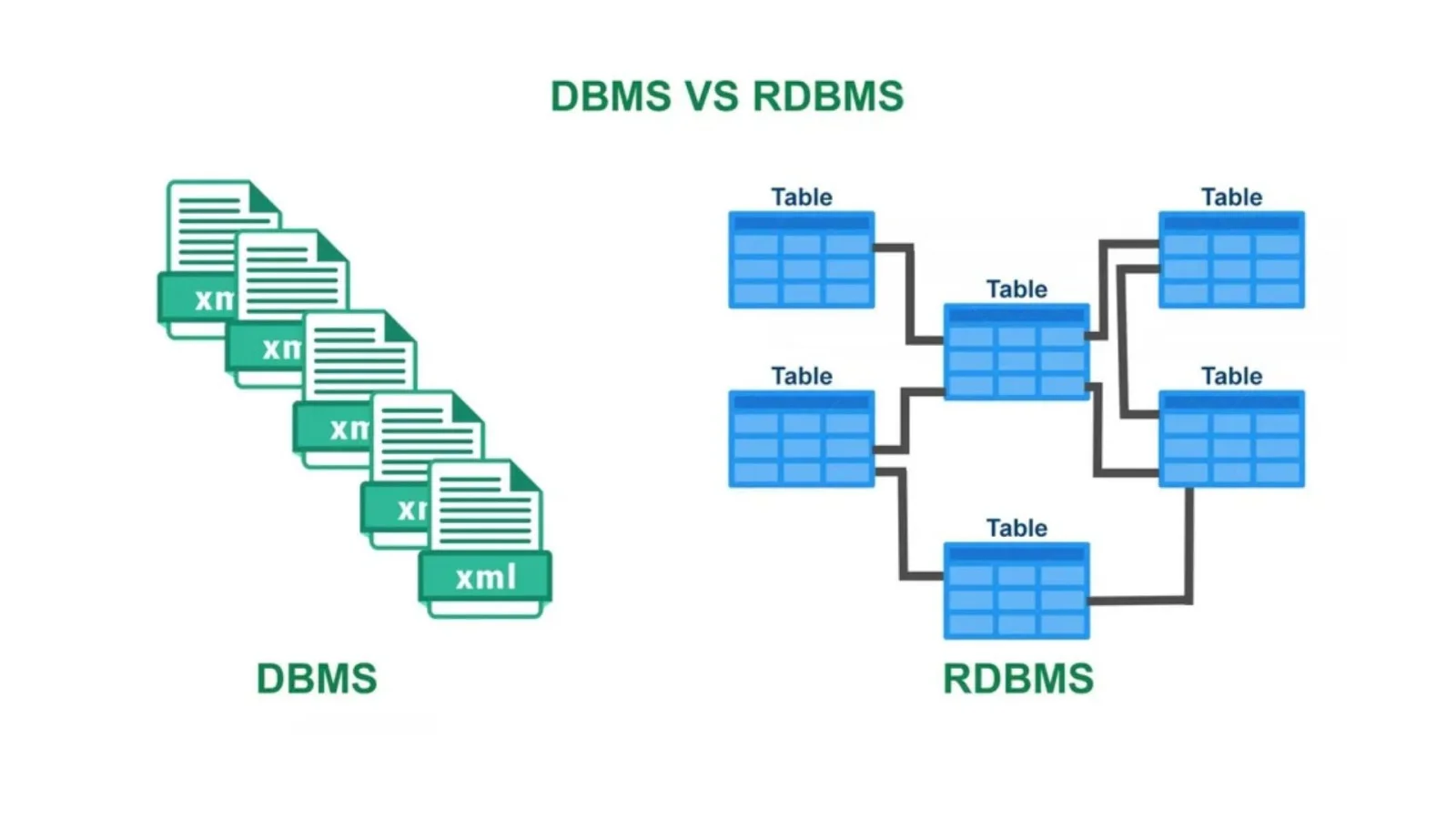
DBMS (Database Management System) and RDBMS are both used to store and manage data. Yet both of these work differently and are used for different types of applications.
A DBMS stores data in various formats like files, hierarchical models or network structures. It is good for small-scale systems, but it lacks advanced features like relationships and data integrity.
On the other hand, a Relational Database Management System is an advanced type of DBMS. It stores data in structured tables and allows you to link related tables using primary and foreign keys. This makes RDBMS more suitable for large, complex and multi-user environments.
| Feature | DBMS | RDBMS |
| Data Structure | Files or tree-like models | Tables (rows and columns) |
| Data Relationships | Not supported | Supported using keys |
| Data Integrity | Limited | Strong integrity rules |
| Multi-user Access | Usually not supported | Supported |
| Security | Basic | Advanced |
| SQL Support | Not always | Fully supports SQL |
| Examples | MS Access, dBase | MySQL, Oracle, SQL Server |
Related Article: How to Set Up and Configure MySQL in Docker?
The architecture of a Relational Database Management System (RDBMS) defines how different components work together to store, process and retrieve data efficiently. Whenever a user submits an SQL query, multiple layers inside the RDBMS collaborate to process the request, retrieve the required data and return accurate results. This architecture ensures data consistency, security and high performance even when thousands of users access the database simultaneously.
The client layer is where users interact with the database. It can be a web application, desktop software, mobile application or a database management tool like MySQL Workbench or SQL Server Management Studio. Users submit SQL queries or perform database operations through this layer.
The query processor receives SQL commands from the client layer and checks them for syntax errors. It analyzes the query, creates an execution plan and determines the most efficient way to retrieve or modify the required data. Query optimization helps reduce execution time and improve database performance.
The storage manager is responsible for managing how data is physically stored on disk. It handles reading and writing database files, manages indexes, allocates storage space and works with the transaction manager to ensure data remains secure and consistent.
The transaction manager controls database transactions and ensures they follow the ACID properties (Atomicity, Consistency, Isolation and Durability). It guarantees that either all operations in a transaction are completed successfully or none of them are applied, preventing partial updates and maintaining data integrity.
The database storage layer contains the actual database files where tables, indexes, views and other database objects are stored. Whenever a query is executed, the required data is retrieved from this storage layer and returned to the user after processing.
| Architecture Component | Primary Responsibility |
|---|---|
| Client Layer | Accepts user requests and SQL queries |
| Query Processor | Parses, validates and optimizes SQL queries |
| Storage Manager | Manages physical storage, indexes and data retrieval |
| Transaction Manager | Maintains ACID properties and transaction consistency |
| Database Storage | Stores tables, indexes and other database objects |
In simple terms, the architecture of an RDBMS follows a straightforward workflow. The user sends an SQL query through an application; the query processor analyzes and optimizes it; the storage manager retrieves the required data from the database storage, and the transaction manager ensures every operation is completed safely before the final result is returned to the user.
A Relational Database Management System offers several features that make it powerful, reliable and suitable for managing large amounts of structured data. These features help businesses in ensuring data accuracy, security and easy access.
Read Also- Data Scientist Salary in India [For Freshers and Experienced]
A Relational Database Management System is built from several key components. Each part plays a unique role in handling data like how it is stored, retrieved and secured. These components work together to keep the system organized, fast and reliable. Here are the major components of an RDBMS:
Tables are the basic structures where all the data is stored. Each table contains rows (records) and columns (fields). Every row represents a data entry, while each column defines a data type or attribute. Tables help keep data well-structured and easy to search.
A schema is like the design or layout of the database. It defines how tables are arranged, what fields each table has and how tables are related. It also includes data types, constraints and relationships. It acts as a blueprint for the entire database system.
A relational database management system uses keys to maintain data relationships and uniqueness. A primary key is a unique identifier for each record in a table. A foreign key links one table to another, which helps in maintaining consistency between related data in different tables.
Indexes work like shortcuts to help the system find data faster. They store pointers to data and reduce the time taken to search large tables. Without indexes, queries would scan the whole table, which leads to slowing down performance in big databases.
The SQL engine is responsible for reading and executing SQL queries. It translates user commands into instructions the system understands. The SQL engine ensures that tasks are processed correctly, whether it is retrieving data or inserting new information.
This component takes SQL commands from users and analyzes, optimizes and runs them. It checks the query structure, finds the best way to execute it and delivers results efficiently. It is key to making a Relational Database Management System fast and accurate.
This part ensures that all database transactions are completed correctly. It follows the ACID principles (Atomicity, Consistency, Isolation and Durability) to protect data even in case of errors, system failures or power loss during transactions.
The storage manager controls how data is physically stored on the disk. It also handles data organization, retrieval, backup and recovery. It ensures that the data is safe and can be restored in case of corruption or loss.
There are different types of users in a Relational Database Management System:
Also Read- What Is Data Warehousing? Everything You Need To Know
An RDBMS works by storing data in tables and using SQL queries to manage and access that data. It uses keys to create relationships between tables and ensures that everything stays organized, secure and accurate. Here is a simple breakdown of how a Relational Database Management System works behind the scenes:
When you create a database, the data is organized into tables with rows and columns. Each row holds a unique record and each column represents a specific type of data (like name, price or date). The tables are linked to each other using keys.
The Relational Database Management System connects different tables using primary keys (unique identifiers) and foreign keys (used to link related tables). This allows you to retrieve related data across tables without duplication.
The users interact with the database using SQL. SQL allows you to insert, update, delete and retrieve data. The SQL engine processes these queries efficiently.
When a query is submitted, the query processor starts to check the syntax, optimizes the command and decides how to execute it. It then fetches the requested data from the relevant tables and sends it back to the user.
If you are making multiple changes to the database, the transaction system ensures all changes happen correctly. If one part fails, the whole transaction is rolled back to keep the data consistent.
RDBMS allows user permissions and authentication. This means only authorized users can perform specific actions. It helps in protecting sensitive data from unauthorized access or changes.
The storage manager handles the physical storage of data on the server. It also manages backup and recovery. Therefore, your data can be restored in case of system failure.
Read Also- Data Warehousing Tutorial for Beginners
There are many RDBMS platforms used around the world. Some are open-source and free to use, while others are commercial and come with advanced enterprise features. Each of these systems allows users to store data in tables, use SQL for queries and manage relationships between data. The most Popular RDBMS software are:
MySQL is one of the most widely used open-source RDBMS platforms. It is fast, reliable and works well for web applications. Large tech platforms like Facebook and YouTube originally used MySQL at scale, and many modern companies still use MySQL along with distributed storage solutions.
Oracle Database is a powerful commercial RDBMS developed by Oracle Corporation. It offers advanced features for large-scale enterprise applications, including strong security, scalability and performance tuning tools.
The SQL Server is a popular RDBMS developed by Microsoft. It is known for its tight integration with other Microsoft products like Azure, Power BI and Excel. It supports high-performance data processing for businesses.
PostgreSQL is an open-source, object-relational database system. It is known for its standards compliance, strong performance and support for advanced indexing and high concurrency. Today it is widely used for modern, scalable applications and cloud-native environments.
IBM DB2 is a commercial RDBMS known for its ability to handle huge volumes of data. It is often used in banking, healthcare and large enterprise environments where performance and security are critical.
MariaDB is a fork of MySQL and is fully open-source. It is often chosen as a drop in replacement for MySQL with added features and better licensing support for community use.
Read Also- PostgreSQL Tutorial For Beginners
In a Relational Database Management System, the most common way to interact with data is through SQL (Structured Query Language). SQL helps you to create tables, insert data, update records, delete data and retrieve information from one or more tables. Here are some of the most basic and essential SQL queries used in relational databases:
This command is used to create a new table in the database. This creates a Students table with four columns: StudentID, Name, Age and Grade.
CREATE TABLE Students ( StudentID INT PRIMARY KEY, Name VARCHAR(100), Age INT, Grade VARCHAR(10) ); |
Used to add data into a table. This adds one student record into the Students table.
INSERT INTO Students (StudentID, Name, Age, Grade) VALUES (1, 'Nehal', 20, 'A'); |
Used to retrieve data from the table. This will fetch all records and all columns from the Students table.
| SELECT * FROM students; |
You can also select specific columns:
| SELECT Name, Grade FROM Students; |
Used to modify existing data in a table. This updates the grade of the student whose ID is 1.
UPDATE Students SET Grade = 'A+' WHERE StudentID = 1; |
Used to remove data from a table. This deletes the record of the student with ID 1.
DELETE FROM Students WHERE StudentID = 1; |
An RDBMS (Relational Database Management System) offers many advantages when it comes to storing, managing and retrieving data. It is widely used in both small and large applications because of its structured design, reliability and ease of use. Here are some of the main benefits of using an RDBMS:
It stores data in tables with rows and columns, which makes it easy to understand and manage. The tabular format helps users clearly see relationships and identify patterns in data.
By using primary keys, foreign keys and constraints, it ensures that the data is valid, unique and consistent. It helps in preventing duplication and errors in the database.
Relational Database Management System supports Structured Query Language (SQL), which is a universal and easy-to-learn language for managing data. SQL makes it simple to add, retrieve, update and delete records.
With the help of this data management system, you can assign user roles and permissions, which ensures that only authorized users can access or modify data. This protects sensitive information from unauthorized access.
As your data grows, it can handle large volumes without losing performance. It works efficiently even with thousands or millions of records, which makes it ideal for business and enterprise use.
Most RDBMS platforms offer automatic backup and recovery options. This helps in protecting data from crashes, failures or accidental loss.
A relational database management system lets you easily connect related data across tables using keys. This avoids duplication, which improves organization and supports complex queries.
Read Also- MongoDB vs MySQL - A Complete Comparative Guide
While Relational Database Management Systems are powerful and widely used, they are not perfect for every situation. In some cases, their structure and design can create limitations, especially when working with large-scale, unstructured or fast-changing data. Here are some key disadvantages of using an RDBMS:
The creation of an RDBMS involves careful planning of tables, relationships, keys and constraints. For large systems, the design can be time-consuming and requires skilled database professionals.
RDBMS platforms consume more CPU, memory and storage- especially when handling large datasets or running multiple transactions. This can slow down performance on low-end systems.
RDBMS is best for structured data stored in rows and columns. It is not suitable for storing unstructured data like images, videos, audio and social media streams.
Most RDBMS systems scale vertically by upgrading hardware, which can be expensive. Scaling out (horizontal scaling) across servers is more difficult compared to NoSQL databases.
RDBMS uses a fixed schema, which means any changes to the structure like adding columns or modifying data types can disrupt the entire system or require migration and downtime.
The enterprise-grade RDBMS like Oracle and SQL Server often come with high licensing, support and maintenance costs, which makes them less accessible for small businesses or startups.
One question I often hear from beginners is, "Should I use an RDBMS for every project?" Based on my experience working with databases for business applications, analytics projects, and web platforms, the answer is no. An RDBMS works best when your data is highly structured, relationships between records matter, and accuracy is critical.
If your application stores customers, orders, payments, products, employees, or any information that is connected to other data, a relational database is usually the safest choice. Features such as primary keys, foreign keys, constraints, and transactions help prevent errors that could otherwise affect business operations.
Banks process thousands of transactions every second. Each transfer must either complete successfully or fail completely. RDBMS platforms use ACID transactions to maintain data consistency, making them ideal for account management, payments, loans, and financial reporting systems.
Online stores rely heavily on relational databases. Customer information, product catalogs, inventory records, shopping carts, and order histories are all interconnected. An RDBMS helps maintain these relationships while ensuring accurate stock levels and order processing.
ERP, CRM, HRMS, and payroll systems commonly use RDBMS technology because they manage structured business data across multiple departments. Relationships between employees, departments, projects, and financial records can be maintained efficiently through relational tables.
Hospitals store patient records, appointments, prescriptions, billing information, and laboratory reports. Since data accuracy and security are essential in healthcare, relational databases provide the consistency and access control required for these critical systems.
Schools, colleges, and universities use RDBMS platforms to manage student records, admissions, attendance, examination results, course registrations, and faculty information. The structured nature of academic data fits perfectly into relational database models.
Many organizations use relational databases as the foundation for reporting and analytics solutions. Tools such as Power BI, Tableau, and SQL-based reporting platforms often connect directly to RDBMS systems to analyze business performance and generate insights.
While RDBMS is excellent for structured data, it may not always be the best choice. Applications dealing with massive volumes of unstructured data such as social media feeds, IoT sensor streams, images, videos, or rapidly changing schemas may benefit more from NoSQL databases or hybrid database architectures.
As a general rule, if data relationships, consistency, and transaction reliability are important, choose an RDBMS. If flexibility, horizontal scalability, and unstructured data handling are your primary concerns, exploring NoSQL solutions may be a better option.
An RDBMS (Relational Database Management System) is one of the most reliable and widely used tools for managing structured data. It allows users to store, retrieve and organize data efficiently using tables and SQL. RDBMS plays a critical role in maintaining data integrity, security and performance from small websites to large enterprise applications.
Everything comes with its pros and cons. RDBMS also offers clear advantages like structured design, multi-user support and powerful query handling. It also has limitations- especially when working with unstructured data, large-scale distributed systems or requiring flexible schema design. In such cases, businesses may consider NoSQL or hybrid database solutions.
Always remember, choosing the right database depends on your specific needs, whether it is data complexity, scalability, cost or speed. Yet for the most traditional use cases, RDBMS is a robust and dependable choice that is today continuing to power data systems around the world.
RDBMS relies on fixed schemas and tables, while NoSQL databases support flexible schemas and handle unstructured data more easily.
SQL is the standard language used to query, update and manage data in an RDBMS, making data operations simple and consistent.
Traditional RDBMS can struggle with very large, distributed datasets. For big data, specialized NoSQL or distributed SQL databases may be more suitable.
RDBMS ensures data accuracy, security and easy data retrieval through structured relationships.
RDBMS is used in banking systems, e-commerce websites, schools, hospitals and many other applications that manage large amounts of data.