The tech world sees new programming languages almost every year, but not all of them solve real problems. Go (popularly known as Golang) is different. It was created by Google engineers who were tired of long compile times, complex codebases, and inefficient concurrency. Their solution? A language that is fast, scalable, and perfect for modern cloud environments.
So what exactly is Golang, why is it popular, and what is it used for? This complete guide breaks everything down in a simple and practical way.
Read Also: control statements in Golang
Golang, officially called Go, is an open-source programming language designed for building scalable, high-performance software. It is widely used to develop:
At its core, Go was inspired by C but refined with modern features like garbage collection and built-in concurrency. Developers choose it because they can write clean, minimal, lightweight code without sacrificing performance. Go’s rich standard library and automatic memory management also help keep projects simple and reliable.
Golang (Go) was created at Google in 2007 by Robert Griesemer, Rob Pike, and Ken Thompson to address the challenges of building large, scalable systems. The goal was to combine the speed and efficiency of C/C++ with the simplicity of modern languages.
Go was released as an open-source project in 2009 and reached its stable 1.0 version in 2012. Since then, it has gained massive adoption, powering major cloud and DevOps tools like Docker, Kubernetes, and Terraform. Today, Go remains one of the most preferred languages for high-performance servers, distributed systems, and cloud-native development.
Explore igmGuru's best Programming Courses for a career in this field.
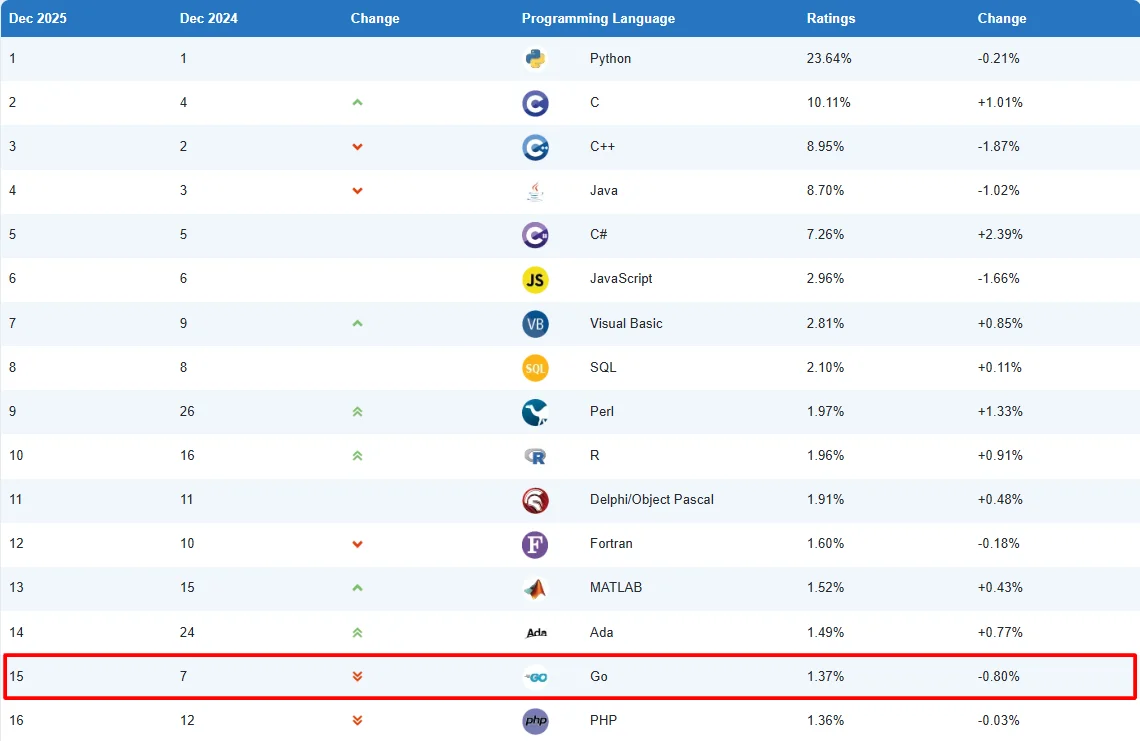
Image Source: TIOBE index
Go is popular because it's both beginner-friendly and powerful. You can learn its core concepts in a short time, but mastering it unlocks performance advantages that most languages struggle to match.
Here's why developers fall in love with Go:
It feels like writing Python but runs almost like C- the best of both worlds.
To run your first Go program, you need to install the Go compiler on your system. Once installed, you can create a simple Go file and write your very first code. Every Go program must be saved with the .go extension. For example, you can create a file named hello.go and place your code inside it.
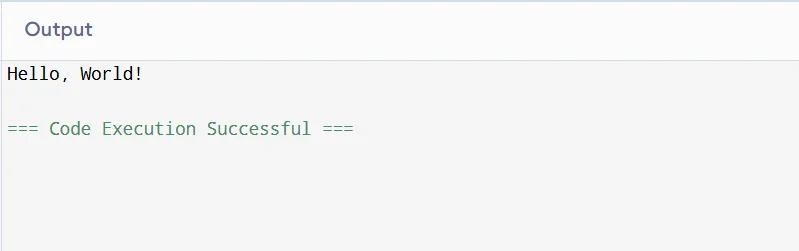
Here is the complete program to print "Hello, World!" in Go:
// First Go Program package main import "fmt" // Main function func main() { fmt.Println("Hello, World!") } |
Output:
Explore the most frequently asked Golang Interview Questions and their answers.
One more question that is often asked by programmers is what is Golang used for. It was initially intended to serve as a replacement for leading high-performance, server-side programming languages like C++ and Java. It was dedicatedly focused on programs related to infrastructure and networking. Now, however, Golang is a leading name in most domains.
There is no dearth of programming languages currently available in the market. Python, Kotlin, Java, C++ and PHP are amongst the most in-demand programming languages, but newcomers like Go are giving tough competition to each of these. It makes the entire toolbox compilable across different platforms and on different hardware. Here is a list of the top Golang benefits that one must know about.
Go is quite a simple programming language to learn, especially for one's having prior basic knowledge of another language. Following the right tips and tricks to master Go means learning it probably in a few hours or a couple of days max. It is fast and most developers prefer using it for almost all the earlier needed command-line interpreters. It thus replaces Python sketches, Java efforts and bash scripts.
Go is highly compatible with most machines for creating a complete tool or web app for cleaning incoming data for processing. It has taken away all the overhead and additional junk that has accumulated on different programming platforms over the years. It is built especially for scalable and cloud-based server environments used in software engineering.
This is a super fast language that becomes clear after taking the best ways to learn Golang. It is the language behind plenty of open source projects like Docker, Kubernetes, Serf and others. Continuous practice leads to excellence and there is nothing better than experience in this field.
Garbage collection is a memory recovery mechanism for finding no longer needed memory space. It frees up memory that can be used for another purpose. It tracks designated heap memory spaces and it is one of the few languages that has internal support for memory management. The two important parts of this mechanism are a mutator and a collector.
Multiple actions can be actively and simultaneously in progress in concurrent systems. It has adopted the lightweight execution entity called goroutine. This is a function that executes simultaneously and independently in relation to other goroutines in the program. Different channels in Go simplify the communication between different goroutines.
Read Also: Golang vs Java
There is a long list when discussing Go vs other programming languages. But this article is going to take the four most often picked ones. It covers Go vs Rust, Go vs C++, Go vs Java, and Go vs Python. Let's move forward to understand how this one language compares with the other leading ones.
Read Also- Go Hello World: Writing Your First Program
Golang is known for its performance, simplicity, and concurrency support, but like any programming language, it has its own set of limitations. These limitations may affect its suitability for certain types of projects.
Before version 1.18, Golang did not support generics, which made code duplication common when working with multiple data types. Developers had to rewrite similar logic for different types, leading to less maintainable code. Although Go now supports generics, the implementation is still maturing and lacks some of the flexibility found in other languages like Java or C#.
Error handling in Golang is explicit, requiring developers to manually check and return errors using the if err != nil pattern. While this encourages clarity and safety, it also leads to repetitive code and visual clutter. In large projects, this verbosity can reduce readability and make the code harder to maintain compared to languages with structured exception handling.
Golang is not a fully object-oriented language. It lacks features such as inheritance, method overloading, and constructors, which are common in traditional OOP languages. Developers transitioning from languages like Java or Python may find Go's interface-based approach restrictive when trying to design complex object hierarchies or reusable abstractions.
Although Go's garbage collector is efficient, it can introduce latency in performance-critical applications. Real-time systems that require deterministic execution may experience small but noticeable pauses due to garbage collection cycles. This makes Go less suitable for certain embedded or high-frequency trading systems.
Related Article- Go Modules: A Complete Guide
Golang is widely adopted in the software industry for its efficiency, concurrency, and scalability. Its performance, combined with a simple syntax, makes it ideal for building modern cloud-native, distributed, and high-performance applications. Below are five major real-world use cases explained in detail:
Golang's lightweight goroutines make it perfect for handling multiple client requests simultaneously without consuming heavy resources. Frameworks like Gin and Echo allow developers to build high-performance RESTful APIs quickly. Companies such as Uber, Netflix, and Dropbox use Go to develop their microservices because of its speed, easy deployment, and strong concurrency model. Its built-in HTTP libraries also make it ideal for scalable web backends.
Go is the backbone of many cloud infrastructure tools, including Docker, Kubernetes, and Terraform. Its cross-compilation capabilities, low memory usage, and static binaries make it highly portable across cloud environments. Developers use Go to build container orchestration systems, CI/CD tools, and distributed storage solutions. Its simplicity ensures faster builds, reduced debugging time, and smoother scalability in multi-cloud environments.
Because Go compiles to a single binary without external dependencies, it's ideal for creating powerful CLI tools. DevOps engineers use Go for tools that manage cloud deployments, monitor systems, or automate workflows. Popular CLI tools like Kubectl (for Kubernetes) and Terraform CLI are written in Go. Its fast compilation time and lightweight nature ensure that command-line programs run efficiently across platforms.
Go's native concurrency support through goroutines and channels makes it a top choice for building networking tools and distributed systems. Developers use Go to create proxies, load balancers, and message brokers that can handle thousands of simultaneous connections with minimal latency. Projects like Caddy Server and Traefik demonstrate Go's power in building robust, high-performance networking software.
Golang's performance and concurrency make it ideal for blockchain projects that require secure and efficient transaction handling. Many blockchain frameworks, including Hyperledger Fabric, are written in Go due to its reliability, strong typing, and easy concurrency management. Fintech companies also leverage Go for developing real-time data pipelines, trading platforms, and digital payment gateways where speed and stability are critical.
From 184th rank in 2010 to 15th position in 2025 on the TIOBE index - Go has risen fast and strong. It brings the speed of C, the simplicity of Python, and the scalability essential for modern cloud infrastructure. Whether you're a beginner or an experienced developer, Go is definitely worth learning.
It is a preferred language for backend app development.
Its code is very similar to Python with similar code and ease of learning for beginners.
It is easier to learn than Java because of its straightforward approach. Java has many features that make it a little complicated to learn.
Explore These Trending Articles:
Course Schedule
| Course Name | Batch Type | Details |
| Golang Training | Every Weekday | View Details |
| Golang Training | Every Weekend | View Details |