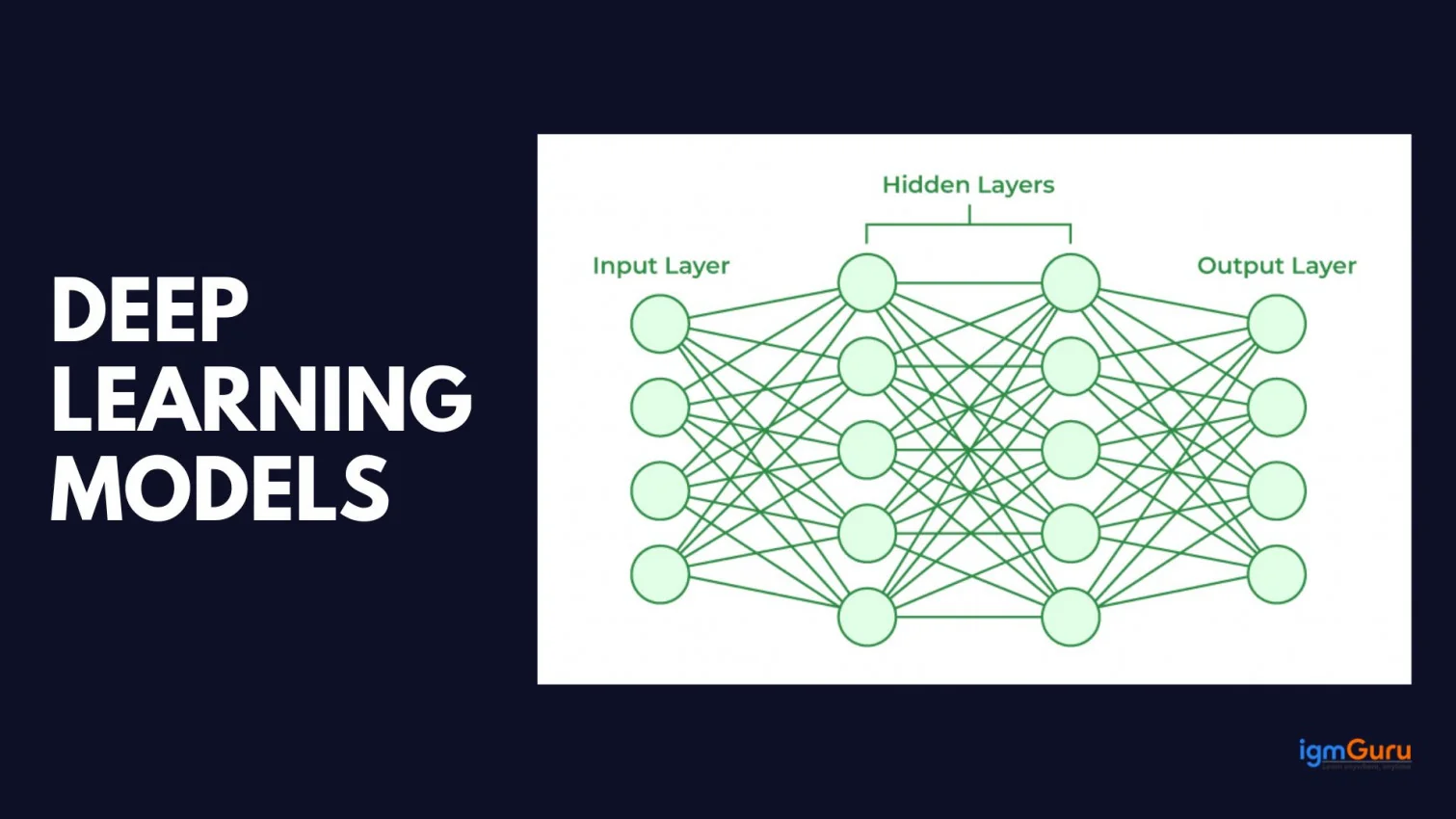
Deep learning stands as a key technology today, with the rise of artificial intelligence in the tech industry. It is changing how machines learn, understand, and interact with complicated data that is usually nearly impossible for humans. It imitates the working of the human brain's neural networks, but with significant computational power. This is done using deep learning models. Do you know what are deep learning models?
These are complicated artificial neural networks designed to mimic the human brain. They process massive amounts of data through multiple "hidden layers" of computation to autonomously discover hidden patterns and features. They are mostly highly accurate at tasks like image recognition, language processing and predictive analytics. Now the question is, how?
To understand that part, you need to learn the working, types, evolution history, use cases and more. This article will explain to you all, from the very basics to technical concepts, that you need to understand this technology. Let’s begin with understanding what Deep Learning is.
Deep learning is an advanced subdivision of artificial intelligence and machine learning that uses multi-layered "artificial neural networks (ANN)" to simulate human decision-making. The ANN layers of interconnected nodes, called neurons, work together for processing and learning from the input data. It autonomously learns to recognize intricate patterns from massive amounts of unstructured data like images, text, and audio without any strict programming.
Traditional machine learning requires humans to manually point out the features a computer should look for in data. Deep learning, however, does this autonomously through a hierarchy of processing layers. It forms an interconnected deep neural network, including an input layer and one or more hidden layers connected one after the other.
Every neuron receives input from the prior layer neurons/input layer. One neuron's output becomes the input to other neurons in the next layer of the network. This procedure goes on until the final layer produces the output of the network. These layers change the input data through a chain of nonlinear conversions. This way, the networks learn complex representations of the input data.
DL is also the foundation for the advancement of artificial intelligence. Deep learning AI is becoming one of the most famous and visible areas of machine learning today. It is successful in different applications like computer vision, natural language processing, and reinforcement learning.
Deep learning models are part of artificial intelligence systems used to mimic the human brain. They are designed in a way that allows them to autonomously learn patterns from humongous amounts of unstructured data without requiring explicit programming. These models apply the data sets to find patterns and solutions in the given information.
The feature to process unstructured or unlabeled data is what makes it an important asset in artificial intelligence. They make their own methods for identifying and understanding the information without telling the computer what to solve or look for. DLMs can recognize both low and high-dimensional data. They can turn tough data sets into simpler and more effective categories. These models grow more accurate with time, with this ability.
Explore this Deep Learning Tutorial for Beginners to understand this technology better.
To understand these models in-depth, you need to learn about the evolution of neural architecture. It will make you understand how they have contributed to the technology being a necessity for every industry.
The evolution of neural architectures has started from shallow, hand-engineered mathematical models to massive, highly automated and self-assembling systems. This progression actually defines the trajectory of modern artificial intelligence. They can solve increasingly complicated problems across vision, language and reasoning.
Every trending technology you see today, including Claude, ChatGPT, Google Gemini, Copilot, Grok, etc, would not be possible with deep learning models. Here is a overview that can help you know how the technology has emerged to become to popular:
| Generation | Neural Architecture | Key Innovation | Primary Use Cases | Limitations |
| 1950s–1980s | Perceptron and Early Neural Networks | Introduced artificial neurons capable of basic pattern recognition. | Binary classification and simple prediction tasks. | Could only solve linearly separable problems and had limited computing power. |
| 1980s–1990s | Multilayer Perceptrons (MLPs) | Backpropagation enabled multiple hidden layers to learn complex patterns. | Classification, regression, and forecasting. | Training deep networks was difficult due to vanishing gradients. |
| 1990s–2010s | Convolutional Neural Networks (CNNs) | Automatically learned visual features through convolution and pooling layers. | Image recognition, object detection, facial recognition, and medical imaging. | Primarily designed for image-related tasks. |
| 1997–2017 | Recurrent Neural Networks (RNNs) and LSTMs | Added memory to process sequential data effectively. | Language translation, speech recognition, sentiment analysis, and time-series forecasting. | Slow training and poor handling of very long sequences. |
| 2014–Present | Generative Adversarial Networks (GANs) | Two neural networks competed to generate realistic synthetic data. | Image generation, video synthesis, deepfakes, and data augmentation. | Difficult to train and prone to instability. |
| 2017–Present | Transformer Networks | Introduced the attention mechanism, enabling parallel processing and understanding of long-range context. | Large language models, translation, summarization, coding assistants, and multimodal AI. | Require massive datasets and significant computational resources. |
| 2023–Present | Mixture of Experts (MoE) | Activates only relevant expert networks for each task, making large models more efficient. | Enterprise AI, reasoning models, large language models, and multimodal applications. | Complex routing mechanisms and infrastructure requirements. |
| Emerging Future | Neural-Symbolic and Agentic Architectures | Combine neural networks with reasoning, planning, memory, and tool usage to build autonomous AI systems. | AI agents, robotics, scientific research, enterprise automation, and autonomous decision-making. | Still evolving, with challenges in reliability, reasoning accuracy, and deployment. |
A deep neural network (DNN) is made up of multiple layers of interconnected artificial neurons. Each layer has a specific responsibility, from receiving the input to generating the final prediction. As the data moves through these layers, the network gradually extracts more meaningful features. This is what allows it to solve complicated tasks such as language understanding, image recognition, speech processing, and recommendation systems.
Although there are many types of deep learning models, such as Convolutional Neural Networks (CNNs), Recurrent Neural Networks (RNNs), and Transformers, they are all built using the same fundamental building blocks.
| Component | Purpose |
| Input Layer | Receives raw data such as text, images, audio, or numerical values. |
| Hidden Layers | Extract features and learn increasingly complex patterns from the input data. |
| Neurons | Perform mathematical calculations and pass information through the network. |
| Weights | Measure the importance of each connection between neurons. |
| Biases | Provide additional flexibility to improve learning and prediction accuracy. |
| Activation Functions | Introduce non-linearity, enabling the network to solve complex problems. |
| Output Layer | Produces the final prediction or decision. |
Related Article: Deep Learning MCQs
A deep learning model works by learning patterns from data instead of following manually written rules. In simple words, it receives thousands or even billions of examples, analyzes them through multiple layers of artificial neurons, identifies relationships between features, and gradually improves its predictions by reducing errors.
This learning process enables the model to make accurate predictions on data it has never seen before. Almost every deep learning model used today follows the same workflow regardless of whether it powers ChatGPT, Gemini, Claude, image generators, recommendation systems or self-driving cars.
Let’s take a deep dive into its working:
The process starts with input data, which should be related to the problem we want to solve using the model.
The input layer simply passes this information to the next layer for processing.
The data then flows through multiple hidden layers. Each neuron performs a mathematical operation on the incoming data before passing the result to the next layer. As the information moves deeper into the network, the model learns increasingly complicated patterns. You can also relate it to how a child learns things like walking, talking, eating, etc, just by noticing the people.
This is also what a child does to learn how to talk. They start with simple words like mom and dad and gradually move to complicated words, then start structuring sentences, and finally start talking.
After each neuron performs its calculation, an activation function determines whether the information should continue through the network. These activation functions introduce non-linearity that allows deep learning models to solve complicated real-world problems. Modern neural networks commonly use functions such as ReLU in hidden layers because they improve training efficiency and reduce common optimization issues.
After passing through all hidden layers, the output layer produces the model's prediction. Depending on the application, the prediction could be:
Initially, these predictions are usually inaccurate because the model has not learned enough from the training data yet. But it will become nearly perfect with time.
The model compares its prediction with the correct answer provided in the training data. The difference between the predicted output and the actual output is called the loss or error. The objective of training is to minimize this loss so future predictions become more accurate.
Once the error is calculated, the model works backward through the network using an algorithm called backpropagation. Backpropagation computes how much each connection contributed to the error and adjusts the model's weights accordingly.
These adjustments are performed alongside gradient descent or related optimization algorithms. This allows the network to improve after every training example or batch of examples.
The model repeats this entire cycle millions or even billions of times. With every training iteration, the weights become more accurate, the loss decreases, and the predictions improve. Training continues until the model reaches an acceptable level of performance or no longer shows meaningful improvement on validation data.
Also Read: How to Learn Deep Learning From Scratch?
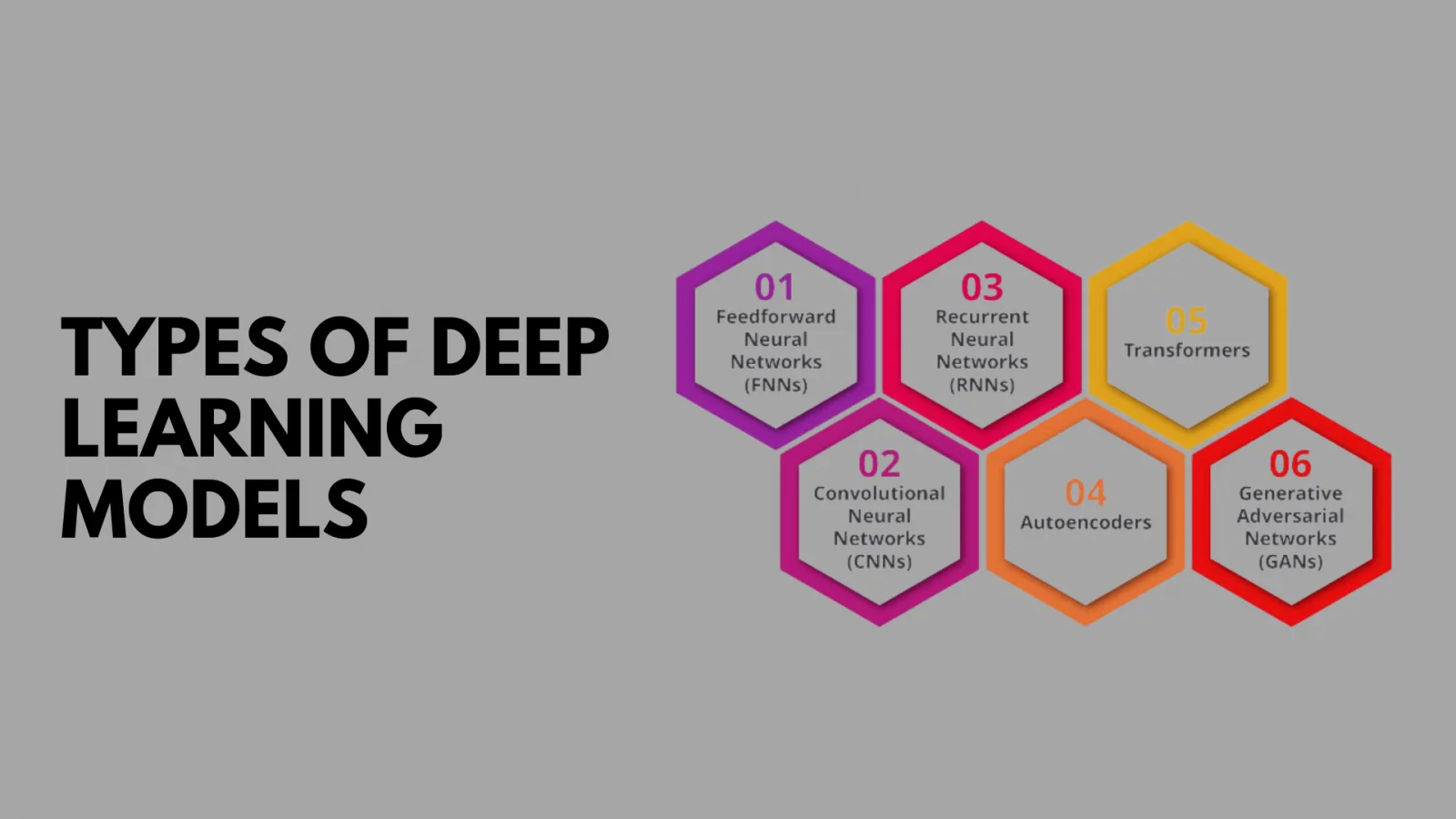
DL systems handle different constructions and frameworks for achieving particular tasks and goals. While not only one network is considered perfect, some models are better suited for performing particular tasks. For choosing the right DL model, it is good to gain a solid knowledge of these models. Let us have a look at the types of deep learning models:
Convolutional neural networks are DLMs that process structured grid data like images. They are successful in image classification, face recognition tasks and object detection. Here is how this model works-
RNNs recognize patterns in data sequences like time series or natural language. They manage a hidden state that captures information about prior inputs. Here is how this model works-
These models are a special type of RNN that are capable of learning long-term dependencies. LSTMs avoid the long-term dependency problem to make them more effective for tasks like time series prediction and speech recognition. Here is how this deep learning model works-
GANs make realistic data by training two neural networks in a competitive setting. They create realistic videos, images and audio. Let us look at how this model works-
These are unsupervised learning models for tasks like data compression, denoising and feature learning. Autoencoders learn to encode data into lower-dimensional representations and decode it back to the original data. This is how it works-
Related Article - Deep Learning vs Machine Learning
DL models are for performing tasks that need human intelligence, like identifying patterns, differentiating data, and automating tasks. The uses of deep learning models are in fields like image recognition, natural language processing, speech recognition and finance. Here are some uses of deep learning models.
It is a computer's capability in understanding and processing images, which is used for content moderation, medical image analysis, facial recognition, and image classification.
Speech recognition includes a computer's capability to analyze and understand human speech. It is usually for virtual assistants like Siri, which understands what one asks and gives answers.
It is for tracking and analyzing a user's habits for creating personalized recommendations. A recommendation engine is for features like Netflix's movie recommendation stream or content in social media feeds.
It understands text copy and is for translation services, chatbots, and keyword indexing.
Implementing a deep learning model is more than simply writing code. I have already explained the working above. You may have to follow each step carefully to implement these models into a real-world application.
The complexity of each step always varies depending on the application. The overall workflow will remain largely the same across most deep learning projects. This process is recommended across modern machine learning frameworks and in official documentation from leading AI platforms.
Common problems are:
A clear objective makes every later stage of development more focused and efficient.
This step typically involves:
Different problems require different neural network architectures.
| Problem | Recommended Architecture |
| Image Classification | Convolutional Neural Network (CNN) |
| Text Generation | Transformer |
| Machine Translation | Transformer |
| Speech Recognition | Transformer or RNN |
| Time-Series Forecasting | LSTM or Transformer |
| Recommendation Systems | Deep Neural Networks or Transformer-based models |
After selecting the architecture, you build the neural network using a deep learning framework such as TensorFlow or PyTorch.
This stage includes:
Choosing an optimizer such as SGD or Adam
During each training iteration, the model:
Once training is complete, the model is tested using data it has never seen before. Common evaluation metrics include:
Developers often improve performance by:
After evaluation, the trained model is deployed so that users or applications can make predictions in real time. Deployment options include:
Deployment is not the end of the lifecycle. As new data becomes available or user behavior changes, the model's performance may decline. To maintain accuracy, organizations regularly:
Machine learning and deep learning are closely related technologies, so most individuals think of them as the same thing. The truth is that they are not the same. Deep learning is actually a subset of machine learning.
Traditional machine learning relies more on human expertise to select and engineer features, whereas deep learning automatically learns those features during training. The choice between the two depends on factors such as the type of data, the problem complexity, the available computing resources and the amount of training data.
Although both technologies enable computers to make predictions and decisions from data, they differ significantly in how they learn and perform. Here is the complete difference at a glance:
| Feature | Machine Learning | Deep Learning |
| Definition | A branch of artificial intelligence that learns patterns from data using algorithms. | A subset of machine learning that uses deep neural networks with multiple hidden layers. |
| Data Requirement | Performs well with small to medium-sized datasets. | Typically requires very large datasets to achieve high accuracy. |
| Feature Engineering | Features are usually selected and created manually by data scientists. | Features are learned automatically from raw data during training. |
| Algorithms | Decision Trees, Random Forest, Support Vector Machines, Naive Bayes, K-Means, Linear Regression. | Convolutional Neural Networks (CNNs), Recurrent Neural Networks (RNNs), Transformers, Autoencoders, GANs. |
| Training Time | Generally faster to train. | Usually takes much longer due to larger models and datasets. |
| Computing Power | Can often run efficiently on standard CPUs. | Commonly requires GPUs or specialized AI accelerators for training. |
| Performance on Unstructured Data | Limited performance without extensive preprocessing and feature engineering. | Excels at processing images, text, audio, and video directly. |
| Interpretability | Easier to understand and explain model decisions. | Often considered a "black box" because internal decision-making is more difficult to interpret. |
| Best Use Cases | Fraud detection, customer segmentation, demand forecasting, credit scoring, predictive analytics. | Chatbots, image recognition, speech recognition, autonomous vehicles, medical imaging, large language models. |
| Examples | Spam filters, recommendation systems using traditional algorithms, and sales prediction. | ChatGPT, Gemini, Claude, Copilot, Grok, image generators, speech assistants. |
The DL field shows a changing leap in artificial intelligence by copying the human brain's neural networks. Deep learning models are making far-reaching changes across industries, from healthcare to finance. The unlimited applications and possibilities of this technology can be seen by pushing the boundaries of computational power and dataset sizes.
Explore Our Related Articles
Hybrid DL models are machine learning models that combine different types of deep neural networks through other techniques. Techniques like traditional statistical methods or probabilistic approaches.
A recurrent neural network (RNN) is a deep learning model trained to process and convert a sequence of inputs into a corresponding sequence of outputs.
Yes, ChatGPT is a DL model, particularly resorting to a kind of neural network architecture.
The 4 major models of AI, officially classified by their capabilities and functional capacities, are Reactive Machines, Limited Memory, Theory of Mind, and Self-Aware AI.