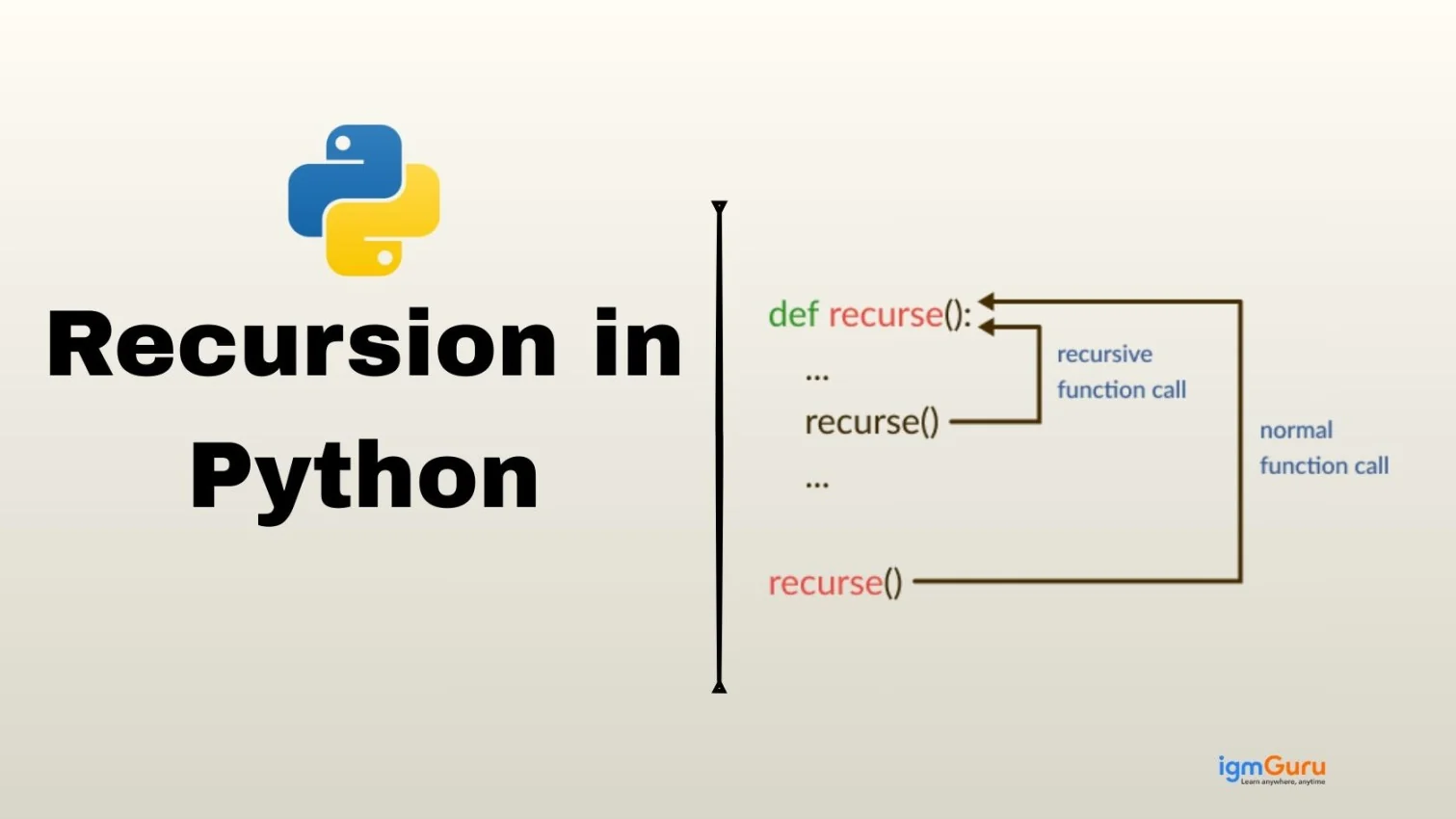
Recursion in Python is a powerful programming technique where a function calls itself to solve a problem. It may sound confusing to you at first, but recursion is actually based on a very simple idea.
It breaks a large problem into smaller and similar problems until it reaches a stopping point known as the base case. Many important concepts in computer science rely heavily on recursion, such as tree traversal, divide-and-conquer algorithms, and backtracking. It helps you write cleaner and more structured code.
This guide explains everything about recursion in Python, from the very basics to advanced topics, with examples like factorial and Fibonacci for a better practical understanding.
Recursion in Python is a programming technique in which a function calls itself to solve a problem. It does not solve the entire problem in one step, but breaks it down into smaller and similar subproblems and solves each of them using the same logic. This process continues until a specific stopping condition is fulfilled.
That stopping condition is known as the base case in Python. If there is no base case, then a recursive function would continue calling itself indefinitely. After that, eventually it will cause a RecursionError due to exceeding Python’s maximum recursion depth.
To understand recursion more clearly, you can think of it like searching for a file inside nested folders on your computer. You open one folder, then another folder inside it, and continue this process until you find the file. Each folder follows the same rule: check the contents and move deeper if necessary. This repeated, self-similar process is a real-world example of recursion.
In simple terms, a recursive function solves a large problem by solving smaller versions of the same problem. Each recursive call reduces the size of the input and moves the function closer to the base case. Here is a simple example of recursion in Python to make it clearer:
|
In this example, the function prints “Hello” and then calls itself with a smaller value of n. When n becomes 0, it means the base case is reached, and the recursion will stop. Each recursive call reduces the problem size by ensuring that the function eventually terminates.
To understand recursion in Python properly, you must understand how a recursive function actually works behind the scenes. Every recursive function is built on two essential components: the base case and the recursive case. These two elements control how the function repeats and when it stops. A recursive function follows a simple logical flow:
1. Check if the base condition is met.
2. If yes, then return the result and stop.
3. If not, then call the same function again with a smaller input.
Below is a general structure of a recursive function in Python:
|
Every recursive function in Python is built on two fundamental components: the base case and the recursive case. If either of these is missing or incorrectly defined, the recursion will fail.
The base case is the condition that stops the recursion. It defines when the function should stop calling itself and return a result. Without a base case, a recursive function will continue to execute indefinitely. In Python, this eventually leads to a RecursionError because the program exceeds the maximum recursion depth.
The base case usually represents the simplest possible version of the problem. For instance, in a factorial function, the base case is when the number becomes 1:
|
Once this condition is met, the function will stop making further recursive calls and begin returning values back up the call stack. A well-defined base case ensures that recursion always terminates properly.
The recursive case is the part of the function where it calls itself. This call must reduce the size of the problem so that each step moves closer to the base case. In a factorial example, the recursive case looks like this:
|
Here, the function calls itself with a smaller value (n - 1). As the input decreases with every call, the function eventually reaches the base case.
The most important rule of the recursive case is that it must make progress toward termination. If the input does not shrink or change correctly, the recursion may never stop.
Together, the base case and recursive case form the complete structure of recursion in Python. The base case stops the process and the recursive case continues the process with a smaller problem. When both of these are implemented correctly, then recursion becomes predictable and reliable.
Also Explore: Python Developer Salary
Before we start with complex problems like factorial or Fibonacci, it is helpful to understand recursion using a very simple example. A countdown function clearly demonstrates how recursion progresses step by step and how it eventually stops.
Consider the following function:
|
When this function runs, it starts with the value 5. Since 5 is not equal to 0, it prints 5 and then calls itself with n - 1, which is 4. The same process repeats for 4, 3, 2, and 1. When n finally becomes 0, that means the base case is satisfied. The function prints “Done!” and stops making further recursive calls. Then your output will look like this:
|
This example is important because it clearly shows the two essential parts of recursion in action. First, the base case (n == 0). It ensures that the function stops. Second, the recursive case (countdown(n - 1)). It reduces the problem size and moves the function closer to termination.
This example also demonstrates an important principle: each recursive call works with its own copy of the variable n. The function does not overwrite the previous call; instead, each call waits for the next one to finish.
By understanding this simple countdown example, you build the foundation needed to understand more advanced recursive problems. Once the idea of “reduce the problem and stop at a base case” becomes clear, recursion becomes much easier to apply in real-world scenarios.
Read Also: While Loop in Python
The factorial of a number is one of the most common examples. It is used to explain recursion in Python because it naturally fits the recursive pattern. Mathematically, the factorial of a number n (written as n!) is defined as:
n! = n × (n - 1) × (n - 2) × ... × 1
More importantly, it can also be defined recursively:
n! = n × (n - 1)!
This recursive definition makes factorial a perfect example for understanding recursion. Here is its recursive implementation in Python:
|
When factorial(5) runs, here is what happens internally in Python:
Now the call stack starts resolving this by:
Final output:
|
Related Article: Python For Loops
The Fibonacci sequence is another classic example used to explain recursion in Python. It is not like factorial; it demonstrates both the power and the limitations of recursive solutions. The Fibonacci sequence follows this pattern:
0, 1, 1, 2, 3, 5, 8, 13, ...
Each number is the sum of the two previous numbers. Mathematically, it can be defined recursively as:
As its definition refers to smaller versions of the same problem, it also naturally fits recursion. Here is the recursive implementation in Python:
|
When you call fibonacci(6), the function breaks the problem into two smaller calls:
Each of those calls again splits into two more calls. This continues until the base case (n <= 1) is reached. For instance:
The function keeps resolving these smaller results until it computes the final answer. The output for fibonacci(6) is:
|
Also Explore: Environment Variables
Recursion in Python is important because many real-world and algorithmic problems naturally follow a recursive structure. Some problems are easier to understand and solve when broken into smaller and similar subproblems. Recursion provides a clean and logical way to express such solutions.
One major area where recursion is widely used is tree-based problems. In a tree structure, each node can have child nodes, and each child node can be treated as a smaller tree. This self-similar structure makes recursion the most natural way to traverse or process trees.
Recursion is also essential in divide-and-conquer algorithms. Algorithms such as Merge Sort and Quick Sort work by dividing a large problem into smaller parts and solving each part independently and then combining the results. The recursive approach directly matches this strategy.
Another important application is backtracking, where the algorithm explores possible solutions step by step. Problems like solving Sudoku, generating permutations, or finding paths in a maze rely heavily on recursion to explore different possibilities.
Beyond algorithms, recursion improves problem-solving skills. It teaches you to think in terms of smaller subproblems rather than trying to handle everything at once. This mindset is especially valuable in technical interviews, where many coding questions are designed to test recursive thinking.
In short, recursion is not just a programming technique. It is a way of thinking that helps you approach complex problems in a structured and systematic manner.
Read Also: Python Interview Questions And Answers
Recursion and iteration are both used to repeat tasks in Python, but they differ in how they manage execution, memory, and performance.
| Feature | Recursion | Iteration |
| Approach | Function calls itself | Uses loops (for, while) |
| Memory Usage | Higher (uses call stack) | Lower (no extra function calls) |
| Performance | Generally slower in Python | Usually faster |
| Code Structure | Cleaner for complex problems | Simpler for basic repetition |
| Risk of Error | Can cause RecursionError if too deep | No stack overflow risk |
| Best Used For | Trees, graphs, divide-and-conquer, backtracking | Simple repetitive tasks |
Recursion in Python is powerful, but it comes with a built-in limitation. To prevent programs from crashing due to excessive memory usage, Python sets a maximum recursion depth. This limit restricts how many times a function can call itself before the program stops execution.
By default, the recursion depth limit in Python is usually around 1000 function calls. If a recursive function exceeds this limit, Python raises the following error:
|
This safeguard exists because every recursive call consumes memory in the call stack. If too many calls are made without reaching the base case, the stack can grow too large and cause instability. You can check the current recursion limit using:
|
It is technically possible to increase the recursion limit using:
|
However, increasing the limit should be done carefully. Setting it too high can lead to excessive memory usage and may crash the program.
In practice, if your solution requires extremely deep recursion, it is often better to consider an iterative approach or optimize the recursive logic to reduce depth.
Read Also: Switch Case in Python
Recursion in Python can be categorized into different types based on how functions call themselves. While the core concept remains the same, understanding these types helps you recognize recursive patterns in different problems. The three main types of recursion are direct recursion, indirect recursion, and tail recursion.
Direct recursion occurs when a function calls itself directly within its own definition. This is the most common and simplest form of recursion.
For example:
|
In this case, the function countdown directly calls itself. Most beginner-level recursive problems, such as factorial and Fibonacci, use direct recursion.
Indirect recursion occurs when one function calls another function, and that second function eventually calls the first one again. Instead of calling itself directly, the recursion happens through multiple functions.
Example:
|
Here, funcA calls funcB, and funcB calls funcA. The recursion alternates between two functions.
Although indirect recursion is less common in everyday coding, it can appear in more complex algorithmic problems.
Tail recursion occurs when the recursive call is the last operation executed in the function. In other words, the function directly returns the result of the recursive call without performing additional operations afterward.
Example:
|
In this case, the recursive call is the final statement.
Some programming languages optimize tail recursion to reduce memory usage. However, Python does not perform automatic tail call optimization. This means tail-recursive functions still consume stack memory like regular recursive functions.
Understanding these types helps you identify recursion patterns more easily and apply them correctly in different problem scenarios.
Also Explore: Python Variables
Recursion in Python is not just a theoretical concept. It is widely used in real-world programming scenarios where problems naturally follow a hierarchical or divide-and-conquer structure. Many advanced algorithms and data structures rely heavily on recursion because it simplifies complex logic. Below are some of the most important practical applications of recursion.
Tree traversal is one of the most common real-world applications of recursion. In a tree data structure, each node can have child nodes and each child node can itself be treated as a smaller tree. This self-similar structure makes recursion the most natural approach.
For instance, in a binary tree, you can visit nodes using recursive traversal methods such as preorder, inorder, or postorder traversal.
|
Here, the function processes the current node and then recursively processes its left and right children. Each subtree follows the same logic as the main tree.
Recursion is also commonly used to navigate file systems. A folder can contain files as well as other folders that may contain more folders. This nested structure is ideal for recursive solutions.
When you are writing programs that search through directories, copy folders, or analyze file structures, recursion will help you explore each subdirectory systematically until there are no more nested folders left. This mirrors the real-world structure of file systems and makes recursion both intuitive and effective.
Merge Sort is a classic example of a divide-and-conquer algorithm that uses recursion. The algorithm works by:
1. Dividing the list into two halves.
2. Recursively sorting each half.
3. Merging the sorted halves back together.
Recursion naturally fits this strategy because each half is a smaller version of the original list. Merge Sort is efficient with a time complexity of O(n log n), and demonstrates how recursion can be both elegant and powerful in algorithm design.
Backtracking problems heavily depend on recursion. In these problems, the algorithm tries one possible solution at a time and moves backward if the solution does not work. Some examples of this is:
In backtracking, recursion explores all possible choices step by step. If a choice leads to failure, the function returns to the previous step and tries a different option. This systematic exploration makes recursion ideal for solving constraint-based problems.
Related Articles: Best Python Certification to Get
Recursion in Python is simple in theory, but small mistakes can easily break the logic or cause runtime errors. If you understand these common mistakes, it will help you write safer and more efficient recursive functions.
Recursion is powerful, yet it is not always the best approach. In some situations, using iteration or another strategy is more practical and efficient.
In practice, recursion should be used when it simplifies the logic of a naturally recursive problem. If it introduces unnecessary complexity or performance risk, iteration is sometimes the better choice.
Recursion in Python is a powerful technique where a function solves a problem by calling itself with smaller inputs until it reaches a base case. It may seem difficult to you at first. But once you understand the relationship between the base case and the recursive case, the concept becomes clear.
In this guide, we have explored what recursion in Python is, how recursion works, saw practical examples like factorial and Fibonacci, compared recursion vs iteration, common mistakes, real-world applications and many more. These concepts form the foundation of writing efficient recursive functions in Python.
Mastering recursion will improve your problem-solving skills and prepare you for advanced algorithms and coding interviews.
Explore Our Trending Articles-
Yes, many coding interview problems test recursive thinking. It includes factorial, Fibonacci, binary search, tree traversal, and backtracking questions.
By default, Python allows around 1000 recursive calls. You can check this limit using sys.getrecursionlimit() but when you increase it, you need to do it carefully.
A RecursionError occurs when a function exceeds Python’s maximum recursion depth. This usually happens when there is no proper base case or when the recursion goes too deep.