Are you preparing for a Laravel interview? Well, it can be a little complicated without exploring the best Laravel interview questions and answers. Employers evaluate your understanding of the PHP Laravel framework, application architecture and real-world development practices. You need to know the essential concepts to prepare for and the best way to answer the questions to impress them.
This guide covers the most commonly asked Laravel interview questions and answers, organized by experience level, from basic fundamentals to advanced topics. Let’s begin with the most basic ones.
Here are some of the most asked Laravel interview questions and answers for freshers, covering basic concepts and definitions.
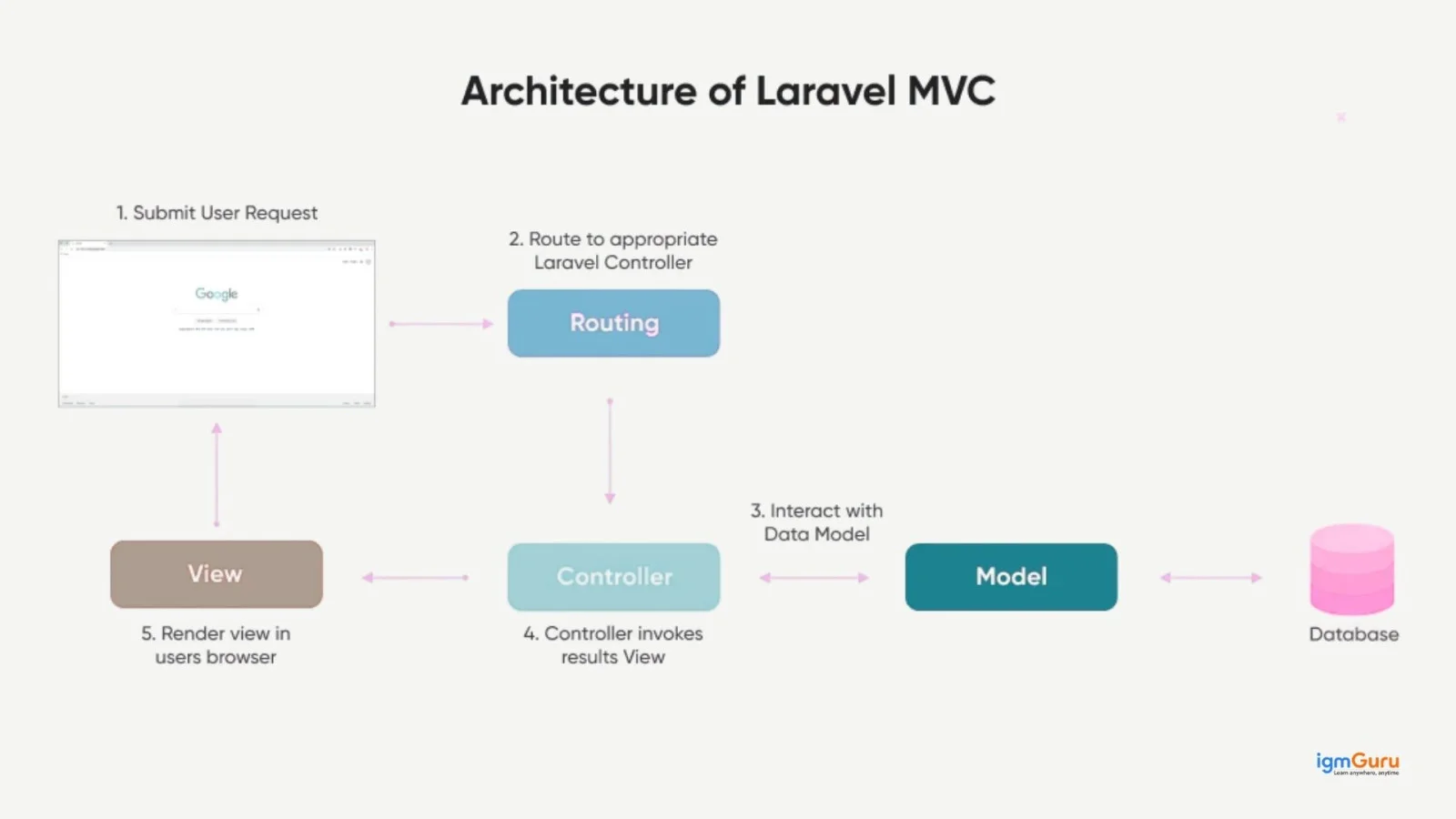
Laravel is an open-source PHP-based web application framework known for its elegant syntax and the use of the Model-View-Controller (MVC) architectural pattern. It is designed to make web development faster, easier, and more enjoyable by providing tools and resources for common tasks. This allows developers to focus on building unique application features.
It is used because it simplifies common development tasks such as database queries, form validation, authentication and error handling. Its expressive syntax, strong security features, reusable components and large ecosystem help developers build scalable, maintainable and high-performance applications efficiently.
Artisan is a built-in command-line interface (CLI) of Laravel that helps developers interact with the framework through terminal commands. It provides a set of predefined commands to perform common development and maintenance tasks. You can use it to automate repetitive tasks such as creating controllers, models, migrations and seeders. It also helps in running database migrations, clearing caches, managing queues and speeding up development with minimal manual effort.
Middleware is basically a type of filter or a gatekeeper for HTTP requests entering your application. It provides a convenient mechanism for inspecting, filtering, or modifying requests before they reach your application's core logic (like controllers) or after a response has been generated, but before it's sent back to the client.
Eloquent ORM is a powerful Object-Relational Mapper of Laravel. Think of it as a component that lets developers interact with databases using an object-oriented, expressive PHP syntax instead of raw SQL. It maps database tables to PHP classes (Models) for easy data manipulation (CRUD, relationships, etc.). It simplifies database operations, which makes code more readable and maintainable by providing an abstraction layer for database interactions.
Laravel stands out from other frameworks because it focuses on developer productivity, clean code and built-in functionality. It offers expressive syntax, powerful tools like Eloquent ORM, Blade templating and Artisan CLI, which reduce development effort.
It also provides strong security, easy authentication and a rich ecosystem out of the box, which is rare in its alternatives. Its MVC structure, extensive documentation, and large community make it easier to learn, scale and maintain applications compared to traditional PHP frameworks.
Composer is a dependency management tool for PHP that helps developers manage and install libraries required by a project. It allows you to define project dependencies in a composer.json file and automatically handles downloading and updating them. Laravel uses it to install the framework itself, manage third-party packages, handle autoloading and keep project dependencies organized and up to date.
Blade is a lightweight and powerful templating engine of Laravel used to build dynamic user interfaces. It allows developers to write clean, readable views using simple syntax while still working with plain PHP. It supports features like template inheritance, reusable components, control structures, and data display with automatic escaping. This makes front-end development faster, more organized, and easier to maintain in Laravel applications.
CSRF (Cross-Site Request Forgery) protection is a security feature that prevents unauthorized actions from being performed on behalf of an authenticated user. These types of attacks usually trick users into submitting malicious requests without their knowledge. Laravel Framework protects against CSRF by generating a unique token for each user session. This token must be included in form submissions, which are validated before processing the request.
The structure of a Laravel project is based on the Model-View-Controller (MVC) architectural pattern by default. It is designed to provide a solid foundation for most applications. Each directory has a specific responsibility within the application. The app folder contains core application logic like controllers, models, services and middleware. Routes define web, API, and console routes.
Laravel 12 is the most recently introduced version of this framework. It has come up with various features, including:
| Feature | Description |
| New Starter Kits | Ready-to-use React, Vue, and Livewire starter kits with authentication and modern frontend tooling |
| PHP Route Attributes | Allows defining routes directly using PHP 8+ attributes in controller methods |
| Native Health Checks | Built-in health check endpoints for monitoring application status |
| Improved Project Structure | A cleaner organization to support large and scalable applications |
| Updated Dependencies | Core libraries and packages upgraded for better performance and long-term support |
| Enhanced Artisan CLI | Improved command output, usability, and developer productivity |
| Better Job Batching | More control and visibility when managing queued and batch jobs |
Now we will discuss the most asked Laravel interview questions and answers for candidates with two years of experience.
Authentication is managed using built-in authentication systems that handle user login, registration, password resets and authorization. Laravel provides ready-made authentication scaffolding, which speeds up implementation. It uses guards and providers to manage how users are authenticated and retrieved. This PHP framework also supports token-based authentication, sessions and APIs through packages like Laravel Breeze, Jetstream, Sanctum and Passport.
Jobs and Queues are used to handle time-consuming tasks asynchronously instead of executing them during a user request. This improves application performance and user experience. A Job represents a single task, such as sending emails or processing files. Queues store these jobs and process them in the background using queue workers. This allows the framework to handle heavy tasks efficiently and reliably.
Here is how they differ from each other:
| Relationship | Description | Foreign Key Location | Example Use Case |
| hasOne | One model is associated with exactly one related record | Foreign key exists in the related table | A User has one Profile |
| hasMany | One model is associated with multiple related records | Foreign key exists in the related table | A Post has many Comments |
| belongsTo | Defines the inverse relationship of hasOne or hasMany | Foreign key exists in the current table | A Comment belongs to a Post |
Events and listeners are used to implement the observer pattern. It allows different parts of an application to communicate without being tightly coupled. An event represents something that has happened in the system.
Listeners are responsible for managing that event and executing specific actions, such as sending emails or logging activity. This approach improves code organization, scalability and maintainability.
The artisan migrate:rollback command is used when you want to undo the most recent database migration changes. It rolls back the last batch of migrations that were executed. This command is commonly used during development or testing when a migration contains mistakes, needs modification or when you want to revert the database schema to a previous stable state without manually changing tables.
Read Also- What Is an IDE (Integrated Development Environment)?
This section lists the most asked Laravel interview questions and answers for candidates with three years of experience.
Migrations are used to manage database schema changes in a structured and version-controlled way. They act like a blueprint for creating, modifying and deleting database tables. Developers use migrations to easily track database changes, share schema updates across teams, and maintain consistency between development, testing, and production environments without writing raw SQL.
Factories are used to generate fake or sample data for testing and database seeding. They help developers create large amounts of realistic test data quickly. They are defined for Eloquent models and use the Faker library to generate data like names, emails and dates. This improves testing accuracy, speeds up development and supports automated testing workflows.
Auth is a built-in authentication system used to verify and manage user identities within an application. It manages common tasks such as login, logout, registration and password validation. It is also used to protect routes, control user access and ensure only authenticated users can perform certain actions. Auth works with guards, middleware and user providers to manage authentication securely.
Dependency Injection is a design pattern where required class dependencies are automatically provided instead of being created manually. This reduces tight coupling between components and makes the code easier to test and maintain. The service container of the framework then handles dependency injection by resolving and injecting dependencies into controllers, routes, middleware and other classes automatically.
The Service Container is a powerful tool used to manage class dependencies and perform dependency injection. It acts as a central place where classes and their dependencies are registered and resolved. The service container automatically injects required dependencies into controllers, services, and other classes. This improves flexibility, testability, and helps maintain a clean, loosely coupled application architecture.
Now, we will dive into the most asked Laravel interview questions and answers for candidates with five years of experience.
The performance of large Laravel applications are optimized using a step-by-step approach, including:
This structured approach ensures scalability, stability, and faster response times as the application grows.
Middleware is basically a filter between the HTTP request and response. It is used to perform checks such as authentication, authorization, logging or request modification. I have used it for:
It provides database transactions to ensure data consistency during complex operations. Transactions are used when multiple database operations must either succeed together or fail together. Using transactions prevents partial data updates in cases like payment processing or order creation. It also supports automatic rollback on exceptions, which helps maintain data integrity.
Laravel Horizon is a queue monitoring and management dashboard built specifically for Redis based queues. It provides real-time insights into job throughput, execution time, failures and worker status. Horizon is used in production systems where queues are heavily used and need monitoring, alerting and fine-grained control over job processing.
A scalable Laravel API is designed using proper versioning, RESTful principles, and clear separation of concerns. API resources are used for consistent responses, while authentication is handled using token-based systems like Sanctum or Passport. Rate limiting, caching, pagination and background jobs are implemented to handle high traffic and ensure smooth scalability.
Let’s now explore some of the most asked PHP Laravel interview questions and answers. These will dive into some core concepts.
The Laravel request lifecycle describes how an HTTP request is processed and converted into a response. It follows a structured flow to ensure consistency and extensibility. Here is the flow:
This lifecycle allows Laravel to manage routing, security and application logic efficiently.
The difference between web.php and api.php routes lies in how Laravel handles state, security and request processing. Here is a comprehensive difference between them:
| Aspect | web.php | api.php |
| Purpose | Used for browser-based web applications | Used for building APIs |
| State | Stateful (uses sessions) | Stateless by default |
| CSRF Protection | Enabled automatically | Not enabled |
| Authentication | Session-based authentication | Token-based authentication |
| Response Type | Usually returns HTML views | Usually returns JSON responses |
| Middleware Group | Uses web middleware | Uses api middleware |
| Use Case | Websites, dashboards, admin panels | Mobile apps, SPA, third-party integrations |
API Resources in this framework are like a transformation layer between your Eloquent models and the JSON responses returned by your API. They provide granular control over the data sent to clients. This ensures responses are consistent, secure and well-structured.
You can even use it to control which fields are exposed, modify data formats and maintain consistent response structures. This improves API clarity, security, and long-term maintainability, especially in large or evolving applications.
Route caching is a performance optimization technique that stores all application routes in a single cached file. This allows the framework to load routes much faster instead of parsing route files on every request. It should be used in production environments where routes are stable and do not change frequently. Using it during active development can cause any route change that requires clearing and regenerating the route cache to take effect.
Accessors and mutators in Eloquent are used to modify model attribute values when retrieving or saving data. They provide a clean way to format or transform data without changing the underlying database values.
Laravel prevents the N+1 query problem primarily by using eager loading in Eloquent relationships. Eager loading allows related records to be retrieved in a single query instead of executing a new query for each record. It can also fetch parent and related data together by using methods like with() or load(). This significantly reduces the number of database queries and improves performance in data-intensive applications.
Here is a complete difference between eager loading and lazy loading:
| Aspect | Eager Loading | Lazy Loading |
| Definition | Loads related models at the same time as the main query | Loads related models only when accessed |
| Query Execution | Uses fewer queries by fetching data in advance | Triggers additional queries when relations are accessed |
| Performance | More efficient for large datasets | Can cause N+1 query problem |
| Usage Method | Uses with() in the query | Relations are accessed dynamically |
| Best Use Case | When related data is known to be needed | When related data is optional or rarely used |
| Impact on Database | Reduces database load | Increases database calls |
Here is how first(), get(), and find() in Eloquent are different:
| Method | Purpose | Return Type | Use Case |
| first() | Retrieves the first matching record | Single model instance or null | When you expect only one result |
| get() | Retrieves all matching records | Collection of models | When multiple records are required |
| find() | Retrieves a record by primary key | Single model instance or null | When searching by ID |
Laravel policies are classes used to organize authorization logic for a specific model or resource. They define rules that determine whether a user can perform actions such as view, create, update or delete a resource.
These policies should be used when authorization logic becomes complex or needs to be reused across controllers, views, and APIs. They help keep permission checks clean, centralized, and aligned with Laravel’s authorization system. Here are the common policies one should know:
| Policy Method | Purpose |
| viewAny | Determines if a user can view a list of resources |
| view | Checks if a user can view a specific resource |
| create | Determines if a user can create a new resource |
| update | Checks if a user can update an existing resource |
| delete | Determines if a user can delete a resource |
| restore | Checks if a user can restore a soft-deleted resource |
| forceDelete | Determines if a user can permanently delete a resource |
Pagination works by automatically limiting the number of records retrieved from the database and generating pagination metadata for navigation internally. It also uses SQL LIMIT and OFFSET to fetch only the required records for the current page.
When pagination methods are applied, the framework also calculates the total number of records, determines the current page and builds pagination links or JSON metadata. This approach improves performance and provides a consistent pagination structure for both web and API responses.
Now we will explore some of the most asked Laravel interview questions and answers for senior developers. These are asked to check the experience and expertise of the candidates.
Enabling the query log in this framework is a step-based process that includes the following steps:
This is mainly used during development to inspect executed SQL queries and should be avoided in production due to performance overhead.
Soft deletes allow data recovery, audit tracking and safer delete operations, which is why they are widely used in real-world applications. I would follow the given steps to implement soft delete in this framework:
Laravel handles exception handling globally through a centralized mechanism that ensures errors are managed consistently across the application. This is primarily done using the global exception handler, which captures all exceptions thrown during request execution.
Laravel routes every exception to a single handler where it can be logged, reported or converted into an appropriate HTTP response. This allows developers to customize error responses, control what is shown in production versus development and handle specific exception types cleanly. This improves application stability and debugging.
I validate incoming requests using a built-in validation system that checks request data against defined rules before processing it. This ensures that only clean, expected and safe data enters the application.
It is mostly managed inside controllers or dedicated form request classes, where rules define required fields, data types, formats and constraints. If validation fails, the framework automatically returns an error response. This makes input handling secure, consistent and developer-friendly.
It handles file uploads and storage using a unified filesystem abstraction that simplifies working with local and cloud storage. Uploaded files are treated as objects, which makes validation and handling consistent and secure.
It also has a storage system to store files on local disks or services like Amazon S3. It manages file paths, visibility and access through a clean API, which allows developers to upload, retrieve and manage files without worrying about underlying storage details.
This section lists the most asked Laravel advanced interview questions and answers. These are based on the most advanced and most useful concepts for a senior developer.
Task Scheduling allows developers to define and manage scheduled commands and jobs within the application instead of relying on multiple system cron entries. It provides a clean and centralized way to automate recurring tasks like backups, emails or data cleanup. Scheduling it is a step-based process:
This approach makes scheduled task management easier, readable and more maintainable in production environments.
Managing multiple authentication guards allows an application to authenticate different types of users separately, such as admins, customers or API users. Each guard defines how users are authenticated and how their credentials are stored or validated. This is typically handled as a step-based approach:
This setup helps maintain clear separation of user roles, improves security and supports complicated applications with multiple user types.
It manages localization and multi-language support through its built-in translation system, which allows applications to display content in multiple languages based on user preference or location. It uses language files to store translated strings instead of hardcoding text.
Translations are organized into language directories and Laravel automatically loads the appropriate language based on the application or user locale. This approach makes it easy to add new languages, maintain consistency and deliver a localized user experience across web and API responses.
It manages sessions using a configurable session system that stores user data across multiple requests. It provides a consistent API to read, write and maintain session data without exposing the underlying storage mechanism. Sessions can be stored using different drivers such as files, databases, cache or cookies. This PHP framework automatically handles session initialization, security, expiration and regeneration. This makes session management reliable and secure for web applications.
Laravel Sanctum is a lightweight authentication system designed for single-page applications (SPAs), mobile applications and simple APIs. It provides token-based authentication while also supporting session-based authentication for first-party frontends. This makes it easy to secure APIs without complicated OAuth flows.
Sanctum is preferred over Passport when the application does not require full OAuth2 features. It is commonly used for SPAs using Laravel as a backend, mobile apps and internal APIs because it is simpler to implement, easier to maintain and has less overhead. A passport is typically chosen only when third-party OAuth access or advanced authorization flows are required.
Laravel 13 provides a first-party AI SDK that makes it easier to integrate AI capabilities such as text generation, tool-calling agents, embeddings, audio, images and vector stores. I would use the AI SDK when building AI-powered features while keeping the implementation consistent with the Laravel application architecture.
For example, I could create an AI agent for customer support, content generation or data analysis and connect it with application services and business logic. I would also use queues for long-running AI tasks and store the required results in the database or cache.
For production applications, I would also implement proper authentication, validation, rate limiting, logging and monitoring around AI requests. This ensures that AI features remain secure, scalable and maintainable as usage increases.
I would use embeddings to represent application data as vectors and then perform similarity searches instead of relying only on traditional keyword matching. Laravel 13 provides native support for vector queries and embedding workflows, which makes it easier to build semantic search features.
I would first generate embeddings for the required content and store them in a vector-capable database such as PostgreSQL with pgvector. When a user performs a search, I would generate an embedding for the query and compare it against the stored vectors to identify semantically similar results.
For a production application, I would combine semantic search with traditional filtering, pagination and access-control rules. This would allow users to find relevant information based on meaning while still respecting application-specific requirements.
I would first separate background tasks based on their priority and processing requirements. Critical jobs such as payment processing would use dedicated queues, while less important tasks such as notifications or report generation could use separate queues.
In Laravel 13, I can also define queue routing by job class, which makes it easier to centrally control which queue and connection should process specific jobs. I would configure appropriate retry, timeout and backoff settings for each type of job.
I would use Redis-based queues and Laravel Horizon to monitor job throughput, failures and worker performance. For applications with unpredictable workloads, I would also scale queue workers horizontally based on queue depth to ensure background processing does not affect the main application.
PHP attributes provide a declarative way to define configuration and behavior directly on classes and methods. Laravel 13 has expanded first-party attribute support for areas such as middleware, authorization, queues, events, validation and resource serialization.
I would use attributes where they make the code easier to understand and keep configuration close to the class or method it applies to. For example, controller middleware and authorization rules can be declared directly on the relevant controller or method.
However, I would avoid using attributes everywhere simply because they are available. I would choose them when they improve readability and maintainability while keeping larger application-level configuration in appropriate configuration files or service providers.
I would design the application with clear boundaries between business logic, AI capabilities and external services. Laravel's current ecosystem provides tools such as the AI SDK and Laravel Boost that can support AI-powered features as well as AI-assisted development.
I would keep core business rules inside dedicated services and allow AI agents to interact with those services through controlled tools rather than giving them unrestricted access to the application. Authentication, authorization and validation would be applied before sensitive operations are executed.
I would also use queues for long-running agent tasks, caching for repeated operations and detailed logging to track agent actions and failures. This approach allows AI capabilities to be introduced without tightly coupling them to the application's core business logic and makes the system easier to test, monitor and scale.
This section focuses on real-world, scenario-based Laravel interview questions that reflect modern development challenges. These questions are aligned with trending topics such as performance optimization, API security, cloud deployment, microservices architecture, queue scaling, and high-traffic systems.
In a production environment, performance issues usually come from database inefficiencies, missing caching layers or blocking background tasks. I would begin by profiling the application using tools like Telescope, server logs or APM tools such as New Relic. Here are the steps I would follow:
For a secure and scalable API, I would follow RESTful principles and proper versioning, such as /api/v1. I would also implement the authentication using Sanctum for token-based authentication unless OAuth2 is required. The steps are:
Handling large-scale background processing requires proper queue management. I would use Laravel’s queue system with Redis as the queue driver for better performance. Each task such as sending emails or generating reports would be dispatched as a job.
I would configure queue workers and use Horizon to monitor job performance, failures, and throughput. Failed jobs would be retried automatically with proper timeout settings. For very large workloads, I would implement job batching and horizontal scaling of queue workers to distribute the load efficiently.
To modernize a monolithic application, I would start by identifying tightly coupled modules and separating concerns using service classes and repositories. Then, I would extract independent components such as authentication or payment services into microservices if required.
API communication between services would be handled securely using token-based authentication. I would containerize the application using Docker and deploy it in a cloud environment like AWS. Caching layers, database optimization and proper load balancing would also be implemented to ensure scalability. This approach ensures maintainability and supports future growth.
Payment systems require strict transactional integrity. I would wrap all related database operations inside a database transaction to ensure atomicity. If any step fails, the entire transaction would roll back automatically.
Additionally, I would implement idempotency keys to prevent duplicate payments in case of repeated requests. Proper logging would be added to trace failures. Queue-based confirmation emails would only be triggered after a successful transaction commit. This ensures data consistency, prevents financial discrepancies, and improves system reliability.
When a query performs well in development but becomes slow in production, the first step is to identify the actual bottleneck instead of making assumptions. Production databases often contain millions of records, making inefficient queries much more noticeable.
I would begin by analyzing the generated SQL query and reviewing the execution plan using database profiling tools. Then, I would follow these optimization steps:
By combining indexing, query optimization, eager loading, and caching, the application can maintain fast response times even when handling millions of records in production.
Handling sudden traffic spikes requires optimizing both the application and infrastructure. I would first cache configuration, routes and views, then move sessions and cache storage to Redis. Database queries would be optimized using eager loading, proper indexing, and query caching where appropriate.
I would also serve static assets through a CDN, enable horizontal scaling behind a load balancer and move long-running tasks such as order confirmations and emails to queues. Finally, I would perform load testing before deployment to identify bottlenecks and ensure the application can handle peak traffic without failures.
I would avoid making the application completely dependent on the external service by implementing retry mechanisms with exponential backoff, request timeouts and proper exception handling. Failed requests would be logged and queued for automatic retries instead of immediately failing the user request.
I would also implement circuit breaker logic to temporarily stop sending requests when the payment service is unavailable. Users would receive clear status updates while administrators would be notified through monitoring and alerting systems to investigate the outage.
I would first determine whether the project requires a shared database with tenant identifiers or separate databases for each tenant based on scalability and security requirements. Middleware would identify the current tenant from the domain, subdomain or request headers before processing any request.
Database queries would automatically filter tenant-specific data using global scopes or dedicated tenancy packages. Authentication, caching and file storage would also be isolated to prevent accidental data exposure between different organizations.
I would use an automated CI/CD pipeline that runs unit tests, static analysis and security checks before deployment. Database migrations would be written to remain backward compatible so the old and new application versions can run safely during deployment.
I would use a rolling or blue-green deployment strategy, warm the application cache after deployment, restart queue workers gracefully and continuously monitor logs and application health. If any critical issue appears, I would immediately roll back to the previous stable release to minimize user impact.
This guide brings together the most important Laravel interview questions and answers that employers actively ask in real interviews. From core Laravel fundamentals to advanced concepts such as performance optimization, APIs, queues, authentication, and system-level design, the questions are structured to match how technical interviews evaluate candidates at different experience levels.
By preparing with these questions, you not only strengthen your theoretical understanding but also gain clarity on how Laravel is used in production-grade applications. Whether you are a fresher or an experienced developer, mastering these concepts will help you demonstrate practical expertise, architectural thinking, and confidence during Laravel interviews.
There are various job roles available for these experts, including:
Various companies across different industries hire these professionals. Some of the common ones are as follows:
| Category | Companies / Examples |
| Large Enterprises | Pfizer, BBC, Adobe, General Electric (GE) |
| Tech & Product Companies | 9GAG, HelloFresh, DISQO, Thumbtack |
| Startups & SaaS Companies | Agent Legend, Groupbook, Hyvikk Solutions |
| IT Services & Consulting Firms | Unified InfoTech, Clarion Technologies, Spec India |
| Laravel Development Agencies | Saritasa, eSparkBiz, Innowise, Zealous System |
| Remote & Global Hiring Platforms | Toptal, LaraJobs, Wellfound (AngelList Talent) |
The earning of Laravel professionals varies depending on the location and experience level. A beginner can earn up to ₹3-4 LPA in India and $40k per annum in the USA. Experienced professionals earn up to ₹7-9 LPA+ in India and $100k+ per annum in the USA.
Before attending a Laravel interview, you should build at least two or three real-world projects that demonstrate your understanding of the framework. Good examples include an e-commerce application, a blog CMS, a REST API with authentication, a task management system, or an inventory management application. These projects should showcase features like authentication, authorization, Eloquent ORM, migrations, queues, caching, API development, file uploads, and database relationships. Practical project experience helps interviewers evaluate your ability to apply Laravel concepts in production environments.