NoSQL databases have revolutionized data storage, management, and retrieval in the modern digital landscape. They offer unmatched flexibility, scalability, and performance compared to traditional relational databases, making them the preferred choice for handling large-scale, unstructured, or semi-structured data. Whether you're a beginner exploring databases or a seasoned professional aiming for a tech role, understanding NoSQL is essential for staying competitive in today’s data-driven world.
This comprehensive guide explains what NoSQL is, its types, features, use cases, and the latest trends. Designed to be clear and engaging, it equips you with everything you need to know about NoSQL databases to excel in data engineering, software development, or data science.
NoSQL (Not Only SQL) databases are non-relational database management systems designed to handle diverse data types and massive datasets that traditional SQL databases struggle with. Unlike SQL databases, which rely on rigid, table-based structures with predefined schemas, NoSQL databases use dynamic schemas, enabling greater flexibility for managing unstructured or semi-structured data, such as social media posts, IoT data, or e-commerce transactions.
NoSQL databases emerged to tackle the limitations of relational databases in addressing the three Vs of big data:
These databases power modern applications like real-time analytics, content management, and machine learning, offering scalable, high-performance solutions for today’s data challenges.
Enroll in igmGuru's Microsoft SQL Server course to boost your database expertise.
The rise of NoSQL databases is driven by the evolving needs of businesses and developers in a data-intensive world. Here’s why NoSQL has gained widespread adoption:
Mastering NoSQL is a valuable skill for careers in data engineering, software development, or data science. Understanding its key terminologies and capabilities unlocks its full potential.
Read Also: What is PL/SQL - Everything You Need to Know
NoSQL databases are categorized into four primary types, each tailored to specific use cases. Here’s a detailed breakdown with examples:
Key-value stores are the simplest NoSQL databases, functioning like a dictionary where each data item is stored as a unique key paired with a value. They excel at high-speed, simple lookups.
Document stores manage data as JSON, BSON, or XML documents, where each document is a self-contained unit with a flexible structure, ideal for semi-structured data.
Column-family stores organize data into columns rather than rows, enabling efficient storage and retrieval for large-scale analytical queries.
Graph databases focus on relationships, storing data as nodes (entities) and edges (relationships), excelling at handling interconnected data.
Read Also: Top SQL Server Interview Questions and Answers
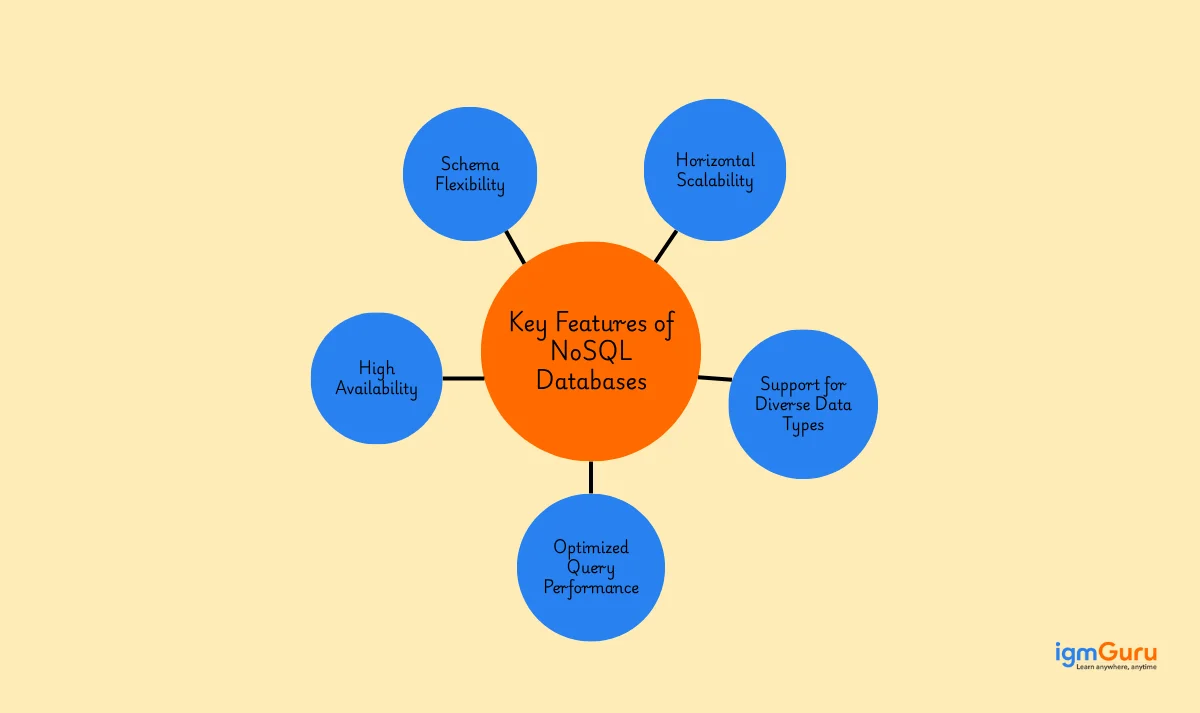
NoSQL databases offer unique features that make them ideal for modern applications. Here’s an overview:
NoSQL databases allow you to add or modify fields dynamically, unlike SQL databases with rigid schemas. For example, in MongoDB, you can add a user_location field to one document without affecting others.
Using sharding (distributing data across servers) and replication (copying data for redundancy), NoSQL databases scale horizontally, ensuring high availability and performance for large datasets.
Example: Amazon’s DynamoDB uses sharding to distribute product data, ensuring fast access during peak shopping seasons.
NoSQL databases prioritize availability and partition tolerance (per the CAP theorem), making them ideal for distributed systems where downtime is unacceptable.
Example: Cassandra’s replication ensures data accessibility even if a server fails.
From JSON documents to graph structures, NoSQL databases handle unstructured, semi-structured, and structured data, offering versatility for various applications.
NoSQL databases are designed for specific query patterns. For instance, key-value stores excel at simple lookups, while graph databases optimize complex relationship queries.
Read Also: PostgreSQL Tutorial for Beginners
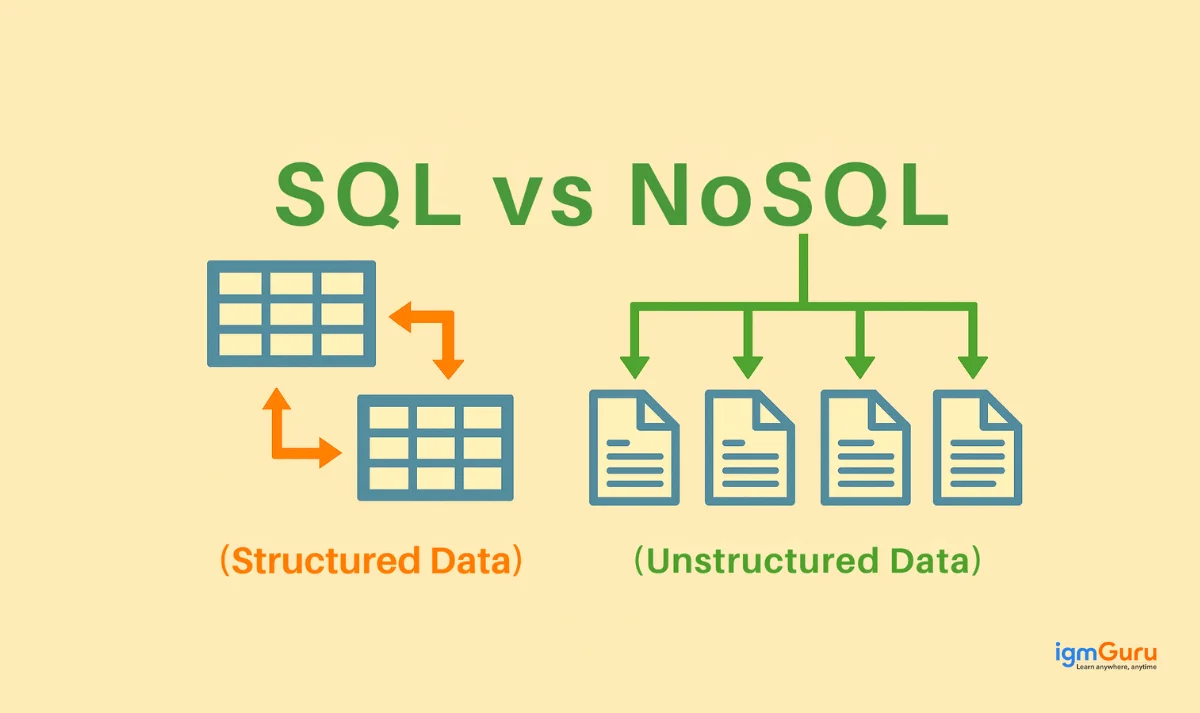
Understanding the differences between NoSQL and SQL databases helps determine the right choice for your project:
| Feature | SQL Databases | NoSQL Databases |
| Data Structure | Tables with fixed rows and columns | Flexible (documents, key-value, graphs) |
| Schema | Predefined, rigid | Dynamic, flexible |
| Scalability | Vertical (add more hardware) | Horizontal (add more servers) |
| Query Language | SQL (standardized) | Varies (e.g., MongoDB queries, CQL) |
| Use Cases | Structured data, financial systems | Unstructured data, real-time analytics |
Example: A bank uses SQL databases for transaction records due to their strict schema and ACID compliance, while a social media platform uses MongoDB to store varied user-generated content.
NoSQL databases excel in scenarios requiring flexibility, scalability, and performance. Common use cases include:
Databases like Cassandra handle high-velocity data, such as website clickstreams or sensor data, enabling real-time insights. For example, a streaming platform uses Cassandra to analyze user viewing patterns instantly.
Document stores like MongoDB manage diverse content (e.g., articles, images, metadata) with flexible schemas. A news website, for instance, stores articles with varying fields in MongoDB.
NoSQL databases manage the high volume and variety of IoT data, such as sensor readings. A smart city system might use HBase to process traffic sensor data.
Graph databases like Neo4j map relationships, making them ideal for social networks or recommendation engines. A retail platform might use Neo4j to recommend products based on user connections.
NoSQL databases manage product catalogs, user sessions, and order histories, supporting rapid scaling during peak traffic. For example, DynamoDB powers Amazon’s shopping cart system for seamless transactions.
Read Also: A Beginner’s Guide to Learn MongoDB
The NoSQL landscape is evolving rapidly to meet modern demands. Here are the latest trends as of 2026:
Selecting the right NoSQL database depends on your project’s needs. Consider these factors:
Example: A startup building a real-time analytics dashboard might choose Cassandra for its scalability, while a social media app might opt for Neo4j to map user relationships.
Despite their advantages, NoSQL databases present challenges:
NoSQL databases are poised to remain a cornerstone of modern data architectures, driven by the growth of big data, cloud computing, and Artificial Intelligence. Innovations like multi-model databases, serverless architectures, and integration with AI and edge computing are expanding their versatility. As businesses generate increasingly diverse and high-volume data, NoSQL databases will continue to evolve to meet these demands.
NoSQL databases provide a powerful solution for managing dynamic, high-volume data in modern applications. From key-value stores to graph databases, their flexibility, scalability, and performance make them indispensable for developers and businesses. By understanding their types, features, and use cases, you can make informed decisions about implementing NoSQL in your projects.
To master NoSQL, explore online tutorials, experiment with databases like MongoDB or Cassandra, and build real-world applications. Whether you’re aiming for a career in data engineering or want to stay ahead in tech, NoSQL expertise is a step toward future-proofing your skills.
SQL databases use structured tables with fixed schemas, while NoSQL databases support dynamic schemas and diverse data types, making them ideal for unstructured or semi-structured data.
No, NoSQL complements SQL. SQL databases excel in structured data and transactional systems, while NoSQL is better for large-scale, unstructured data and real-time applications.
MongoDB is an excellent starting point due to its ease of use, extensive documentation, and wide adoption across web apps and analytics.
Yes, NoSQL databases can handle structured data, but they are optimized for unstructured or semi-structured data. SQL databases may be more efficient for highly structured data.
Many NoSQL databases, like MongoDB, Cassandra, and Redis, are open-source. Others, like DynamoDB, are proprietary cloud-based solutions.
Modern NoSQL databases implement encryption, role-based access control, and compliance with regulations like GDPR to ensure data security.
NoSQL databases are ideal for real-time analytics, content management, IoT applications, social networks, and e-commerce platforms requiring scalability and flexibility.
Course Schedule
| Course Name | Batch Type | Details |
| Microsoft SQL Server Training | Every Weekday | View Details |
| Microsoft SQL Server Training | Every Weekend | View Details |