Data is an important component for an organization's functioning. The increasing importance associated with data has soared the need for storing gigantic quantities of data. This in turn brings databases into the equation where PL/SQL stand as an important name. This blog encompasses all the aspects and everything you need to know about this relational DB language. It begins with an answer to 'what is PL/SQL'.
It's a procedural language extension for SQL or Structured Query Language. It's quite well known for building Database-driven applications. It creates as well as manages views, tables, functions, procedures, triggers and packages. It combines procedural programming language and database language.
Enroll in igmGuru's Oracle PL/SQL Course program to boost your knowledge.
PL/SQL blocks use the keywords DECLARE, BEGIN, EXCEPTION, and END to break the block into three parts: declaration, execution, and error handling. In the declaration section, you can set up constants and variables. If you don't give a variable a value, it will automatically be set to NULL. You can also nest blocks and use them with tools like SQL*Plus.
It can calculate and return a single value or a collection like a nested table or VARRAY. You can create your own functions beyond what Oracle offers. While you can use functions in a Structured Query Language statement, procedures can't be used that way.
Here are the basics of PL/SQL that one must know -
1. It has features like conditions and loops, making it easy to declare constants, variables, procedures, functions, and triggers.
2. Within, you can declare variables in the DECLARE section.
3. Oracle has a PL/SQL engine that handles PL/SQL statements.
4. PL/SQL mixes Structured Query Language with the features you find in programming languages.
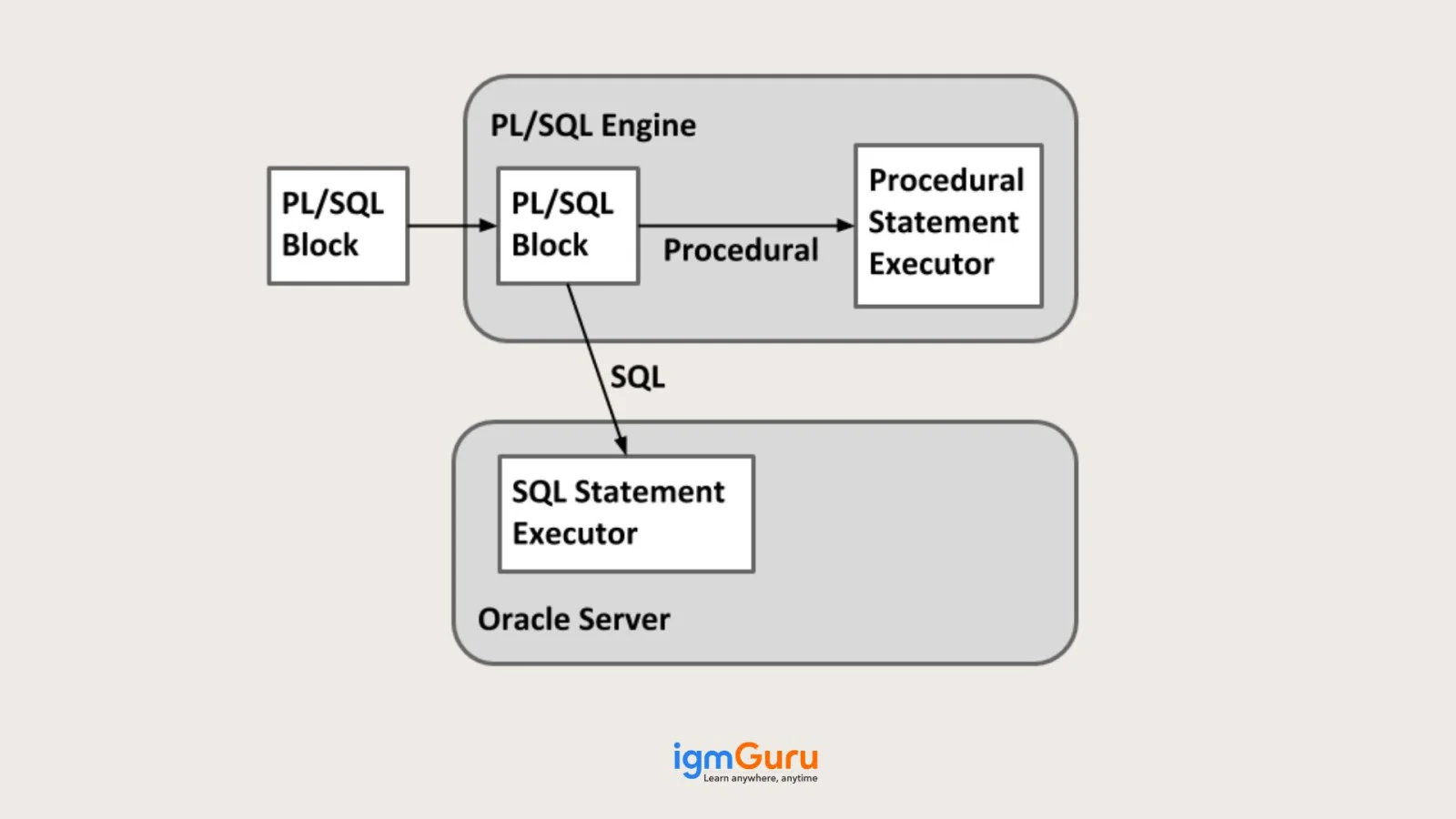
The PL/SQL architecture has three main components that are a must-learn for success. These components are discussed here and a brief intro is given for each of them.
This is the main input that has this language's code. It contains three different sections for logically dividing the code.
All the units of this DB are considered PL/SQL blocks. A few types of units are library, function, type, package specification and anonymous block. These encompass Structured Query Language instructions for interacting with the DB server.
It executes PL/SQL code on the server. This component segregates PL/SQL units and SQL parts in the input while handling the former's units. The Structured Query Language aspect is relocated to the DB server.
It stores the data and uses the SQL executor for parsing and executing input Structured Query Language statements. The above component uses the SQL from units for interacting with this component.
Related Article- PostgreSQL Tutorial For Beginners
Another important question here is 'what are the main features of PL/SQL?'. A few of these are mentioned here for a better understanding of this language.
A question that's asked quite often is what is the difference between Structured Query Language and PL/SQL. There is a general line of confusion between the two because of the similarity in their names. This table will clear basic doubts about what these are separately.
| SQL | PL/SQL |
| It's the acronym for Structured Query Language for querying and manipulating the data that's stored in databases. | It is a procedural language for implementing SQL statements in a better light. |
| It is declarative and specifies the actions that must be taken. It does not focus on how they should be taken. | It's procedural and is written like a sequence of instructions. |
| Data variables are not supported. | Data types and variable constraints are supported. |
| It retrieves data from the DB while modifying the table and data structure. | It creates server pages and web applications. |
| It interacts directly with the DB server. | It does not interact directly with the DB server. |
| I/O operations are not supported. | I/O operations are supported as inputs are accepted, stored and processed. |
| A single query or operation is executed at a given time. | Multiple operations or complete blocks are executed at a given time to reduce network traffic. |
| Relational databases use it for executing different queries like delete table, create table, insert into table and more. | It writes program blocks, triggers, functions, packages, functions and cursors. |
| It doesn't support control structures. | It supports control structures like For loop, if-else and While loop. |
| Slower processing speed is experienced when dealing with gigantic quantities of data. | High processing speed is experienced when dealing with gigantic quantities of data. |
| This language is quite easy to understand, learn and even use. | Certain concepts and aspects of this language are complicated and might require prior knowledge. |
| Both DDL (Data Definition Language) and DML (Data Manipulation Language) are used for writing commands and queries. | It has code blocks having functions, conditional statements, control structures, triggers and variables. |
So, what is a cursor in PL/SQL? It's a pointer to the context (memory) area that is created after the processing of a Structured Query Language statement. It comprises all necessary information about processing the statement and controls the context area. It has the details on a select statement as well as the rows of data it accesses.
Some of the common actions that are a part of working with cursors in this language are Declare Cursor, Fetch. Deallocate, Open and Close. It is bifurcated into two types namely implicit cursor and explicit cursor.
This block-structured language combines SQL's power with procedural statements. This blog answers the important question of 'what is PL/SQL' as well as other aspects. It then moves on to discuss its architecture, features and definition of cursor. Structured Query Language and PL/SQL are often confused with each other, so their main differences are covered here too.
Explore These Trending Articles:
The three types of statements in this language are conditional selection statements, sequential control statements and loop statements.
It's easy to learn but a few of its aspects might require prior knowledge. It has many security features and unheard of optimizations.
Course Schedule
| Course Name | Batch Type | Details |
Every Weekday/ Weekend | View Details | |
| Microsoft SQL Server Training | Every Weekday/ Weekend | View Details |