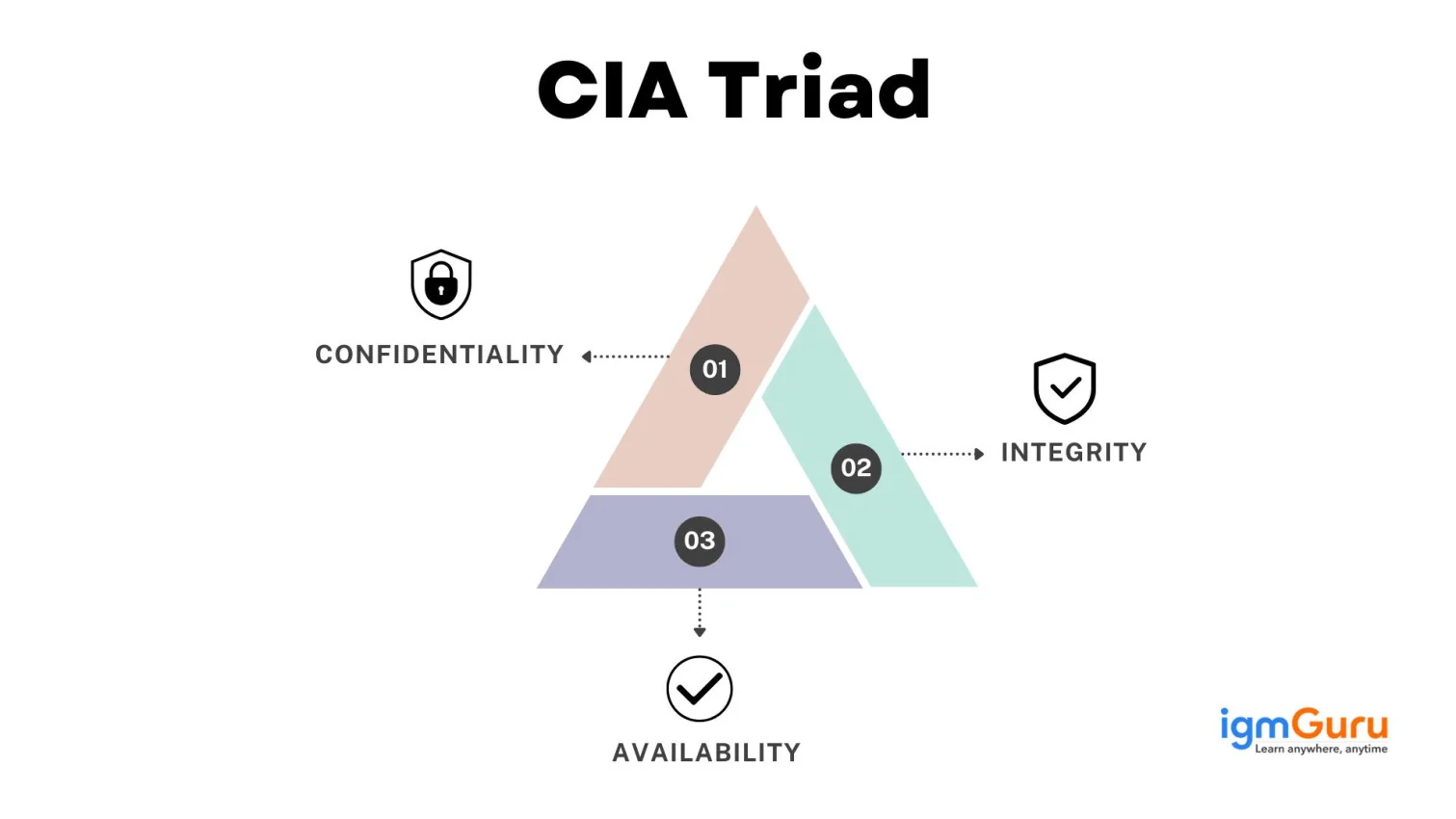
The CIA Triad is the foundation of modern cybersecurity. It defines three core principles for protecting data: Confidentiality, Integrity, and Availability. Whether you are securing medical records, banking systems, or cloud infrastructure, the CIA Triad model helps organizations design, evaluate, and strengthen their security posture. These are known as the three principles that guide organizations in designing, evaluating, and enhancing security posture.
This looks simple, but it plays a central role in global standards like NIST, ISO 27001, HIPAA, and PCI DSS. The CIA triad is also used in ISO 27001, a global standard for managing information security. In this article, we will explore each aspect of this model, real-world examples, threats, and responses. It also explains how organizations implement these principles at a large scale. Let's begin.
Read Also: How Does Encryption Work?
The CIA Triad is a foundational information security model. It helps organizations to protect their sensitive data and systems. Its explicit formulation as a core triad gained prominence in the 1980s and 1990s, with roots as old as the 1972 Anderson Report. It has three core principles:
These three pillars together act as the backbone of cybersecurity. It helps organizations to evaluate risks, implement controls, and build resilient systems. NIST SP 800-12 Rev 1 defines the CIA Triad as an essential component to protect information and ensure operational continuity in digital systems.
Quick Fact: The term "CIA" has no link to the US Central Intelligence Agency; it simply defines the three core goals of information security.
The CIA Triad plays a crucial role in managing risk, financial impact, and regulatory compliance. The sheer scale of cyber threats underscores its importance:
The global average cost from a data breach is now $4.44 million, according to the 2025 IBM report.
The global impact of cybercrime is projected to be $10.5 trillion in 2025, a figure often cited as the third-largest "economy" after the U.S. and China. The rising loss figures, such as the FBI IC3 reported $12.5 billion in losses during 2023, reflect a massive exponential rise in malicious attacks.
Modern threats are sophisticated. For instance, AI-powered phishing and social engineering have become highly effective, directly targeting confidentiality by tricking employees into giving up credentials.
Insider threats are now affecting over 83% of organizations, reflecting a sharp year-over-year increase, directly challenging Integrity and Confidentiality controls.
Standards like HIPAA, PCI DSS, and ISO 27001 directly align with the CIA model. Non-compliance can lead to massive fines and reputational damage. In India, the new Digital Personal Data Protection Act (DPDP Act) mandates strict controls over personal data, demanding high Confidentiality and Integrity.
Also Read: What Is Penetration Testing?
The CIA Triad stands for confidentiality, integrity, and availability. Let's understand them individually:
Confidentiality means the data can only be accessed by authorized people and it also prevents unauthorized access or disclosure of information. The main tools for the same are:
NIST SP 800-12 and the Cybersecurity Framework highlight the confidentiality controls. The IBM Cost of a Data Breach Report (2025) revealed that the global average breach cost decreased slightly to $4.44 million, a figure still driven by stolen sensitive data, customer trust erosion, and compliance fines. In sectors like healthcare, breaches remain the most costly, averaging $7.42 million in 2025.
Integrity means protecting data from unauthorized alteration and ensuring that all records remain accurate and reliable throughout their lifecycle. The main tools for the same are:
For example, the Stuxnet attack against Iranian nuclear centrifuges demonstrated a major integrity failure: the malicious code was designed to physically damage the centrifuges while simultaneously manipulating the sensor data displayed to operators, making the system appear normal. This two-pronged attack corrupted both the physical process and the monitoring records.
Read Also: Cyber Security Tutorial
This means ensuring the availability of data or services whenever needed, guaranteeing reliable and timely access for authorized users.
Main Controls:
One of the major instances of availability failure is the AWS Outage (2020) that affected major services like Alexa, Kindle, and Netflix, highlighting the risk of single-region dependency. Downtime is not just inconvenient; outages in healthcare or disaster management can be life-threatening, while banking system failures cause massive revenue loss and reputational damage.
The CIA Triad and Zero Trust serve different but complementary purposes in cybersecurity. This is where various beginners often get confused between the two concepts. The CIA Triad defines what needs to be protected, while Zero Trust defines how protection is enforced. Understanding their practical differences helps them design security architectures that are both goal-oriented and operationally effective.
| CIA Triad | Zero Trust |
| Defines core security objectives | Defines a security architecture and enforcement model |
| Focuses on protecting data and systems | Focuses on identity, device posture and context |
| Conceptual and principle-driven | Operational and continuously enforced |
| Static goals: confidentiality, integrity, availability | Dynamic verification for every access request |
| Applicable at the policy and strategy level | Applied at the network, application and access layers |
Also Read: What Is Endpoint Security?
In today's evolving battlefield, threats often target multiple pillars simultaneously. The prime example is Ransomware, which targets Availability (by locking systems) and often Confidentiality (by threatening to leak data).
The table below shows major cyber incidents and how they affected the core pillars of security:
| Incident | Affected CIA Pillar(s) | Consequences |
| Change Healthcare Ransomware (2024) | Availability, Confidentiality | Massive system downtime, halting payments; hospitals reverted to manual operations. |
| Stuxnet (2010) | Integrity | Iran's nuclear centrifuges damaged by stealthy malware; operators saw false "normal" readings. |
| LastPass Breach (2022) | Confidentiality, Integrity | Customer vault data compromised and development systems breached. |
| AWS Outage (2020) | Availability | Major services (Netflix, Alexa, Roku) went down for hours due to a single-region failure. |
| Equifax Data Breach (2017) | Confidentiality | 147M users' sensitive data (SSNs, DOBs) leaked; massive compliance and trust fallout. |
Read Also: What Is Password Salting and How Does It Work?
CIA Triad implementation is a continuous process spanning three levels: people, process, and technology. This approach utilizes a layered security architecture and standard frameworks.
The goal is to protect data from unauthorized users. Zero Trust is a key framework here; every request is verified regardless of where it originates.
Integrity ensures data is reliable, accurate, and tamper-free. This is critical for auditing and compliance.
Availability ensures systems and data remain accessible, even during system failures or attacks. Cloud architecture is heavily relied upon here.
For every organization, CIA Triad implementation depends on their industry, risk appetite, compliance needs, and tech maturity. Yet the core principles stay the same: Secure the data (Confidentiality), Trust the data (Integrity), and Access the data (Availability).
Read Also: What Is a Firewall?
CIA Triad is not just a theoretical model. It functions as a practical framework that guides real-world security decisions across strategy, operations and governance. Organizations use it to evaluate risks, design controls, assess maturity and align security investments with business priorities. Each pillar plays a distinct role at different stages of decision-making and system design. Let's understand each area in depth:
It helps leaders and security teams make informed decisions by evaluating how each choice affects confidentiality, integrity and availability. For example, enabling remote access improves availability but may increase confidentiality risks if not properly controlled. By mapping decisions against the triad, organizations can clearly understand trade-offs and choose controls that align with their risk appetite.
During risk assessments and threat modeling, it is used to categorize threats based on which pillar they target. Data breaches impact confidentiality, data tampering affects integrity and denial-of-service attacks compromise availability. This classification helps prioritize risks, assign impact levels, and design targeted mitigation strategies rather than applying generic security controls.
Different industries emphasize CIA pillars differently. Healthcare prioritizes confidentiality and integrity to protect patient records, while financial institutions focus heavily on integrity and availability to ensure transaction accuracy and uptime. In contrast, e-commerce platforms often prioritize availability during peak traffic periods. It adapts naturally to industry-specific risk and compliance requirements.
It applies across the entire data lifecycle, from creation and storage to processing, transmission, archiving and deletion. Confidentiality is critical during storage and transmission, integrity must be preserved during processing and updates and availability ensures data remains accessible throughout its useful life. Viewing security through the data lifecycle prevents gaps caused by siloed controls.
Human behavior is one of the most common causes of CIA failures. Weak passwords, phishing attacks, accidental data sharing, and insider misuse directly affect confidentiality and integrity. Availability can also be impacted by operational mistakes. Security awareness training, access controls and clear policies help align human actions with the goals of the CIA Triad.
Security audits and compliance assessments rely heavily on it to evaluate control effectiveness. Auditors examine whether data is properly restricted (confidentiality), protected against unauthorized changes (integrity) and consistently accessible (availability). Many compliance frameworks explicitly map their control requirements to these three pillars.
It can also be viewed as a maturity model for organizations. Early-stage security programs often focus only on availability, while mature programs balance all three pillars through layered controls, continuous monitoring, and governance processes. As maturity increases, organizations move from reactive protection to proactive risk management.
Also Read: Artificial Intelligence vs Cyber Security: Which Career Is Better?
From my experience working with cybersecurity frameworks and security assessments, one of the biggest misconceptions I see is that the CIA Triad is only for cybersecurity professionals. In reality, it is a practical framework that can be used by almost anyone responsible for protecting information, systems, or business operations. Whether you are managing a small website or securing an enterprise cloud environment, the principles of Confidentiality, Integrity, and Availability help you make better security decisions.
Over the years, I have found that organizations often struggle with security because they focus too heavily on a single area. Some prioritize availability and overlook confidentiality, while others implement strict access controls but fail to ensure business continuity. The CIA Triad provides a balanced approach by helping teams evaluate all three aspects together. Here is who should use it:
Security analysts, SOC engineers, penetration testers, security architects, and CISOs use the CIA Triad as a foundation for risk assessments, threat modeling, incident response planning, and the implementation of security controls. It serves as one of the first frameworks that security professionals learn because it applies to virtually every security decision.
Network administrators, cloud engineers, database administrators, and infrastructure teams regularly use CIA principles when configuring servers, managing backups, enforcing access controls, monitoring systems, and designing disaster recovery strategies. Their daily responsibilities directly impact all three pillars.
Business leaders may not work with security tools directly, but they make decisions that affect organizational risk. Understanding the CIA Triad helps executives evaluate cybersecurity investments, prioritize business continuity initiatives, and ensure customer data remains protected while maintaining operational efficiency.
Developers should apply CIA principles throughout the software development lifecycle. Secure authentication protects confidentiality, validation controls preserve integrity, and resilient application design improves availability. Modern DevSecOps practices heavily align with these principles.
Professionals working with ISO 27001, NIST, HIPAA, PCI DSS, GDPR, or DPDP compliance frameworks frequently use the CIA Triad to assess whether security controls adequately protect sensitive information and support regulatory requirements.
The CIA Triad is not limited to large enterprises. Startups, educational institutions, healthcare providers, financial organizations, government agencies, and even small businesses can use it as a simple framework for evaluating security risks. Regardless of company size, every organization must protect sensitive data, maintain data accuracy, and ensure critical services remain available.
In my view, if your role involves handling information, managing technology, protecting customer data, or making decisions about business systems, the CIA Triad is a framework worth understanding. It is simple enough for beginners to grasp yet powerful enough to guide enterprise-level cybersecurity strategies.
Also Read: What Is SailPoint?
Although the CIA Triad provides a simple and effective framework for protecting information, implementing it in real-world environments is not always straightforward. Organizations often struggle to maintain the right balance between confidentiality, integrity and availability while meeting business requirements, regulatory obligations and evolving cyber threats. As technology continues to advance, these challenges become even more complicated.
One of the biggest challenges is maintaining strong security without affecting business productivity. For example, implementing strict authentication methods and access controls improves confidentiality but may slow down employee workflows. Organizations must carefully balance security requirements with operational efficiency to avoid disrupting daily business activities.
Cyber threats continue to evolve every year. Attackers now use ransomware, AI-powered phishing campaigns, supply chain attacks, and zero-day vulnerabilities that can target multiple CIA pillars simultaneously. This is why security teams must continuously update their defenses, monitor emerging threats, and adapt their security strategies to remain protected.
Technology alone cannot guarantee security. Employees may accidentally expose sensitive information, click phishing links, use weak passwords, or improperly configure systems. In some cases, malicious insiders intentionally misuse their privileges. Regular security awareness training, access reviews, and monitoring are essential to reduce these risks.
Many organizations still rely on legacy applications and outdated infrastructure that were not designed for modern cybersecurity requirements. These systems may lack encryption, strong authentication, or proper monitoring capabilities, making it difficult to fully implement the CIA Triad without significant upgrades or infrastructure modernization.
Implementing advanced cybersecurity controls requires investment in skilled professionals, security tools, monitoring solutions, backups, and compliance programs. Small and medium-sized businesses often have limited budgets, making it difficult to deploy comprehensive security measures while maintaining day-to-day operations.
Organizations operating across different industries and countries must comply with various regulations such as ISO 27001, NIST, HIPAA, PCI DSS, GDPR, and the DPDP Act. Aligning security controls with multiple compliance frameworks while maintaining confidentiality, integrity, and availability can become a complex and ongoing process.
Despite these challenges, the CIA Triad remains one of the most reliable foundations of modern cybersecurity. Organizations that continuously assess risks, invest in employee awareness, adopt modern security technologies, and regularly review their security controls are better equipped to protect their data and maintain long-term resilience against evolving cyber threats.
A core challenge in cybersecurity is that improving one pillar often comes at the expense of another. Security professionals must find the right balance for their specific business needs:
While the CIA Triad is the foundation, it has been expanded to address modern threats that focus on non-traditional elements:
Modern frameworks like NIST CSF 2.0 often incorporate these extended concepts, but all of them are built upon the bedrock of Confidentiality, Integrity, and Availability.
Read Also: What Is the Future of Cybersecurity?
The CIA Triad is not merely a technical framework; it is a fundamental strategy for digital survival. These three pillars include Confidentiality, Integrity, and Availability. They define how trusted, secure, and resilient your data and systems are.
In an era of sophisticated ransomware, insider threats, and AI-powered attacks, treating the CIA Triad as non-negotiable has become a company-wide responsibility. By implementing strong tools, clear policies, trained teams, and adhering to global standards like ISO 27001 and NIST, organizations can significantly reduce risk, improve compliance, and most importantly, protect the trust of their users and stakeholders.
Hence, it is globally said that "Cybersecurity may evolve, but the CIA Triad remains its timeless foundation."
The Zero Trust model (Never Trust, Always Verify) is a modern architecture for enforcing the CIA Triad. By requiring constant verification for every user and device, it dramatically enhances Confidentiality and Integrity, and by ensuring only verified processes run, it contributes to Availability by preventing breaches that cause downtime.
If an organization fails to implement the CIA Triad properly, it can face massive financial losses, legal penalties (e.g., GDPR, DPDP fines), and loss of customer trust. It will also suffer operational disruptions and long-term reputational damage.
The best framework depends on your needs:
Yes, AI is crucial. It can improve Confidentiality by detecting and blocking abnormal access patterns, enhance Integrity by verifying code security, and ensure Availability by predicting system failures and automating patch deployment to maintain uptime.
Yes, it is one of the most commonly asked foundational concepts in cybersecurity interviews.